If you have encountered the Amorites in a Bible reading plan, you may wonder whether they were one specific nation, a broad regional population, or simply another name for the Canaanites. The clearest answer is that “Amorite” has more than one biblical use. It can identify a people associated with Canaan, refer to particular kingdoms and rulers, or describe the older inhabitants of the land that Israel entered.
The Amorites were an ancient West Semitic-speaking population known across the ancient Near East. In the Bible, they appear in stories involving Abraham, Moses, Joshua, the judges, and Israel’s later prophets. Their role ranges from local allies and neighboring rulers to a symbol of the moral corruption that, according to the biblical writers, eventually brought judgment on Canaan.
Short answer: The Amorites were an ancient people connected with the western lands of the Fertile Crescent. The Bible places them in Canaan and in kingdoms east of the Jordan, especially under kings Sihon and Og.
The English word Amorite represents the Hebrew term ’emori. Related names appear in other ancient languages, including the Akkadian term Amurru. These names generally pointed toward people or lands west of Mesopotamia, although their exact meaning depended on the writer, period, and political setting.
That background helps explain why the Bible does not use “Amorite” in only one narrow way. Ancient peoples were often identified by region, political allegiance, language, ancestry, or remembered tradition. A name could describe a particular kingdom in one passage and a much wider population in another.
In historical sources outside the Bible, Amorite-related names are associated with people who moved through or ruled parts of Syria and Mesopotamia during the second millennium BCE. Some Amorite rulers became prominent in cities such as Babylon. The famous king Hammurabi, for example, ruled Babylon in the early second millennium BCE and belonged to a dynasty commonly described by historians as Amorite.
That does not mean every person called an Amorite belonged to one centralized empire. There was no single Amorite nation controlling all the lands mentioned in the Bible. The term could cover different communities connected by language, ancestry, political history, or their association with the western regions.
Archaeology and ancient inscriptions also show that labels such as “Amorite” were not modern ethnic categories. A population could change its language, adopt local customs, join a new kingdom, or be identified differently by neighboring peoples. For that reason, biblical references should be read in their literary and geographical setting rather than forced into one simple definition.
Where the Bible places the Amorites
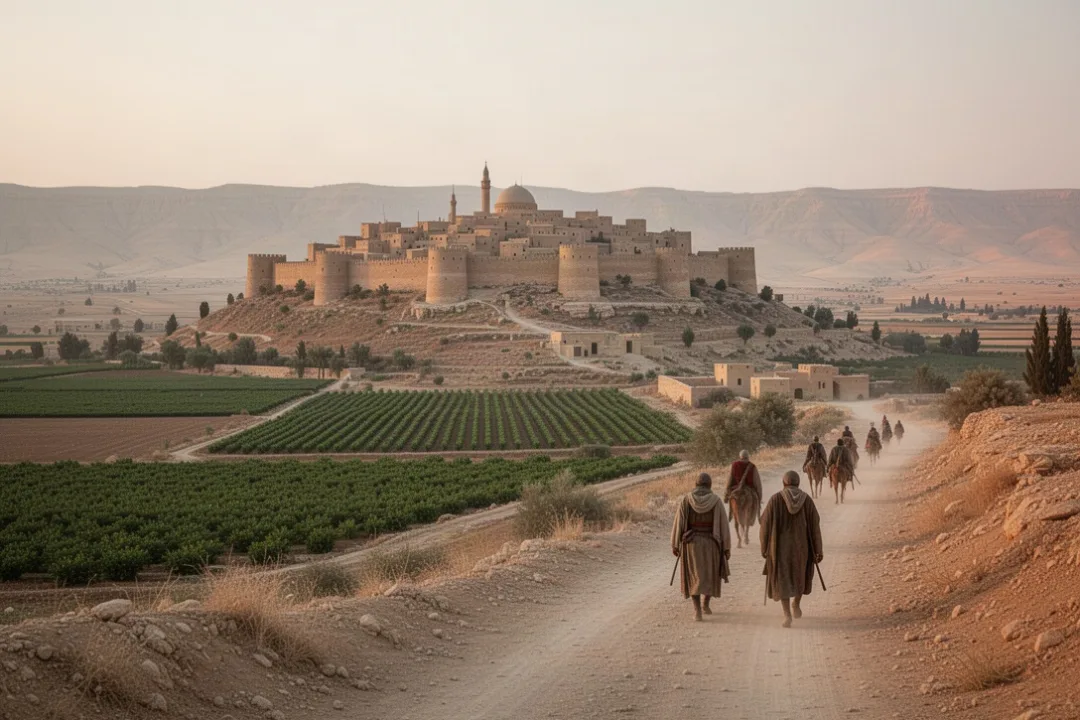
The Bible associates the Amorites with several parts of the southern Levant. They are connected with the hill country of Canaan, the central highlands, regions near Hebron, and the land east of the Jordan River. Their location shifts because the term sometimes describes a specific local group and sometimes a broader population inhabiting the land.
One early reference appears in the genealogy of Genesis 10, where the Amorites are listed among the descendants associated with Canaan. This passage places them within the biblical account of the peoples of the land. It does not provide a modern-style ethnic history, but it does explain why later biblical writers regard the Amorites as one of the established populations of Canaan.
Genesis 14 presents a different picture. Abraham lives near Hebron, and three Amorite men—Mamre, Eshcol, and Aner—are described as his allies. They join Abraham when he pursues the forces that captured Lot. This episode shows that some Amorites could be local partners rather than automatic enemies.
The Bible also uses “Amorite” for powerful rulers east of the Jordan. Numbers 21 describes Israel’s conflict with Sihon, king of the Amorites, whose kingdom included territory around Heshbon. After Israel defeated Sihon, the region became part of the land assigned to the tribes of Reuben and Gad and half of Manasseh, according to later passages.
Another major ruler is Og, king of Bashan. Deuteronomy 3 describes Og as a king of the remnant of the Rephaim and records Israel’s victory over him. Other biblical passages group Sihon and Og together as Amorite kings, even though their territories were distinct.
Southern Canaan: Amorites appear among the peoples living in the land around the time of the patriarchs and Israel’s settlement.
The hill country: Several passages connect Amorite inhabitants with elevated central regions west of the Jordan.
East of the Jordan: Sihon’s kingdom and the territory of Og are prominent in Israel’s memory of conquest.
Wider biblical geography: “Amorite” can function as a broad label for populations associated with the land of Canaan.
Joshua 24:15 refers to the gods worshiped by the Amorites in whose land Israel was living. The wording reflects the people’s settlement in a land where several groups and religious traditions were present. It also shows that the biblical writers could use the Amorites as a representative name for the older inhabitants of the region.
How the Amorites appear in Israel’s biblical history
The Amorites enter the biblical story long before the Israelite conquest. In Genesis 15, God tells Abram that his descendants will return to the land after a period of waiting because “the iniquity of the Amorites” has not yet reached its full measure. The verse presents judgment as delayed rather than arbitrary: the Amorites’ wrongdoing is described as developing over time, while Abram’s descendants are not given the land immediately.
This passage also illustrates how the Bible can use the name “Amorite” as a representative term for the people of Canaan. Later biblical descriptions of the land include multiple peoples, such as Canaanites, Hittites, Perizzites, Hivites, and Jebusites. The Amorites are one group among them, but sometimes their name seems to stand for the broader population Israel encountered.
During the period of Moses, Israel approaches the kingdoms east of the Jordan. Numbers 21 records the refusal of Sihon to allow Israel to pass through his territory. The conflict ends with Sihon’s defeat and the capture of his towns. The victory becomes one of the central examples of God giving Israel land before the people cross the Jordan.
Deuteronomy repeatedly recalls the defeat of Sihon and Og. These memories serve several purposes: they explain Israel’s possession of territory east of the Jordan, encourage the people before the campaigns in Canaan, and emphasize that the outcome depended on divine help rather than military strength alone.
Once Israel enters Canaan, the Amorites appear in both military and political settings. Joshua 10 describes a coalition of Amorite kings in the southern part of the land. They attack Gibeon after the Gibeonites make peace with Israel, and Israel responds by fighting the coalition. The passage names rulers associated with Jerusalem, Hebron, Jarmuth, Lachish, and Eglon.
These kings were not necessarily part of one unified Amorite empire. They were local rulers who formed a temporary alliance against a common threat. This pattern was common in the ancient Near East, where city-states and small kingdoms often cooperated during a military crisis and then returned to separate political control.
The book of Judges gives a more gradual account of Israel’s settlement. It says that the Amorites pressed the Danites into the hill country and did not allow them to come down into the coastal plain. It also describes Amorite settlements in the territory of the tribes of Joseph. These references suggest that Israel’s control of the land was incomplete and contested for generations.
In the period of the monarchy, the Amorites are remembered in several ways. First Kings 21:26 describes the wickedness associated with Ahab’s reign by comparing it with the practices of the Amorites whom the Lord had driven out. First Kings 9:20-21 refers to remaining populations in the land, including Amorites, who were placed under forced labor during Solomon’s reign. These passages reflect the biblical writers’ interest in both political control and religious faithfulness.
Why the Bible condemns the Amorites
Biblical references to the Amorites often carry a negative moral judgment, but that judgment needs to be read carefully. The Bible does not say that every individual Amorite was personally guilty of the same acts. Instead, it describes the societies associated with the land as practicing forms of idolatry, violence, injustice, and religious corruption.
Leviticus 18 lists sexual and ritual practices that Israel is forbidden to imitate. The chapter says that the nations in the land were defiled by such conduct and that the land itself was affected by their wrongdoing. Although the passage uses several terms for the peoples of Canaan, the Amorites are included in the wider biblical picture of the communities whose practices Israel must not adopt.
Deuteronomy and Joshua connect the removal of the Canaanite peoples with their worship of other gods and with practices that Israel is commanded to reject. The concern is not simply that the Amorites were foreigners. The biblical texts present religious loyalty and ethical conduct as the central issues.
At the same time, the Bible contains examples that complicate any claim that all Amorites were treated as indistinguishable enemies. Abraham’s Amorite allies in Genesis 14 cooperate with him. The Gibeonite episode in Joshua also shows that political relationships could change through negotiation, even when conflict remained around them.
The prophets later use Amorite language symbolically. In Ezekiel 16:3, Jerusalem is described through a harsh metaphor that calls its ancestry Amorite and Hittite. The statement is not a straightforward genealogy of every resident of Jerusalem. It is a prophetic accusation: Jerusalem’s conduct has become so corrupt that the city is portrayed as sharing the moral character of the nations it claims to have replaced.
Amos 2:9-10 remembers the Amorite as tall and strong, comparing the people’s stature to cedars and their power to oaks. The point is theological rather than biological. Israel’s possession of the land is portrayed as an act of God against a formidable population, not as an easy victory over a weak opponent.
Reading the condemnation responsibly: The biblical criticism of the Amorites concerns collective practices and covenant judgment in the story’s ancient setting. It should not be used to assign moral guilt to modern ethnic, regional, or religious communities.
How the Amorites differed from other peoples in Canaan
Readers sometimes assume that “Amorite” and “Canaanite” are interchangeable. The relationship is more precise than that. Canaanite is often the broader geographic or cultural label for the peoples living in Canaan, while Amorite identifies one population or one traditional category within that larger setting.
The Bible names several groups separately. Hittites, Perizzites, Hivites, Jebusites, Girgashites, and Canaanites appear in various lists. The exact historical boundaries between these groups are not always clear, and the lists differ from one passage to another. They function partly as theological and literary descriptions of the peoples Israel encountered.
“Amorite” can also overlap with the broader idea of “people of the land.” In some passages, the name seems to refer to a specific population, while in others it summarizes the inhabitants whose religious practices and political power are being contrasted with Israel’s identity.
The Amorites should not be confused with the Ammonites or Amalekites. The names sound similar in English, but these were different peoples in the biblical narrative. The Ammonites lived east of the Jordan near the territory of Moab, while the Amalekites appear as a separate people associated with conflicts involving Israel in the wilderness and later periods.
Nor should every reference to “the nations” be silently changed to “the Amorites.” Biblical authors use a range of names for neighboring peoples, and each passage deserves attention to its own wording. A careful reading asks whether “Amorite” is naming a local group, a kingdom, a surviving population, or a representative category.
Amorites: A people associated with the western regions, Canaan, and kingdoms east of the Jordan.
Canaanites: A broader name for inhabitants or cultures of the land of Canaan.
Ammonites: A neighboring people east of the Jordan, distinct from the Amorites.
Amalekites: Another separate people who appear in Israel’s wilderness and later conflicts.
Hittites and Jebusites: Other groups named in the biblical lists of Canaan’s inhabitants.
What historians can say about the Amorites
Historical evidence outside the Bible supports the existence of populations known by related names, but it does not allow historians to map every biblical reference directly onto one archaeological group. Texts from Mesopotamia and Syria mention Amorite-related peoples and rulers, while personal names and political records show their influence in several cities.
Historians commonly describe the Amorites as West Semitic-speaking groups who were active across Syria and Mesopotamia during the early second millennium BCE. Some established ruling dynasties in cities that already had older populations and institutions. Their political success did not erase local cultures; instead, Amorite rulers often became part of the societies they governed.
The term Amurru in ancient Near Eastern records could refer to a western land, a population, or a political entity. Its use changed over time. A name that began as a geographic description could later become a dynastic or cultural label, which is one reason comparisons with the Bible require care.
The biblical picture includes details consistent with a world of small kingdoms, mobile groups, fortified towns, and shifting alliances. Sihon’s kingdom, the coalition in Joshua 10, and Abraham’s local allies all reflect different forms of political organization. The Amorites were therefore not simply wandering outsiders or one uniform tribe.
There is also no reliable basis for assigning modern racial categories to the Amorites. Ancient identities were shaped by language, political loyalty, family history, place, and worship. Modern people cannot be identified as direct Amorite descendants merely because they live in the same broad region or share a biblical connection to it.
For Bible readers, the most useful approach is to hold together the historical and literary dimensions. Historically, the Amorites were part of the ancient populations and ruling groups of the Levant and neighboring regions. Biblically, they are also characters in a theological narrative about promise, judgment, land, idolatry, and Israel’s responsibilities.
When you read a passage about them, ask three questions:
What location is being described? The answer may distinguish Canaan west of the Jordan from Sihon’s kingdom east of it.
Is “Amorite” being used narrowly or broadly? It may refer to a ruler, a local population, or the older inhabitants of the land as a whole.
What is the passage emphasizing? The focus may be ancestry, military conflict, religious faithfulness, moral judgment, or God’s promise to Israel.
These distinctions make the biblical references easier to understand. The Amorites were a real ancient people with connections across the western Near East, but the Bible also uses their name as part of its theological vocabulary. Their story is therefore both historical and interpretive: they appear as neighbors, allies, rulers, opponents, and examples in Israel’s account of life before God.
Frequently asked questions
Were the Amorites the same as the Canaanites?
Not exactly. Canaanite is often a broad term for the peoples and cultures of Canaan, while Amorite identifies one population or category within that wider setting. Biblical writers sometimes use Amorite broadly enough to represent the inhabitants of the land, which creates overlap. The surrounding passage, location, and purpose determine whether the reference is narrow or collective.
Who were Sihon and Og?
Sihon was the Amorite king of Heshbon whose territory Israel captured east of the Jordan, according to Numbers 21 and later books. Og was king of Bashan and is associated with the remnant of the Rephaim. The Bible remembers both rulers as major victories before Israel entered Canaan, although they governed different territories.
Did the Amorites live only in Canaan?
No. Biblical references place Amorites in Canaan and in kingdoms east of the Jordan, while ancient Near Eastern records connect related Amorite names with Syria and Mesopotamia. The term could describe western peoples or lands across a broad area. It did not always identify one compact nation with fixed borders.
What happened to the Amorites?
The Bible describes many Amorite kingdoms as defeated or absorbed during Israel’s settlement, while other Amorite populations remained in the land for periods of time. Historically, groups identified as Amorite also became integrated into larger Near Eastern societies. There is no clear modern ethnic group that can be identified simply as “the Amorites” today.




Leave a Reply