When you read about Gilgal in the Bible, it can seem as though the name refers to one clearly identifiable place. The difficulty is that Scripture may use “Gilgal” for more than one location, and not every reference is easy to assign with certainty. The best-known Gilgal was Israel’s first camp west of the Jordan River, near Jericho, where the nation renewed its covenant with God after entering the Promised Land.
Gilgal became associated with several defining moments: crossing the Jordan, circumcision, Passover, the memorial stones, Joshua’s military leadership, Saul’s kingship, Samuel’s ministry, and later prophetic criticism. Its story moves from a place of new beginnings to a warning about worship that has lost its obedience.
The Hebrew name Gilgal is related to a word associated with a circle or something rolling. In Joshua, the name is explained through the idea that God had “rolled away” the reproach of Egypt from Israel. That explanation connects the place with a major change in the nation’s identity: Israel was no longer wandering under the shame and uncertainty associated with its former life.
The name’s meaning should not be treated as a complete map reference. Several biblical locations may have carried the name, perhaps because of a circular geographical feature, a stone arrangement, or a place that had acquired religious significance. The word therefore helps explain the symbolic importance of Gilgal, but it does not by itself identify every site mentioned in Scripture.
For Christians and Jewish readers, Gilgal often represents a transition point. Israel had received the promise of the land, but now the people had to live as a covenant community in that land. The events at Gilgal show that entering a new season did not remove the need for obedience, remembrance, and worship.
Keep the locations distinct: The Gilgal near Jericho is the central site in Joshua. Later references may point to another place, and some passages remain geographically uncertain.
Gilgal near Jericho and Israel’s crossing of the Jordan
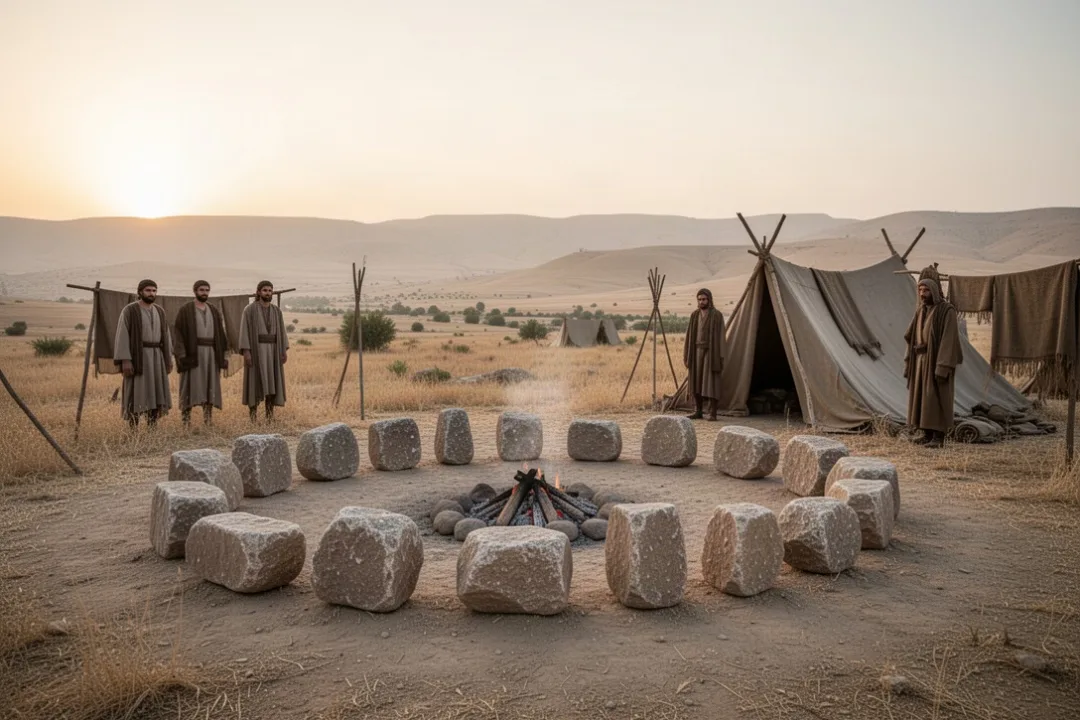
The main Gilgal in the Bible appears in the opening chapters of Joshua. Israel crossed the Jordan River on dry ground while the priests carrying the ark stood in the riverbed. After the people had crossed, God instructed Joshua to select twelve stones, one for each tribe, from the riverbed.
The stones were carried to the place where Israel camped. Joshua set them up at Gilgal so future generations would ask what they meant. The answer was meant to preserve the memory of God stopping the Jordan and bringing Israel safely into the land. Gilgal was therefore both a campsite and a memorial site.
The memorial had an educational purpose. Parents were expected to explain the stones to their children, connecting the visible object with the story of divine deliverance. The stones were not presented as magical objects or as replacements for faith. They were reminders that helped the community remember what God had done.
Gilgal also became the operating base for Israel’s early campaigns in Canaan. From there, Joshua led the people toward Jericho and other locations. The camp near Jericho gave the nation a place to organize, worship, and return between military movements. Its importance came from what happened there, not simply from its location.
Why circumcision took place at Gilgal
Before Israel could move forward in the land, the men of the new generation were circumcised at Gilgal. The wilderness generation had not maintained the covenant sign in the same way, so this act marked a serious renewal of Israel’s identity. Circumcision showed that the people were not merely an army entering foreign territory; they were a covenant people accountable to God.
The timing is significant. Israel had crossed the Jordan, but the nation did not immediately continue its military advance. The people stopped to obey God’s command and to receive the covenant sign. This delay shows that biblical success was not defined only by speed or conquest. Faithfulness came before further action.
Because of the procedure, the men remained at the camp until they recovered. The account presents this period as a time of vulnerability. Israel had just entered enemy territory, yet its leaders followed God’s instruction rather than relying only on military readiness. The story places trust and covenant loyalty at the center of the nation’s strength.
After the circumcision, the name Gilgal was explained in relation to the removal of Egypt’s reproach. The statement does not mean that Israel’s past had never happened. It means that God had brought the people into a new stage of life, where their former condition no longer defined their relationship with the land and the covenant.
Passover and the end of wilderness provision
Israel celebrated Passover at Gilgal after crossing the Jordan. This observance connected the people’s present experience with the original exodus from Egypt. Passover remembered God’s deliverance, and celebrating it in the land showed that the exodus story was continuing toward its promised destination.
After Passover, Israel ate produce from the land. The manna that had sustained the people in the wilderness stopped appearing after they began eating the food of Canaan. Gilgal thus marks a change from wilderness dependence to life in the land God had promised.
The change was practical, but it was also theological. Manna had been a daily reminder of God’s provision during a season of wandering. The end of manna did not mean that God had stopped providing. It meant that provision would now come through the land, its harvests, and the responsibilities of settled life.
Crossing the Jordan: God brought Israel into the land.
Setting up the stones: The nation preserved the memory of that deliverance.
Renewing circumcision: The people reaffirmed their covenant identity.
Celebrating Passover: Israel remembered the exodus and its fulfillment.
Eating the land’s produce: The wilderness season came to an end.
Gilgal and the beginning of Israel’s campaigns
Gilgal was closely connected with the events surrounding Jericho. After the people prepared themselves there, Israel moved toward Jericho under Joshua’s leadership. The narrative emphasizes that victory would come through obedience to God’s unusual instructions, not through ordinary military confidence alone.
The camp at Gilgal also appears as a point from which Joshua carried out military operations in the southern parts of Canaan. The place functioned as a base for movement, planning, and return. It was not the only important location in the conquest, but it was one of the first centers from which Israel organized its life in the land.
Joshua later reminded Israel that God had brought them through the Jordan and given them victories. Gilgal belonged to the memory of those beginnings. The location represented the moment when promises made to earlier generations became visible in Israel’s national experience.
Some biblical references to Gilgal in Joshua are difficult to locate with certainty. For example, the phrase “the king of the nations of Gilgal” appears in a list of defeated kings, but interpreters have debated whether this refers to the main Gilgal near Jericho or another place. Such passages should be read carefully rather than forced into a single geographical theory.
How Gilgal appears during the period of the judges
After Joshua’s death, Israel’s relationship with the land became more complicated. The people repeatedly turned away from God, adopted the worship practices of surrounding nations, and then cried out when oppression followed. Gilgal belongs to the earlier memory of faithful beginnings, but the period of the judges shows that a sacred history did not automatically produce faithful living.
Judges does not make Gilgal the center of its narrative in the same way Joshua does. Still, the place remains part of the landscape of Israel’s early settlement and memory. The lesson is not that the physical site guarantees faithfulness. Rather, Gilgal demonstrates that remembered miracles must lead to present obedience.
A place can be connected with important acts of God and still become spiritually empty if the people stop listening. That theme becomes clearer in the later references to Gilgal from the ministries of Samuel, Elijah, Elisha, Hosea, and Amos.
Gilgal, Samuel, and the early monarchy
In 1 Samuel, Gilgal becomes an important setting for the transition from the period of the judges to the monarchy. Samuel gathered the people there to renew the kingdom and confirm Saul as king. The assembly gave the nation an opportunity to recognize Saul’s leadership while also reaffirming its relationship with God.
Gilgal was a fitting place for this event because it already carried memories of national beginnings and covenant identity. The people had entered the land there, and now they were publicly establishing a new form of government. The location linked Israel’s past deliverance with its present political responsibilities.
Samuel also used Gilgal as one point in his circuit of leadership. Scripture describes him traveling among several locations to judge Israel, with Gilgal included among them. This shows that Gilgal was not merely a monument or abandoned campsite. It remained part of the nation’s active religious and administrative life.
Saul’s failures at Gilgal reveal the danger of treating a significant place as a substitute for submission. In one episode, Saul became impatient while waiting for Samuel and offered a burnt offering. The issue was not that sacrifice was always wrong; the problem was Saul’s refusal to wait for the prophetic instruction he had received.
In another episode, Samuel confronted Saul at Gilgal after Saul failed to carry out God’s command concerning the Amalekites. Saul preserved what he had been told to destroy and then defended his actions by appealing to sacrifice. Samuel’s response made the principle clear: obedience cannot be replaced by religious performance.
“To obey is better than sacrifice” is the central idea of Samuel’s rebuke in 1 Samuel 15:22.
The reference should be read as a paraphrased principle, not as permission to dismiss worship or sacrifice in general. Samuel was addressing a specific kind of disobedience: carrying out religious actions while refusing to follow God’s command. Gilgal therefore becomes a warning against using ritual to cover rebellion.
Practical lesson: A meaningful spiritual location, ceremony, or memory cannot make disobedience acceptable. Biblical faith joins worship with a willingness to follow God’s instruction.
Gilgal in the stories of Elijah and Elisha
Second Kings begins one of its prophetic narratives with Elijah and Elisha at Gilgal. Elijah told Elisha to remain there while he continued to another place, but Elisha refused to leave him. The two then traveled through Bethel and Jericho before crossing the Jordan.
This Gilgal may not be the same place as the camp near Jericho. Many interpreters place it in the hill country, probably somewhere between Bethel and the central highlands, because of the route described in the passage. The exact site remains uncertain, and the text does not provide enough information to settle the question beyond debate.
The episode is less about the physical site than about prophetic succession and faithful perseverance. Elisha stayed with Elijah through each stage of the journey. He wanted to witness the transfer of prophetic authority and continue the work after Elijah’s departure.
The reference also illustrates why every mention of Gilgal should not automatically be placed near Jericho. The name may have been used for multiple locations. Context, travel routes, nearby towns, and the purpose of the passage all matter when identifying a biblical place.
Why the prophets criticized Gilgal
Hosea and Amos mention Gilgal in negative contexts. By their time, the name had become associated with religious activity that did not reflect genuine loyalty to God. The prophets condemned Israel’s idolatry, injustice, and reliance on outward worship while the nation ignored covenant obligations.
Hosea connected Gilgal with the people’s unfaithfulness and warned that the site would not protect them from judgment. Amos likewise included Gilgal among places whose religious gatherings could not compensate for injustice and rebellion. Their message was not that Gilgal itself was inherently evil. They were confronting the false confidence that sacred places and ceremonies could guarantee divine approval.
This criticism forms a sharp contrast with the earlier stories. In Joshua, Gilgal was linked with obedience, remembrance, and a new beginning. In the prophets, the same name became a symbol of empty religious confidence. The difference was not simply the location. It was the spiritual condition of the people who gathered there.
The prophetic warnings are especially relevant to the way religious memory works. A community may preserve the stories of past deliverance while neglecting justice, mercy, and faithfulness in the present. Gilgal teaches that a holy history cannot excuse an unholy life.
What Gilgal teaches about remembrance and renewal
Gilgal was a place where Israel was repeatedly reminded of who God was and what God had done. The stones from the Jordan, the covenant ceremony, and the Passover celebration all turned memory into a visible practice. Remembering was not merely looking backward; it was meant to shape the people’s choices.
Healthy remembrance does at least three things. It gives a community a truthful account of its past, directs gratitude toward God rather than toward human achievement, and creates responsibility for the future. The stones at Gilgal were useful because they prompted questions and gave parents an opportunity to teach their children.
Gilgal also shows that renewal may require deliberate action. Israel did not simply assume that entering the land made everything right. The people stopped for circumcision, celebrated Passover, and received God’s direction before moving into battle. New circumstances required renewed faithfulness.
At the same time, the prophetic books warn against confusing renewal with ceremony. A person may attend worship, repeat familiar words, or visit a meaningful place while remaining unwilling to change. The biblical pattern joins memory, worship, justice, and obedience together.
Common mistakes when studying Gilgal
Gilgal can be misunderstood when readers treat every reference as though it describes one site and one period. A careful reading separates the major events and asks what each passage is emphasizing. These practical guidelines can prevent the most common errors.
Do not assume every Gilgal is the same place. The Gilgal near Jericho is central in Joshua, but the setting in 2 Kings may point to another location.
Do not reduce the name to one symbolic meaning. The explanation about God rolling away Egypt’s reproach is important, but the name may also reflect a physical feature or place-name tradition.
Do not treat the stones as magical objects. Their purpose was to prompt teaching and remembrance, not to function as independent sources of power.
Do not separate worship from obedience. Saul’s story shows that religious actions cannot repair deliberate refusal to follow God.
Do not read prophetic criticism as an attack on every sacred gathering. Hosea and Amos condemned hypocrisy, idolatry, and injustice, not remembrance itself.
Do not overlook historical context. Gilgal means something different in Joshua’s conquest narrative, Samuel’s monarchy narrative, and the prophets’ warnings.
How to study a Gilgal passage carefully
When you encounter Gilgal in Scripture, begin by reading the surrounding chapter rather than relying on the place-name alone. Ask who is present, what has just happened, and whether the location is connected with travel, worship, military action, leadership, or judgment.
Identify the book and period. Joshua, Samuel, Kings, Hosea, and Amos describe different stages of Israel’s history.
Look for nearby place-names. Mentions of Jericho, Bethel, the Jordan, or other towns can provide clues about the location.
Observe the action at Gilgal. Is the passage about remembering, covenant renewal, sacrifice, prophetic ministry, or judgment?
Separate the physical setting from the spiritual message. A location may be uncertain even when the passage’s main lesson is clear.
Compare related passages. Reading the events in Joshua alongside Samuel and the prophets shows how Gilgal’s significance developed over time.
This approach helps you avoid two opposite errors. One error is treating Gilgal as nothing more than a geographic label. The other is assigning every later reference the exact same meaning as the first Gilgal near Jericho. Scripture presents the name as both a real place-name and a developing symbol in Israel’s story.
What Gilgal means for readers today
Gilgal speaks to anyone standing between an old season and a new one. Israel had crossed the Jordan, but the nation still needed to renew its covenant identity, remember God’s work, and obey before advancing. A change in circumstances did not remove the need for spiritual attentiveness.
The memorial stones suggest the value of keeping an accurate record of God’s help. This can involve telling family members what you have learned, marking significant moments in prayer, or returning to Scripture when fear makes past faithfulness easy to forget. The point is not to glorify the object or the experience. It is to keep memory connected to trust.
The story of Saul adds a necessary caution. It is possible to use religious language while resisting the actual demands of faithfulness. Gilgal reminds you to examine whether worship is shaping your decisions, relationships, and treatment of other people.
The prophetic passages add another dimension: spiritual health cannot be measured by the presence of religious activity alone. Gilgal had a respected history, but that history did not protect Israel from judgment when worship was joined to injustice and disobedience. Faithful remembrance must produce faithful living.
For these reasons, Gilgal is more than a place on an ancient map. It is a setting where Scripture explores transition, memory, identity, leadership, worship, and accountability. The central Gilgal near Jericho marks Israel’s entry into the land, while the later references show that a promising beginning must be followed by continuing obedience.
Frequently asked questions
Where was Gilgal located in the Bible?
The best-known Gilgal was near Jericho, west of the Jordan River, and served as Israel’s camp after crossing into Canaan. However, the Bible may refer to more than one place named Gilgal. The Gilgal in the Elijah and Elisha narrative appears to have been on a route involving Bethel and Jericho, so it may have been a different site.
Why did Israel set up stones at Gilgal?
The stones came from the Jordan River after Israel crossed on dry ground. They served as a memorial for future generations, giving parents an opportunity to explain how God had brought Israel into the land. Their purpose was teaching and remembrance, not magical protection or independent religious power.
What happened to Saul at Gilgal?
Gilgal was the setting for important moments in Saul’s reign. Samuel confirmed Saul’s kingship there, but Saul later disobeyed instructions involving sacrifice and the Amalekites. Samuel used these events to show that religious ceremony cannot replace obedience. Saul’s failures at Gilgal contributed to the rejection of his dynasty.
Is Gilgal mentioned in the New Testament?
Gilgal is not a major New Testament setting, and the New Testament does not retell its Old Testament events in detail. Its significance comes primarily from the Hebrew Bible, especially Joshua, 1 Samuel, 2 Kings, Hosea, and Amos. Any Christian application should begin with those passages and their original historical context.






Leave a Reply