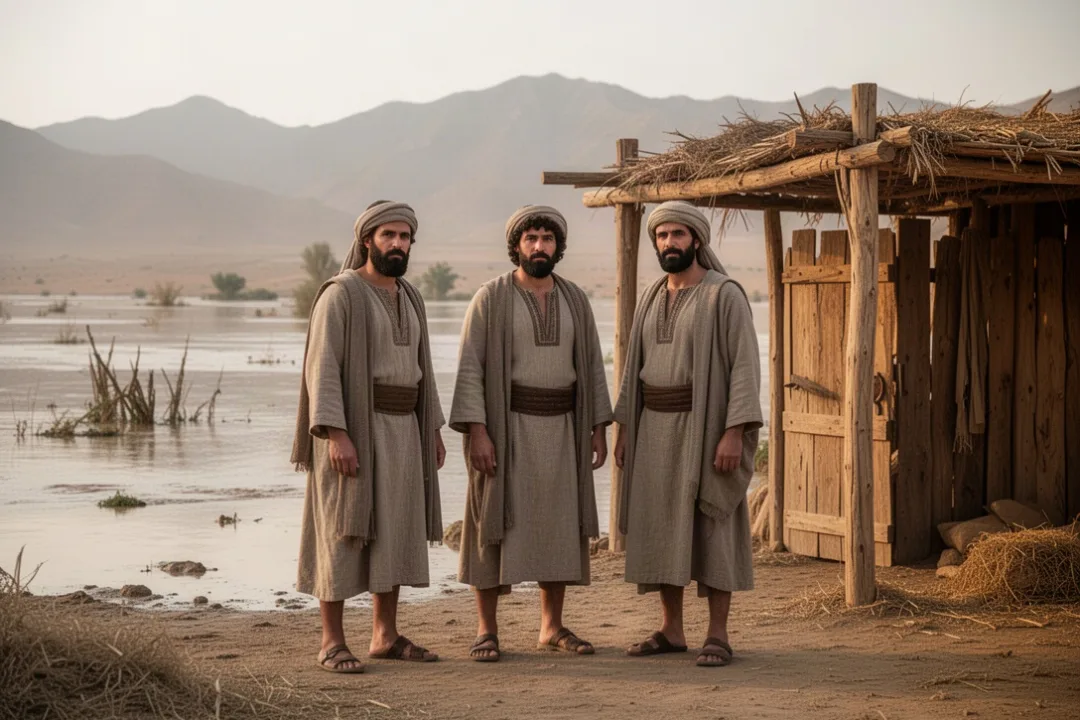
If you are trying to remember who Noah’s sons were, the short answer is Shem, Ham, and Japheth. Genesis presents them as Noah’s three sons, each entering the ark with his wife during the flood and later becoming the ancestor of an extended family group (Genesis 7:13; 9:18).
Their story matters for more than memorizing three names. The account connects them with the survival of Noah’s family, the spread of peoples after the flood, and the Bible’s early explanation of how nations were distributed. It also includes Noah’s troubling words about Canaan, a passage that has often been misused to justify racism and slavery.
The essential answer: Noah’s sons were Shem, Ham, and Japheth. Genesis 10 traces descendants from all three, but its genealogies describe major family and people groups rather than providing a modern scientific map of every nation.
Genesis names Noah’s sons as Shem, Ham, and Japheth. Noah was already several centuries old when these sons were born, according to the chronological framework of Genesis. The text first lists them together in Genesis 5:32 and repeats their names when describing the flood and the ark.
Shem is presented as the ancestor of the line that leads to Abraham and the Israelite story.
Ham is associated in Genesis 10 with peoples and kingdoms including Egypt, Cush, Put, and Canaan.
Japheth is connected with several peoples traditionally associated with regions north and west of the ancient Near East.
Genesis does not give a complete biography of each son. Most of the narrative focuses on Noah’s household as a whole, and then Genesis 10 provides a genealogy for each branch. The sons are therefore important as family ancestors, but the Bible does not portray them as three equal-length individual character studies.
What Genesis says about Noah’s family before the flood
Genesis 6:9 describes Noah as a righteous man who walked with God in a violent generation. The chapter then says that Noah had three sons: Shem, Ham, and Japheth. God instructed Noah to build the ark because judgment was coming on the earth, while also preserving Noah, his family, and representatives of the animal world.
The account does not describe the sons as independently chosen prophets or heroes. Instead, they participate in the rescue of the household through their connection with Noah and through their obedience to the ark’s instructions. Genesis 7:7 and 7:13 place Noah, his sons, their wives, and Noah’s wife inside the ark.
The names of the sons’ wives are not given. Later traditions sometimes supply names, but those names are not part of the biblical account in Genesis. If you are answering a question from the Bible itself, the safest answer is that each son had a wife, but the text does not identify her.
How Noah’s sons appear in the flood account
The flood narrative emphasizes the family’s shared experience. Noah and his sons enter the ark, remain there during the waters, and leave together after the earth dries. Genesis does not describe separate roles for Shem, Ham, or Japheth during the construction of the ark or the flood itself.
After leaving the ark, Noah builds an altar and later plants a vineyard. The narrative then shifts from the flood’s destruction to a family incident that shapes the rest of the story. Noah becomes drunk, lies uncovered inside his tent, and Ham sees his father’s nakedness. Ham tells his two brothers, while Shem and Japheth respond by covering Noah without looking at him (Genesis 9:20-23).
The passage’s details matter. Shem and Japheth do not enter backward because the text gives them a humorous task; their action is described as a way of showing respect and preserving their father’s dignity. Ham’s conduct is presented differently, though interpreters debate exactly what his offense involved because the brief account does not spell out every implication.
What happened between Noah, Ham, Shem, and Japheth?
After Noah learns what happened, he pronounces words concerning Canaan, Ham’s son, rather than directly cursing Ham. Noah says that Canaan will be under the authority of Shem and that Japheth will be enlarged or given room, with Japheth dwelling in the tents of Shem (Genesis 9:24-27).
This is one of the most misunderstood sections of Genesis. The text does not say that all of Ham’s descendants were cursed, and it does not say that people with dark skin were cursed. It specifically names Canaan. It also does not present a divine command authorizing later slavery or racial hierarchy.
Important clarification: The so-called “curse of Ham” is an inaccurate label for the passage in Genesis 9. Noah’s words concern Canaan, not every descendant of Ham, and the Bible never links the statement to skin color.
Some readers ask why Canaan is named when Ham was the one who saw Noah. Genesis does not provide a single, universally accepted explanation. Possible approaches include seeing the episode as a literary explanation of later conflict involving Canaan, recognizing that the story may focus on Ham’s family line, or treating the pronouncement as part of an ancient family and nation genealogy. The text itself should remain the starting point, rather than later racial theories.
What Genesis 10 says about the descendants of Noah’s sons
Genesis 10 is often called the Table of Nations. It lists descendants connected with Shem, Ham, and Japheth and describes the spread of families, lands, languages, and nations after the flood. The chapter does not read like a modern census. It uses genealogy to explain relationships among peoples and to place them within the Bible’s story.
Genealogies in the ancient world could serve several purposes. They might preserve family memory, explain political relationships, identify a people’s place in the world, or connect a nation to a larger theological story. Names can refer to individuals, clans, cities, territories, or peoples, and the same name may function in more than one way.
Descendants associated with Japheth
Genesis 10 lists sons of Japheth including Gomer, Magog, Madai, Javan, Tubal, Meshech, and Tiras. It then names several descendants connected with some of those lines. Ancient interpreters often associated Japheth’s branch with peoples located to the north and west, though the exact identification of every name remains uncertain.
Javan is frequently connected with Greek-speaking peoples, while names such as Tubal and Meshech appear elsewhere in the Hebrew Bible in contexts involving regions north of Israel. These associations are useful as broad historical clues, but they should not be turned into confident one-to-one identifications when the evidence is incomplete.
Genesis 10 also says that the coastland peoples spread out in their lands, each according to language, clan, and nation. The phrase fits the chapter’s interest in geographic distribution and cultural groups. It does not provide a simple claim that every modern European or Asian nation can be assigned to Japheth with certainty.
Descendants associated with Ham
Genesis 10 names Ham’s sons as Cush, Mizraim, Put, and Canaan. Mizraim is the Hebrew name commonly associated with Egypt, and Canaan refers to the land and peoples that feature prominently in the rest of the Old Testament. Cush is often associated with regions south of Egypt, while Put is linked by many interpreters with a location in North Africa, though its precise identification is debated.
Cush’s descendants include Nimrod, described as a powerful figure and a hunter. Genesis associates him with early kingdoms and cities in Mesopotamia, including Babel, Erech, Akkad, and Calneh, and later with Assyria and Nineveh in the wording of the passage. This section shows that the genealogy is not merely listing private family members; it is connecting ancestral names with significant centers of power.
The Canaanite groups listed in Genesis 10 include peoples such as the Jebusites, Amorites, Hivites, and others. These names become important in later biblical narratives about the land of Canaan. The genealogy therefore prepares readers for later stories while also presenting the nations as related through a common human family.
Descendants associated with Shem
Shem’s branch receives special attention near the end of Genesis 10. His sons include Elam, Asshur, Arphaxad, Lud, and Aram. The text later follows the line of Arphaxad through several generations to Terah, and then to Abram, who is later called Abraham.
That connection makes Shem especially important within the biblical narrative. The Old Testament story of Abraham, Isaac, Jacob, and the people of Israel emerges through this line. The word “Semitic,” used in modern language for a family of related languages and sometimes peoples, comes from the name Shem, although modern linguistic categories should not be treated as a perfect duplicate of Genesis 10’s genealogy.
Aram is commonly associated with Aramean regions and languages. Asshur is connected with Assyria, and Elam with the ancient region east of Mesopotamia. As with the other branches, these links provide a broad ancient-world framework rather than a complete genetic account of every population that later lived in those regions.
Which son was the oldest?
Many readers assume that the order “Shem, Ham, and Japheth” gives the birth order. The text is not quite that simple. Genesis 10:21 describes Shem as the brother of Japheth the elder in many English translations, while some translations or interpretations understand the wording differently because the underlying Hebrew can be read in more than one way.
Genesis 9:24 calls Ham Noah’s younger son in the standard English rendering. If Ham is younger and Japheth is older than Shem, then Japheth may have been the oldest, Shem may have been born later, and Ham may have been the youngest. However, the chronological details have generated discussion because Genesis presents ages and wording that require careful reading.
A cautious answer is best: Japheth is often understood to be the oldest, Ham the youngest, and Shem somewhere between them, but readers should recognize that translations and interpretations differ. The Bible does not require you to settle the question in order to understand the main point of the passage.
How the sons relate to the Tower of Babel
Genesis 10 ends by describing the division of peoples according to clans, languages, lands, and nations. Genesis 11 then tells the story of the Tower of Babel, where human language is confused and people are scattered. The order of these chapters has led to different ways of reading them.
Some readers see Genesis 10 as a broad account of the nations and Genesis 11 as a closer explanation of how their language differences arose. Others recognize that biblical genealogies do not always follow a strictly linear timeline and read the two chapters as complementary accounts arranged for theological purposes.
The connection is clear even when the exact sequence is debated: the sons of Noah represent humanity’s post-flood spread, while Babel explains a major rupture in human unity. Genesis presents both diversity among peoples and a shared ancestry through Noah’s family.
Why Noah’s sons matter in the larger Bible story
The three sons provide the framework for Genesis 10, but their importance extends beyond that chapter. Their descendants represent the many peoples encountered in the Bible’s ancient setting. Through Shem’s line, the narrative moves toward Abraham and the covenant story; through Ham’s line, it addresses Egypt, Canaan, and surrounding powers; through Japheth’s line, it points toward distant peoples and coastlands.
The structure also supports a major biblical theme: all nations share a human origin. Genesis does not portray one branch as a separate creation. It places different peoples within one family history, even while explaining conflict, separation, and unequal political power.
The New Testament later uses the nations theme in a different setting. Acts 17:26 describes humanity as coming from one ancestor or common source, depending on the translation, while the broader New Testament emphasizes God’s concern for people from every nation. Those passages do not erase cultural differences, but they challenge the idea that ancestry makes one group more human or more valuable than another.
How to avoid common mistakes about Noah’s sons
Questions about Noah’s sons often come with claims that sound familiar but are not supported by the text. A careful reading can separate what Genesis actually says from interpretations developed much later.
Do not call it the curse of Ham. Genesis 9 names Canaan, not all of Ham’s descendants.
Do not connect the passage to skin color. Genesis does not describe such a connection.
Do not treat Genesis 10 as a modern racial chart. Its categories involve clans, languages, lands, and nations in an ancient setting.
Do not assume every named person is a private individual. Some names likely represent peoples, places, or broader groups.
Do not claim certainty where the text is brief. The identities of several ancient groups remain debated.
Do not confuse later tradition with Genesis. Names for Noah’s wife and the sons’ wives may appear in later writings, but Genesis does not provide them.
These distinctions are not minor technicalities. The false idea that Ham’s descendants were divinely marked for slavery was used for centuries to defend the enslavement of Africans. It conflicts with the wording of Genesis and with the Bible’s broader teaching about human dignity, justice, and accountability.
What can readers learn from the story of the three brothers?
The account of Shem, Ham, and Japheth does not present a simple morality tale in which one brother is flawless and the others are condemned. It presents a family affected by shame, respect, authority, and consequences. Shem and Japheth’s response to Noah’s vulnerability contrasts with Ham’s response, but Genesis gives little personal detail about any of the three.
The story also shows how ancient biblical writers connected family conduct with later national relationships. Noah’s pronouncement looks beyond one household event toward the future of Canaan and the peoples connected with Shem and Japheth. Readers should handle that connection carefully, especially because later history cannot be used to excuse exploitation or domination.
Another lesson is the tension between shared ancestry and human division. Genesis 10 names different nations and territories, but it places them within one post-flood family. Difference is part of the narrative, yet no branch is outside humanity or beyond moral concern.
A simple way to remember Shem, Ham, and Japheth
If you need a concise study guide, remember the sons in three layers: the names, the narrative, and the genealogies.
Names: Noah’s sons were Shem, Ham, and Japheth.
Narrative: All three entered the ark with their wives, survived the flood, and were involved in the account of Noah’s drunkenness.
Genealogies: Genesis 10 traces peoples and lands associated with each branch.
Interpretation: Canaan, not Ham as a whole, is named in Noah’s pronouncement, and the passage does not teach a racial curse.
Larger meaning: The story explains the spread of nations while preserving the idea of a common human family.
For a focused reading, start with Genesis 5:32, then read Genesis 6:9-10, 7:13, and 9:18-29. Continue with Genesis 10, paying attention to how the text moves from family names to clans, lands, languages, and nations. That sequence gives you the clearest biblical foundation for understanding Noah’s sons without adding claims the text does not make.
Frequently asked questions
Were Noah’s sons triplets?
No. Genesis names the three sons together, but it does not say they were born at the same time. Biblical genealogies and age statements suggest they were born at different points in Noah’s life. The text also does not give a full birth record that settles every chronological question, so claims that they were triplets go beyond what Genesis says.
Did all three sons enter the ark?
Yes. Genesis describes Noah, his sons, their wives, and Noah’s wife entering the ark before the flood. The passage does not assign separate jobs to Shem, Ham, and Japheth during the flood. Their shared survival establishes them as the ancestors of the family groups listed later in Genesis 10.
Was Ham cursed because of his skin color?
No. Genesis 9 does not mention skin color, and Noah’s words name Canaan rather than all of Ham’s descendants. The interpretation connecting the passage with Black people developed later and was used to defend slavery and racism. It is not a conclusion supported by the wording of the biblical account.
Which of Noah’s sons was Abraham descended from?
Abraham’s line is traced through Shem. Genesis 10 follows Shem’s descendants through Arphaxad and later generations to Terah, Abraham’s father. This genealogy gives Shem a central place in the biblical storyline that continues through Abraham, Isaac, Jacob, and the people of Israel.









Leave a Reply