Hittites in the Bible: who they were and where they lived
Hittites in the Bible: who they were and where they lived
When you read that Abraham bought a burial place from a Hittite or that David’s army included Uriah the Hittite, you may wonder whether these people came from the famous Hittite Empire of ancient Anatolia. The short answer is that the Bible uses Hittite in more than one setting. Some references concern people living in or near Canaan, while others point to a powerful kingdom north of Israel.
The biblical Hittites appear in stories about Abraham, Esau, David, Solomon, and Israel’s conquest of Canaan. Ancient records from Anatolia also confirm that a major kingdom called Hatti existed during the second millennium BC. The relationship between that empire and the Hittites named in the Bible is possible in some passages, but it should not be assumed in every case.
The English word Hittite represents Hebrew terms connected with Heth, including Hitti and “sons of Heth.” In Genesis, Heth is presented as a descendant of Canaan through Ham’s family line. The name therefore functions in some passages as an ethnic or local designation for a people living in the land of Canaan.
The Bible also lists the Hittites among the peoples occupying the land before Israel’s settlement. They appear alongside groups such as the Amorites, Canaanites, Perizzites, Hivites, and Jebusites. These lists are often general rather than detailed population surveys, so the same group may not be described with the same level of precision in every passage.
At the same time, several books refer to a “king of the Hittites” or to Hittite kings in a way that suggests a substantial foreign power. Those references fit more naturally with the northern kingdom known in ancient Near Eastern records as Hatti. The biblical word can therefore cover related names or traditions without proving that every Hittite mentioned belonged to one political state.
Essential distinction: “Hittite” in the Bible is not always a precise equivalent of “citizen of the Hittite Empire.” Context matters. A person identified as a Hittite in a family story may belong to a local community in Canaan, while a reference to Hittite kings may concern the northern Anatolian power.
Where the Hittites lived in biblical geography
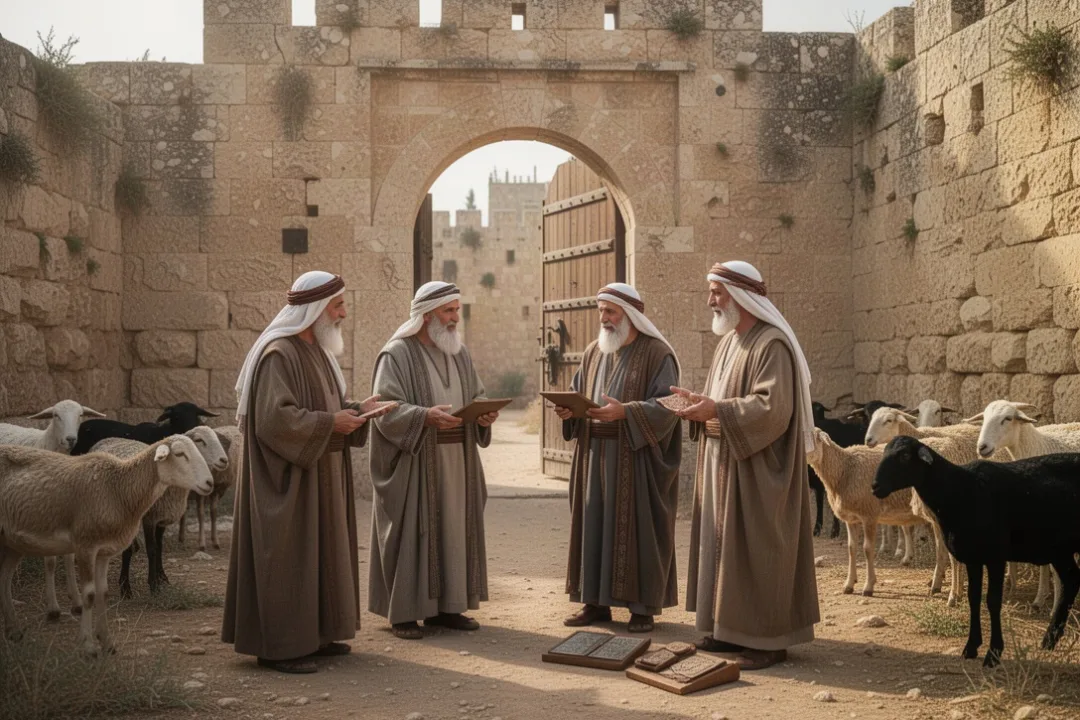
Biblical references place Hittites in more than one geographical setting. In the patriarchal narratives, they are associated with Hebron and the surrounding hill country. Abraham negotiates with the “sons of Heth” after Sarah dies, and the transaction takes place at the gate of the city, where local elders conduct public business.
Other passages place Hittites among the peoples of Canaan. Lists in the books of Exodus, Numbers, Deuteronomy, Joshua, Judges, and related writings use the name for one of the populations Israel encounters in the land. These references do not give a complete map of every Hittite settlement, but they associate the group broadly with Canaan’s pre-Israelite inhabitants.
The northern Hittite kingdom occupied a different region. Its central territory was in central Anatolia, in what is now Turkey. The capital, Hattusa, stood in the north-central part of the Anatolian plateau. From there, Hittite rulers controlled territory that at various times extended toward northern Syria and interacted with major powers such as Egypt, Assyria, and the kingdoms of Mesopotamia.
That distance helps explain why careful reading is necessary. A local Hittite community in the southern Levant and the imperial Hittite state in Anatolia may have been connected by language, memory, migration, or political influence, but the Bible does not provide enough information to identify every reference with certainty.
Abraham’s dealings with the Hittites in Genesis
The best-known early reference appears in Genesis 23. After Sarah’s death, Abraham seeks a permanent burial place. He approaches the Hittites living in the area of Hebron and asks to purchase the cave of Machpelah, which belongs to Ephron son of Zohar.
The account emphasizes negotiation, public witnesses, and a legal transfer of property. Ephron first offers the field and cave, but Abraham insists on paying the full value. The sale is then recognized before the people gathered at the city gate. This makes the passage significant not only for its mention of Hittites but also for what it shows about land ownership, public contracts, and burial customs in the patriarchal narrative.
The Hittites treat Abraham as a respected resident and “mighty prince,” in the sense that they recognize his social standing. They are not portrayed as an anonymous enemy population. They are local landowners and civic participants who conduct a formal transaction with him.
The passage repeatedly calls them the “sons of Heth.” That wording connects them with the genealogical Heth named earlier in Genesis. It also differs from the imperial references elsewhere in the Old Testament, which often speak of Hittite kings or a powerful northern realm.
Sarah’s burial in the purchased cave becomes an important family marker. Abraham, Isaac, Rebekah, Leah, and Jacob are later associated with the same burial place. The Hittite landowner therefore appears at a pivotal moment in the family story: his sale provides the patriarchal household with its first clearly defined holding in Canaan.
Esau’s Hittite wives and family conflict
Hittites also appear in the account of Esau’s marriages. Genesis identifies Judith, daughter of Beeri, and Basemath, daughter of Elon, as Hittite women whom Esau married. The text says these marriages brought grief to Isaac and Rebekah.
The narrative does not say that the women were morally corrupt simply because they were Hittites. Instead, their marriages contribute to a larger family conflict involving cultural identity, household expectations, and the preservation of the family line. Rebekah later expresses distress over the possibility that Jacob might marry a local woman from the same surrounding peoples.
Genesis 36 again identifies some of Esau’s wives in connection with the peoples of Canaan, although the names and descriptions do not align neatly in every detail with the earlier account. Readers should avoid forcing the genealogical lists into a single simplified chart. Ancient biblical genealogies can serve theological, social, and family-record purposes, and variations may reflect different traditions or ways of presenting relationships.
The practical point is that the Hittites in these chapters are part of the social world around the patriarchal family. Their presence shows that the biblical story imagines the ancestors of Israel living among diverse communities, forming relationships, negotiating property, and making marriage decisions across ethnic boundaries.
Hittites among the peoples of Canaan
Several biblical passages list Hittites as one of the peoples Israel would encounter in Canaan. God’s promises to the patriarchs name the Hittites among the inhabitants of the land. The same pattern continues in descriptions of the exodus, the conquest, and the settlement period.
These lists have a theological purpose. They emphasize that Israel’s possession of the land involves displacement, judgment, covenant responsibility, and a new national identity. The lists also remind readers that Canaan was not depicted as an empty territory. It contained established communities with their own political and religious practices.
In Deuteronomy and Joshua, the Hittites are included among groups that Israel must confront or avoid adopting religious practices from. The emphasis is usually on loyalty to Israel’s covenant with God, not on providing a detailed ethnographic description of each people.
Joshua 1:4 uses the phrase “land of the Hittites” in a description of the territory promised to Israel. The expression can be read as a traditional geographic designation for a broad area, possibly reflecting the fame of the northern Hittite power. It does not necessarily mean that the Hittite Empire controlled every part of the land described in the verse.
Later biblical texts continue to mention Hittites as part of the population of the land. In Judges, the Israelites are criticized for living among peoples including the Hittites and for failing to remove or reject their religious influence. The repeated appearance of the name shows that “Hittite” remained a familiar category in Israel’s historical and theological memory.
Uriah the Hittite and David’s army
The most prominent individual Hittite in the Bible is Uriah the Hittite, a soldier in David’s army. His story appears in 2 Samuel 11, where David sees Bathsheba, Uriah’s wife, and then attempts to conceal the resulting pregnancy. David eventually arranges for Uriah to be placed in a dangerous part of battle, where he is killed.
Uriah’s identity matters because the narrative presents him as a loyal and honorable soldier. When David summons him from the battlefield, Uriah refuses to enjoy the comfort of home while the army and the ark are in the field. His conduct contrasts sharply with David’s abuse of royal power.
Uriah is not described as an outsider who has just arrived among Israel. He bears a Hebrew name meaning “the Lord is my light,” serves in David’s forces, and is listed among David’s elite warriors. His Hittite designation may indicate family ancestry, an inherited ethnic label, or membership in a community that had become integrated into Israel.
The story therefore challenges a simple assumption that every Hittite was an enemy or a pagan foreigner. Uriah is a trusted member of the military establishment, yet the text retains his ethnic designation. Biblical identity could include several layers at once: ancestry, loyalty, residence, religious affiliation, and service to the king.
Uriah also appears in the list of David’s mighty men in 2 Samuel 23. The list places him among distinguished warriors, giving his name a wider significance than the Bathsheba episode alone. His inclusion shows that a person identified as Hittite could hold a respected and influential position within Israel’s royal society.
The Hittite kingdom in references to the northern powers
Several passages use Hittites in a way that differs from the family narratives. Solomon’s trade network included horses and chariots obtained from Egypt and from the kings of the Hittites and Aram, according to 1 Kings 10 and 2 Chronicles 1. These texts present Hittite rulers as international political partners or commercial powers rather than as small Canaanite communities.
In 2 Kings 7, an Aramean army abandons its camp after hearing what it believes is the sound of approaching forces. The Arameans assume that Israel’s king has hired the kings of the Hittites and Egypt. The scene depends on the reputation of these powers: the Hittites are imagined as a military force capable of changing the balance of a regional conflict.
These references fit the memory of a northern kingdom with enough strength to be recognized alongside Egypt. Ancient Near Eastern records describe the kingdom of Hatti as a major power, especially during the Late Bronze Age. Its rulers fought Egypt for influence in Syria, and one of its famous diplomatic agreements was made with Pharaoh Ramesses II after conflict over the region.
The Bible does not provide a full history of Hatti. It mentions the name as part of the political landscape known to later writers. The references may preserve older memories of the Hittite Empire, even though the biblical books were composed, edited, and transmitted across different periods.
The word “Hittite” can therefore function much like a historical label that outlasts a particular empire. A later writer may use a well-known name for a northern power even after political boundaries have changed. This is one reason biblical geography should be read alongside, but not mechanically equated with, modern maps and archaeological periods.
What archaeology tells us about the Hittites
Modern knowledge of the Hittite Empire comes largely from archaeological discoveries in Anatolia. The site of Hattusa, near modern Boğazkale in Turkey, contains monumental buildings, fortifications, temples, and archives written mainly in cuneiform. Scholars began to identify the significance of the Hittite records after excavations uncovered texts from the ancient capital.
The Hittites spoke an Indo-European language, although their empire included people who used several languages and belonged to different cultural traditions. Their diplomatic and administrative records reveal treaties, royal correspondence, religious rituals, legal material, and accounts of campaigns in Anatolia and northern Syria.
The kingdom rose to major power during the second millennium BC and later declined and fragmented. The exact boundaries and strength of Hatti changed over time. After the collapse of the Late Bronze Age political system, several smaller states in northern Syria and southeastern Anatolia continued traditions associated with the Hittites. These are often called Neo-Hittite or Syro-Hittite states.
Archaeology confirms that the Hittite name belonged to a real and influential ancient power. It does not, by itself, prove that the Hittite community who sold land to Abraham, or the Hittite ancestry attributed to Uriah, came directly from Hattusa. Historical evidence must be matched to the specific biblical passage, its geography, and its literary setting.
How to read the evidence: Archaeology can illuminate the Hittite Empire’s existence, location, culture, and political reach. It cannot automatically identify every biblical Hittite as an imperial citizen or settle every question about how the name was used in Israelite tradition.
Why scholars distinguish biblical Hittites from Hatti
The distinction rests on several kinds of evidence. First, the Bible places some Hittites directly in Canaan, especially around Hebron. Second, the biblical lists of Canaanite peoples treat the Hittites as one group among many. Third, references to Hittite kings occur in descriptions of international trade and military power.
The name may have traveled through several channels. Local communities could have preserved an old ethnic name, biblical writers could have used a traditional label for different populations, and memories of the Hittite Empire could have shaped later geographic language. The available evidence does not allow a single explanation for every passage.
Some interpreters identify all biblical Hittites with the Anatolian empire. Others separate them completely. Both approaches can become too rigid. The safest reading recognizes that the Bible itself uses the name in different contexts and allows the surrounding passage to determine its likely meaning.
Ancient peoples were also not organized according to modern ideas of ethnicity and nationality. A person could belong to a local clan, live under a foreign ruler, speak one language at home, use another in administration, and retain an ancestral name across generations. That complexity makes Uriah’s identity easier to understand without treating “Hittite” as a complete description of his beliefs or political loyalty.
Common mistakes when studying Hittites in the Bible
Assuming every Hittite belonged to the empire: Local Hittites in Genesis are not automatically residents of Anatolia or subjects of Hattusa.
Assuming the name refers to unrelated peoples in every passage: The biblical references may preserve connected traditions, even when their immediate settings differ.
Ignoring geography: Hebron, Canaan, northern Syria, and Anatolia are not interchangeable locations.
Treating ethnic labels as moral judgments: The Bible’s use of “Hittite” does not by itself mean wicked, uncivilized, or hostile.
Overlooking positive examples: Uriah the Hittite is portrayed as loyal and courageous, and the Hittites in Genesis conduct a formal and honorable property transaction.
Forcing every genealogy into one chart: The descriptions of Esau’s wives contain differences that should be acknowledged rather than quietly harmonized.
Using archaeology as a shortcut: Finding Hattusa does not answer every question about a biblical person or place.
How to study a Hittite reference in its context
If you encounter the word Hittite in a Bible passage, begin with the immediate story rather than with a general definition. The setting often indicates whether the writer is discussing a local population, a family relationship, a military force, or a remembered kingdom.
Identify the passage’s location. Ask whether the scene takes place in Hebron, Canaan, Israel’s capital, northern Syria, or a broader international setting.
Observe the role of the Hittites. Are they landowners, marriage partners, soldiers, residents, enemies, or foreign kings?
Compare nearby ethnic lists. A list of Canaanite peoples carries a different emphasis from a reference to Egypt, Aram, and Hittite kings.
Check the historical setting carefully. Biblical books preserve material from different periods, and a name may reflect an older political memory.
Separate what the text says from later theories. The passage may identify someone as Hittite without explaining ancestry, language, religion, or political allegiance.
This approach produces a balanced answer. The Hittites were both a significant ancient power known from Anatolian records and a people repeatedly mentioned in the Bible’s stories and lists about Canaan. The connection between those uses is historically possible, but the Bible’s wording does not require every reference to mean exactly the same community.
What the Hittites reveal about the biblical world
The Hittite references broaden the biblical picture of the ancient Near East. They show a world of cross-cultural contact, regional trade, military alliances, intermarriage, and migration. Abraham negotiates with local elders, Esau marries women from surrounding communities, and Uriah serves in Israel’s army while retaining a Hittite designation.
The references also show that Israel’s story unfolds within a populated and politically connected region. Canaan was linked to Anatolia, Syria, Egypt, and Mesopotamia through trade routes and conflict. Names preserved in biblical texts sometimes carry memories of powers that had already changed or disappeared by the time later readers encountered them.
For Christian and Jewish readers, these passages also carry theological themes. They address the family’s relationship to neighboring peoples, the consequences of political power, the responsibilities of covenant life, and the dangers of treating outsiders as less human. Uriah’s story in particular turns an ethnic label into a setting for a powerful contrast between faithful service and royal wrongdoing.
The most accurate answer to “Who were the Hittites in the Bible?” is therefore layered. They were a people associated with Canaan in several biblical narratives, the ancestry claimed or assigned to individuals such as Uriah, and the name of a major northern kingdom remembered in accounts of international affairs. Reading each passage on its own terms preserves both the historical richness and the literary purpose of the biblical text.
Frequently asked questions
Were the Hittites in the Bible the same people as the Hittite Empire?
Not necessarily in every passage. The Bible names Hittites living in Canaan, especially around Hebron, and also mentions Hittite kings as a major foreign power. The Anatolian empire of Hatti may lie behind some northern references, but the text does not prove that every person called Hittite came from that empire.
Was Uriah the Hittite an Israelite?
Uriah served in David’s army and belonged to David’s elite warriors, so he was fully integrated into Israel’s royal society. The Bible still preserves his Hittite designation. It may refer to ancestry, family identity, or an inherited ethnic label, but the passage does not explain precisely how he acquired it.
Where was the Hittite Empire located?
The Hittite Empire was centered in central Anatolia, in modern Turkey. Its capital was Hattusa. At various times, Hittite rulers controlled or influenced territory extending into northern Syria. This northern kingdom was geographically distinct from the Hittite communities associated with Hebron and Canaan in Genesis.
Why did Abraham buy land from the Hittites?
Abraham needed a permanent burial place for Sarah and negotiated with local Hittite landowners near Hebron. The purchase of the field and cave of Machpelah was publicly witnessed and legally recognized. The transaction became the family’s first clearly defined property holding in Canaan and later served as a burial place for other patriarchal family members.







Leave a Reply