If you are trying to place Abraham on a modern map, the short answer is that he came from Ur of the Chaldeans, an ancient city in Mesopotamia. His family later settled in Haran, where Abraham—then called Abram—received the command to continue toward Canaan.
That means Abraham’s origin and the place where his biblical story begins are not exactly the same. He was associated with Ur, but he spent part of his early adult life in Haran before traveling south and west into the land of Canaan.
The Book of Genesis identifies Abraham’s original home as Ur of the Chaldeans. Genesis 11 describes his father, Terah, as taking Abram, Sarai, and other members of the household from Ur with the stated destination of Canaan. The family stopped in Haran instead of completing that journey immediately.
Ur was part of Mesopotamia, the broad region between the Tigris and Euphrates rivers. In ancient times, this area included many important cities, kingdoms, trade routes, and farming communities. Mesopotamia is not a single city or country; it is a geographic region that covered much of present-day Iraq and extended into neighboring areas.
The name Abram means something different from the later name Abraham, but both refer to the same biblical person. The name change appears later in Genesis, when God establishes a covenant with him and gives him the name Abraham. References to “Abram” therefore usually concern the earlier part of his life, especially before his journey from Haran.
The biblical description places Abraham’s family within an established urban world rather than presenting them as people with no permanent home. They belonged to a household with family relationships, livestock, servants, and enough resources to travel. Their movement from one region to another was significant, but it was also connected to the migration patterns and trade routes of the ancient Near East.
Short answer: Abraham’s family originated in Ur of the Chaldeans, in Mesopotamia. Abraham later lived in Haran and then moved to Canaan, where the main events of his biblical story unfold.
Where Ur of the Chaldeans was located
Many historians and archaeologists identify biblical Ur with the ancient city whose ruins are near Tell el-Muqayyar in southern Iraq. This site lies near the Euphrates and is associated with the powerful Sumerian city of Ur. Its remains include large religious and civic structures, showing that it was a major center long before the period traditionally associated with Abraham.
Under this identification, Abraham’s family began their journey in southern Mesopotamia. They then traveled northward along the Euphrates region toward Haran. From Haran, Abraham later traveled south into Canaan. The journey therefore covered a considerable distance and crossed several distinct parts of the ancient Near East.
Many Bible readers describe the location simply as modern-day Iraq. That is a useful general answer, but modern national borders did not exist in Abraham’s time. Ur was an ancient city within a shifting collection of kingdoms and cultural regions, so it is more accurate to say that Abraham came from southern Mesopotamia, in the area now associated with Iraq.
Some interpreters have proposed that the biblical name “Ur of the Chaldeans” could refer to a different place farther north. The southern Iraqi site is the most common identification, but the precise historical identification has been discussed because the Chaldeans became especially prominent in southern Mesopotamia at a later period. The biblical wording may use a familiar geographic label to identify the city for later readers.
That question does not change the central biblical answer. In Genesis, Abraham’s family is connected with a place called Ur, and that place is located within the wider Mesopotamian world. The text then traces a real change of residence: from Ur to Haran, and from Haran to Canaan.
Why Abraham’s family stopped in Haran
Genesis 11:31 says that Terah left Ur with his household and intended to go to Canaan. The group reached Haran, settled there, and remained until Terah died. The passage does not give a detailed explanation for why the family stopped, so readers should avoid treating speculation about the delay as a stated biblical fact.
Haran was another ancient city in northern Mesopotamia. It was located in the region of the upper Euphrates and is commonly associated with the area near modern Harran in southeastern Turkey. In the ancient world, Haran was well placed along routes connecting Mesopotamia, Syria, and the Levant.
The move to Haran helps explain why Abraham is sometimes described in different ways. He came from Ur in terms of family origin, but he also lived in Haran before entering Canaan. A person can be described by both an original homeland and a later place of residence, and the biblical account uses both locations as part of Abraham’s story.
Haran also appears in the family records connected with Abraham. His brother Haran, according to Genesis, was the father of Lot and died in Ur before the family migration was complete. Lot later traveled with Abraham, so the journey from Mesopotamia involved not only Abraham and Sarah but also a wider network of relatives.
When God later tells Abram to leave his country, relatives, and father’s household, the immediate setting is Haran. Genesis 12 presents this departure as the beginning of Abraham’s life in Canaan. The command follows the earlier family migration from Ur, so the two journeys should be read together rather than treated as unrelated events.
How Abraham traveled from Mesopotamia to Canaan
After leaving Haran, Abraham traveled toward Canaan, the land later associated with the people of Israel. Canaan covered parts of the eastern Mediterranean region, including areas corresponding broadly to modern Israel and the Palestinian territories, Jordan, Lebanon, and Syria. Ancient boundaries changed over time, so the term does not match one modern country exactly.
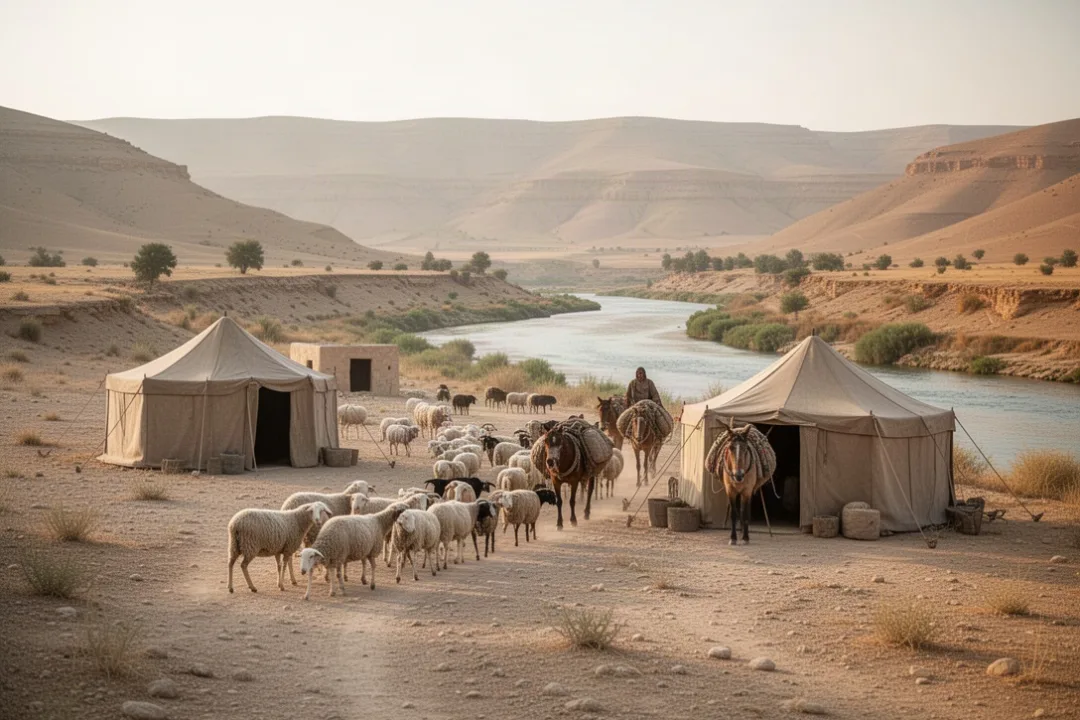
Genesis describes Abraham’s movement through several locations in Canaan. He reached Shechem, traveled through the land, and camped near places such as Bethel and Ai. He also spent time in the Negev, the dry southern region. These accounts portray Abraham as a mobile pastoral household rather than a resident of one permanent city.
The family’s movement likely depended on access to water, grazing land, and safe travel routes. Abraham’s household included flocks and herds, and Genesis later describes disputes between the herdsmen of Abraham and Lot because the land could not support all their animals together. The story shows how practical concerns shaped where the household could settle.
Abraham’s journey can be outlined in this order:
Ur: His family’s original home in southern Mesopotamia.
Haran: The northern Mesopotamian settlement where Terah’s household stopped.
Canaan: The land Abraham entered after leaving Haran.
Egypt and later Canaanite regions: Places Abraham visited during different episodes of his life.
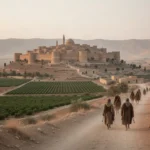
The route was not a single straight line drawn across a modern map. Ancient travelers followed rivers, roads, seasonal paths, and areas where people and animals could find supplies. The Euphrates corridor offered one practical route through Mesopotamia, while the journey toward Canaan led through the northern Levant and down into the land west of the Jordan River.
Abraham’s origin matters because the journey is central to his identity in Genesis. He does not begin as a settled leader in Canaan. He arrives as a foreigner who must negotiate land, travel through territories ruled by others, form agreements, and trust that his descendants will eventually receive a homeland.
What the Bible says about Abraham’s homeland and faith
The question of where Abraham came from is geographical, but the biblical account gives the move a theological meaning as well. Abraham’s departure from Mesopotamia is presented as an act of obedience to God’s call. God promises to make him into a great nation, bless those who bless him, and extend blessing through him to others, as described in Genesis 12.
That promise is made before Abraham has a secure home in Canaan. He leaves behind the familiar surroundings of Haran and travels to a land he has not yet received as his own. The narrative repeatedly places him between places: he has left Mesopotamia, but he is not yet established in the promised land.
The New Testament also reflects on this departure. Stephen’s speech in Acts 7 refers to the God of glory appearing to Abraham while he was in Mesopotamia, before Abraham lived in Haran. Hebrews 11 presents Abraham’s departure and life in tents as examples of trust in God’s promise. These passages reinforce the sequence found in Genesis: Mesopotamia first, Haran next, and Canaan afterward.
The Book of Joshua later reminds the Israelites that their ancestors, including Terah and Abraham, lived beyond the Euphrates and served other gods before God called Abraham. This reference locates Abraham’s family east of the Euphrates and emphasizes a change in religious allegiance as well as a change in geography.
The biblical account does not provide a complete biography of Abraham’s childhood in Ur. It does not tell us exactly how long he lived there, what his daily life looked like, or the precise route taken by his household. It gives enough information to identify his broad origin and to show the major stages of his migration.
For that reason, the most careful answer includes all three locations:
Ur was Abraham’s family origin and the place from which Terah’s household departed.
Haran was where the family settled for a period before Abraham continued the journey.
Canaan became the land where Abraham lived after responding to God’s call.
How to answer “Where did Abraham come from?” accurately
If someone asks for a one-sentence answer, say that Abraham came from Ur of the Chaldeans in Mesopotamia, probably in the region of present-day southern Iraq. Add that he lived in Haran before moving to Canaan if the question is about the full route described in Genesis.
It is less precise to say that Abraham came from Canaan, because Canaan was the destination of his migration rather than his original homeland. It is also incomplete to say only that he came from Haran. Haran was an important residence in his life, but Genesis traces his family’s earlier origin to Ur.
The phrase “Ur of the Chaldeans” can also cause confusion because “Chaldean” is a historical term with changing uses. It should not be assumed that Abraham belonged to every later group known by that name. In the biblical wording, the phrase primarily identifies the location associated with Abraham’s family.
A clear explanation can therefore distinguish between birthplace or ancestral origin, early residence, and later homeland. Abraham’s ancestral origin was Ur, his early adult household lived in Haran, and his later life was centered in Canaan.
This distinction is useful beyond Abraham’s story. Ancient people often moved between cities and regions, and biblical narratives may identify them by origin, residence, tribe, or political territory depending on the context. Treating those labels as interchangeable can make a straightforward account seem contradictory when it is not.
In the biblical storyline, Abraham’s journey begins in Mesopotamia and leads to Canaan. His family left Ur, settled in Haran, and then Abraham continued onward after receiving God’s call. That is why the best short answer names Ur first while also mentioning Haran and Canaan.
Frequently asked questions
Was Abraham born in Ur or Haran?
The Bible connects Abraham’s family origin with Ur of the Chaldeans, but it does not explicitly describe the details of his birth. Genesis says his father, Terah, took the family from Ur to Haran, where they settled. Abraham later left Haran for Canaan, so Haran was an important residence rather than the location identified as his original homeland.
Is Ur of the Chaldeans in modern Iraq?
The most common identification places biblical Ur at the archaeological site near Tell el-Muqayyar in southern Iraq. This city was part of ancient Mesopotamia and stood near the Euphrates. Because ancient geographic labels and modern borders do not correspond exactly, “southern Mesopotamia” is the most careful broader description.
Where did Abraham go after leaving Haran?
Abraham traveled to Canaan, the land associated with the eastern Mediterranean and the later history of Israel. Genesis describes him visiting places including Shechem and the area near Bethel before moving through other parts of the land. His household remained mobile, moving with its flocks and herds.
Why did Abraham leave his homeland?
Genesis presents Abraham’s departure from Haran as a response to God’s call and promise. He was told to leave his country, relatives, and father’s household and go to a land God would show him. The account does not give a separate practical reason, such as war or famine, for Abraham’s departure from Haran.






Leave a Reply