When you see a list of the 12 tribes of Israel, you may notice that the names do not always match from one biblical passage to another. The basic explanation is that Israel’s tribes came from Jacob’s twelve sons, but Joseph’s inheritance was later counted through his two sons, Ephraim and Manasseh, while Levi had a special religious role rather than one large territorial allotment.
The tribes were extended family groups that became the principal divisions of the people of Israel. They shaped Israel’s history, land distribution, military organization, worship, leadership, and identity. Their story begins with Jacob, whose name was changed to Israel, and continues through the settlement of Canaan, the divided kingdoms, the Assyrian conquest, and the Babylonian exile.
Jacob, also called Israel, had twelve sons whose descendants became the ancestral tribes. Genesis presents these sons as born through Jacob’s wives Leah and Rachel and their servants Bilhah and Zilpah. Their family relationships help explain why several tribes had distinct reputations and different positions in later biblical history.
Reuben was Jacob’s firstborn son through Leah.
Simeon was Leah’s second son.
Levi was also born to Leah and became associated with Israel’s priestly and religious service.
Judah, Leah’s fourth son, became the ancestor of the Davidic royal line.
Dan was born through Rachel’s servant Bilhah.
Naphtali was also Bilhah’s son.
Gad was born through Leah’s servant Zilpah.
Asher was Zilpah’s second son.
Issachar and Zebulun were Leah’s later sons.
Joseph and Benjamin were Rachel’s sons, with Benjamin born after Joseph.
These names first identify Jacob’s sons, but they soon become names for larger communities. The book of Genesis describes the family moving to Egypt during a famine, where Joseph had risen to power. The book of Exodus then tells how the descendants of Jacob grew into a people and were eventually led out of Egypt under Moses.
The phrase “children of Israel” therefore refers not only to a single family but to the descendants of all twelve sons. Their shared ancestry did not eliminate differences among them. Each tribe developed its own territory, leaders, military responsibilities, and historical experiences.
The central distinction: The original family list contains Joseph as one son and Levi as another. Later territorial and census lists commonly count Joseph through Ephraim and Manasseh, producing twelve landholding tribes while treating Levi separately.
Jacob’s blessings in Genesis 49 and Moses’ blessings in Deuteronomy 33 are not simple membership lists. They are poetic statements about the tribes’ character, future, strength, or place among the people. Some descriptions appear favorable, while others reflect family conflict or later expectations.
For example, Judah receives an especially significant blessing connected with leadership. Joseph receives an extended blessing associated with fruitfulness and abundance. Reuben, Simeon, and Levi are addressed in ways that reflect serious incidents in the family’s past. These passages show that the tribal tradition preserved both shared ancestry and complicated family memory.
The names and roles of the 12 tribes
The twelve tribal names are best understood as the names of Israel’s ancestral branches. Their later history does not always correspond neatly to the order in which they appear in Genesis, and their importance changes across different periods.
Reuben, Simeon, Levi, and Judah
Reuben, Jacob’s firstborn, received land east of the Jordan River. Reuben’s position as firstborn did not lead to lasting political dominance. Biblical genealogical traditions explain that his privileges were affected by an offense against his father’s household, while leadership became especially associated with Judah and Joseph.
Simeon received an inheritance within the territory assigned to Judah. This placement likely helps explain why Simeon becomes less visible as an independent political unit in later accounts. Some of its towns are listed alongside Judah’s territory, and the tribe’s identity appears to have been absorbed, at least in part, into the southern kingdom.
Levi is unusual because the Levites did not receive one continuous tribal territory like the other major groups. Instead, they were assigned towns throughout Israel. Their responsibilities included religious service, care for sacred objects, and assistance with worship. The descendants of Aaron, who belonged to the tribe of Levi, served as priests.
Judah received a large territory in the southern part of Canaan. Jerusalem eventually stood near the boundary of Judah and Benjamin and became the capital of the Davidic kingdom. Judah remained the dominant southern tribe after the kingdom divided, and the name “Jew” is historically related to Judah through later developments in the kingdom of Judah and its population.
Dan was first assigned territory in the coastal region west of Benjamin and Judah. Pressure from neighboring peoples led part of the tribe to migrate north, where Dan established a settlement near the northern limit of Israel. The phrase “from Dan to Beersheba” later expressed the traditional span of the land from north to south.
Naphtali received land in the far north, around the western and northern areas of the Sea of Galilee. Its location placed it near important routes and exposed it to conflict with neighboring powers. The tribe appears in accounts of battles during the period of the judges and in later references to northern Israel.
Gad settled east of the Jordan, in a region associated with pastureland. Along with Reuben and the eastern half of Manasseh, Gad requested land suitable for livestock before the Israelites crossed fully into Canaan. The agreement required these tribes to help the other Israelites in the conquest of the western territories.
Asher held territory in the northwest, near the Mediterranean coast and the Phoenician cities. The biblical account suggests that Asher did not fully displace all the earlier inhabitants of its assigned region. Its position connected the tribe to coastal trade routes and to the influence of neighboring peoples.
Issachar, Zebulun, Joseph, and Benjamin
Issachar occupied a fertile area in the Jezreel Valley and surrounding regions. Its location was agriculturally valuable but strategically exposed. The valley’s roads and open terrain made it a frequent setting for battles described in the books of Judges and Kings.
Zebulun was located in northern Canaan, near routes linking the interior with the coast and the region around the Sea of Galilee. The tribal boundaries are described differently in various passages, so modern maps should be treated as approximate rather than perfectly certain.
Joseph is counted among Jacob’s sons, but his descendants became the tribes of Ephraim and Manasseh. This two-branch inheritance is the main reason readers encounter different versions of the twelve-tribe list. Ephraim received a central territory, while Manasseh held land both west and east of the Jordan.
Benjamin received a relatively small territory between Judah and the northern tribes. Jerusalem was close to its southern boundary, and several important events in Israel’s history involved Benjaminite locations. Saul, Israel’s first king, came from Benjamin, while the apostle Paul later identified himself as a member of the tribe of Benjamin.
Why biblical lists of the tribes are different
There is no single list of the tribes that appears in exactly the same order and form throughout the Bible. The differences are not necessarily contradictions. They usually reflect the purpose of the passage: a family genealogy, a military census, a land allotment, a religious arrangement, or a symbolic vision.
The most important variation involves Joseph and Levi. A list based on Jacob’s sons includes Joseph and Levi. A list based on territorial inheritance usually divides Joseph into Ephraim and Manasseh and leaves Levi out of the main land count because the Levites received towns and religious support rather than one consolidated region.
Family lists: These generally name Jacob’s sons, including Joseph and Levi.
Land-allotment lists: These commonly count Ephraim and Manasseh separately and treat Levi differently.
Census lists: These may organize the tribes by military groups, camp positions, or administrative needs.
Worship-related lists: These may give Levi a prominent place because of priestly and sanctuary responsibilities.
Symbolic lists: Passages such as Revelation’s list of twelve tribes may use names and arrangements for theological reasons rather than as a map of ancient territory.
Some lists also omit a tribe or use a different order. Dan, for example, is absent from the list in Revelation 7, while Joseph appears there and Manasseh is also named. The passage does not explain the omission in a way that settles every later interpretation, so readers should avoid treating every list as a direct census of all historical tribal populations.
Chronology also matters. The tribal organization changed over time. A list from the wilderness period may not serve the same purpose as a list written after the monarchy or after the exile. Tribes could become politically weaker, merge into larger populations, lose territory, or remain known mainly through ancestry rather than as independent states.
How to read the lists: First ask what the passage is counting. Is it Jacob’s sons, landholding groups, military units, surviving communities, or symbolic representatives? The answer usually explains why the names differ.
The number twelve itself carries significance. It communicates a complete, organized people descended from Israel. Because the exact names can change according to context, the number often expresses the unity and fullness of Israel more than a fixed administrative chart.
Where the tribes lived in the land of Israel
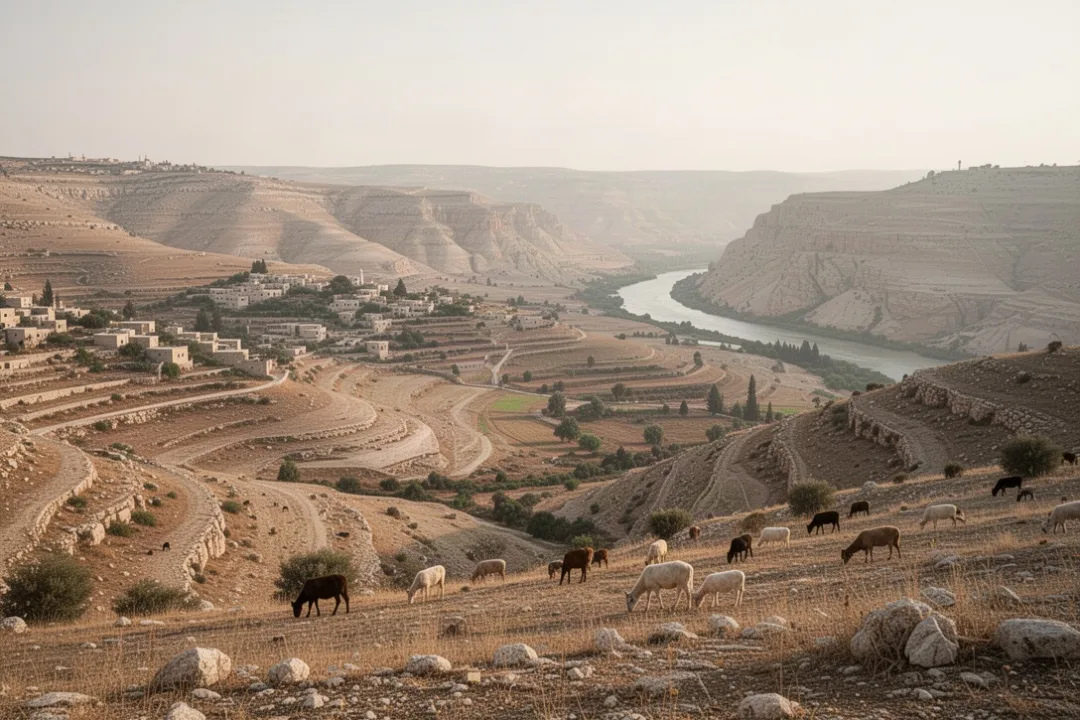
After the Israelites entered Canaan, the book of Joshua describes the distribution of land among the tribes. The boundaries are presented using towns, valleys, slopes, rivers, and neighboring peoples. Some locations can be identified with reasonable confidence, but others remain uncertain, so a modern map cannot reproduce every border precisely.
The main pattern is still clear. Judah, Simeon, Benjamin, Dan, and parts of Joseph were associated with the central and southern areas. Ephraim and western Manasseh occupied important central highland regions. Issachar, Zebulun, Asher, Naphtali, and eastern Manasseh were connected with the north, while Reuben and Gad held areas east of the Jordan.
The eastern tribes created a geographic challenge. Reuben, Gad, and half of Manasseh had land east of the Jordan but remained part of the larger Israelite community. Their arrangement required them to participate in the campaigns in Canaan before returning to their families and possessions across the river.
Tribal borders were not always equivalent to complete political control. The biblical narratives repeatedly state that some Canaanite populations remained in the land. In practice, influence could be mixed, and a tribe’s named territory might include towns or regions where control was contested.
Several tribal locations became especially important:
Judah included or bordered the area around Jerusalem and later became the heartland of the southern kingdom.
Benjamin occupied a central corridor between Judah and the northern tribes.
Ephraim included the hill country around important early sanctuaries such as Shiloh.
Manasseh stretched across both sides of the Jordan, making it one of the geographically broadest tribal groups.
Naphtali and Asher occupied northern regions close to major international routes and neighboring kingdoms.
Reuben and Gad lived in pasture-rich lands east of the Jordan.
Levitical towns were distributed among the other tribes. This arrangement placed religious specialists throughout the country rather than concentrating them in one region. It also reflects the Levites’ different status in Israel’s social and worship system.
Jerusalem later became the most important political and religious center, but it was not initially the only significant sanctuary. Places such as Shiloh, Bethel, Dan, and Gibeon appear in different periods of Israel’s history. The location of worship influenced the political importance of nearby tribes and towns.
What happened to the tribes after the kingdoms divided
Under Saul, David, and Solomon, the tribes were joined under a monarchy, although the unity was never free from internal tensions. After Solomon’s death, the kingdom divided into a northern kingdom, often called Israel, and a southern kingdom, called Judah.
The northern kingdom included most of the tribes associated with the central and northern territories. Its capital eventually became Samaria. The southern kingdom centered on Judah and included Benjamin, with Levites and other Israelites also living within its territory. Simeon’s earlier connection with Judah helps explain why it is not always treated as a separate major political power during this period.
The Assyrian conquest of the northern kingdom in the eighth century BCE brought deportations and major population changes. Some people were taken away, while others remained in the land or moved into neighboring areas. Because the biblical record does not provide a complete account of every community, later generations spoke of the “lost tribes of Israel.”
“Lost” does not necessarily mean that every descendant vanished or that no one knew anything about the tribes. It means that the northern tribes no longer maintained the same clear political and genealogical identity that they had before the conquest. Some individuals and families may have joined the population of Judah, while others were absorbed into communities shaped by later migrations and empires.
The kingdom of Judah continued for a longer period but was conquered by Babylon in the sixth century BCE. The Babylonian exile and the later return to the land reshaped Israelite identity again. The surviving community increasingly used terms connected with Judah, Jerusalem, the temple, and the Jewish people, even though the older twelve-tribe tradition remained meaningful.
The New Testament continues to refer to the tribes in several ways. Jesus’ family and the early Christian movement arose within the Jewish world shaped by Judah, Benjamin, Levi, and the other ancestral traditions. Anna is identified as belonging to Asher in Luke 2, and Paul identifies himself with Benjamin in Philippians 3. James addresses “the twelve tribes” as a way of referring to the wider Jewish people.
The book of Revelation also uses the twelve tribes symbolically in its vision of God’s people. Its list differs from some earlier lists, which shows that the number twelve had a theological and identity-forming purpose. It represented the completeness of Israel rather than providing a simple record of which tribes had survived as separate political communities.
How the 12 tribes are understood today
For Jewish readers, the tribes belong to the foundational story of Israel and help explain biblical genealogies, land traditions, priestly roles, and the history of the kingdoms. The tribe of Levi remains especially significant in Jewish tradition, and many Jewish families preserve traditions associated with Levites or kohanim, the priestly descendants.
Some tribal identities are more clearly preserved than others. Jewish tradition generally recognizes priestly and Levitical status in particular families, while the exact tribal ancestry of most Jewish people is not known. Historical displacement, intermarriage, exile, conversion, migration, and the destruction of ancient records all contributed to this loss of detailed tribal identification.
Outside Judaism, the tribes are often studied through biblical history, theology, archaeology, and geography. They are also connected with discussions about the identity of the northern tribes and the meaning of Israel in later religious texts. Claims that a modern nation or ethnic group can be definitively identified as one of the “lost tribes” require careful evaluation because biblical evidence alone does not establish most such claims.
The tribes should not be treated as twelve completely separate nations from the beginning. They shared a common ancestry, worshiped the God of Israel within the biblical tradition, and were connected through covenant, law, marriage, military cooperation, and political alliances. At the same time, the Bible preserves genuine rivalries and differences among them.
The most useful way to remember the structure is to keep three related lists in mind:
Jacob’s twelve sons: Reuben, Simeon, Levi, Judah, Dan, Naphtali, Gad, Asher, Issachar, Zebulun, Joseph, and Benjamin.
Joseph’s two tribal branches: Ephraim and Manasseh replace Joseph in many land and census arrangements.
Levi’s special position: Levites are counted as an Israelite tribe but are often handled separately because of their religious duties and scattered towns.
That framework answers most questions about why the lists vary. The tribes were simultaneously family lines, geographic communities, political units, and symbols of Israel’s unity. A passage may emphasize one of those meanings while leaving another in the background.
Frequently asked questions
Which son of Jacob became the ancestor of the tribe of Judah?
Judah, Jacob’s fourth son through Leah, became the ancestor of the tribe of Judah. His descendants settled in the southern part of Canaan, and the tribe later became associated with David’s royal line, Jerusalem, and the kingdom of Judah. The terms “Jew” and “Jewish” are historically connected with Judah through the later development of that kingdom and its people.
Why are Ephraim and Manasseh sometimes counted instead of Joseph?
Joseph’s two sons, Ephraim and Manasseh, received separate tribal inheritances. As a result, lists focused on land or political organization often name both of them rather than Joseph. This keeps the total at twelve when Levi is treated separately because the Levites received towns throughout Israel instead of one consolidated territory.
Were the 12 tribes all still identifiable after the exile?
Not with the same clarity. The Assyrian conquest disrupted the northern kingdom, and many communities were deported, relocated, or absorbed into other populations. Judah preserved a stronger continuing identity through the Babylonian exile and later restoration. Some tribal traditions survived, but the exact ancestry of most later Jewish families cannot be established from available records.
What does “the lost tribes of Israel” mean?
The phrase usually refers to the northern tribes whose separate political and genealogical identities became difficult to trace after Assyria conquered the northern kingdom. “Lost” does not prove that every descendant disappeared. It describes the loss of clear historical records and independent tribal organization, not necessarily the extinction of every person connected with those tribes.







Leave a Reply