Goshen in the Bible: meaning, location, and significance
Goshen in the Bible: meaning, location, and significance
When you read that Jacob’s family moved to Egypt, you may wonder where they lived and why that place mattered so much. Goshen in the Bible was the region assigned to Israel’s family during their time in Egypt. It provided pasture for their flocks, became home to the growing Israelite community, and was repeatedly distinguished from the rest of Egypt during the plagues.
Goshen appears mainly in Genesis and Exodus, with another place called Goshen mentioned in Joshua. The best-known Goshen was in Egypt, probably in the eastern Nile Delta, although the Bible does not give enough information to identify its exact modern location with certainty.
Goshen was the Egyptian territory where Jacob, his sons, and their households settled after Joseph invited them to move from Canaan. Joseph had risen to authority in Egypt and was managing the country during a severe famine. When his brothers and father came to Egypt for food, Joseph arranged for them to live in Goshen.
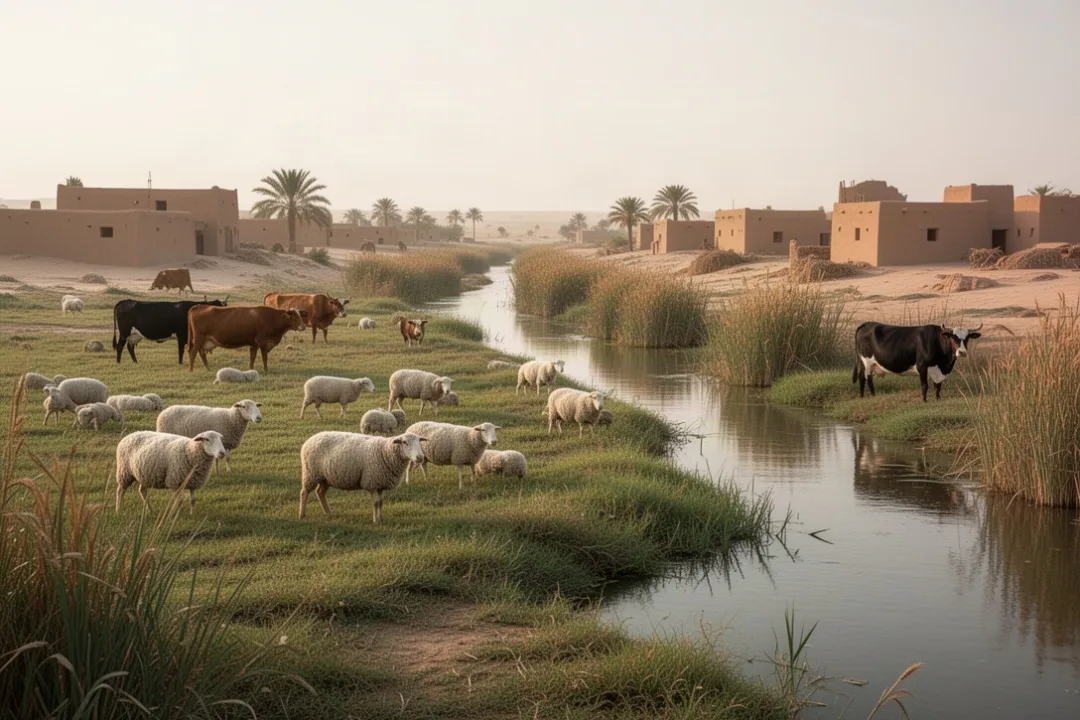
The region suited the family because they were shepherds. Joseph told Pharaoh that his relatives worked with livestock, and Pharaoh allowed them to settle in the best part of the land. Genesis 47 describes Goshen as a place where Israel acquired property, became productive, and increased in number.
The name therefore refers first to a real geographical region in Egypt, not merely to a symbolic spiritual idea. At the same time, the biblical account gives Goshen a larger role. It becomes the place where God preserves Jacob’s descendants, separates them from Egyptian society, and prepares them for their eventual departure.
Core idea: Goshen was both a place of provision during famine and the setting where Israel grew into a distinct people before the Exodus.
Where Goshen was located in Egypt
The biblical descriptions place Goshen in or near the eastern Nile Delta, the broad, fertile region where the Nile divided into branches before reaching the Mediterranean Sea. This area was well suited to agriculture and livestock because it had access to water, pasture, and rich soil.
Genesis does not provide a modern map reference. Jacob’s family came down from Canaan, and Goshen appears to have been in the part of Egypt closest to the land routes from Canaan. Its eastern position also fits the later Exodus account, in which the Israelites left Egypt and traveled toward the wilderness and the Red Sea.
Some writers have connected Goshen with places such as the Wadi Tumilat or other areas in the northeastern Delta. These proposals may help explain the geography, but none can be stated with complete certainty. The Bible identifies the region clearly enough for the story without giving the exact city, border, or archaeological site.
Region: likely the northeastern or eastern Nile Delta.
Environment: fertile land with pasture suitable for flocks.
Relationship to Canaan: positioned near Egypt’s eastern approaches.
Modern identification: uncertain, because the ancient landscape and waterways changed over time.
Goshen should not be treated as a precise modern place name with universally accepted boundaries. It is better to say that the Israelites lived in Egypt’s eastern Delta region, in an area known in the biblical text as Goshen.
How Goshen fits into Genesis step by step
The story of Goshen develops through several connected events. Following the sequence helps show why the region mattered to Jacob’s family.
Joseph rises to authority. After years of hardship, Joseph becomes a powerful administrator in Egypt. He stores grain during the years of abundance so the country can survive the coming famine.
Joseph’s brothers travel to Egypt. Famine affects Canaan, so Jacob sends his sons to Egypt to buy grain. Their trips eventually reveal Joseph’s identity and bring the family’s painful history into the open.
Joseph invites Jacob to relocate. Joseph tells his father to come to Egypt with the entire household. He promises that the family can live near him and receive food during the remaining famine.
Jacob receives a promise of reassurance. In Genesis 46, God speaks to Jacob at Beersheba and tells him not to fear going down to Egypt. The promise includes the assurance that God will make Jacob’s family into a great nation there.
Judah goes ahead to Goshen. Jacob sends Judah before the family to guide them toward Goshen and prepare the way.
Joseph meets Jacob. Joseph travels to Goshen to meet his father. Their reunion is one of the emotional turning points in the Joseph narrative.
The family settles there. Joseph presents his brothers and father to Pharaoh. They receive permission to live in Goshen, where they can care for their animals.
Israel grows in the land. Genesis 47 says the family becomes fruitful and greatly increases. Goshen becomes the community’s home for generations.
This sequence shows that Goshen was not an accidental stopping place. It was selected because it served the family’s economic needs and allowed them to remain together under Joseph’s protection.
Why Joseph chose Goshen for Jacob’s family
Joseph’s family had a particular occupation: they were keepers of livestock. In Genesis 46:31–34, Joseph instructs his brothers to describe themselves as shepherds and livestock keepers when they meet Pharaoh. This detail matters because it explains why Goshen was a practical choice.
Pharaoh’s court understood that the family needed land where their animals could graze. Genesis 47 presents Goshen as a favorable area, and Pharaoh tells Joseph that his relatives may live there. The region offered a place for the family to remain economically useful without requiring them to abandon their livelihood.
Joseph also wanted his family to be honest and consistent about their identity. Their work was not presented as a temporary disguise. They were shepherds, and Goshen provided a suitable setting for that way of life.
The passage also mentions that Egyptians viewed shepherds negatively or considered them socially unacceptable in some way. The exact reason is not fully explained, and interpretations differ. It may relate to cultural attitudes, food practices, religious customs, or the memory of foreign pastoral groups. Whatever the precise reason, the social distance likely helped Jacob’s descendants live together as a distinct community.
Pasture: Goshen supported sheep, cattle, and other livestock.
Separation: The family could remain together rather than dispersing across Egypt.
Protection: Joseph’s authority gave them access to food and security.
Continuity: They could preserve their family identity and occupation.
Goshen as a place of provision during famine
The immediate reason Jacob’s family went to Egypt was the famine. Canaan could not provide enough food, but Egypt had grain because Joseph had administered the storage program during the preceding years of abundance. Goshen became the place where Jacob’s household survived the crisis.
Genesis 47 emphasizes that the famine was severe, yet Jacob’s family had access to food through Joseph’s position. Their move was not simply an immigration decision; it was a response to a life-threatening disaster. Goshen represented shelter from hunger and a stable home during a period when many people were forced to sell their possessions and land for food.
At the same time, the account does not portray Goshen as a permanent substitute for the promised land. Jacob’s family lives there, but the broader promises made to Abraham, Isaac, and Jacob remain connected to Canaan. Goshen is a place of preservation for a season, not the final destination of Israel’s story.
This distinction helps explain the tension in Genesis. Egypt saves the family from famine through Joseph’s leadership, but later Exodus passages describe Israel’s deliverance from forced labor under a new Pharaoh. The same land can function as a refuge in one generation and a place of oppression in another.
What happened to Goshen during the plagues
Goshen becomes especially significant in Exodus. When Moses announces the plagues, several passages distinguish between the Egyptians and the Israelites living in Goshen. For example, Exodus 8 describes swarms of insects affecting Egyptian territory while Goshen is treated differently. Exodus 9 makes a similar distinction during the plague on livestock and the plague of hail.
The biblical point is that God knew where Israel lived and could protect the people within the wider land of Egypt. The text does not describe Goshen as magically immune in every imaginable sense, nor does every plague passage mention the region. Instead, the repeated contrast communicates God’s deliberate care for the covenant people.
Exodus 10 again distinguishes Goshen from the areas affected by darkness. The darkness covers the Egyptians’ territory, while the Israelites have light where they live. This contrast reinforces the division between Pharaoh’s kingdom and the people God is preparing to release.
These passages make Goshen more than a geographic reference. It becomes a visible setting for the difference between Egyptian oppression and God’s protection. Israel is still physically inside Egypt, but the biblical narrative shows that the nation is not abandoned to Egypt’s fate.
Reading the plague passages carefully: The Bible’s emphasis is not that every Israelite experience was effortless, but that God distinguished and preserved his people as the plagues unfolded.
How Goshen relates to the Exodus
Goshen was the Israelites’ home before they left Egypt. Exodus 12 reports that a large number of Israelites departed from the area associated with their Egyptian settlement and traveled toward Succoth. The account presents the departure as a major transition: a family that entered Egypt during Joseph’s lifetime had become a large people leaving under Moses.
The length of their residence in Egypt is discussed in Exodus 12 and elsewhere, but the biblical passages are read differently by various interpreters because of questions about chronology and how the stated time periods should be understood. The central point is clear: Israel’s stay in Egypt lasted for generations, and the departure fulfilled God’s promise to bring Jacob’s descendants out.
Goshen therefore stands at the beginning of the Exodus movement. It is the place where Israel lived, worked, raised families, and multiplied. It is also the place from which the people were summoned to leave behind Egypt’s control and follow God toward the land promised to their ancestors.
The move from Goshen to the wilderness was not merely a change of address. It marked a change in identity. The descendants of one extended family became a people organized around God’s covenant, Moses’ leadership, and the Passover deliverance.
What Goshen teaches about Israel’s growth
Genesis repeatedly connects Goshen with Israel’s increase. Jacob’s household entered Egypt as a family group, but the community later left as a substantial population. The biblical narrative presents this growth as connected to God’s promise to Abraham, Isaac, and Jacob.
God had promised that Jacob’s descendants would become numerous. Goshen provided the setting in which that promise advanced during an unexpected period of foreign residence. The family was not in Canaan, yet its identity and population continued to develop.
This growth also explains why Pharaoh later perceived the Israelites as a threat. Exodus begins by describing a new king who did not regard Joseph’s earlier service as significant. He saw the large Israelite population and responded with fear, forced labor, and harsh policies.
Goshen thus contains two contrasting parts of Israel’s story:
Preservation: Joseph’s leadership and the land’s resources save the family from famine.
Multiplication: The family grows into a large community.
Vulnerability: A later Pharaoh views that growth as dangerous.
Deliverance: God brings the people out through the Exodus.
The change from welcome guests to oppressed laborers also warns against assuming that a favorable political situation will last forever. Jacob’s family benefited from Joseph’s position, but later generations faced a ruler who had no loyalty to Joseph’s memory.
Goshen and the theme of separation
Goshen helped establish a physical separation between Jacob’s descendants and the broader Egyptian population. The family lived in Egypt, benefited from Egypt’s resources, and depended on Joseph’s administration, but it did not simply disappear into Egyptian society.
That separation was connected to several factors: their family lineage, their pastoral work, their worship of the God of Abraham, Isaac, and Jacob, and the promises attached to their identity. The Bible does not describe every detail of their daily cultural life, so it would be inaccurate to claim that Goshen was completely isolated. It was more likely a region where the Israelites could remain a recognizable community.
During the plagues, the distinction becomes theological as well as social. Goshen represents the fact that Israel lives in Egypt without belonging entirely to Egypt. The people are physically present in Pharaoh’s territory, but God’s covenant defines their future.
That theme appears throughout the biblical story: God can preserve a people even when they are living among nations with different beliefs, customs, and rulers. Goshen is one early example of a community maintaining its identity while residing in a foreign land.
Is the Goshen in Joshua the same place?
Joshua mentions another Goshen in a very different setting. Joshua 10:41 says that Joshua defeated territory extending from Kadesh-barnea to Gaza and all the country of Goshen, toward Gibeon. Joshua 11:16 also refers to the hill country and the Negev, including Goshen, as part of the land conquered by Joshua.
This Goshen is associated with the land of Canaan, not the Egyptian region where Jacob’s family lived. It should therefore be distinguished from the Goshen in Genesis and Exodus. The identical name does not prove that the two locations were the same.
The exact location of the Canaanite Goshen is also uncertain. It may have been a regional district in the southern part of Canaan, but the biblical references do not provide enough detail to mark its boundaries confidently. Readers should pay attention to the surrounding geography and historical setting rather than assuming every biblical use of Goshen refers to Egypt.
Egyptian Goshen: the home of Jacob’s family before the Exodus.
Canaanite Goshen: a region mentioned in Joshua’s account of conquest.
Shared name: a similar name does not establish one location.
Best practice: identify the place from its biblical context.
What Goshen means for understanding God’s promises
Goshen illustrates how biblical promises may unfold through unexpected circumstances. Jacob’s family entered Egypt because of famine, not because they had planned to build their future there. Yet God used Joseph’s position and Egypt’s resources to preserve them.
The account also shows that provision does not eliminate every later difficulty. Goshen was a place of safety and abundance for a time, but Israel eventually experienced oppression there. The good season did not cancel the need for deliverance; it became part of the longer story leading to deliverance.
Genesis 46 connects Jacob’s journey to God’s promise that his descendants would become a great nation. This promise is significant because Jacob was afraid to go to Egypt. The divine reassurance addressed both his immediate fear and the larger question of whether leaving Canaan would threaten the family’s future.
Goshen demonstrates that a temporary place can still have lasting importance. It was not the promised homeland, but it was the place where the family survived, grew, and prepared for the next stage of God’s work.
How to read references to Goshen in the Bible
When you encounter Goshen in a Bible passage, first determine whether the setting is Genesis, Exodus, or Joshua. The surrounding names and events usually make the answer clear. Genesis and Exodus place Goshen in Egypt, while Joshua places another Goshen within the geography of Canaan.
Next, ask what role Goshen is playing in the passage. It may be connected with pasture, family settlement, protection from a plague, population growth, or departure. Those details help you understand why the biblical writer mentions the place.
A useful reading process is:
Identify the book and chapter. The historical setting determines which Goshen is intended.
Read the surrounding verses. Do they mention Pharaoh, Egypt, Jacob, Moses, Joshua, or Canaanite towns?
Observe the practical details. Look for livestock, food, settlement, geography, or military campaigns.
Notice the larger theme. Goshen may illustrate provision, separation, preservation, growth, or transition.
Avoid overclaiming the location. The Egyptian Goshen can be placed broadly in the eastern Delta, but its exact boundaries remain uncertain.
This approach keeps the interpretation grounded in the text. It also prevents two common mistakes: treating Goshen as only a metaphor and treating every place named Goshen as the same location.
Why Goshen still matters to Bible readers
Goshen matters because it connects several major biblical themes in one setting. It is linked with family, famine, migration, providence, identity, oppression, and deliverance. The region’s significance comes from what happened there, not from its size or modern fame.
For Jacob’s family, Goshen meant food when Canaan was suffering. For Joseph, it was a practical solution that kept his relatives together. For Israel’s later generations, it was the place where their population expanded. For Moses’ generation, it became the starting point of a historic departure.
The Bible also presents Goshen as a reminder that God’s work can continue during periods of displacement. Jacob’s descendants were living outside the land associated with their ancestral promises, yet they were not forgotten. Their story in Goshen moved toward the fulfillment of a larger covenant purpose.
When you read the Goshen passages together, the region is best understood as a protected but temporary home. It offered pasture and food, allowed Israel to grow, and displayed God’s distinction during the plagues. But the story did not end there. Goshen was a significant stage on the way to the Exodus and the formation of Israel as a nation.
Frequently asked questions
Was Goshen a city or a region?
Goshen is best understood as a region or district rather than a single city. The biblical account describes it as land suitable for grazing livestock and large enough to support Jacob’s growing household. Its exact boundaries are unknown, but it was likely located in the eastern Nile Delta of Egypt.
Did the Israelites live in Goshen during all their years in Egypt?
Genesis and Exodus present Goshen as the principal settlement area of Jacob’s descendants before the Exodus. The Bible does not describe every movement or village within Egypt, so it is safest to say that Goshen was their main homeland and community center during that period.
Did the plagues affect the Israelites in Goshen?
Several plague accounts specifically distinguish Goshen from Egyptian territory, showing God’s protection of the Israelites there. The text does not claim that every hardship disappeared from their experience, but it repeatedly emphasizes that God knew where his people lived and preserved them during the judgments.
Why is there another Goshen in the book of Joshua?
Joshua refers to a Goshen within the land of Canaan, probably a southern district. It is separate from the Egyptian Goshen of Genesis and Exodus. The same name can be used for different locations, so the surrounding geography and historical setting are essential for identifying which Goshen a passage means.




Leave a Reply