Valley of Jehoshaphat: location, meaning, and Bible context
Valley of Jehoshaphat: location, meaning, and Bible context
The Valley of Jehoshaphat is traditionally identified with the Kidron Valley, the ravine running between Jerusalem’s Old City and the Mount of Olives. The name comes from the prophecy in Joel 3, where God gathers the nations for judgment. However, the Bible does not clearly state that the Kidron Valley is the place Joel had in mind, so the identification remains a matter of interpretation.
In Joel’s prophecy, the valley represents the place where God judges nations for their treatment of his people and for violence, injustice, and the destruction of Jerusalem. It is also associated with the “valley of decision,” a phrase that emphasizes the seriousness of divine judgment rather than naming a separate, clearly mapped location.
Why the Valley of Jehoshaphat is linked with Jerusalem
The connection begins with Joel 3:2, which describes God gathering the nations in the “Valley of Jehoshaphat.” Joel 3:12 returns to the same setting and presents the nations as coming before God’s judgment. The passage then refers to a nearby “valley of decision” in Joel 3:14.
The name Jehoshaphat comes from Hebrew elements commonly understood to mean “Yahweh judges” or “the Lord judges.” That meaning fits Joel’s message, but it does not necessarily prove that the valley was named after King Jehoshaphat of Judah. The name may function as a theological description of the event rather than as a reference to a known historical landmark.
Over time, Jewish and Christian tradition connected the prophetic valley with the Kidron Valley. The Kidron lies immediately east of Jerusalem and below the Temple Mount, making it a natural location for traditions about judgment, resurrection, and the final gathering of the nations. Its proximity to important biblical sites helped strengthen that association.
Core distinction: “Valley of Jehoshaphat” is a biblical and traditional name, while “Kidron Valley” is the name of the physical ravine beside Jerusalem. Many people use the names interchangeably, but they are not identical in certainty or origin.
What Joel 3 says about the Valley of Jehoshaphat
Joel 3 is the central biblical passage for the Valley of Jehoshaphat. The chapter describes a future act of judgment against nations that have harmed God’s people, divided the land, and treated human beings as commodities. Joel presents the judgment in vivid prophetic imagery, using harvest language to show that the nations have reached the point at which their actions must be assessed.
The passage includes several connected ideas:
God restores his people: The chapter begins with a promise that Judah and Jerusalem will be restored.
The nations are summoned: God calls hostile nations to the place of judgment.
Wrongdoing is exposed: The accusations involve violence, captivity, land seizure, and contempt for God’s people.
God acts as judge: The outcome depends on divine justice rather than military power.
The Lord remains present with Jerusalem: The chapter ends with imagery of God dwelling in Zion and protecting his people.
Joel’s language is prophetic and poetic, so readers should be cautious about treating every image as a modern geographical description. References to a valley, harvest, darkness, trembling heavens, and divine presence work together to communicate cosmic judgment. The text is more concerned with who judges, why judgment occurs, and what it means for God’s people than with giving survey coordinates.
How to understand the name “Jehoshaphat” in Joel
The Hebrew form behind the name is often explained as meaning “Yahweh judges.” This makes the name especially appropriate for Joel 3, which centers on God’s judgment. Some readers understand Jehoshaphat as a reference to the Judean king; others see it as a symbolic name that describes what happens in the valley.
King Jehoshaphat appears in the historical books of the Old Testament, especially in accounts found in 1 Kings and 2 Chronicles. He ruled Judah during a period of conflict and religious reform. In 2 Chronicles 20, a coalition of enemies comes against Judah, and the crisis is connected with a place called the Valley of Beracah, or the Valley of Blessing, after Judah’s deliverance.
That story has encouraged some readers to connect King Jehoshaphat with later traditions about a judgment valley. Yet Joel 3 does not explicitly say that the valley is named after the king or that the events of 2 Chronicles 20 are the same event. The two passages share themes of threatened Judah and divine intervention, but they should not be treated as identical without qualification.
A careful reading allows both possibilities: the name may evoke the king’s association with divine deliverance, and it may also carry the direct meaning “the Lord judges.” The safest conclusion is that Joel uses the name to focus attention on God’s judgment, while the precise historical origin of the place-name is uncertain.
Where the traditional Valley of Jehoshaphat is located
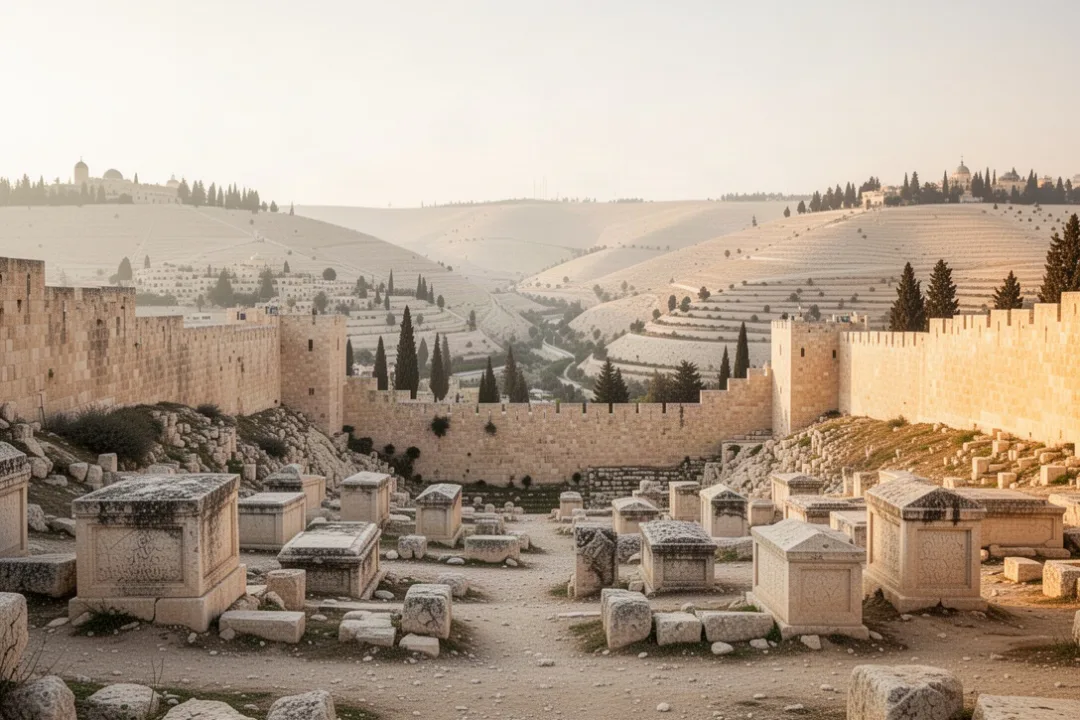
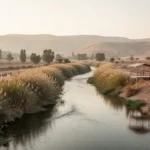
Traditionally, the Valley of Jehoshaphat is placed in the Kidron Valley on the eastern side of Jerusalem. The ravine begins north of the city area and runs southward between the Old City and the Mount of Olives. It continues toward the Judean wilderness and the Dead Sea region, although the character of the landscape changes along the route.
The traditional location is easy to understand geographically. The valley stands between several sites central to biblical history:
Jerusalem’s Old City: The western side of the upper valley borders the city’s eastern walls.
The Temple Mount: The valley lies below and east of this major religious site.
The Mount of Olives: The eastern side rises sharply above the ravine.
Ancient burial areas: The slopes contain extensive tombs and cemeteries from different periods.
Important religious landmarks: Churches, chapels, shrines, and Jewish burial sites occupy parts of the valley and its surrounding slopes.
Modern visitors may hear the terms Kidron Valley, Valley of Jehoshaphat, and sometimes Valley of the King used in discussions of the same general area. These labels reflect different biblical references, later traditions, and local usage. They do not always mark precisely the same boundaries.
The ravine has also been shaped by centuries of construction, erosion, roads, graves, walls, and religious buildings. The landscape seen today should not be assumed to look exactly as it did in biblical times. The physical valley is real, but the traditional prophetic identification belongs to the history of interpretation rather than to an explicit geographic statement in Joel.
What the Bible says about the Kidron Valley
The Kidron Valley is mentioned by name in several biblical passages, but those references do not directly call it the Valley of Jehoshaphat. The Kidron appears in accounts involving royal departures, mourning, religious reform, and movement between Jerusalem and the Mount of Olives.
King David crossed the Kidron during his flight from Jerusalem in the account of Absalom’s rebellion. Later, the valley is associated with the removal or destruction of objects connected with idolatrous worship during reforms under kings such as Asa, Hezekiah, and Josiah. These passages give the Kidron historical and religious importance, even though they do not identify it with Joel’s valley.
The New Testament also refers to Jesus and his disciples crossing the Kidron Brook on the way to a garden after the Last Supper, as recorded in John 18. The reference places the valley within the setting of Jesus’ arrest, but it does not connect the passage directly with Joel 3.
The distinction matters because readers sometimes combine every biblical reference to the Kidron with every prophecy about final judgment. A more precise approach is to keep the passages separate:
Joel 3 describes the Valley of Jehoshaphat as a setting for judgment.
Other Old Testament passages describe the Kidron as a real ravine east of Jerusalem.
Later Jewish and Christian tradition connects the two locations.
The Bible itself does not provide an unambiguous sentence saying that Jehoshaphat and Kidron are the same valley.
Is the Valley of Jehoshaphat a literal place or a symbolic one?
Interpretations generally fall along a spectrum rather than into two completely separate camps. Some readers expect Joel’s prophecy to refer to a real location near Jerusalem. Others understand the valley primarily as a symbolic courtroom, where the nations stand before God and receive judgment.
A literal reading does not require every detail to function like a modern map. Biblical prophecy often uses real places as settings for symbolic and theological meaning. Jerusalem, Zion, mountains, valleys, harvests, and nations may all refer to concrete realities while also carrying a broader message about God’s rule.
A symbolic reading does not mean the prophecy is unreal or unimportant. It means the main point may be divine justice, not the identification of a particular ravine. In Joel 3, the valley is the setting where wrongdoing is answered, the nations are held accountable, and God’s relationship with his people is publicly vindicated.
Several features of the text support caution about exact geography:
The valley is named in a way that carries theological meaning.
The passage uses highly poetic descriptions of cosmic disturbance.
The “valley of decision” appears as a closely related expression.
The text does not provide boundaries, landmarks, distances, or a route to the site.
The focus remains on God’s judgment of nations rather than on travel or settlement.
For these reasons, many interpreters describe the Kidron identification as traditional rather than certain. It is reasonable to visit the Kidron Valley and understand why it has been linked to Joel 3. It is less responsible to claim that archaeology has proven the exact location of the prophetic valley.
What “the valley of decision” means
Joel 3:14 describes multitudes in the “valley of decision.” This phrase is often connected with the Valley of Jehoshaphat, but the wording can be misunderstood. It does not necessarily mean that people are standing in a place where they must make a personal choice between two options.
In context, the decision belongs to God as judge. The nations have been gathered, their actions have been weighed, and judgment is about to occur. The phrase therefore points to the decisive moment when God’s ruling is carried out.
Some Christian preaching uses “valley of decision” as an invitation for individuals to choose faith. That application may have pastoral value, but it is not the primary meaning of Joel 3. The original context concerns the judgment of nations and the public establishment of God’s justice.
The language also creates a sense of urgency. Joel portrays the nations as numerous and the moment as imminent, using imagery of harvest and overflowing violence. The valley becomes a place where history reaches a point of accountability.
Reading tip: Start with Joel’s own context before applying “valley of decision” to personal choices. The chapter’s central theme is God judging nations and defending his people, not merely a private decision made by an individual.
How the Valley of Jehoshaphat relates to end-times beliefs
The Valley of Jehoshaphat is often discussed in connection with end-times prophecy because Joel presents the judgment as a future and climactic event. Some Jewish and Christian traditions associate the valley with the resurrection of the dead, the final judgment, or the gathering of the nations at the end of history.
Those associations should be handled carefully. Joel 3 does speak about God’s ultimate intervention, but the chapter does not give a complete timeline of all events commonly included in end-times systems. It also does not explicitly identify the Valley of Jehoshaphat with every other prophetic location mentioned elsewhere in Scripture.
For example, the Battle of Armageddon is associated with a different place-name in Revelation 16. Armageddon, the Valley of Jehoshaphat, and other prophetic locations are sometimes combined in popular teaching because they all relate to divine judgment and conflict. The biblical texts, however, should be examined separately before drawing a connection.
Likewise, the New Testament uses themes from Joel, including the outpouring of the Spirit and signs associated with the day of the Lord. Acts 2 applies part of Joel’s prophecy to the coming of the Holy Spirit at Pentecost. That use shows that Joel’s imagery can have significance beyond one narrowly defined geographical event, while leaving room for different views about its future fulfillment.
Why the Kidron Valley matters to Jewish tradition
The Kidron Valley has long held significance in Jewish memory because of its proximity to Jerusalem, the Temple Mount, and the Mount of Olives. The surrounding slopes contain ancient and later cemeteries, and the area has been associated with expectations concerning resurrection and the messianic age.
Traditions about burial near Jerusalem’s holy sites developed for religious, historical, and practical reasons. The Mount of Olives in particular became an important Jewish burial area. These traditions do not establish the exact meaning of Joel’s prophecy, but they help explain why the Kidron Valley became closely linked with final judgment and the future restoration of God’s people.
Jewish interpretations are not uniform. Some emphasize the valley’s association with Jerusalem and the nations’ judgment; others treat the passage through broader prophetic themes. The label “Valley of Jehoshaphat” may therefore refer to a traditional setting without implying that every Jewish reader interprets Joel in exactly the same way.
Why Christians visit or study the Valley of Jehoshaphat
For Christian visitors, the traditional valley brings together several layers of biblical history. The area is connected with Jerusalem’s Temple, Jesus’ crossing of the Kidron, the Mount of Olives, and later reflection on prophecy. A visit can help place biblical narratives in relation to one another, even though the modern landscape is not a perfect reproduction of ancient Jerusalem.
People commonly study the valley for several reasons:
Biblical geography: It helps explain the relationship between Jerusalem, the Temple Mount, and the Mount of Olives.
Prophetic interpretation: Joel 3 raises questions about judgment, restoration, and the meaning of symbolic place-names.
Jesus’ final hours: The Kidron appears in the Gospel account of Jesus’ arrest.
Jewish and Christian history: The valley has been shaped by centuries of worship, burial, pilgrimage, and political change.
Reflection on justice: Joel’s message centers on accountability for violence and oppression.
Visitors should remember that the valley includes active religious sites, cemeteries, narrow paths, roads, and areas with uneven footing. Respect for graves and local religious customs is essential. Depending on the season and exact route, heat, steep slopes, and limited access can also affect a visit.
What the Valley of Jehoshaphat teaches about judgment
Joel’s prophecy does not present judgment as arbitrary anger. The nations are judged because of identifiable actions, including violence, exploitation, captivity, and the violation of the dignity of God’s people. The passage insists that political power does not place nations beyond accountability.
The chapter also connects judgment with restoration. God’s purpose is not only to punish enemies but to renew the fortunes of Judah and Jerusalem. This pairing is important: biblical judgment is presented as part of a larger act of setting wrongs right and protecting a vulnerable community.
The imagery of harvest conveys moral ripeness. Joel portrays evil as having accumulated until the time for judgment arrives. The metaphor does not encourage readers to appoint themselves as judges of every enemy. Instead, it places final authority in God’s hands and calls attention to the seriousness of injustice.
The final section of Joel 3 turns toward God’s presence in Zion and the security of his people. That ending gives the valley a broader meaning. It is not simply a place of destruction; it is part of a prophetic vision in which evil is answered, Jerusalem is restored, and God remains with his people.
Common mistakes when explaining the Valley of Jehoshaphat
Several misunderstandings appear frequently in discussions of this subject. Correcting them makes the biblical and historical picture clearer.
“The Bible clearly says it is the Kidron Valley.” Joel names the Valley of Jehoshaphat, but it does not explicitly equate it with the Kidron.
“It is definitely named after King Jehoshaphat.” The name may refer to the king, but its Hebrew meaning also functions naturally as a description of divine judgment.
“The valley is the same as Armageddon.” These names come from different passages and should not be treated as identical without an argument from the texts.
“Valley of decision means only personal conversion.” Joel’s immediate context concerns God’s judgment of nations.
“Archaeology has confirmed the prophecy’s exact site.” The Kidron’s physical identity is clear, but the prophetic identification remains traditional and interpretive.
A strong explanation can affirm the traditional location while acknowledging uncertainty. That approach respects both the historical importance of the Kidron Valley and the poetic, theological character of Joel’s prophecy.
How to study the Valley of Jehoshaphat carefully
If you want to research the subject, begin with the biblical text rather than with a map or a modern tour description. Read Joel 2 and 3 together, because the promise of restoration and the day of the Lord provide the context for the judgment scene.
Read Joel 3 in several translations. Compare the wording of the valley names and the surrounding images without treating any one translation as the only possible wording.
Trace the references to the Kidron Valley. Read the passages in Samuel, Kings, Chronicles, and John that mention the Kidron or its brook.
Separate biblical statements from later tradition. Mark which claims come directly from Scripture and which come from Jewish, Christian, or local interpretation.
Compare related prophetic passages cautiously. Joel, Isaiah, Ezekiel, Zechariah, and Revelation use overlapping themes, but they do not automatically describe one single location or event.
Consider historical geography. A map of Jerusalem, the Temple Mount, the Mount of Olives, and the Kidron helps explain why the traditional identification developed.
Ask what the passage emphasizes. Focus on justice, restoration, accountability, and God’s presence rather than only on the name of the valley.
This method avoids two extremes: treating the prophecy as a simple travel guide or dismissing the geography as meaningless. The Valley of Jehoshaphat is best understood through both lenses. It has a real traditional setting beside Jerusalem, and it carries a theological message about the certainty of divine judgment.
What the Valley of Jehoshaphat means today
Today, “Valley of Jehoshaphat” usually refers to the traditional area of the Kidron Valley east of Jerusalem, especially in religious writing, pilgrimage accounts, and discussions of biblical prophecy. The name remains powerful because it connects a visible landscape with Joel’s vision of justice before God.
At the same time, the most responsible explanation includes a qualification: the exact location of Joel’s prophetic valley is not proven. The Kidron identification is ancient and understandable, but the text itself may use the valley as a symbolic setting rather than as a precise geographic label.
That balance preserves the main force of the passage. Joel calls readers to take injustice seriously, to recognize that nations are accountable for their treatment of others, and to trust that God’s judgment is joined with restoration. Whether one emphasizes the physical Kidron or the symbolic courtroom of prophecy, the Valley of Jehoshaphat points to the same central claim: human power does not have the final word over justice.
Frequently asked questions
Is the Valley of Jehoshaphat the same as the Kidron Valley?
The two are traditionally identified with the same general area east of Jerusalem, but the Bible does not explicitly say that Joel’s Valley of Jehoshaphat is the Kidron Valley. “Kidron Valley” names a real ravine, while “Valley of Jehoshaphat” comes from Joel’s prophecy and later tradition.
What does Jehoshaphat mean in the Bible?
Jehoshaphat is commonly understood to mean “Yahweh judges” or “the Lord judges.” That meaning fits Joel 3, where God gathers nations for judgment. The name may refer to King Jehoshaphat, but the biblical text does not clearly establish that the prophetic valley was named after him.
Does the Valley of Jehoshaphat refer to the end times?
Joel 3 presents the valley as a setting for a major act of divine judgment, so many Jewish and Christian interpreters connect it with future or end-times events. The passage does not, however, provide a complete end-times timeline or explicitly equate the valley with every other prophetic battlefield.
Can you visit the Valley of Jehoshaphat today?
You can visit the area traditionally identified with the Valley of Jehoshaphat, mainly the Kidron Valley beside Jerusalem’s Old City and the Mount of Olives. Conditions vary by route, and the area includes cemeteries, religious sites, steep paths, and roads. Visitors should follow local access rules and show respect at burial places.




Leave a Reply