Joel in the Bible is best known as the prophet behind the Book of Joel, a message about judgment, repentance, restoration, and God’s Spirit. The book is only three chapters in many English Bibles, yet it connects a local crisis with broad promises about Israel, the nations, and the future.
Joel describes a devastating invasion of locusts and a severe agricultural disaster. He interprets the crisis as a warning connected with the day of the Lord, a phrase for God’s decisive intervention in judgment and salvation. At the same time, he calls the people to return sincerely to God rather than merely performing outward religious rituals.
Joel is identified in the opening line as the son of Pethuel. The Bible gives no further family history, occupation, hometown, or account of his calling. Unlike Isaiah, Jeremiah, Ezekiel, and several other prophets, Joel does not provide a clear date connected to a named king.
That limited background means the book’s message carries more weight than information about the prophet’s personal life. Joel speaks to Judah, the southern kingdom, and refers to Jerusalem, the temple, priests, and the land. His audience appears to include the whole community, from elders and priests to farmers and children.
The Book of Joel is part of the Minor Prophets, the collection of twelve shorter prophetic books at the end of the Old Testament. “Minor” refers to the length of the books, not to their importance. Joel’s compact prophecy contains themes that later biblical writers and the early Christian church considered highly significant.
The book is commonly divided into three chapters in English translations, although chapter and verse numbers were added later to help readers locate passages. The main movement is easy to trace:
Joel 1 describes the devastation caused by locusts and calls the community to mourn and seek God.
Joel 2 presents the day of the Lord, urges wholehearted repentance, and promises restoration and the outpouring of God’s Spirit.
Joel 3 describes God’s judgment on the nations and the security, holiness, and abundance of Zion.
Joel’s date remains debated because the text does not name a king or give an explicit historical setting. Some interpreters place it early in Judah’s history, while others place it after the exile. The evidence does not settle the question with complete agreement, so it is safer to focus on the book’s stated message rather than assign a precise date.
Important distinction: Joel is both the name of a biblical prophet and the name commonly given to the prophetic book associated with him. The book does not provide enough biographical information to construct a detailed life story.
What the locust disaster means in Joel
The book begins with an agricultural catastrophe unlike anything the people remember. Joel calls on older generations to tell their children about it, presenting the event as something that should not be forgotten. The language emphasizes the destruction of crops, trees, grain, wine, and oil—the resources that supported ordinary life and worship.
Locusts appear throughout the opening chapter in a series of descriptions that convey overwhelming loss. They have stripped the land, consumed vegetation, and left the people without the produce normally associated with prosperity. The disaster affects more than individual farms; it threatens the community’s food supply and religious offerings.
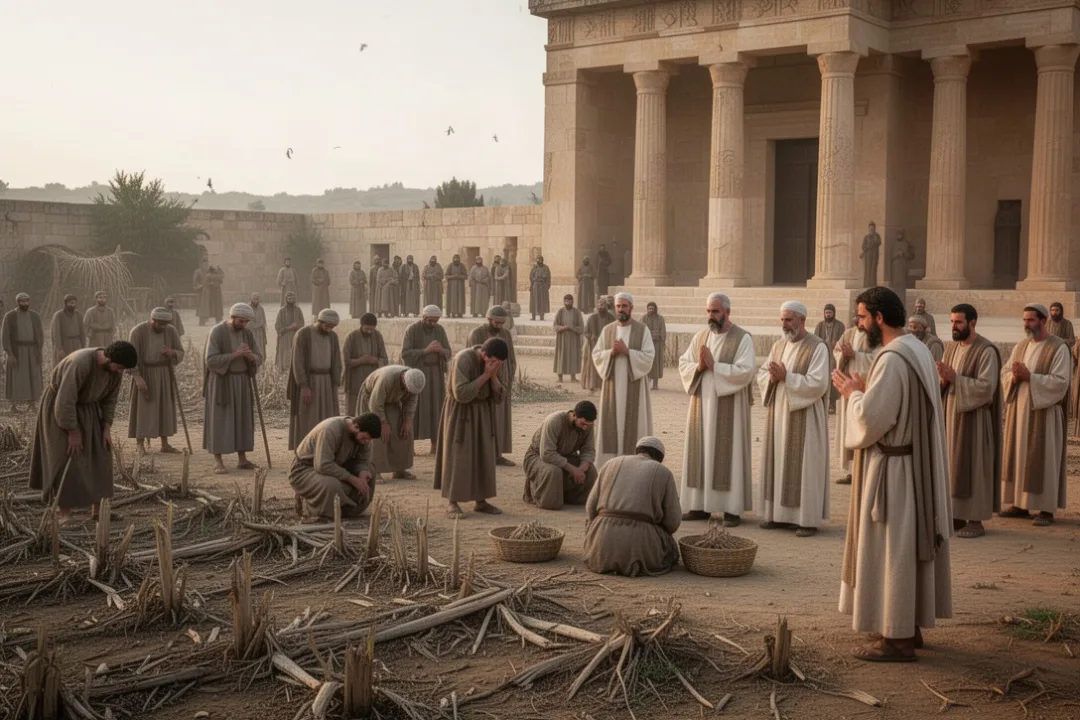
Joel also describes the priests mourning because the regular grain and drink offerings at the temple have been interrupted. The crisis therefore has both an economic and spiritual dimension. The people are not simply dealing with failed crops; the normal patterns of community worship have been disrupted as well.
The prophet calls for a public response. Elders, priests, farmers, and all residents are urged to gather, fast, and cry out to God. Joel does not tell the people to treat the disaster as meaningless bad luck. He asks them to recognize its seriousness and bring their need directly before the Lord.
The locusts may be understood in more than one way. Some readers take them as a literal plague of insects, while others emphasize that Joel’s language also portrays a frightening army or a symbolic picture of coming judgment. The book itself moves between the immediate disaster and the larger day of the Lord, so the locusts function as both a real crisis and a warning that points beyond it.
Joel’s imagery becomes especially intense in chapter 2. A vast force advances like an army, darkening the land and producing fear. Mountains tremble, the heavens shake, and the day of the Lord is described as great and terrifying. These pictures communicate the scale of God’s intervention rather than giving readers a simple military timetable.
The prophet’s use of the disaster teaches several principles:
Communal suffering calls for a communal response, not merely private concern.
Material loss can expose how deeply a society depends on harvests, trade, and stable seasons.
Worship is affected when people lose the resources and security they take for granted.
Warning is meant to move people toward God, not to satisfy curiosity about disasters.
Joel does not minimize the physical pain caused by the crisis. Hunger, economic loss, and grief are real. Yet he interprets them through the relationship between God and his people, asking what the community’s response should be when ordinary sources of security disappear.
Why Joel calls for repentance from the heart
Joel’s central appeal is a call to return to God. He presents repentance as more than public emotion, religious appearance, or temporary fear. The people are urged to turn back with all their hearts, with fasting, weeping, and mourning, while remembering that God is gracious, compassionate, patient, and rich in steadfast love.
The well-known appeal to “rend your heart” rather than merely tearing clothes captures the prophet’s concern. Tearing one’s clothing was a traditional sign of grief, but Joel insists that visible sorrow alone is not enough. God seeks inner change that produces a sincere return to him.
This does not mean that communal ceremonies are useless. Joel specifically calls for gatherings, fasting, prayer, and public leadership from the priests. His point is that outward practices must express genuine trust and repentance. A public religious act can be appropriate, but it cannot substitute for a changed relationship with God.
The priests are told to stand between the porch and the altar and plead for mercy. Their prayer is concerned not only with personal forgiveness but also with the reputation of the community and the honor of God’s name. If Judah is destroyed, neighboring nations might ask where its God is. Joel therefore combines repentance, intercession, and concern for God’s name.
The character of God is central to the appeal. Joel does not present repentance as an attempt to manipulate a harsh deity. He grounds the call in God’s compassion and willingness to show mercy. At the same time, the prophet does not treat mercy as automatic permission to ignore sin. The people must respond seriously because the day of the Lord is near.
Joel’s message is not simply “be afraid of judgment”; it is “return to God because his mercy is still open.”
The text does not promise that every hardship will disappear immediately after a public religious observance. Instead, it directs the community toward God in the middle of crisis. That distinction matters. Biblical repentance is not a technique for controlling circumstances; it is a restored posture of loyalty, humility, and dependence.
Joel’s call also has a remarkably broad scope. The assembly includes elders, children, infants, newly married couples, priests, and ordinary residents. No group is treated as outside the need for repentance or outside the hope of mercy. The entire community is invited to seek God together.
Practical meaning: In Joel, repentance involves the heart, the community, and the direction of life. It is not only feeling sorry after a crisis; it is turning toward God with sincerity and allowing that return to shape action.
What the day of the Lord means in Joel
The phrase day of the Lord appears repeatedly in Joel and provides the book’s main framework. It refers to a time when God acts decisively in history. That action includes judgment, but it also includes rescue, restoration, and the vindication of those who call on him.
Joel’s language can sound frightening because it describes darkness, trembling, fire, clouds, and a great shaking of the created order. These images communicate that the day of the Lord is not an ordinary event. Human power, political arrangements, and agricultural security cannot prevent God from bringing hidden realities into the open.
At the same time, Joel does not use the day of the Lord only as a threat. The phrase carries a double meaning in the book. For those who oppose God and harm his people, it is a day of judgment. For those who call on the Lord, it becomes a day of deliverance and refuge.
This pattern appears elsewhere in the prophetic books. God’s intervention can bring down prideful nations while protecting and restoring his people. Joel therefore warns against assuming that the day of the Lord automatically favors everyone who belongs to a particular nation or religious community. The decisive issue is the people’s relationship with God.
Joel also uses the locust crisis as a near sign of a greater reality. A disaster already experienced by the community becomes a lens through which the people understand future judgment. The prophet does not invite them to calculate dates. He urges them to live with spiritual alertness and to respond to God while there is opportunity.
The New Testament gives Joel’s prophecy a major place in its understanding of the Holy Spirit. In Acts 2, Peter explains the events at Pentecost by referring to Joel’s promise that God would pour out his Spirit on all kinds of people. Peter’s speech presents the outpouring of the Spirit as part of the fulfillment of Joel’s prophetic expectation.
Joel’s promise emphasizes breadth and accessibility. God’s Spirit is not described as being limited to kings, priests, or a small group of recognized prophets. Sons and daughters prophesy, young and old receive spiritual insight, and servants are included in the promise. The passage portrays a widening of participation in God’s work.
Peter also connects Joel’s promise with signs in the heavens and with salvation for those who call on the Lord. Christians interpret this connection through the death, resurrection, and exaltation of Jesus, while Joel’s original prophecy remains rooted in its own vision of God’s future intervention. Reading both contexts helps avoid reducing the passage to a single isolated phrase.
Paul refers to the salvation language associated with Joel in Romans 10:13. His use of the passage highlights the openness of God’s invitation: anyone who calls on the Lord may be saved. In the New Testament setting, that promise supports the proclamation of the gospel to both Jews and Gentiles.
How Joel describes restoration after judgment
After the call to repentance, Joel turns from devastation to restoration. God promises to answer his people, remove the shame associated with the disaster, and renew the land. The text specifically mentions grain, wine, and oil—the very resources that had been destroyed or withheld.
This restoration is not presented as a vague improvement. Joel uses concrete images of full threshing floors, overflowing vats, rain at the proper time, and abundant trees. The prophet speaks to people who understand their lives through seasons, harvests, livestock, and worship. Restoration is therefore described in terms that address hunger, work, community stability, and praise.
The promise includes a striking reversal of loss. What the locusts consumed is represented as being restored. Joel does not erase the fact that devastation occurred, but he declares that destruction will not have the final word. God can renew what the community could not repair by its own strength.
Joel also says that God will dwell among his people and that they will know he is present. Restoration is not merely an economic recovery. God’s presence is the heart of the promise. Abundant crops matter because they signify renewed blessing, covenant relationship, and the removal of disgrace.
The later part of the book turns toward judgment on the nations. The nations are portrayed as having scattered God’s people, divided the land, and treated human beings as commodities. Joel announces that God will gather those nations for judgment in the valley associated with divine decision.
Readers should be careful with the book’s war imagery. Joel is speaking in prophetic and poetic language about divine judgment, not giving permission for modern communities to claim that their opponents are automatically God’s enemies. The passage addresses God’s final authority over injustice and oppression; it should not be used to justify personal revenge or political violence.
The book ends with a vision of Judah and Jerusalem secured, fruitful, and holy. A spring flows from the house of the Lord, while the land of God’s people is pictured as enduring abundance. The closing image reinforces a major biblical theme: God’s judgment is not his only purpose. He judges evil in order to establish a people and a place marked by his presence.
Joel’s movement from crisis to restoration can be followed in these stages:
Destruction exposes human vulnerability. The people lose the harvests that sustain daily life and worship.
The community gathers before God. Priests, families, elders, and children respond together.
Repentance turns the people back. The prophet emphasizes the heart rather than external display alone.
God restores what was lost. Land, crops, dignity, and worship are renewed.
God judges persistent injustice. The nations are held accountable for violence and exploitation.
God establishes secure holiness. The final vision centers on divine presence and lasting blessing.
What Joel teaches readers today
Joel speaks to readers who face crises that seem larger than individual control. Its original setting involves crops and locusts, but the underlying questions remain familiar: How should people respond to loss? What does a community do when its normal systems fail? How can worship remain honest when suffering interrupts ordinary life?
The book offers no simplistic explanation for every disaster. It does not say that every illness, storm, crop failure, or economic collapse is a direct punishment for a particular sin. Instead, Joel interprets one crisis within a prophetic message and calls the people to humility, prayer, repentance, and hope.
Joel also challenges a shallow form of religion. The people are not told to perform a ceremony and then return unchanged. They are called to seek God with their whole hearts. For modern readers, that means examining whether religious language and public practices are matched by compassion, integrity, justice, and loyalty to God.
The book treats worship as a community responsibility. Children, adults, leaders, workers, priests, and families all have a place in the response. That emphasis can encourage congregations to make room for shared prayer and shared responsibility rather than leaving spiritual care only to formal leaders.
Joel’s teaching about the Spirit is equally significant. God’s promised presence reaches across age, gender, and social position. The vision includes sons and daughters, young and old, and male and female servants. The message is that God is able to speak and work through people whom society might overlook.
The book also balances urgency with hope. Judgment is real, and Joel does not soften the danger of rejecting God. Yet the purpose of the warning is to invite return. The same God who exposes sin promises mercy, restoration, and deliverance to those who call on him.
For personal reflection, Joel’s message can lead to several practical questions:
Have you confused outward religious activity with sincere change of heart?
How do you respond when a crisis affects an entire community rather than only your household?
Are you willing to seek God before circumstances improve?
Do your beliefs make room for God to work through people of different ages and social backgrounds?
Where can you pursue justice instead of treating another person’s suffering as someone else’s problem?
Joel’s short book remains powerful because it refuses to separate judgment from mercy, or spiritual renewal from practical restoration. The prophet sees the locust plague, the frightened community, the empty fields, the disrupted worship, and the hope of a renewed future as parts of one theological vision.
The final emphasis is not the prophet’s biography or the exact date of the locust invasion. It is the character and action of God: God calls people to return, hears sincere cries, pours out his Spirit, judges oppression, restores what has been devastated, and makes his presence known among his people.
Frequently asked questions
Is Joel a person or a book in the Bible?
Joel is both. Joel was a prophet identified as the son of Pethuel, and the Book of Joel is the prophetic writing associated with him. The Bible gives very little biographical information about him. The book focuses mainly on a national crisis, a call to repentance, the day of the Lord, restoration, and the promise that God will pour out his Spirit.
What is the main message of the Book of Joel?
Joel calls people to return to God sincerely and wholeheartedly. A devastating locust plague becomes a warning about the day of the Lord, but the message also offers hope. God promises mercy, restoration, spiritual renewal, and deliverance for those who call on him. The book also emphasizes accountability for nations that commit violence and exploit God’s people.
Why is Joel quoted in the New Testament?
Joel is quoted especially in Acts 2, where Peter explains the outpouring of the Holy Spirit at Pentecost. Joel’s promise that God would pour out his Spirit on sons, daughters, young people, older people, and servants is applied to that event. Joel’s salvation language is also used in Romans 10 to emphasize that everyone who calls on the Lord can be saved.
When was the Book of Joel written?
The exact date is uncertain because Joel does not name a king or provide a clear historical marker. Biblical scholars have proposed different periods, including settings before and after the Babylonian exile. The book’s location in Judah and its references to Jerusalem and the temple are clearer than its date. Its central themes do not depend on resolving that dating question.








Leave a Reply