Jerusalem Golden Gate: history, meaning, and what to see
Jerusalem Golden Gate: history, meaning, and what to see
Jerusalem’s Golden Gate is a sealed eastern entrance to the Old City, known for its layered history and importance to Jewish, Christian, and Muslim traditions.
Where Jerusalem’s Golden Gate stands and what it looks like
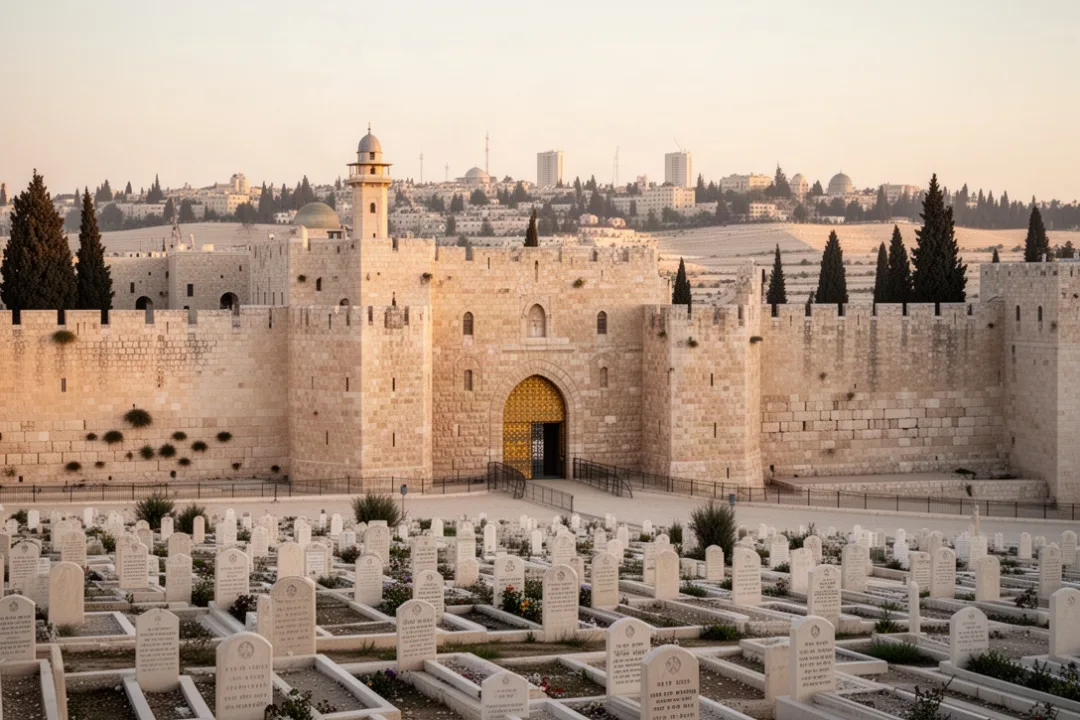
The Golden Gate stands in the eastern wall of Jerusalem’s Old City, facing the Mount of Olives and the Kidron Valley. From this position, it looks toward one of the city’s most significant landscapes: the slopes associated with ancient Jerusalem, Jewish burial grounds, Christian pilgrimage traditions, and important Islamic sites.
The gate is also called the Gate of Mercy or Sha’ar HaRachamim in Jewish tradition. In Arabic, it is commonly known as Bab al-Rahma, meaning the Gate of Mercy. “Golden Gate” is the familiar English name, although the gate is not covered in gold and its exact connection to that name is uncertain.
Unlike the busy entrances used to enter the Old City today, the Golden Gate has been closed for centuries. Its two large arched openings are blocked by masonry, so visitors cannot walk through it. The gate is best understood as a historic architectural feature and a place of religious memory rather than as a functioning passage.
The visible structure has a distinctive double-arched design. The two openings are often described as the southern and northern arches, though the gate’s layout and original function have been interpreted in different ways by scholars. Decorative details are relatively restrained compared with some other monuments in Jerusalem, but the gate’s position gives it unusual visual and symbolic power.
At a glance: The Golden Gate is on the eastern Old City wall, facing the Mount of Olives. It is sealed, viewed from outside, and surrounded by the Muslim cemetery known as the Bab al-Rahma cemetery.
Several names can make research confusing. The term “Golden Gate” may refer to the whole eastern gateway, while “Gate of Mercy” reflects a religious and traditional name. Some older sources also connect the site with names such as the Beautiful Gate, but those identifications are not universally accepted and should not be treated as identical without qualification.
How the Golden Gate developed through Jerusalem’s history
Jerusalem’s walls and gates have been rebuilt many times. That means the present Golden Gate should not automatically be identified with every ancient gate mentioned in historical or religious sources. The eastern side of the city has held strategic and ceremonial importance for centuries, but the visible gate belongs to a complex sequence of construction, repair, and reuse.
Archaeological and architectural interpretations generally place the existing structure in the late Byzantine or early Islamic period, although the exact date remains debated. Some researchers have proposed a Byzantine date, while others connect its construction or major rebuilding with the early centuries of Muslim rule. Earlier remains may exist beneath or near the present structure, but the surviving gate cannot be assigned with complete certainty to one single phase.
The gate may have served more than one purpose. It could have functioned as a ceremonial entrance, a route toward the Temple Mount area, or part of a larger approach system connecting the city with the Mount of Olives. Its alignment and design suggest that it was more than a simple defensive opening, although historians continue to debate how it operated in different periods.
During the medieval period, the gate was connected with religious processions and expectations about Jerusalem’s future. Accounts from different communities describe the eastern side of the city as a place of arrival, judgment, royal ceremony, or messianic hope. These traditions sometimes overlap, but they do not all describe the same historical event or architectural phase.
The current Old City walls were largely rebuilt in the 16th century under Ottoman ruler Suleiman the Magnificent. The walls include prominent gates such as Damascus Gate, Jaffa Gate, and Lion’s Gate. The Golden Gate, however, was already an important structure associated with the eastern side of Jerusalem, and its sealed condition reflects the political and religious history of the area.
Many popular accounts say the gate was sealed by Suleiman in 1541 to prevent the Jewish Messiah from entering Jerusalem. That explanation is widely repeated, but it presents a later tradition as though it were the only documented reason. The closure may also have had practical, defensive, and administrative motives, and the precise circumstances deserve careful treatment.
Ancient and Second Temple periods: Earlier eastern approaches and walls existed, but the surviving gate should not be casually equated with a specific biblical gate.
Byzantine and early Islamic periods: The present structure is commonly associated with one or more of these phases, though its dating remains disputed.
Medieval centuries: The gate acquired strong associations with ceremony, pilgrimage, judgment, and redemption.
Ottoman period: The entrance was sealed and remained part of the eastern wall rather than a working city gate.
Modern Jerusalem: The gate continues to be viewed from the outside and remains central to religious interpretation and historical study.
Jerusalem’s layered construction makes simple timelines unreliable. A wall can be repaired while retaining older foundations, and a gate can preserve an earlier location while taking a new architectural form. For that reason, descriptions such as “ancient gate” need context: the site is ancient, but the visible masonry represents later building phases.
Why the Golden Gate matters in Jewish, Christian, and Muslim traditions
The Golden Gate has unusual importance because several religious traditions place future events, sacred processions, or divine judgment near Jerusalem’s eastern side. The meaning of the gate is therefore not limited to its masonry. It has become a symbol of expectation, with each tradition interpreting the site through its own texts, history, and practices.
Jewish associations with the eastern gate
In Jewish tradition, the eastern direction is linked with the Mount of Olives, the Temple, and hopes connected with redemption. The gate is often called the Gate of Mercy, and many Jewish interpretations associate it with the future arrival of the Messiah or with the resurrection of the dead. These associations help explain why the nearby slopes became an important Jewish burial area.
The Hebrew Bible refers to eastern gates and future visions of Jerusalem, especially in prophetic passages concerning the Temple and the city. However, the biblical references do not provide a simple architectural label that can be matched with certainty to the present Golden Gate. The connection is shaped by later interpretation as well as by the physical setting.
The large cemetery outside the gate is one visible expression of these beliefs. For many centuries, Jewish families sought burial on or near the Mount of Olives because of its religious significance and its proximity to Jerusalem. The cemetery is not the same as the Golden Gate, but its presence strengthens the gate’s association with death, resurrection, and the future restoration of the city.
Christian associations with the eastern approach
Christian visitors often connect Jerusalem’s eastern side with the Triumphal Entry of Jesus, traditionally remembered on Palm Sunday. The New Testament describes Jesus entering Jerusalem from the direction of the Mount of Olives, but it does not name the present sealed structure as the gate he used. The commonly repeated identification reflects later tradition and geography rather than an explicit biblical statement.
Christian interest also comes from prophetic readings of Jerusalem’s future. Some visitors connect the sealed gate with passages in the Book of Ezekiel that describe a gate facing east and a restricted entrance. That connection is meaningful within certain Christian interpretations, although the biblical gate in the vision should not be assumed to be a direct architectural blueprint for the surviving monument.
For pilgrims, the Golden Gate can represent arrival, kingship, prophecy, and sacred memory. It is often viewed together with the Mount of Olives, the Garden of Gethsemane, and the Old City walls. These locations create a geographical setting for Christian reflection, even when the exact historical identification of individual gates remains uncertain.
Muslim associations with Bab al-Rahma
In Islamic tradition, the gate is known as Bab al-Rahma, the Gate of Mercy. The name is connected with the gate’s eastern position and with religious ideas about mercy, judgment, and the end of time. The area also includes the Bab al-Rahma cemetery, a historic Muslim burial ground extending along the eastern wall.
The gate’s proximity to the Dome of the Rock and the al-Aqsa Mosque compound gives it additional importance within Jerusalem’s Islamic landscape. It is not one of the main public entrances used to access the compound today, but it forms part of the historic boundary and is visually connected with the sacred precinct.
Some Islamic traditions associate the eastern side of Jerusalem with the final judgment and with events at the end of time. As with Jewish and Christian interpretations, these meanings developed through a combination of religious texts, commentary, local tradition, and the physical setting. The gate’s significance is therefore both architectural and theological.
Keep the traditions distinct: Jewish, Christian, and Muslim accounts may all attach sacred meaning to the Golden Gate, but they do not describe one identical history. Separate documented architecture from later interpretation when evaluating claims about the site.
Why the Golden Gate was sealed and what that means today
The closed arches are the feature most visitors notice first. Their masonry creates a strong visual impression: an entrance designed to admit people, yet deliberately made unusable. That contrast has encouraged centuries of explanation, including stories that the gate was closed to stop a prophesied redeemer from entering Jerusalem.
The most familiar account connects the closure with Suleiman the Magnificent, who rebuilt Jerusalem’s walls in the Ottoman period. According to popular tradition, he sealed the gate after learning that the Jewish Messiah would enter through it. The story may reflect the symbolic importance of the entrance, but historians do not treat it as a complete, independently established explanation for the closure.
Defensive logic may have mattered as well. A gate facing the open ground east of the city could be vulnerable during conflict, and closing an entrance simplified control of the walls. Political decisions in Jerusalem often had several motives at once, so the gate’s closure may have combined security concerns with the desire to regulate access to an area of religious importance.
The sealed arches also became part of the monument’s meaning. A closed gate can represent waiting, judgment, exclusion, protection, or future opening. Different communities have read those ideas into the structure in different ways. The physical barrier has therefore preserved the gate as a symbol rather than reducing it to an ordinary route through the city.
Visitors should avoid treating the gate as a hidden passage or a place where the Messiah is physically expected to appear according to one universally shared belief. Religious interpretations vary significantly among Jewish, Christian, and Muslim communities. A respectful visit recognizes the site’s importance without presenting one tradition’s explanation as historical fact for everyone.
The gate also illustrates a broader rule for studying Jerusalem: later stories often attach themselves to older stones. A tradition can be culturally and spiritually important even when the historical evidence for a specific claim is limited. Understanding that difference makes the site more interesting, not less, because it reveals how communities have remembered and interpreted the city across time.
Identify what can be observed directly, such as the double arches, sealed openings, wall construction, and surrounding cemetery.
Separate archaeological dating from religious tradition and medieval or modern storytelling.
Check whether a claim refers to the present structure, an earlier gate at the same location, or a symbolic gate in a sacred text.
Consider which community uses a particular name or interpretation, since terminology can carry religious meaning.
How to visit and view Jerusalem’s Golden Gate respectfully
The Golden Gate is best seen from the Mount of Olives side of the Old City walls. A visitor standing near the cemetery can look west toward the sealed arches, while the elevated ground provides a broader view of the wall and the Old City beyond it. The exact visibility depends on access conditions, weather, construction, and local security arrangements.
It is also possible to appreciate the gate from viewpoints around the Mount of Olives and the Kidron Valley. The surrounding terrain is uneven, and paths may be steep or rough. Comfortable shoes, water, sun protection, and enough time for careful walking are useful, especially during the warmer months.
Because the gate borders a religious site and a cemetery, behavior should be conservative and considerate. Clothing that covers shoulders and knees is a sensible choice, particularly when visiting other sacred places nearby. Avoid climbing walls, touching graves, entering restricted areas, or photographing people who are praying or attending a burial without permission.
Access rules in Jerusalem can change. The Old City, the Temple Mount and al-Aqsa compound, the cemetery, and nearby roads may each have separate restrictions. Check current local guidance before visiting, and follow instructions from security personnel and religious authorities rather than relying on old travel information.
Plan the area as a walking visit: Combine the gate with the Mount of Olives, the Kidron Valley, and nearby historic viewpoints.
Allow time for the landscape: The eastern wall makes more sense when seen in relation to the valley, cemetery, and Temple Mount area.
Use a guide carefully: A knowledgeable local guide can distinguish archaeological evidence from traditional interpretation.
Respect photography boundaries: Take wide architectural views and avoid intrusive images around graves and worshippers.
Verify access before leaving: Security conditions, religious holidays, and site policies can affect routes and opening arrangements.
The best time for photography is often when the eastern light reveals the texture of the wall and the shape of the arches. Morning and late afternoon can produce strong shadows, but conditions change with season and weather. A wide view usually communicates more than a close image because it shows the gate’s relationship to the Mount of Olives and the Old City.
What the Golden Gate reveals about Jerusalem’s past
The Golden Gate matters because it brings together architecture, archaeology, sacred geography, and living tradition. Its two blocked arches are only part of the story. The surrounding wall records changing political authority, while the cemetery and nearby holy places show how communities have continued to give the eastern side of Jerusalem religious meaning.
The site also demonstrates why Jerusalem’s monuments resist one-line explanations. A gate may have an ancient location, a later visible structure, medieval legends, Ottoman alterations, and modern political significance. These layers do not cancel one another; they show how the city has been rebuilt and reinterpreted repeatedly.
For travelers, the Golden Gate is a reminder to look beyond the most familiar names. “Golden Gate,” “Gate of Mercy,” and “Bab al-Rahma” point to the same landmark but emphasize different cultural memories. Learning those names before a visit makes the surrounding landscape easier to understand and encourages a more respectful approach to the people who regard it as sacred.
The gate’s enduring power comes partly from its closure. An open gate is a route, but a sealed gate invites questions about who closed it, why it remains closed, and what future generations believe it represents. In Jerusalem, those questions are never only architectural. They touch on faith, empire, burial, prophecy, and the continuing meaning of the city’s eastern horizon.
Frequently asked questions
Can you enter Jerusalem through the Golden Gate?
No. The Golden Gate’s two openings are sealed, and it is not used as a public entrance to the Old City. Visitors generally view it from outside the eastern wall, especially from the Mount of Olives, the Kidron Valley, or nearby cemetery areas. Access around the site can vary, so local restrictions should be checked before visiting.
Is the Golden Gate the same gate mentioned in the Bible?
That identification is not certain. Biblical passages describe eastern gates and visions connected with Jerusalem, but they do not clearly label the surviving structure as the present Golden Gate. Later Jewish and Christian traditions connected the site with those texts, while historians distinguish between scriptural symbolism, earlier gates, and the current masonry.
Who sealed Jerusalem’s Golden Gate?
The closure is commonly associated with Ottoman ruler Suleiman the Magnificent during the 16th-century rebuilding of Jerusalem’s walls. Popular tradition says it was sealed to prevent the Messiah from entering through it, but that explanation is not the only possible factor. Security, access control, and local political considerations may also have influenced the decision.
Why is there a cemetery beside the Golden Gate?
The eastern side of Jerusalem has long held religious significance in Jewish and Muslim traditions, so burial grounds developed near the gate and along the Mount of Olives. The Jewish cemetery on the Mount of Olives and the Muslim Bab al-Rahma cemetery reflect different community histories. Their presence also reinforces the area’s associations with resurrection, judgment, and sacred memory.





Leave a Reply