Mount of Olives: history, meaning, and places to see
Mount of Olives: history, meaning, and places to see
The Mount of Olives is a historic ridge east of Jerusalem, separated from the Old City by the Kidron Valley and central to Jewish and Christian tradition.
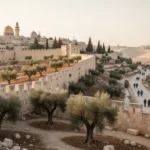
The Mount of Olives is not a single peak but a long ridge running north to south along the eastern side of Jerusalem. Its western slope faces the Old City, while its eastern side descends toward the wilderness and the Jordan Valley. The ridge rises above Jerusalem and provides broad views across the city, the Temple Mount, the Kidron Valley, and the surrounding hills.
Its name comes from the olive groves that once covered much of the hillside. Some olive trees still grow in the area, although visitors should be cautious about claims that particular trees are the same ones mentioned in the New Testament. The exact age of individual trees is difficult to establish, and many groves have been replanted over the centuries.
The mountain’s religious importance comes from several layers of history. In the Hebrew Bible, it is connected with King David’s flight from Jerusalem, prophetic visions, and the future restoration of Jerusalem. In the New Testament, it is associated with Jesus’ teaching, his final days in Jerusalem, his prayer at Gethsemane, and the account of his ascension.
The central geographic fact: The Mount of Olives stands directly east of Jerusalem’s Old City, with the Kidron Valley forming the natural boundary between the ridge and the city walls.
The Mount of Olives in biblical history
The ridge appears in several important biblical settings. Its location made it a natural route for people traveling east from Jerusalem, but its height also gave it symbolic force. From the mountain, a person could look back toward the city while remaining outside its walls, making it a fitting setting for mourning, prayer, prophecy, and pilgrimage.
David’s escape from Jerusalem
In 2 Samuel 15, King David leaves Jerusalem during Absalom’s rebellion and goes up the Mount of Olives while weeping. The passage describes David traveling barefoot and grieving as he climbs. This scene connects the ridge with royal sorrow and exile, themes that later readers have also associated with Jesus’ suffering outside Jerusalem.
The account is not a travel guide with modern place names, so the precise path cannot be reconstructed with certainty. Still, the general setting fits the mountain’s position east of the city and its traditional role as a route away from Jerusalem.
Prophetic imagery in Zechariah
Zechariah 14 describes the Lord standing on the Mount of Olives, which is pictured as splitting in two and creating a valley. The passage belongs to a prophetic vision of Jerusalem’s future and has been interpreted in different ways by Jewish and Christian communities.
For many readers, the reference gives the mountain an important end-times significance. It also helps explain why the Mount of Olives has been connected with resurrection, divine intervention, and the future renewal of Jerusalem.
Jesus’ ministry around the ridge
The Gospels repeatedly place Jesus on or near the Mount of Olives. He taught his disciples there, traveled between Bethany and Jerusalem across the eastern slopes, and approached the city from the direction of the mountain during the events remembered on Palm Sunday.
Matthew 24, Mark 13, and Luke 21 describe Jesus teaching about the future on the Mount of Olives, often called the Olivet Discourse. The setting is significant: from the ridge, the disciples could look toward the Temple and Jerusalem while listening to teaching about judgment, perseverance, and the future.
How the Mount of Olives fits the final days of Jesus
The Mount of Olives is especially important in Christian memory because several events associated with Jesus’ final days are located around its western and eastern slopes. These places are close together geographically, but their exact historical identifications are based on a combination of biblical references, early Christian tradition, archaeology, and centuries of pilgrimage.
Bethany: Jesus is described as visiting Bethany, a village on the eastern side of the Mount of Olives, where he was welcomed by Mary, Martha, and Lazarus.
Bethphage: The Gospels place Bethphage near the route Jesus took toward Jerusalem before his entry into the city. Its traditional location is on the eastern slope.
The Palm Sunday route: Christian tradition follows a route from the Mount of Olives down toward Jerusalem, remembering Jesus’ arrival while crowds welcomed him with branches.
Gethsemane: The garden at the foot of the mountain is associated with Jesus’ prayer and arrest.
The ascension: Acts 1 places the ascension near the Mount of Olives, and several sites on the ridge preserve this memory.
The Gospel accounts do not provide enough information to identify every location with absolute certainty. The strongest value of the traditional sites is that they preserve the geography of Christian worship and help visitors understand how Jerusalem’s landscape shaped the stories.
Major places to see on the Mount of Olives
Gethsemane and the Church of All Nations
At the foot of the Mount of Olives, beside the Kidron Valley, lies the traditional Garden of Gethsemane. The garden contains ancient-looking olive trees and is associated with Jesus’ prayer before his arrest. The nearby Church of All Nations, also known as the Basilica of the Agony, was built over earlier churches.
The church’s interior is intentionally dim, creating a reflective atmosphere. Its design and decoration focus on Jesus’ suffering and prayer. A rock in front of the altar is traditionally connected with the place where Jesus prayed, although the exact location cannot be proven from the biblical text.
Visitors should distinguish between the garden and the church. They are adjacent but separate spaces, and access arrangements may vary. The garden is generally valued for quiet observation, while the basilica is an active place of Christian worship.
Dominus Flevit
Dominus Flevit means “the Lord wept” in Latin. This small Franciscan church stands partway up the western slope and commemorates Jesus’ sorrow over Jerusalem, especially the scene described in Luke 19. Its distinctive window looks toward the Old City and the Temple Mount.
The view from the church makes the setting especially meaningful. Jerusalem appears beyond the Kidron Valley, and visitors can see how a person approaching from the east would have looked across the valley toward the city. Archaeological remains near the church include burial areas and evidence of earlier settlement.
The Church of the Pater Noster
The Church of the Pater Noster is traditionally associated with Jesus teaching his disciples to pray. The name refers to the Latin opening of the Lord’s Prayer. The site is known for panels displaying the prayer in many languages, although displays and access can change.
The church stands near a cave traditionally connected with Jesus’ teaching. As with several locations on the Mount of Olives, the tradition is ancient but the precise historical identification remains a matter of faith and interpretation rather than something that can be demonstrated conclusively.
The Chapel of the Ascension
The Chapel of the Ascension is located near the summit of the ridge. It is a small structure built around a stone associated by Christian tradition with Jesus’ ascension. The site has passed through different religious and political periods and reflects the layered history of Jerusalem.
Acts 1:12 says the disciples returned to Jerusalem from the Mount of Olives after the ascension. The passage does not identify a particular building or exact spot. The chapel therefore represents a longstanding place of remembrance rather than a location that can be mapped with complete certainty from the text alone.
The Russian Orthodox Church of Mary Magdalene
With its prominent golden domes, the Russian Orthodox Church of Mary Magdalene is one of the most recognizable landmarks on the western slope. It was built in the late nineteenth century and is associated with the Russian Orthodox tradition.
The church is often photographed from across the Kidron Valley, but visitors should check opening arrangements before planning an interior visit. Religious sites may have limited hours, restricted photography, or services that affect access.
The Mount of Olives and Jewish burial tradition
The western and southern slopes contain the Mount of Olives Jewish Cemetery, one of the most significant Jewish cemeteries in the world. Jewish burial on the mountain has taken place for many centuries, and the cemetery contains graves from different periods, with older and newer sections spread across the hillside.
The cemetery’s significance is connected partly with the mountain’s position opposite the Temple Mount and partly with biblical and rabbinic expectations concerning resurrection. Zechariah 14’s vision of the Mount of Olives has contributed to the ridge’s importance in Jewish thought, although interpretations vary among Jewish communities.
The cemetery also reflects Jerusalem’s turbulent history. Tombs and gravestones have been damaged at different times, while later restoration efforts have repaired or documented many areas. Some sections are densely packed, and the hillside can be difficult to walk across.
Visitors should treat the cemetery as a sacred burial ground rather than simply a scenic viewpoint. Avoid stepping on graves, do not move stones or objects, and follow local guidance about photography and access. Modest clothing and respectful behavior are appropriate.
What the Mount of Olives means in Christianity
Christian significance on the mountain centers on the movement between suffering, prayer, death, and hope. Jesus’ prayer at Gethsemane is remembered at the foot of the ridge, while the ascension is remembered higher up. The route between these locations gives the landscape a narrative shape.
The mountain also appears in Christian reflection on Jesus’ entry into Jerusalem. The traditional Palm Sunday route descends from the ridge, crosses the Kidron Valley, and approaches the Old City. The route is not merely scenic; it emphasizes the contrast between a welcome procession and the suffering that follows in the Gospel accounts.
For pilgrims, the mountain can be a place of prayer, Bible reading, and remembrance. For historians, it offers evidence of changing Jerusalem communities, burial practices, architecture, and pilgrimage traditions. For other visitors, its views and archaeological remains provide a way to understand the city’s physical setting.
The Mount of Olives is best understood as both a real ridge above Jerusalem and a landscape shaped by centuries of memory.
How the geography explains the biblical stories
The distance between the Mount of Olives and the Old City is short, but the terrain is uneven. A traveler coming from the summit or eastern slope would descend toward the Kidron Valley before climbing toward Jerusalem. This helps explain why biblical accounts describe going up to Jerusalem even when a person is approaching from a lower valley.
The ridge also offers strategic views. From its western slope, the Temple Mount and much of the Old City are visible. A teacher or traveler could see Jerusalem clearly from outside the walls, while a large group moving down the slope would be visible from the city.
Its eastern side opens toward Bethany, the Judean wilderness, and routes leading toward Jericho. This made the ridge part of a broader travel corridor rather than an isolated religious site. The mountain connected villages, wilderness paths, and Jerusalem’s urban center.
A practical way to visit the Mount of Olives
A visit usually works best when planned as a downhill or mixed walking route rather than as one short stop. The ridge is steep in places, and the sidewalks, road shoulders, and paths are not equally comfortable. Comfortable shoes are more useful than trying to cover every site quickly.
Begin with the viewpoint: Start near the upper western slope to see the Old City, Temple Mount, Kidron Valley, and cemetery together.
Visit the upper churches: Depending on opening hours, see the Chapel of the Ascension and the Church of the Pater Noster.
Continue toward the middle slope: Stop at Dominus Flevit for its view and its connection with Jesus’ mourning over Jerusalem.
Descend carefully: Follow the road or designated paths toward Gethsemane, allowing extra time for steep sections and uneven pavement.
Visit the lower sites: See the garden and Church of All Nations near the Kidron Valley.
Continue into the Old City: If conditions and access permit, cross toward the city through the area near St. Stephen’s Gate, also called Lions’ Gate.
That sequence is only a general plan. Some religious sites have separate entrance policies, and opening hours can change because of worship services, holidays, restoration, or local conditions. Confirm current details before setting out, especially if you need wheelchair access or have limited walking ability.
What to bring and how to dress
Bring water, sun protection, and shoes with a firm sole. The hillside can be hot and exposed, while the descent toward the Kidron Valley can be tiring. A small amount of food may be useful, although visitors should avoid eating inside churches or near graves unless the setting clearly permits it.
Wear clothing that covers shoulders and knees when visiting churches or other sacred spaces.
Carry water, particularly during warmer months.
Use caution near roads and do not assume every path has a safe pedestrian shoulder.
Ask before photographing worshippers, clergy, cemetery workers, or ceremonies.
Allow more time than the map distance suggests because of steep slopes and stops.
When to go
Early morning is often the most comfortable time for walking and photography, especially during warmer seasons. The light across the Old City can be beautiful in the morning, and the ridge is generally less tiring before the strongest heat of the day.
Late afternoon can also offer striking views, but the descent may become less comfortable as daylight fades. Check sunset times and leave enough time to reach your next destination safely. Religious holidays can make the area especially meaningful but may also bring crowds, processions, road restrictions, and limited access.
Respect sacred spaces: The Mount of Olives includes active churches and a major cemetery. Keep voices low, follow posted rules, and treat traditional sites with care even when historical evidence is uncertain.
What is historically certain and what remains traditional
The Mount of Olives itself is an identifiable geographic ridge east of Jerusalem. The Kidron Valley, the Old City, ancient burial grounds, and many surviving churches provide a strong physical framework for understanding the area. Archaeology can also show that people lived, worshiped, and buried their dead around the ridge over long periods.
Some individual identifications are less certain. The New Testament names places such as Bethany and the Mount of Olives, but it does not always specify the exact cave, garden, rock, or building later associated with an event. Churches often stand on locations preserved by longstanding tradition, not on sites that can be proven by an uninterrupted archaeological record.
That distinction does not make the sites meaningless. A traditional site can preserve the memory of how generations of worshippers understood a biblical event. The most accurate approach is to describe the tradition clearly without presenting every traditional detail as established fact.
Why the Mount of Olives still draws visitors
The ridge brings together several experiences that are rarely found in one place: an expansive view of Jerusalem, major Jewish and Christian holy sites, ancient and modern burial grounds, archaeological remains, and a landscape directly connected with biblical narratives.
Its importance is also visual. Standing on the slope makes the relationship between the Mount of Olives, the Kidron Valley, and the Old City immediately clear. Stories that can seem abstract on a page become tied to roads, hills, gates, gardens, and distances that visitors can see for themselves.
Whether you come as a pilgrim, a student of history, or a traveler interested in Jerusalem’s geography, the Mount of Olives rewards a slower visit. Give attention to the landscape as well as the buildings, and remember that the ridge is a living neighborhood and sacred place—not only a collection of famous viewpoints.
Frequently asked questions
Is the Mount of Olives mentioned in the Bible?
Yes. The Mount of Olives appears in both the Hebrew Bible and the New Testament. It is associated with David’s flight from Jerusalem, the prophecy in Zechariah 14, Jesus’ teaching and prayer, and the ascension account in Acts 1. Different passages emphasize different aspects of the mountain, including grief, prophecy, worship, and future hope.
Can you walk from the Mount of Olives to Jerusalem’s Old City?
Yes, many visitors walk downhill from the Mount of Olives toward the Old City through the Kidron Valley and approach the area near Lions’ Gate. The route includes steep sections, uneven surfaces, and roads with traffic. Walking times vary depending on your starting point, stops, weather, and mobility, so allow additional time rather than relying only on map distance.
Are the olive trees on the Mount of Olives 2,000 years old?
Some trees are very old, but claims that a particular tree has survived unchanged since Jesus’ time cannot usually be verified. Olive trees can regrow from roots after damage, and the present trunks may not be the original trees. The groves are historically important even when their exact ages remain uncertain.
Is the Mount of Olives safe for tourists?
Many people visit the ridge as part of a Jerusalem pilgrimage or sightseeing trip, but conditions can change. Use well-traveled routes, be cautious near traffic and steep paths, and check current local guidance before going. Religious sites may have restrictions or closures. If visiting the cemetery or churches, follow local instructions and behave respectfully.







Leave a Reply