Valley of dry bones in the Bible: meaning and message
Valley of dry bones in the Bible: meaning and message
The valley of dry bones in the Bible appears in Ezekiel 37:1–14. In the vision, God brings the bones of a dead army together, covers them with flesh, and gives them breath so they live again. The immediate meaning is that God will restore Israel after exile, but the passage also has wider significance for resurrection, spiritual renewal, and hope when a situation seems beyond repair.
Ezekiel does not present the valley as a vague dream with an unlimited number of meanings. God explains the vision directly: the bones represent the people of Israel, who feel cut off and without hope. The promise is that God will open their graves, bring them back to the land, and put his Spirit within them, as described in Ezekiel 37:11–14.
Where the valley of dry bones appears in Scripture
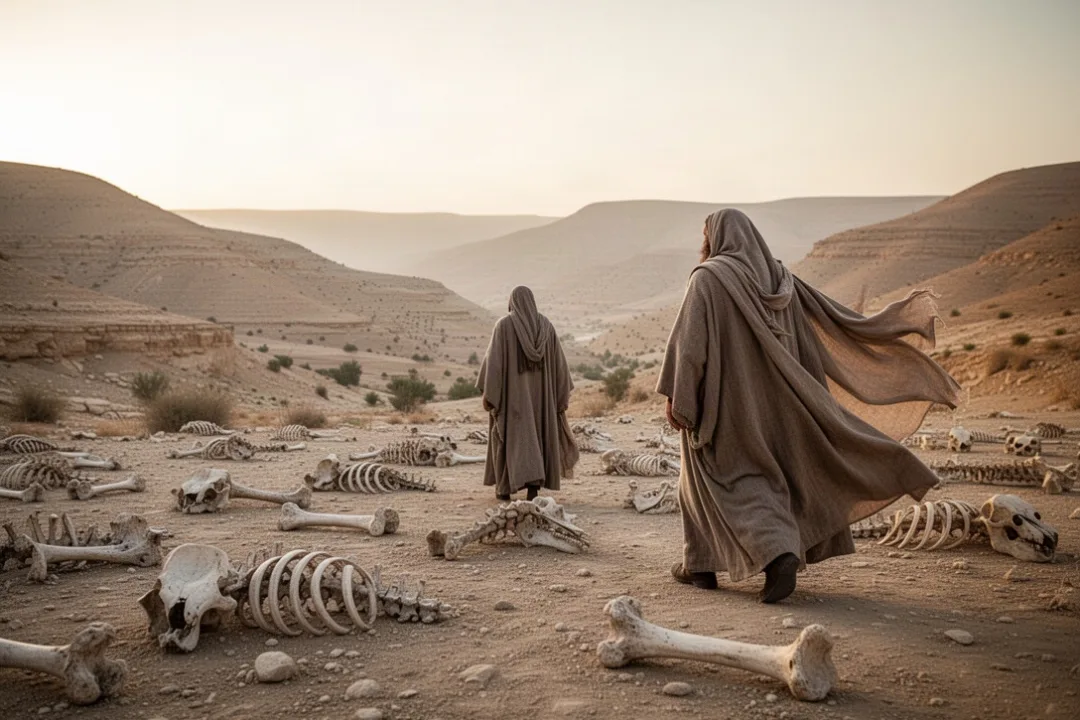
The vision is recorded in Ezekiel 37, the first half of a chapter that contains two closely related signs. Ezekiel is carried by God’s Spirit into a valley filled with bones. He is led around them, and he sees that they are very numerous and completely dry. Their condition communicates long death rather than a recent battlefield loss.
God asks Ezekiel whether the bones can live. Ezekiel answers cautiously, placing the matter in God’s hands rather than claiming that he knows the outcome. God then tells him to speak to the bones. As Ezekiel prophesies, the bones come together, tendons and flesh appear, and skin covers them. The bodies look complete, but they do not yet have breath.
Ezekiel then receives another command. He is told to speak to the breath, or wind, and call it from the four directions so that it may enter the bodies. The breath enters them, and they stand alive as a vast army. This two-stage movement—from scattered bones to formed bodies, and from bodies to living people—gives the vision its dramatic structure.
The chapter continues with a different sign involving two sticks. One represents Judah and the other represents Joseph, or the northern tribes of Israel. Ezekiel joins them to symbolize the reunification of God’s divided people under one king. The dry-bones vision and the joined sticks therefore belong together: God promises both life for a devastated nation and unity for a divided one.
What the dry bones represent in Ezekiel 37
God supplies the central interpretation in Ezekiel 37:11–14. The bones represent the whole house of Israel. The people say that their bones are dried up, their hope has disappeared, and they have been cut off. Their words describe national despair after defeat, displacement, and the destruction associated with Jerusalem’s fall.
The vision’s first and most direct meaning is therefore the restoration of Israel from exile. The people may see themselves as a dead nation, but God says he will bring them out of their graves, return them to their land, and make them know that he is the Lord. The image of graves conveys the depth of their hopelessness; God’s promise answers that hopelessness with restoration.
That restoration includes more than a change of geography. The promise also involves God’s Spirit, knowledge of God, renewed identity, and life as a people. The passage presents restoration as something God initiates and accomplishes, not as a recovery achieved solely through human strength.
Central meaning: In its original setting, the dry bones represent exiled and despairing Israel. The vision assures them that God can restore the nation, return it to the land, and give it renewed life through his Spirit.
The phrase “whole house of Israel” also matters. The promise is not limited to one surviving group or one political faction. Ezekiel’s later sign of the two joined sticks makes clear that the hope includes the reunification of Israel and Judah. The chapter points toward a restored people rather than merely a collection of individuals rescued from hardship.
How Ezekiel’s vision moves from death to life
The vision unfolds in several deliberate stages. Each stage adds meaning to the picture of restoration and helps explain why the image has remained so memorable.
The bones are scattered and dry: Israel’s defeat and exile have left the people feeling completely ruined.
The bones come together: God begins the work of reassembling what has been broken apart.
Sinews, flesh, and skin appear: the restored people take visible form, but outward structure alone is not enough.
Breath enters the bodies: God supplies the life that the formed bodies cannot produce for themselves.
The people stand as an army: restoration results in a living, organized community with strength and purpose.
This sequence prevents a shallow reading of the passage. God is not merely repairing damaged objects. He is creating a living people. The bodies become alive only when breath enters them, emphasizing that physical form without God-given life remains incomplete.
The Hebrew word ruach can refer to spirit, breath, or wind, depending on context. Ezekiel 37 uses this range of meaning in a purposeful way. The wind comes from the four directions, breath enters the bodies, and God promises to put his Spirit in his people. These related meanings connect the visible scene with God’s invisible life-giving action.
The vision also shows that restoration may occur in stages. At first, there is only an impossible landscape of bones. Then there is structure without life. Finally, there is a living community. The passage does not describe a quick emotional turnaround; it portrays God bringing order, form, breath, and purpose to a people who believe their story is over.
Why the historical setting matters
Ezekiel prophesied among Judean exiles in Babylon during a period of national catastrophe. Jerusalem had been attacked, the temple had been destroyed, and many people had been taken from their homeland. The people’s despair was not abstract. They had experienced the collapse of their political, religious, and social world.
Earlier parts of Ezekiel explain that Jerusalem’s destruction was connected to persistent unfaithfulness and idolatry. Yet judgment is not the final word in the book. Later chapters turn toward restoration, cleansing, a renewed heart, a restored land, and God’s presence among his people. The valley of dry bones stands within that broader movement from judgment to renewal.
Understanding this setting keeps the passage from becoming a generic slogan about overcoming any difficulty. The original audience was a displaced people asking whether their national identity and relationship with God had ended. The vision speaks into that specific crisis with a specific promise: God has not abandoned his covenant people, and exile will not have the last word.
The passage also addresses the apparent finality of national death. Israel’s circumstances looked irreversible because the people had lost land, leadership, security, and hope. By using bones that are not merely dead but dry, Ezekiel emphasizes how impossible restoration appears from a human perspective. God’s power is shown precisely where human resources have reached their limit.
Does the valley of dry bones mean physical resurrection?
The passage has a clear first reference to the national restoration of Israel, but it also uses imagery associated with bodily resurrection. The dead are reassembled, covered with flesh, and given breath. For that reason, readers and religious traditions have often connected Ezekiel 37 with broader biblical teaching about resurrection.
Still, Ezekiel’s own interpretation should guide the reading. God says the bones are the house of Israel and explains the vision in terms of bringing the people from their graves and back to their land. The chapter is not primarily describing an individual person dying, being judged, and entering eternal life. It is addressing the restoration of a people after exile.
That does not make the resurrection connection meaningless. Biblical imagery can carry both an immediate historical meaning and a wider theological significance. Ezekiel’s vision demonstrates that God has authority over deathlike conditions and can create life where none appears possible. Later biblical passages develop resurrection hope more explicitly, including Daniel 12:2 and teachings about resurrection in the New Testament.
A careful distinction helps:
Primary context: restoration of Israel from exile and national despair.
Theological principle: God can bring life, hope, and identity out of what appears dead.
Broader biblical connection: the imagery contributes to Scripture’s developing witness about God’s power over death.
Interpretive caution: the vision should not be treated as a complete description of every Christian or Jewish belief about the afterlife.
Some Christian readers see the passage as pointing ahead to the resurrection of the dead or as a picture of the spiritual life God gives through his Spirit. Those applications may be meaningful, but they should be distinguished from the original explanation in Ezekiel 37:11–14.
What the breath and Spirit signify
Breath is the turning point of the vision. The bones can be joined and the bodies can be fully covered, yet they remain lifeless until breath enters them. This detail presents God’s Spirit as the source of genuine life, not merely the force that improves an already functioning structure.
The image recalls the creation account in Genesis 2, where God gives life to the human creature. It also fits Ezekiel’s wider message about inner renewal. In Ezekiel 36:26–27, God promises a new heart and a new spirit and says that his Spirit will enable his people to live faithfully. Ezekiel 37 develops that promise through the visual scene of a dead community brought back to life.
The Spirit’s role includes more than private emotion. The breath creates a people who stand together as an army. In the chapter’s setting, restored life is communal, covenantal, and directed toward a renewed relationship with God. The text does not reduce spiritual renewal to a temporary feeling of encouragement.
The four winds may suggest completeness, as the breath comes from every direction. The image does not imply that the wind itself is a deity or an impersonal life force. It serves God’s command. God directs the breath, and the breath carries out his life-giving purpose.
For readers who apply the passage spiritually, the implication is substantial: external repair is not the same as inner renewal. A person, church, or community may regain organization and appearance while still lacking spiritual vitality. Ezekiel’s picture calls attention to the source of life rather than only to the visible shape of restoration.
What Ezekiel’s role teaches about speaking hope
Ezekiel is told to prophesy to the bones and then to the breath. His words matter, but the prophet is not presented as the source of the miracle. He speaks because God commands him, and God supplies the power that fulfills the message.
This pattern shows the relationship between faithful proclamation and divine action. Ezekiel does not pretend that the bones can live through ordinary observation. He also does not change the message to make the situation sound less severe. He acknowledges the deathlike condition and announces the word God has given him.
The scene offers a model for responsible hope. Hope does not require denying loss, minimizing grief, or making a promise God has not made. Ezekiel names the bones as dry and the people as hopeless before proclaiming restoration. Biblical hope faces reality honestly while trusting God’s ability to act beyond what people can see.
There is also a practical lesson for teachers and spiritual leaders. The prophet’s responsibility is obedience and faithful speech; the result belongs to God. This guards against manipulation. The passage should not be used to suggest that a person can create any desired outcome by speaking positively enough.
How the two sticks complete the chapter’s message
The two-stick sign in Ezekiel 37:15–28 expands the vision from restored life to restored unity. One stick is associated with Judah, the southern kingdom, and the other with Joseph or Ephraim, representing the northern kingdom. Ezekiel joins them in his hand so they become one.
God explains that the divided kingdoms will become one people in the land. They will have one king, and God’s sanctuary will be among them. The promise addresses a long history of political division, rivalry, and separate identities. Restoration includes the healing of fractures that had become part of the people’s story.
This detail matters because the dry bones are not revived merely so individuals can return to isolated private lives. The goal is a restored community living under God’s rule. The chapter combines life, land, unity, covenant faithfulness, and divine presence.
The two signs also correct an individualistic reading. A reader may naturally apply the dry bones to personal discouragement, but Ezekiel’s vision is fundamentally communal. God is reviving a people and joining divided groups. Personal application can be appropriate, but it should not erase the chapter’s concern for shared identity and public restoration.
Common mistakes when interpreting the dry bones
The imagery is powerful enough to invite many applications, but several common approaches miss what the passage actually says. These mistakes can be avoided by reading the vision with its setting and interpretation in view.
Treating it as an unexplained dream: God interprets the vision in the chapter, so the reader should begin with Israel’s restoration rather than inventing a completely separate meaning.
Making it only about individual success: the bones represent the whole house of Israel, not simply one person facing a difficult season.
Ignoring exile: the vision speaks to a displaced nation after catastrophe. Removing that setting weakens the force of the promise.
Equating every application with the original meaning: a personal or church application may be useful, but it should not replace Ezekiel’s stated interpretation.
Promising a specific outcome: the passage reveals God’s promise to Israel; it does not guarantee that every desired personal situation will be restored in the same way.
Stopping at the bodies: the formed bodies do not live until breath enters them, so visible repair is not the same as God-given life.
Using the passage to avoid grief: Ezekiel does not deny the reality of death, exile, or loss. Hope in the vision is honest about devastation.
Reading tip: Ask three questions in order: What did the vision mean to Ezekiel’s exiled audience? What does the passage reveal about God? How can that truth be applied without claiming a promise the text does not make?
How the valley of dry bones can shape faith today
The passage can speak to people who feel that a relationship, community, calling, or spiritual life has become irretrievably broken. Its message is not that every loss will be reversed exactly as before. Its deeper assurance is that God sees conditions that look beyond human repair and is not limited by them.
For someone experiencing discouragement, Ezekiel 37 validates the language of hopelessness without allowing hopelessness to define the future. The exiles describe themselves as cut off, but God gives them a future. Readers can bring their own grief honestly to God while remaining open to forms of renewal they cannot yet imagine.
The passage also encourages patience with the stages of restoration. The bones come together before the breath enters them. A situation may show signs of structure or improvement without being fully alive. Conversely, a person may be in an unseen stage of renewal before others recognize any change.
For churches and other communities, the chapter raises questions about unity and spiritual vitality. Are people merely maintaining an outward structure, or is there genuine life and shared purpose? Are old divisions being healed, or are they being treated as permanent? Ezekiel’s second sign suggests that restoration includes reconciliation rather than only numerical or organizational recovery.
For leaders, the passage offers both encouragement and restraint. Leaders can speak faithfully, serve patiently, and participate in acts of restoration. They cannot manufacture the breath of life. That distinction protects people from pressure and keeps attention on God rather than on the personality of the messenger.
A practical way to study Ezekiel 37
Reading the chapter slowly can reveal details that are easy to miss when the image is reduced to one phrase. The following process keeps the study grounded in the text.
Read Ezekiel 36–37 together. Notice how the promise of a new heart and Spirit in chapter 36 prepares for the breath and Spirit imagery in chapter 37.
Mark what Ezekiel sees. Record the number, condition, and location of the bones, along with each change that follows.
Separate commands from results. Observe what God tells Ezekiel to do and what God himself brings about.
Read the interpretation in verses 11–14 carefully. Let the explanation of the bones guide the meaning of the vision.
Continue through the two-stick sign. Ask how restored unity and God’s presence complete the message.
Compare applications with the original setting. Apply the theological principle without turning a national promise into an automatic guarantee about a private circumstance.
A useful prayer or reflection might focus on the difference between honest recognition of loss and surrender to despair. The chapter allows both realities to be named. It also asks what kinds of life, unity, and faithfulness God may be forming, rather than limiting restoration to a return to the exact past.
The valley itself is significant as a place of death and apparent abandonment. Yet God leads Ezekiel there and asks him to look closely. The prophet does not receive hope by avoiding the valley. He receives it by seeing the devastation clearly and listening to God’s word about what can happen next.
Why the image remains powerful
The valley of dry bones combines a concrete visual scene with an explicit divine interpretation. Readers can picture scattered bones, hear the noise of reassembly, see bodies take shape, and then witness breath enter them. The image communicates the difference between appearance and actual life more powerfully than an abstract statement about restoration would.
Its enduring power also comes from the tension between what people see and what God promises. The bones are dry; the people feel hopeless; the nation appears finished. Yet God asks whether the bones can live, directing attention away from the limits of human judgment and toward his own power.
Ezekiel 37 does not offer a formula for controlling outcomes. It gives a vision of God’s faithfulness to a people who believe they have been abandoned. It presents restoration as God’s work, life as dependent on his Spirit, and unity as part of the healing he promises.
For that reason, the most responsible reading holds several truths together: the passage speaks first to Israel’s restoration from exile; it reveals God’s authority to bring life from deathlike conditions; it contributes to wider biblical hope about resurrection; and it invites faithful, honest application without erasing the text’s historical meaning.
Frequently asked questions
Is the valley of dry bones a literal event or a vision?
Ezekiel presents it as a prophetic vision given by God. The text does not describe Ezekiel discovering a real valley where thousands of corpses physically came back to life. The vision communicates God’s promise through vivid symbols, and God then explains that the bones represent the people of Israel in their hopeless condition.
What does “dry bones” mean spiritually?
Spiritually, the image can describe a condition that appears lifeless, broken, or beyond human repair. It may help readers think about despair, damaged communities, or the need for renewal. Its biblical meaning should remain primary: the bones symbolize exiled Israel, and the breath represents God restoring life to his people.
What is the connection between Ezekiel 37 and the Holy Spirit?
Breath, wind, and spirit are connected through the Hebrew word ruach. In the vision, breath enters the formed bodies and makes them alive. God then promises to put his Spirit in Israel, linking national restoration with renewed relationship and obedience rather than with physical recovery alone.
Why does Ezekiel mention two sticks after the bones?
The two sticks represent the divided kingdoms of Judah and Israel, often associated with Judah and Joseph or Ephraim. Joining them symbolizes God’s promise to reunite his people as one nation. This shows that restoration includes community, unity, rightful leadership, and God’s presence—not only individual survival.







Leave a Reply