Jehoshaphat was a king of Judah who sought to follow God, strengthened his nation, and became known for trusting God during a military crisis. His story appears mainly in 2 Chronicles 17–20 and 1 Kings 22.
He was not a flawless ruler. Jehoshaphat made several wise decisions, including teaching the Law of God throughout Judah and relying on prayer when an overwhelming army approached. At the same time, he formed dangerous partnerships with the northern king Ahab and later allowed another harmful alliance to influence his reign.
Jehoshaphat was the son of King Asa and became king of the southern kingdom of Judah after Asa’s death. Asa had generally been remembered as a reforming king, although his later years included a serious failure to depend on God. Jehoshaphat inherited both a stable kingdom and the responsibility of continuing Judah’s worship reforms.
Judah and Israel had been divided after the reign of Solomon. Judah occupied the southern part of the former united kingdom, with Jerusalem as its capital. Israel, the northern kingdom, had its capital at Samaria. During Jehoshaphat’s reign, Ahab ruled Israel, and Ahab’s wife, Jezebel, was strongly associated with the worship of Baal.
Jehoshaphat ruled Judah during a period when the two Hebrew kingdoms sometimes fought and sometimes cooperated. That political setting helps explain one of the central tensions in his story: he wanted peace with Israel, but some of his alliances brought him into close contact with leaders who opposed faithful worship of God.
The name Jehoshaphat is commonly understood to mean “the Lord has judged” or “the Lord judges.” The name fits the biblical emphasis on God as the true judge and ruler of his people, although a person’s name did not guarantee that every choice he made would be wise.
Jehoshaphat’s early reforms and commitment to God
Second Chronicles presents Jehoshaphat as a king who began his reign with a clear spiritual priority. He strengthened himself against Israel, but his security was not described only in military terms. The account says that he followed the earlier ways of David and did not seek the Baals.
Jehoshaphat removed pagan worship practices from Judah and encouraged the people to seek the God of their ancestors. These reforms were significant because religious compromise was a recurring problem among Israel’s kings. The biblical writer portrays Jehoshaphat’s early rule as a period in which Judah’s loyalty to God shaped national policy.
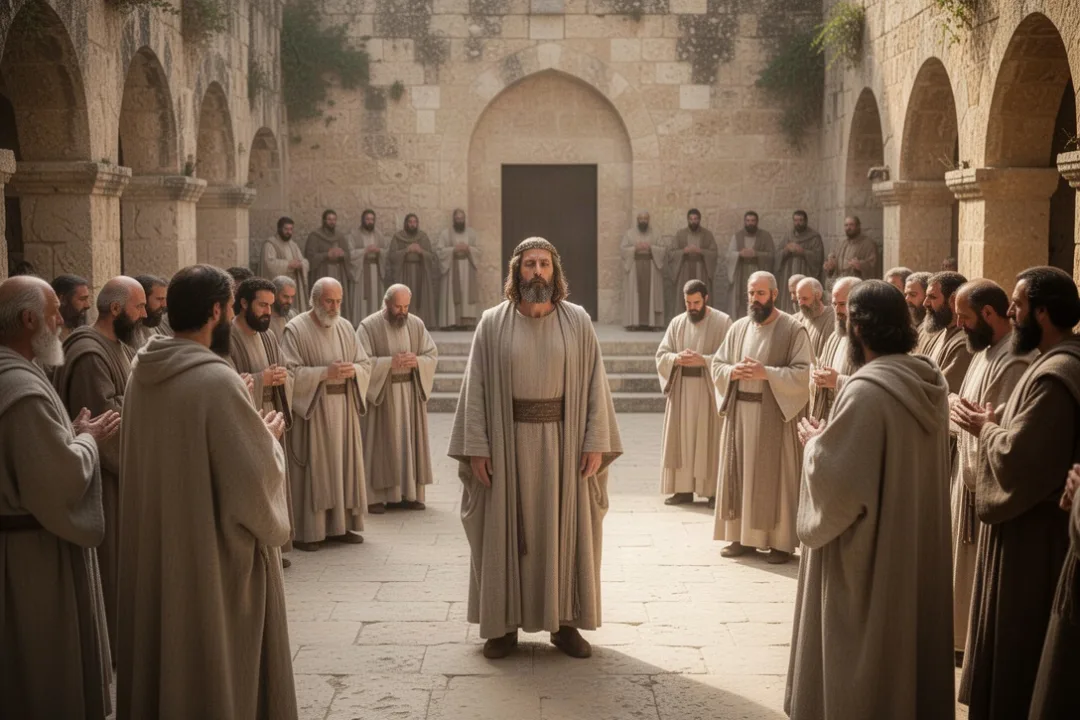
One of his most distinctive actions was sending officials, Levites, and priests throughout the towns of Judah. They carried the Book of the Law and taught the people. This was more than a ceremonial display of religion; it was an effort to make God’s instruction accessible beyond Jerusalem.
The order of events is meaningful. Jehoshaphat first sought God, then worked to teach the people, and also strengthened the kingdom’s defenses. His reign shows that biblical leadership was not presented as a choice between spiritual faithfulness and practical administration. A king was expected to pursue both.
Key idea: Jehoshaphat’s strongest reforms focused on teaching God’s Law, not merely removing visible idols. The biblical account connects faithful leadership with helping people understand how to live.
How Jehoshaphat strengthened Judah
Jehoshaphat built fortified towns and maintained military forces in Judah. The biblical record lists commanders, divisions, and substantial resources assigned to the kingdom’s defense. The purpose of these details is to show that Judah became organized and secure under his administration.
Neighboring nations feared Judah during this period, and some brought tribute. The account describes this respect as a result of the Lord’s blessing on Jehoshaphat, while also emphasizing the king’s practical preparations. The biblical narrative does not treat trust in God as an excuse for neglecting wise planning.
Jehoshaphat also appears to have had a strong administrative structure. Officials oversaw different regions, and military leaders were assigned responsibilities. Although the Bible does not provide a modern-style description of his government, these references suggest a ruler who understood the importance of organized civil and military leadership.
His success, however, created a potential danger. A strong kingdom can make a ruler confident in his own position. Jehoshaphat’s later choices suggest that military strength and political influence did not automatically give him good judgment about personal alliances.
Jehoshaphat’s alliance with Ahab and its consequences
The most serious criticism of Jehoshaphat concerns his relationship with Ahab, king of Israel. Jehoshaphat arranged a marriage connection between his family and Ahab’s household. The biblical accounts associate Jehoram, Jehoshaphat’s son, with Athaliah, who was connected to Ahab and Jezebel’s royal family.
This arrangement may have been intended to strengthen peace between Judah and Israel. Political marriages were common among ancient royal families, and cooperation could provide military or economic advantages. Yet the alliance also brought Judah’s royal house into close contact with a family known for promoting idolatry and opposing the prophets of the Lord.
Jehoshaphat later visited Ahab, and Ahab persuaded him to join a military campaign against Aram. Before agreeing, Jehoshaphat asked that they seek the word of the Lord. That request was commendable, but he still went along with the campaign even after the prophetic message revealed that the battle would be dangerous.
Ahab’s prophets predicted success, while the prophet Micaiah spoke a warning. Micaiah’s message portrayed Israel as scattered and without a shepherd, indicating that Ahab would not return safely. Jehoshaphat apparently recognized the difference between popular assurances and a difficult prophetic truth, but he did not withdraw from the alliance.
During the battle, Jehoshaphat nearly died. The opposing forces mistook him for the king of Israel, while Ahab attempted to disguise himself. Jehoshaphat cried out, and the attack against him stopped when the soldiers realized he was not Ahab. Ahab, however, was struck and died later that day.
The episode shows both Jehoshaphat’s vulnerability and the cost of poor judgment. He had sought God’s guidance, but he had already placed himself in a situation where another king’s deception and disobedience threatened his life. Seeking advice is not enough if a person refuses to act on the warning received.
After Jehoshaphat returned to Jerusalem, the prophet Jehu son of Hanani confronted him. The prophet asked why he helped the wicked and showed love toward those who hated the Lord. Yet the rebuke also acknowledged that Jehoshaphat had done some good and had removed the Asherah poles from the land.
This response is important because the Bible does not portray Jehoshaphat as either entirely righteous or entirely corrupt. His faithfulness was real, and his compromise was real. The account preserves both facts rather than simplifying his character into a perfect hero.
Jehoshaphat’s judicial reforms in Judah
After the warning, Jehoshaphat continued working to reform the nation. He traveled among the people from Beersheba to the hill country of Ephraim and brought them back to the Lord. He appointed judges in fortified cities and gave them instructions about exercising justice.
His instructions emphasized that judges were not serving merely human political interests. They were accountable to God, who does not act unjustly, show partiality, or accept bribes. Jehoshaphat also established a higher court in Jerusalem for difficult cases involving the Law, disputes, bloodshed, and other serious matters.
The king appointed Levites, priests, and family heads to administer these cases. Their responsibility was to judge carefully and warn the people against wrongdoing. Jehoshaphat’s reforms therefore included both religious teaching and public justice.
These details make his reign especially relevant to questions of leadership. Jehoshaphat understood that worship could not be separated from the way people were treated in courts and communities. A nation could not claim to honor God while allowing bribery, favoritism, or careless judgments to govern public life.
Judges were expected to act with integrity rather than favoring powerful people.
Serious cases were given a central place for review instead of being handled casually.
Religious leaders had public responsibilities connected to justice and moral instruction.
Officials were reminded that they served under God’s authority, not merely under the king.
How Jehoshaphat responded to the Moabite invasion
The best-known event in Jehoshaphat’s life began when a large coalition from Moab, Ammon, and the Meunites came to fight Judah. The report created fear in Jerusalem because the invading forces appeared too strong for Judah to defeat through ordinary military means.
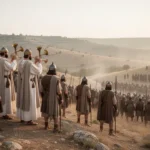
Jehoshaphat responded by seeking the Lord and proclaiming a fast throughout Judah. People gathered from every town to ask God for help. The king stood in the temple courtyard and prayed publicly, appealing to God’s covenant, past acts of deliverance, and ownership of the land.
His prayer did not pretend that Judah had enough strength. Jehoshaphat openly admitted that the people did not know what to do, while declaring that their eyes were on God. That combination of honesty and trust is one of the clearest features of the narrative.
Jehoshaphat’s prayer presents dependence on God as an honest admission of weakness, not as a denial that danger exists.
A prophet named Jahaziel then delivered a message that Judah would not need to fight the battle in the ordinary way. The people were told to take their positions, stand firm, and witness God’s deliverance. The message did not mean that Judah should become careless; the people still had to assemble, march out, and respond in faith.
Jehoshaphat bowed before the Lord, and the people worshiped. Levites and singers praised God. The next morning, the army went out with singers at the front, praising God’s steadfast love. Before Judah reached the battlefield, the invading forces had turned against one another and destroyed themselves.
Judah gathered valuable goods from the abandoned camp, and the people returned to Jerusalem with music and worship. The location was named the Valley of Berakah, or the Valley of Blessing, because the people blessed the Lord there. The story emphasizes that the victory came from God, not from Judah’s military superiority.
Jehoshaphat’s conduct in this crisis differs sharply from his conduct in the campaign with Ahab. In the earlier episode, he allowed a political relationship to draw him into danger. In the invasion from Moab and Ammon, he gathered the people, sought God openly, listened to the prophetic message, and led the nation in worship.
What Jehoshaphat’s prayer teaches about fear and leadership
Jehoshaphat did not hide fear from the people. He accepted that the threat was genuine, but he refused to let fear become the kingdom’s only response. His prayer remembered God’s character and promises before asking for immediate rescue.
That pattern offers a useful model for prayer. Jehoshaphat identified the danger, admitted Judah’s inability to solve it, and placed the situation before God. He did not claim that the people were strong enough on their own, and he did not treat prayer as a substitute for obedience.
The account also shows the value of public leadership during a crisis. Jehoshaphat did not pray privately while leaving the nation uninformed. He gathered the people, encouraged worship, and moved forward under the direction they had received.
For readers who apply this story personally, the lesson is not that every crisis will end with a miraculous reversal. The biblical account teaches that fear should drive people toward God, that leaders should tell the truth about danger, and that faithful action may require waiting for direction rather than rushing into a solution.
Jehoshaphat’s failed partnership with Ahaziah
Jehoshaphat made another problematic alliance near the end of his reign. He partnered with Ahaziah, Ahab’s son and successor in Israel, to build a fleet of trading ships. The ships were constructed at Ezion-Geber, a port associated with access to the Red Sea.
The partnership failed before the ships could carry out their purpose. A prophet named Eliezer son of Dodavahu announced that the Lord would destroy the work because Jehoshaphat had allied himself with Ahaziah. The fleet was wrecked, and the business venture did not succeed.
This event repeats the same warning found in the earlier alliance with Ahab: Jehoshaphat’s political judgment was weaker when he partnered with Ahab’s family. His spiritual reforms and public prayers did not prevent him from making the same kind of relational mistake more than once.
The biblical writer does not describe every economic detail of the project, so readers should avoid adding assumptions. The clear point is that the partnership was disapproved of and did not prosper. Jehoshaphat’s failure was not a lack of intelligence or resources; it was a failure to recognize the spiritual danger of the alliance.
Common mistakes when interpreting Jehoshaphat’s story
Jehoshaphat’s life is sometimes reduced to one dramatic victory, but the full account is more balanced. Several mistakes can lead to an incomplete understanding of who he was and what the biblical narratives emphasize.
Calling Jehoshaphat a perfect king: He followed God in important ways, but his alliances with Ahab and Ahaziah were serious failures.
Calling him a completely wicked king: He removed pagan practices, taught the Law, reformed the courts, and sought God during national danger.
Ignoring the role of teaching: His reforms were not limited to destroying idols; he sent teachers throughout Judah.
Treating the battle narrative as a promise of effortless success: Judah still had to gather, march, stand firm, and worship in obedience.
Separating faith from justice: Jehoshaphat connected worship with honest courts and responsible public administration.
Assuming every alliance is beneficial because it creates peace: His partnerships brought political advantages but also exposed Judah to harmful influence.
Confusing different people named Jehoshaphat: The king of Judah is the principal Jehoshaphat in these accounts, but the name also appears for other individuals in the Old Testament.
Jehoshaphat’s death and the reign that followed
Jehoshaphat died after ruling Judah for many years and was buried with the kings in Jerusalem. His son Jehoram succeeded him. The transition exposed the long-term consequences of Jehoshaphat’s family alliance with Ahab’s house.
Jehoram did not follow his father’s best example. The biblical account describes him as walking in the ways of the kings of Israel and doing evil. His marriage connection to Ahab’s family helped bring northern religious and political influence into Judah’s royal household.
Jehoram also killed his brothers after becoming king, an act that reveals how far the royal family had moved from the justice Jehoshaphat had tried to establish. The biblical narrative does not say that Jehoshaphat intended these later crimes, but it does show that present choices can shape the environment inherited by the next generation.
Athaliah, the woman connected to Ahab’s family, later seized power in Judah and attempted to eliminate the royal heirs. Only Joash was preserved, and he eventually became king. These later events belong to the next generation, yet they help explain why Jehoshaphat’s alliances mattered beyond his own lifetime.
What Jehoshaphat’s life teaches about faithful leadership
Jehoshaphat’s story holds together several truths that are often separated. A leader can sincerely seek God and still make serious mistakes. Strong reforms can coexist with poor relationships. Public success does not guarantee private wisdom, and a past record of faithfulness does not make future decisions automatically safe.
His example encourages active dependence on God. When Judah faced invasion, Jehoshaphat did not rely only on soldiers, fortified cities, or diplomatic arrangements. He gathered the people to seek God. Yet his story also warns that prayer cannot be used to justify relationships and plans that contradict God’s direction.
He also demonstrates the importance of teaching. Jehoshaphat did not assume that the people would remain faithful simply because the king had a good personal intention. He sent qualified people to explain the Law, showing that lasting reform requires clear instruction and consistent public practice.
His judicial reforms offer another lasting principle. Faithfulness is visible not only in worship services or moments of crisis but also in how decisions are made, how the vulnerable are treated, and whether officials resist bribery and favoritism.
Finally, Jehoshaphat’s failures make his story more useful, not less. His life does not present a distant, impossible standard of perfection. It shows a ruler who genuinely sought God, responded well in some crises, accepted correction, and still repeated damaging mistakes. The most faithful response to his example is to imitate his dependence and reforms while avoiding his unwise alliances.
Where to read about Jehoshaphat in the Bible
The main account of Jehoshaphat’s reign is found in 2 Chronicles 17–20. These chapters describe his early reforms, the teaching mission throughout Judah, the judicial system, the invasion from Moab and Ammon, and the failed shipping partnership.
1 Kings 22 records his relationship with Ahab, the campaign against Aram, Micaiah’s warning, Ahab’s death, and Jehoshaphat’s death. Related references appear in 1 Kings 15:24, 2 Kings 3, and other passages connected with the royal history of Judah.
Reading both 1 Kings and 2 Chronicles gives a fuller picture. Chronicles highlights Jehoshaphat’s religious reforms and prayer during the invasion, while Kings gives important details about his alliance with Ahab and the military campaign that nearly cost him his life. Together, the passages portray a faithful but imperfect king whose choices still speak to prayer, teaching, justice, and discernment.
Practical lessons from Jehoshaphat’s decisions
Jehoshaphat’s example can be applied without treating every ancient event as a direct prediction for modern life. The principles arise from the way he responded to God, people, danger, correction, and political pressure.
Seek God before reacting to fear. Jehoshaphat responded to the invasion with prayer and fasting rather than panic-driven action.
Admit when you do not know what to do. His prayer modeled honest dependence instead of pretending to possess enough strength.
Build faith through teaching. He understood that people need clear instruction, not only inspirational speeches or dramatic experiences.
Make justice part of spiritual faithfulness. His court reforms linked devotion to God with fair treatment in public decisions.
Take warnings seriously. Micaiah and Jehu delivered difficult messages, and Jehoshaphat’s trouble grew when he failed to act decisively on such warnings.
Examine close partnerships carefully. Peace, profit, or political convenience does not make every alliance wise.
Consider the effect of decisions on future generations. Jehoshaphat’s family arrangements influenced Judah long after his own reign ended.
Jehoshaphat was therefore neither simply “the king who won a battle through prayer” nor merely “the king who made bad alliances.” He was a ruler who pursued God, taught the nation, strengthened justice, and trusted God in crisis, while also showing how compromise can weaken an otherwise faithful life.
Frequently asked questions
Was Jehoshaphat a good king in the Bible?
Jehoshaphat is generally regarded as one of Judah’s faithful kings because he sought God, removed pagan practices, taught the Law, and improved the courts. However, he was not without serious faults. His alliances with Ahab and Ahaziah created spiritual and political danger, so the biblical account presents him as a godly but imperfect ruler.
What happened when Jehoshaphat prayed during the invasion?
When Moab, Ammon, and their allies threatened Judah, Jehoshaphat gathered the people to seek God. A prophetic message said Judah would not need to win the battle by its own strength. The invading forces turned against one another, and Judah collected goods from the abandoned camp before returning to Jerusalem in worship.
How was Jehoshaphat related to Ahab?
Jehoshaphat formed a family connection with Ahab’s household through his son Jehoram’s marriage connection to Athaliah. He also cooperated personally with Ahab in a military campaign against Aram. These relationships brought political benefits but exposed Judah to the influence of Ahab’s idolatrous royal family.
What is the main lesson from Jehoshaphat’s life?
His life shows that genuine faith should affect prayer, teaching, justice, and leadership. It also warns that a person who trusts God can still make poor choices through unhealthy alliances. Jehoshaphat’s example encourages dependence on God while calling for discernment about the people, plans, and pressures that shape important decisions.




Leave a Reply