Ezekiel in the Bible: His Life, Visions, and Message
Ezekiel in the Bible: His Life, Visions, and Message
If you have opened Ezekiel and wondered why it begins with wheels, living creatures, fire, and a storm, you are not missing an obvious explanation. Ezekiel is one of the Bible’s most vivid and challenging prophetic books, written during a national crisis that reshaped Israel’s identity.
Ezekiel was a priest who became a prophet among the Israelites exiled in Babylon. His messages warned that Jerusalem’s destruction was connected to persistent unfaithfulness, yet they also promised that God could restore his people, renew their hearts, and dwell among them again. The book moves from terrifying visions of judgment to some of Scripture’s strongest images of hope.
Ezekiel identifies himself as the son of Buzi the priest. He was living among Judean exiles in Babylon near the Chebar canal when he received his prophetic calling. His ministry began during the sixth century B.C., after Babylon had already taken many people from Jerusalem into captivity and before the city’s final destruction.
The book opens by placing Ezekiel’s first vision in the fifth year of King Jehoiachin’s exile. The date matters because Ezekiel was not speaking from a comfortable distance. He was part of the displaced community, surrounded by people who had lost their homes, political independence, temple, and familiar way of life.
As a priest, Ezekiel would have understood the significance of Jerusalem’s temple, sacrifices, ritual holiness, and the presence of God among Israel. His prophetic message repeatedly returns to those subjects. However, his visions also show that God’s presence is not trapped inside one building or city. God appears to Ezekiel in Babylon, among the exiles.
Ezekiel’s ministry covers the period before and after Jerusalem fell to Babylon. Early messages focus heavily on warning and judgment. After news arrives that Jerusalem has been destroyed, the emphasis shifts toward responsibility, restoration, and future hope. This change does not erase the earlier warnings; it shows how the prophet’s message addresses a changing crisis.
The prophet’s personal life also becomes part of his public ministry. Ezekiel’s wife dies on the day the siege of Jerusalem begins, and God instructs him to respond in an unusual restrained way rather than performing the customary public mourning described in Ezekiel 24. The event becomes a sign to the people that the coming catastrophe will be so overwhelming that ordinary expressions of grief will be interrupted.
Historical setting: Ezekiel speaks to people living through displacement and national collapse. Understanding exile helps explain why the book gives so much attention to Jerusalem, the temple, guilt, identity, and the promise of return.
What Ezekiel’s major visions mean
Ezekiel is especially known for symbolic visions. They are not presented as decorative dream scenes; they communicate theological claims about God’s holiness, authority, judgment, and presence. The imagery can be difficult because the prophet describes realities that exceed ordinary human experience.
The living creatures and wheels in Ezekiel 1
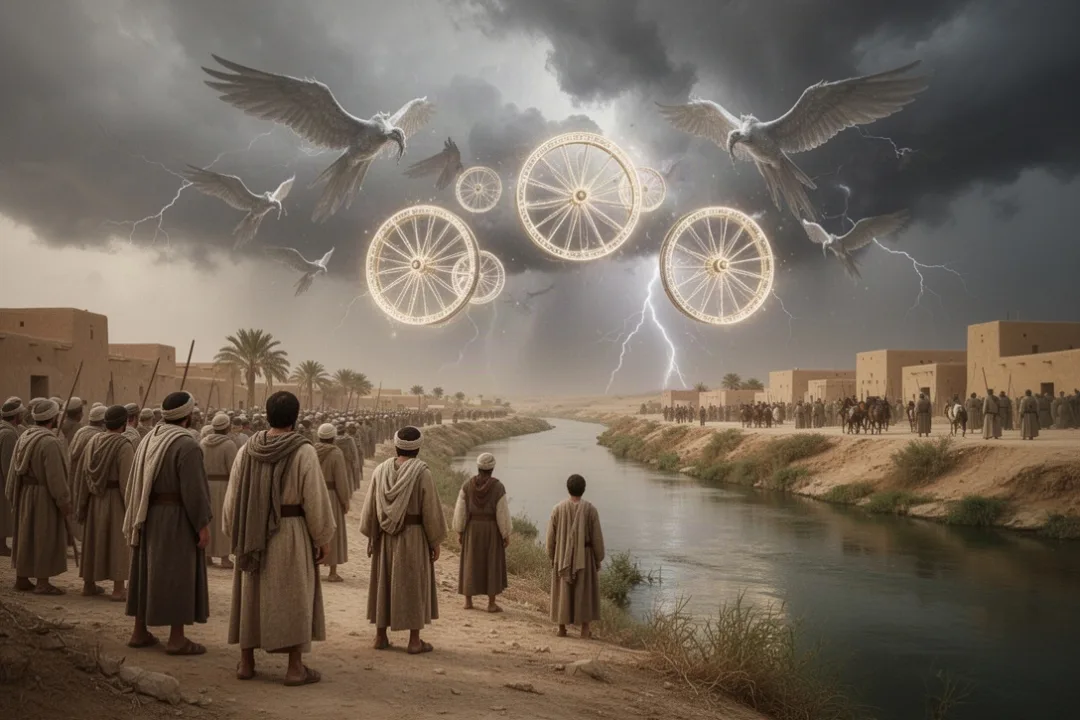
Ezekiel’s first vision begins with a storm cloud, flashing fire, and four living creatures. Each creature has several faces, wings, and humanlike features, while beside them are wheels that appear to move in every direction. The vision emphasizes coordinated movement, extraordinary power, and the ability to go wherever the divine presence directs.
The wheels are often remembered as “wheels within wheels,” but the larger point is more significant than the phrase itself. The vision presents a mobile throne-chariot, suggesting that God is not confined to Jerusalem. Even in Babylon, among people who may have wondered whether their God had been defeated, God remains sovereign and present.
The creatures are later associated with cherubim, heavenly beings connected with God’s glory and throne. Ezekiel does not portray them as cute winged figures. In his visions, they are powerful and awe-inspiring attendants who underline the holiness and majesty of God.
The scroll and Ezekiel’s prophetic calling
In Ezekiel 2 and 3, the prophet receives a scroll covered with words of lament, mourning, and woe. He is told to eat it, and it tastes sweet to him. The image communicates that Ezekiel must internalize the message before delivering it. He is not merely repeating information; the word becomes part of his prophetic vocation.
The scroll is sweet even though its content is painful. That contrast can suggest that receiving and obeying God’s word is good, while the message itself may still announce grief and judgment. Ezekiel’s calling therefore involves both faithful obedience and emotional difficulty.
The glory leaving Jerusalem
In chapters 8 through 11, Ezekiel is shown forms of idolatry and corruption connected with the temple and Jerusalem. The vision culminates in the departure of the glory of the Lord from the temple. The movement of the glory is central to the book’s explanation of Jerusalem’s coming judgment.
The point is not that Babylon’s gods have overpowered Israel’s God. Instead, Ezekiel presents judgment as a response to the people’s persistent rebellion and defilement. The departure of divine glory also prepares the reader for a later promise: God’s presence will return, but in connection with cleansing, renewed obedience, and a transformed community.
The valley of dry bones
Ezekiel 37 describes a valley filled with dry bones. God asks whether the bones can live, and the prophet watches as the bones come together, receive tendons and flesh, and are given breath. The vision is explained as a picture of Israel’s national restoration. The people feel cut off and without hope, but God promises to open their graves metaphorically, bring them back, and place his Spirit within them.
Many readers apply this passage to individual resurrection, but Ezekiel’s immediate explanation focuses on the restoration of Israel as a people. The vision uses deathlike imagery to describe national hopelessness and divine renewal. It does not reduce the passage’s later theological significance, but its first meaning is tied to exile and the recovery of a scattered community.
The restored temple and river of life
The final major vision, in Ezekiel 40–48, describes a future temple, its worship arrangements, the division of the land, and the city’s renewed order. A river flows from the temple, becoming deeper as it moves and bringing life to places associated with barrenness and death.
This vision emphasizes holiness, ordered worship, healing, and God’s return to dwell among the people. The closing name of the city is often translated as “The Lord Is There.” That ending answers one of the book’s deepest questions: after judgment and exile, will God continue to live among his people? Ezekiel’s answer is yes, but the renewed presence belongs to a renewed community and a holy order.
What Ezekiel teaches about judgment and personal responsibility
Ezekiel’s warnings are direct because his audience needed more than vague reassurance. Many exiles believed that Jerusalem, the temple, or their national identity would somehow guarantee protection. Ezekiel challenges that confidence by declaring that religious symbols cannot replace faithful relationship with God.
The prophet identifies idolatry, violence, exploitation, injustice, and rejection of God’s commands as reasons for judgment. In Ezekiel 8, the temple visions portray practices that defile the place associated with God’s holiness. In Ezekiel 16 and 23, extended metaphors describe Israel and Jerusalem as unfaithful spouses. These chapters use deliberately shocking language to express the seriousness of covenant betrayal.
The harsh imagery should be read carefully. It reflects the prophetic style of the ancient Near East and communicates moral outrage through extended metaphor. It should not be used to excuse abuse or to blame victims of violence. The target of Ezekiel’s condemnation is corporate unfaithfulness, exploitation, idolatry, and betrayal, not people who have suffered harm.
One of Ezekiel’s most important teachings appears in chapter 18. The people complain that they are suffering because of the sins of earlier generations. Ezekiel responds by stressing that each person is accountable for their own conduct. A righteous person will not be condemned simply because of a parent’s wrongdoing, and a wicked person who turns away from evil can live.
This does not mean Ezekiel denies the social consequences of sin. Elsewhere, he describes how one generation’s corruption damages the whole community. His emphasis in chapter 18 is that individual moral responsibility remains real. People cannot use ancestry, tradition, or past circumstances as a complete excuse for present choices.
The chapter also presents God as willing to forgive genuine repentance. When a wicked person turns from wrongdoing and practices justice, Ezekiel says that God does not delight in that person’s destruction. When a previously righteous person turns to persistent evil, earlier righteousness does not function as a permanent exemption.
This teaching gives the book a strong ethical center. Ezekiel is not simply predicting events. He is calling people to examine how they live, treat others, use power, and respond to God. The book’s warnings are severe, but they are connected to the possibility of turning and receiving life.
The watchman’s responsibility
Ezekiel 3 and 33 use the image of a watchman stationed on a city wall. If the watchman sees danger and warns the people, the people remain responsible for their response. If the watchman refuses to warn them, the watchman bears responsibility for failing in the assigned duty.
The image explains Ezekiel’s own role. He cannot control whether the people listen, but he must deliver the warning faithfully. This does not make every modern leader automatically equivalent to Ezekiel. It does show that speaking truth carries responsibility, especially for those entrusted with guiding a community.
How Ezekiel describes Israel’s restoration
After Jerusalem falls, Ezekiel’s message changes noticeably. The prophet still addresses sin, but he increasingly speaks about rebuilding, gathering, cleansing, and renewed life. Restoration is not described as a simple return to the past. God promises to create a people capable of living differently.
One of the clearest promises appears in Ezekiel 36. God says he will gather Israel from the nations, cleanse the people from impurity, give them a new heart, and put a new spirit within them. The promise includes more than a change in location. It describes an inward transformation that makes faithful obedience possible.
The phrase “new heart” in this setting refers to a renewed center of thought, desire, and will. Ezekiel contrasts a stubborn heart with one that is responsive to God. The promise is therefore both spiritual and communal: God restores a people, and he changes the people who are restored.
The two sticks in Ezekiel 37 provide another image of restoration. One represents Judah and the other represents Joseph, or Ephraim. The prophet joins them into one stick, symbolizing the reunion of divided parts of Israel under one king and one covenant identity.
This image addresses a long-standing division between the southern kingdom of Judah and the northern kingdom of Israel. Restoration includes reconciliation and unity, not merely the survival of scattered individuals. The people are to become one community again.
Ezekiel 34 uses shepherd imagery to criticize Israel’s leaders. The shepherds have fed themselves instead of caring for the flock, so God promises to seek the lost, strengthen the weak, heal the injured, and judge between members of the flock. God also promises a shepherd connected with David’s line.
The shepherd passage is significant because it combines judgment on abusive leadership with care for vulnerable people. It establishes a standard by which rulers and religious leaders should be measured: Do they protect and nourish the people, or do they use authority for themselves?
Christian readers often connect the promised Davidic shepherd with Jesus, especially in light of the shepherd imagery in the Gospel of John. Jewish readers may understand the passage within expectations of restored Davidic leadership and Israel’s future renewal. The connection should be made with awareness that Ezekiel’s original setting concerns Israel’s leadership, exile, and restoration.
Read restoration as transformation: Ezekiel does not promise that everything will simply return to its former condition. The restored people receive cleansing, a new heart, reunited identity, responsible leadership, and God’s renewed presence.
How to read the difficult parts of Ezekiel responsibly
Ezekiel can be rewarding, but it should not be read as a collection of isolated predictions or strange images. The book has a broad movement: calling, judgment, responsibility, restoration, and renewed worship. Reading the surrounding chapters helps clarify what each vision is addressing.
Start by paying attention to repeated phrases. Ezekiel frequently uses expressions such as “they will know that I am the Lord.” This does not merely mean learning a fact about God. In the book’s context, recognition comes through acts of judgment, rescue, purification, and restored relationship.
It also helps to separate three layers of meaning:
The historical layer: What did the vision mean to Judeans living in Babylon before and after Jerusalem’s destruction?
The theological layer: What does the passage say about God’s holiness, justice, mercy, presence, and covenant?
The later interpretive layer: How have Jewish and Christian communities understood the passage in light of later Scripture and tradition?
Apocalyptic and symbolic imagery should not automatically be turned into a modern prediction chart. The book contains dates, places, historical references, symbolic actions, visions, poetry, and extended metaphors. Genre matters. A vision of wheels is not written in the same way as a historical notice, and a metaphor about shepherds should not be read as a literal report about livestock.
The book’s sexualized metaphors in chapters 16 and 23 are among its most disturbing sections. Read them in context, with attention to the prophetic purpose and the ancient literary setting. They express covenant betrayal through shocking imagery, but they are not permission to speak about real people with degrading language or to minimize sexual violence.
Ezekiel’s temple vision also raises interpretive questions. Some readers understand it as a literal future temple, others as a symbolic picture of restored holiness, and still others connect it with broader biblical expectations about God’s dwelling. The text itself invites careful study of its measurements, boundaries, worship, land arrangement, and closing declaration rather than a quick attempt to force every detail into a modern system.
A practical reading plan can keep the book manageable:
Read Ezekiel 1–3 to understand the prophet’s calling and the first vision.
Read chapters 8–11 to follow the temple vision and the departure of God’s glory.
Read chapters 18 and 33 for personal responsibility and the watchman image.
Read chapters 34–37 for leadership, restoration, the new heart, and the dry bones.
Read chapters 40–48 for the restored temple, land, worship, and the city named for God’s presence.
Keep a simple list of repeated themes as you read: glory, holiness, knowledge of God, responsibility, spirit, shepherding, and presence. These themes connect the dramatic visions to the book’s central message. Ezekiel is not strange for the sake of being strange; its imagery serves a consistent claim about what happens when a community rejects holiness and what God promises after judgment.
For Christian readers, Ezekiel also provides background for ideas that appear elsewhere in the New Testament, including shepherd leadership, living water, resurrection imagery, the Spirit’s renewing work, and God’s dwelling among his people. Those later connections should be studied alongside Ezekiel’s own historical message rather than replacing it.
For Jewish readers and readers studying the Hebrew Bible, Ezekiel stands within Israel’s prophetic tradition, addressing covenant faithfulness, the sanctity of God’s name, the land, the temple, and the restoration of Israel. Across interpretive traditions, the book insists that God’s judgment is not the last word. Its final vision leaves readers with a restored community and a city defined by divine presence.
Frequently asked questions
Why is Ezekiel considered one of the hardest books in the Bible to understand?
Ezekiel combines historical prophecy, symbolic actions, poetry, visions, temple measurements, and dramatic metaphors. The imagery comes from an ancient setting that may be unfamiliar to modern readers. Reading the book in sections, identifying its historical setting, and distinguishing literal descriptions from symbolic visions makes it easier to follow. Cross-references to Israel’s temple, exile, covenant, and prophetic traditions are also helpful.
Was Ezekiel a priest before he became a prophet?
Yes. Ezekiel identifies himself as the son of Buzi the priest, and his knowledge of temple worship and holiness shapes much of his message. His priestly background helps explain his concern with God’s glory, impurity, sacred space, leadership, and the restored temple. His prophetic work took place among Judean exiles in Babylon rather than from a secure position in Jerusalem.
Does the valley of dry bones refer to the resurrection of individuals?
The immediate explanation in Ezekiel 37 identifies the bones with the people of Israel, who feel cut off and without hope during exile. The vision primarily promises national restoration and renewed life for a scattered community. Later Jewish and Christian interpretation has also connected the imagery with resurrection, but that broader application should be distinguished from the passage’s original explanation.
What is the main message of Ezekiel in the Bible?
Ezekiel explains why Jerusalem and the temple face judgment, emphasizing idolatry, injustice, corrupt leadership, and personal responsibility. At the same time, the book promises that God can gather, cleanse, reunite, and transform the exiled people. Its final hope is not merely political recovery but a holy community living with renewed divine presence.








Leave a Reply