When you come across the name Tobiah in the Bible, you may wonder whether every reference describes the same person. The answer is no. Tobiah is a name used for more than one figure, and the best-known Tobiah appears in the book of Nehemiah as a powerful opponent of Jerusalem’s restoration.
The name is associated with the Hebrew idea that “the Lord is good.” Depending on the passage, Tobiah may refer to an enemy of Nehemiah, a family connected with returning exiles, or a person mentioned in Zechariah. The name is also related to Tobias, the central figure in the Book of Tobit, although that work is part of the Catholic and Orthodox biblical traditions rather than the Hebrew Bible or most Protestant Bibles.
Quick answer: The most prominent Tobiah is the Ammonite official who opposed Nehemiah and tried to undermine the rebuilding of Jerusalem’s wall. He used political relationships, intimidation, and influence within the temple community.
In Nehemiah, Tobiah is introduced as “the Ammonite official” in Nehemiah 2:10. He objected to Nehemiah’s effort to help the people of Jerusalem and rebuild the city’s defenses after the Babylonian exile. His opposition placed him alongside Sanballat, the governor or leading official connected with Samaria, and later Geshem the Arab.
Tobiah was not simply a distant critic. The narrative presents him as a person with regional authority and influential connections. He appears able to communicate with officials, cultivate relationships among Judean nobles, and exploit divisions inside the community. His opposition shows that the rebuilding project was both a spiritual undertaking and a political threat to established interests.
Nehemiah 2:19 describes Tobiah, Sanballat, and Geshem mocking the Jews and questioning whether they were rebelling against the Persian king. Their accusation was serious because Jerusalem was within the Persian imperial system. A claim of rebellion could bring military or administrative intervention, so the criticism was designed to make the restoration project appear dangerous.
Nehemiah answered that the God of heaven would give the builders success and refused to grant the opposing leaders any legitimate claim over Jerusalem. The exchange establishes the central conflict: Nehemiah wanted to restore the city, while Tobiah and his allies wanted to prevent the community from regaining strength and independence.
What did Tobiah do during the rebuilding of Jerusalem?
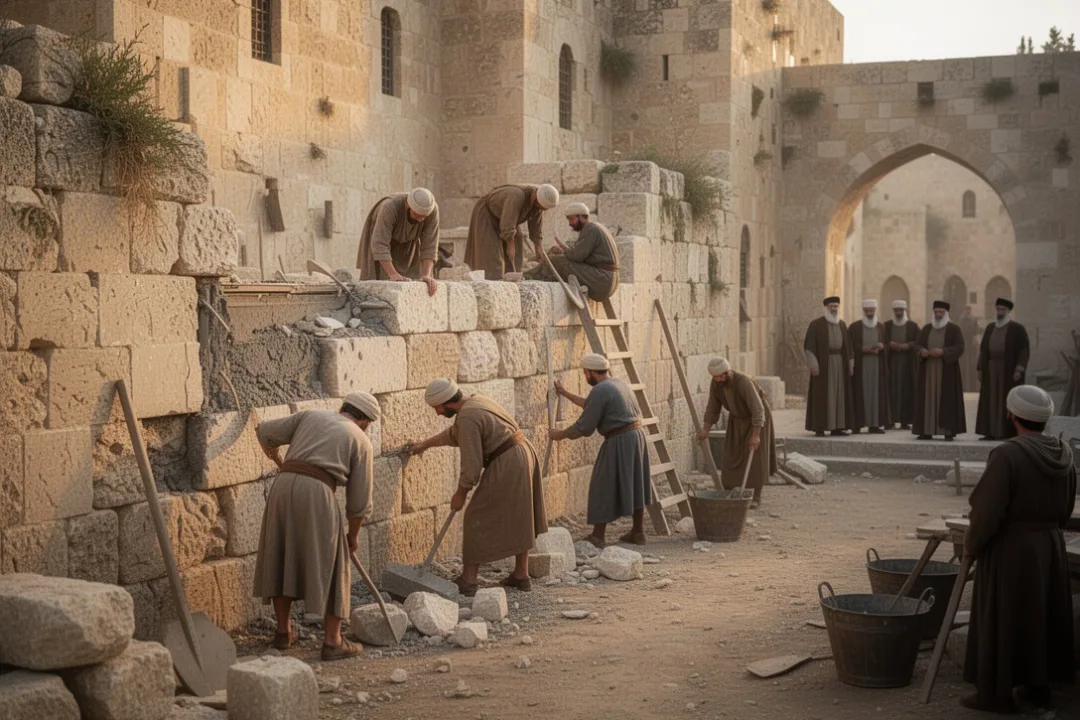
Tobiah’s opposition developed in stages. At first, he participated in public ridicule. When the wall began to rise, the hostility became more direct. Nehemiah 4 records mockery from Tobiah and his allies, including a taunt that even a weak animal could break down the wall the Jews were building.
The point of the ridicule was not merely to insult the workers. Mockery can weaken resolve, especially when a group is tired, vulnerable, and aware that powerful neighbors are watching. Tobiah’s comments attempted to persuade the builders that their work was foolish and that the city could not realistically be restored.
When ridicule did not stop the project, the enemies considered violence. Nehemiah 4 describes threats of attack and a plan to create confusion among the workers. Nehemiah responded by organizing guards, arming families, and encouraging the people to remember the Lord while defending their relatives and homes.
The rebuilding continued under pressure. Workers had to perform their assigned tasks while remaining prepared for danger. Nehemiah’s account shows how external opposition and internal responsibility existed at the same time: the people were repairing the wall, protecting one another, managing supplies, and maintaining unity.
Tobiah’s role is especially revealing because he did not defeat the project through open force. His methods included ridicule, political pressure, personal correspondence, and social influence. The story presents opposition as something that can operate through relationships and reputation as well as through direct threats.
How did Tobiah use relationships inside Judah?
After the wall was completed, Tobiah continued to influence people within Jerusalem. Nehemiah 6 says that many nobles of Judah exchanged letters with him because he had connections through marriage with members of the Judean elite. Those nobles then reported Tobiah’s good deeds to Nehemiah and repeated Nehemiah’s words to Tobiah.
This network created a serious problem. Tobiah could be outside the city’s leadership structure and still receive information about Nehemiah’s decisions. His relationships gave him access to influential families, while the nobles’ correspondence weakened the community’s ability to act with a united purpose.
The chapter also describes letters from Tobiah that were intended to frighten Nehemiah. The exact contents are not fully reproduced, but the effect is clear: Tobiah attempted to use written communication and political pressure to make Nehemiah retreat or lose credibility.
This part of the story helps explain why Nehemiah repeatedly emphasizes integrity. A community can rebuild its walls and still remain vulnerable if its leaders are controlled by private alliances. Physical restoration did not automatically produce moral or social restoration.
Public ridicule: Tobiah questioned whether the rebuilding effort could succeed.
Threats and intimidation: He joined efforts to make the workers fear attack.
Political relationships: Marriage ties connected him with Judean nobles.
Private correspondence: Letters helped him gather information and pressure Nehemiah.
Influence inside Jerusalem: His strongest advantage came through people who accepted or promoted his interests.
Why was Tobiah connected to the temple?
Tobiah’s most striking appearance comes near the end of Nehemiah. During a period when Nehemiah was away from Jerusalem, the high priest Eliashib prepared a large chamber in the temple courts for Tobiah. The room had previously been used to store grain offerings, incense, temple articles, and the tithes that supported the Levites and singers.
Nehemiah returned and was distressed by what had happened. He removed Tobiah’s belongings from the chamber and ordered the room to be cleansed. He then restored the supplies connected with worship and the support of temple workers, as described in Nehemiah 13.
The account does not describe Tobiah as a priest or as someone entitled to occupy the room. Instead, his presence appears to have resulted from favor and political connection. Eliashib was related to Tobiah by marriage, and that family connection seems to have influenced the use of sacred space.
Why the temple room mattered: The issue was not simply that Tobiah occupied a building. His presence displaced resources meant for worship and for the Levites, showing how personal alliances had begun to interfere with communal responsibilities.
Nehemiah’s response was practical and forceful. He threw Tobiah’s household goods out of the room, ordered the chambers to be purified, and returned the appropriate offerings and temple equipment. He also addressed the failure to provide for the Levites, who had gone back to their fields because the required support had been neglected.
This scene gives Tobiah a symbolic role in the book. He represents the danger of allowing a respected or well-connected outsider to receive privileges that compromise the community’s worship. The problem was not only Tobiah’s presence; it was the willingness of leaders to make sacred responsibilities secondary to personal relationships.
Was Tobiah an Ammonite or an Israelite?
Nehemiah identifies Tobiah as an Ammonite official, but the text does not provide a complete biography or genealogy. Ammonites were associated with the region east of the Jordan River, and the books of Ezra and Nehemiah often distinguish the returned Judean community from neighboring peoples.
His ethnic identity matters because the restoration of Jerusalem involved questions about membership, loyalty, and the boundaries of the covenant community. Tobiah’s opposition was not presented as a simple disagreement between two local politicians. He stood on the outside of the community being restored, yet he gained access through relationships with important Judeans.
At the same time, the narrative does not suggest that every person from a neighboring nation was automatically a personal enemy. The issue is more specific: Tobiah actively opposed the rebuilding, cultivated influence among Judah’s leadership, and received access to temple space in a way Nehemiah considered unacceptable.
Readers should also avoid assuming that “Ammonite” identifies every person named Tobiah in Scripture. Biblical names can be shared by unrelated people. The Tobiah connected with Nehemiah’s conflict should be distinguished from other people who bear the same or a closely related name.
What is the meaning of the name Tobiah?
Tobiah comes from a Hebrew name commonly explained as meaning “the Lord is good” or “Yahweh is good.” The first part is related to goodness, and the second part refers to the divine name. Similar forms include Tobijah and the Greek-influenced form Tobias.
The meaning of a biblical name does not necessarily describe the character of the person who carries it. In Nehemiah, Tobiah’s name expresses a truth about God, but Tobiah himself is portrayed as an opponent of the work being done in Jerusalem. This is a useful reminder that name meanings are not character evaluations.
Many biblical names refer to God’s character, human circumstances, family hopes, or religious commitments. The narrative must determine how a particular person behaves. Tobiah’s actions—not the positive meaning of his name—explain why Nehemiah treated him as a threat.
How should you distinguish the different biblical Tobiahs?
Several references can be confusing because English translations may use forms such as Tobiah, Tobijah, or Tobias. The surrounding passage is the best guide. Look at the person’s location, family connections, role, and the book in which the name appears.
Tobiah the Ammonite official: This is the principal opponent of Nehemiah in Nehemiah 2, 4, 6, and 13. He opposed the rebuilding of Jerusalem and later received a chamber in the temple through his relationship with Eliashib.
The descendants of Tobiah: Ezra 2:60 and Nehemiah 7:62 mention a group called the sons or descendants of Tobiah among families returning from exile. They could not establish their Israelite genealogy at that time, so their status was treated cautiously.
Tobijah in Zechariah: Zechariah 6:10 refers to Tobijah, along with other people, in connection with silver and gold brought from the exiles. The passage does not identify him as Nehemiah’s opponent.
Tobiah or Tobias in the Book of Tobit: Tobiah is the son of Tobit in a Jewish story preserved in the Catholic and Orthodox Old Testament. He travels with the angel Raphael and marries Sarah. This figure is separate from Nehemiah’s Tobiah.
The group called the descendants of Tobiah should not automatically be identified with the Ammonite official. Ezra and Nehemiah do not provide enough information to make that connection certain. Similar names alone are not sufficient evidence that two references describe the same family or individual.
What happened to Tobiah after Nehemiah confronted him?
The book of Nehemiah gives no detailed account of Tobiah’s later life. When Nehemiah returned to Jerusalem, he removed Tobiah’s possessions from the temple chamber and restored the room’s intended use. The narrative focuses on the correction of the abuse rather than on a later trial, exile, or death.
Because the text ends without describing Tobiah’s final fate, claims about what happened to him afterward go beyond the biblical evidence. The safest answer is that his privileged access to the temple was revoked, but his broader political position is not explained.
This limited ending is significant. The account is less interested in satisfying curiosity about Tobiah’s biography than in showing how Nehemiah dealt with compromised leadership. He confronted the misuse of sacred space, restored neglected provisions, and reestablished standards for the community.
What can Tobiah’s opposition teach about leadership?
Tobiah’s story shows that opposition may come through apparently respectable channels. He was not merely shouting from outside the city. He had correspondence with nobles, family links to influential leaders, and enough standing to receive a room in the temple complex.
That combination makes the account relevant to questions of leadership and accountability. A leader may face obvious enemies, but quiet conflicts of interest can be more difficult to recognize. When a person’s private relationships affect public decisions, the whole community can bear the consequences.
Nehemiah’s response offers several practical principles:
Judge actions rather than appearances: Tobiah’s connections did not make his opposition harmless.
Protect shared resources: Temple supplies and support for religious workers were communal responsibilities, not personal favors.
Keep authority accountable: Eliashib’s family connection with Tobiah influenced a decision that Nehemiah had to reverse.
Address problems directly: Nehemiah did not leave the chamber arrangement in place merely to avoid conflict.
Restore the intended purpose of institutions: The room was returned to storing resources needed for worship and service.
The story also warns against confusing peace with the absence of confrontation. Nehemiah’s actions were disruptive, but they were aimed at correcting a practice that had damaged the community. Faithful leadership sometimes requires a clear boundary when influence has become corruption.
How does Tobiah contrast with Nehemiah?
Nehemiah and Tobiah represent opposing approaches to Jerusalem’s restoration. Nehemiah accepts responsibility for the city’s condition, seeks permission to rebuild, organizes workers, and persists despite threats. Tobiah seeks to weaken the project, question its legitimacy, and preserve his own influence.
The contrast is not simply between courage and fear. Nehemiah’s work depends on public responsibility and shared effort, while Tobiah’s influence operates through private relationships and the pressure those relationships create. The book repeatedly brings hidden arrangements into public view.
Nehemiah also responds to opposition by turning attention back to the community’s purpose. When workers are afraid, he organizes protection. When temple resources are misused, he restores them. When officials collaborate with Tobiah, he confronts the arrangement rather than allowing it to define Jerusalem’s future.
Tobiah’s presence therefore helps clarify the meaning of restoration in the book. Rebuilding a wall was only one part of the task. The people also had to renew worship, economic responsibility, Sabbath observance, and communal identity. A restored city needed restored practices.
Is Tobiah the same person as Tobias in the Book of Tobit?
No. The Tobiah in Nehemiah and the Tobias, or Tobiah, in the Book of Tobit are generally understood as different figures. Nehemiah’s Tobiah is an Ammonite official who opposes Jerusalem’s rebuilding. Tobit’s Tobias is a young Jewish man whose story centers on family hardship, a journey, marriage, healing, and divine guidance.
The names are related, and English editions may spell them differently, which creates confusion. The books also come from different parts of the biblical tradition. Nehemiah belongs to the Old Testament recognized across major Christian traditions, while Tobit is included in Catholic and Orthodox Bibles and is treated as deuterocanonical by Catholics.
The Book of Tobit identifies the traveling companion of Tobias as the angel Raphael. Rather than reproducing its wording, it is enough to say that the story presents Raphael as a guide whose identity is revealed later. The narrative’s themes include faithfulness, family duty, prayer, healing, and trust in God.
Reading the two stories side by side can be helpful as long as their characters remain distinct. One Tobiah illustrates opposition and compromised influence; the other belongs to a story about family, providence, and restoration.
Where should you read about Tobiah?
If you want to study the main Tobiah connected with Nehemiah, begin with the passages that trace the conflict from public opposition to temple intrusion. Reading them in sequence makes his changing tactics easier to see.
Nehemiah 2:10: Tobiah is introduced as an Ammonite official who is displeased with Nehemiah’s mission.
Nehemiah 2:19-20: Tobiah joins Sanballat and Geshem in mocking the rebuilding effort and questioning its legitimacy.
Nehemiah 4: Tobiah participates in ridicule and threats against the workers.
Nehemiah 6: Tobiah uses relationships and letters to pressure Nehemiah and gather information.
Nehemiah 13:4-9: Tobiah is given a temple chamber and later removed when Nehemiah returns.
Then compare those passages with Ezra 2:60, Nehemiah 7:62, and Zechariah 6:10. These references show why a careful reader should not merge every Tobiah into one biography. Finally, if your Bible includes Tobit, read its opening chapters to meet the separate Tobias who is Tobit’s son.
Why does Tobiah still matter when his story is short?
Tobiah’s story matters because it shows how restoration can be challenged even after visible progress has been made. The wall was rebuilt, but the community still faced pressure from influential outsiders and from insiders willing to compromise for personal or family reasons.
His role also makes the book of Nehemiah more realistic. Communities do not rebuild through construction alone. They must decide who has authority, how resources are handled, which relationships deserve trust, and what happens when leaders misuse their positions.
The central lesson is not that every outsider is dangerous or that every relationship is corrupt. It is that loyalty must be measured by actions and responsibility. Tobiah’s name had a positive meaning, and he had respected connections, but his conduct threatened the project and displaced resources intended for worship.
For readers trying to understand the biblical text, Tobiah is therefore both a historical character in Nehemiah and a helpful study in influence. He demonstrates how opposition can appear as mockery, fear, political networking, or a seemingly generous arrangement. Nehemiah’s response shows the need for discernment, accountability, and the courage to restore a community’s proper priorities.
Frequently asked questions
Was Tobiah an Israelite?
The Tobiah who opposed Nehemiah is identified as an Ammonite official, not as a Judean Israelite. He nevertheless had marriage connections with influential Judean families. Those relationships gave him access to information and eventually helped him obtain a chamber in the temple. Other biblical references to people named Tobiah cannot automatically be assigned the same ethnic identity.
What did Tobiah do wrong in Nehemiah 13?
Tobiah was given a large temple chamber by Eliashib, the high priest, apparently because of their family connection. The room had been intended for offerings, incense, temple equipment, and supplies supporting the Levites. Nehemiah removed Tobiah’s belongings, purified the chamber, and restored it to its religious and communal purpose.
Is Tobiah the same as Sanballat?
No. Tobiah and Sanballat are presented as separate opponents of Nehemiah. Sanballat is associated with Samaria, while Tobiah is identified as an Ammonite official. They work together in mocking the rebuilding and applying pressure, but the biblical narrative treats them as distinct people with different regional connections.
What is the difference between Tobiah and Tobias in Tobit?
Tobias in the Book of Tobit is Tobit’s son and the main human character in a separate Jewish story. The Tobiah in Nehemiah is an Ammonite official who opposes Jerusalem’s restoration. Their names are related and may be spelled similarly in different translations, but the people, settings, and stories are different.







Leave a Reply