Zechariah 1: Meaning, visions, and lessons for today
Zechariah 1: Meaning, visions, and lessons for today
Have you ever looked at a difficult season and wondered whether God sees what is happening? Zechariah 1 speaks directly to that question. The chapter begins with a call for Judah to return to the Lord, then describes two visions that explain how God regards Jerusalem’s suffering and the nations that have harmed his people.
The message is both a warning and a promise. God tells the returned exiles not to repeat the stubbornness of their ancestors, but he also assures them that Jerusalem will receive mercy. The chapter’s images—riders among myrtle trees and four horns opposed by craftsmen—show that God is aware of world events and remains committed to his purposes.
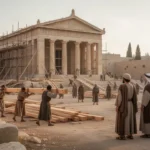
Zechariah ministered among the Jewish people after their return from exile in Babylon. Jerusalem and the temple had been devastated, and the returning community faced the hard work of rebuilding. The book identifies Zechariah as the son of Berechiah and grandson of Iddo, and dates this opening message to the eighth month of the second year of King Darius.
That dating places the prophecy in the early period of the Persian Empire, after Babylon had fallen. The people had returned to Judah, but their restoration was incomplete. The temple project had stalled, the city remained vulnerable, and the community needed spiritual as well as physical renewal.
Zechariah’s first chapter should also be read alongside the ministry of Haggai. Both prophets addressed the returned community during the reign of Darius and encouraged the people to resume faithful worship and rebuild the temple. Haggai emphasizes practical obedience, while Zechariah 1 adds visions that reveal the spiritual meaning behind the community’s situation.
Central message: God calls his people to return to him, remembers the suffering of Jerusalem, and promises that the powers opposing his purposes will not have the last word.
What Zechariah 1 says about returning to God
The chapter opens with a message from the Lord delivered through Zechariah. God tells the people to return to him, and he promises to return to them. This is the controlling idea for the rest of the chapter: restoration begins with a restored relationship with God.
The command is not merely an invitation to feel regret. In the biblical sense, returning to God involves repentance—turning away from disobedience and turning back toward faithful dependence. The people needed more than a new building or a change in national circumstances. They needed renewed loyalty to the Lord.
God then points to the previous generation. The earlier prophets had warned their ancestors to abandon their evil ways, but those warnings had not produced lasting obedience. The ancestors eventually died, and the prophets were gone, yet the consequences of their choices remained visible. Their experience showed that God’s word does not become irrelevant simply because time passes.
The people acknowledge that the Lord had dealt with their ancestors according to their deeds. This response matters because it recognizes both God’s justice and the community’s responsibility. Zechariah is not asking the returned exiles to blame their hardships entirely on foreign rulers or historical events. He is asking them to examine their own relationship with God.
Repentance in Zechariah 1 is personal and communal
The command to return was given to a community, but it required individual choices. Each person had to respond to God’s word. At the same time, the people were part of a covenant community whose shared attitudes and practices shaped their future.
This makes the opening verses relevant beyond the original setting. A person may inherit religious language, traditions, or the consequences of earlier generations, but inherited identity does not replace present faithfulness. Zechariah 1 presses the reader to ask whether devotion is genuine now.
Look honestly at the past: learn from the failures of those who came before rather than repeating them.
Respond to God’s word: repentance begins when a person takes divine correction seriously.
Change direction: returning to God involves conduct, priorities, and loyalties—not only private feelings.
Trust God’s response: the promise that God will return to those who return to him shows his readiness to receive the repentant.
The first vision: riders among the myrtle trees
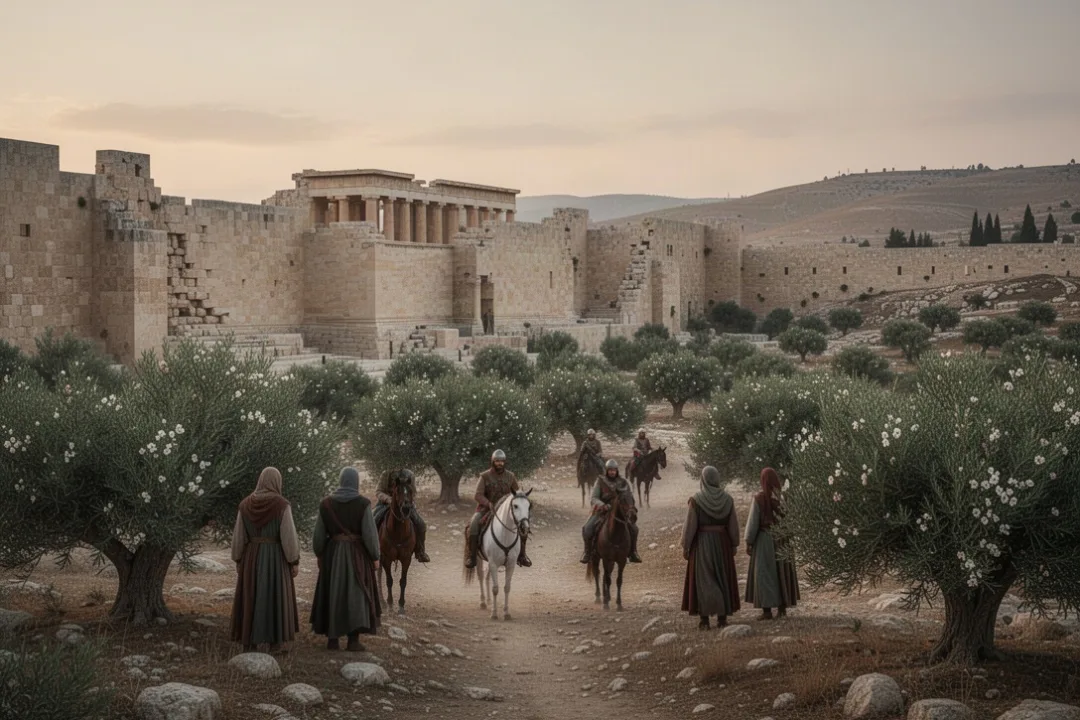
In the first vision, Zechariah sees a man riding a red horse standing among myrtle trees in a ravine. Behind him are other horses of different colors. The imagery is unfamiliar to modern readers, but the scene gradually explains itself through a conversation between Zechariah and an interpreting angel.
The riders report that they have traveled throughout the earth and found it quiet and at rest. Their report creates an important contrast. The nations appear settled, while Jerusalem and Judah have endured devastation and humiliation. External calm does not necessarily mean that justice has been done.
The man among the myrtles asks how long God will withhold compassion from Jerusalem and the cities of Judah. The question gives voice to the suffering community. Judah had experienced the destruction associated with exile, and the people could reasonably wonder how long their low condition would continue.
The Lord answers with words of comfort. He declares his strong concern for Jerusalem and expresses displeasure toward the nations that felt secure while contributing to Judah’s distress. The nations had gone beyond what God intended, treating the suffering of his people with excessive severity.
The vision then turns toward restoration. God promises that his house will be rebuilt in Jerusalem and that the city will again experience prosperity and blessing. The promise is not presented as a reward for Judah’s power. It rests on God’s compassion and covenant commitment.
What the horses and riders represent
The horses and riders are commonly understood as heavenly messengers who patrol the earth and report what they observe. The chapter does not give every detail of their identity or explain a complete symbolic system for the colors. Their main function is to show that the Lord is not distant from events among the nations.
The scene communicates several ideas:
God sees the condition of the world: the riders have surveyed the earth, so human events are not hidden from him.
God hears the question of the oppressed: the concern about Jerusalem’s future is brought before him.
God distinguishes peace from justice: the nations may be quiet while Jerusalem remains wounded.
God controls the outcome: the apparent stability of the nations does not cancel his purpose for his people.
The first vision should not be treated as a coded chart for identifying modern countries or predicting every political event. Zechariah gives enough information to understand the central message, but he does not explain every visual detail. The safest interpretation stays close to the chapter’s own emphasis: divine awareness, righteous concern, and promised restoration.
Why God says he is jealous for Jerusalem
Zechariah 1 describes the Lord as deeply concerned for Jerusalem and Zion. In Scripture, God’s jealousy is not petty insecurity or uncontrolled envy. It describes his devoted commitment to his covenant relationship and his determination to defend what belongs to him.
Jerusalem’s destruction had raised a difficult question. If the city was chosen by God, why had God allowed it to be conquered? The vision does not deny that Judah had sinned or that judgment was deserved. Instead, it shows that judgment was not the end of God’s relationship with his people.
God’s displeasure toward the nations also matters. Foreign powers had been used as instruments of judgment, but they were still responsible for their own pride, violence, and harshness. Their role did not give them unlimited permission to oppress. God judges both the sins of his people and the arrogance of the nations.
This distinction offers a careful way to think about suffering. A difficult circumstance may expose personal or communal wrongdoing, but that does not mean every person who suffers is more guilty than every person who appears comfortable. The first vision rejects the idea that visible prosperity proves divine approval.
God’s promise to rebuild Jerusalem
The first vision ends with a promise that Jerusalem will be rebuilt and that its boundaries will overflow with prosperity. These words would have sounded remarkable to a people living among ruins and uncertainty. The Lord presents the city’s future as something he himself will secure.
The promise includes more than construction. Rebuilding the temple and city represents the restoration of worship, community, identity, and public life. Jerusalem was not simply a location on a map. It was central to the people’s covenant story and their understanding of God’s presence among them.
That promise also corrects despair. The exiles could look at present weakness and assume that their story had ended. God’s vision teaches them to interpret the present in light of his purpose rather than interpreting his purpose solely through present appearances.
Reading principle: Zechariah’s visions are meant to strengthen faithful hope, not satisfy curiosity about every symbolic detail. Start with the explanation given in the chapter and let the main message govern the minor images.
The second vision: four horns and four craftsmen
Zechariah then sees four horns. The interpreting angel explains that these horns represent powers that scattered Judah, Israel, and Jerusalem. In the ancient world, a horn often symbolized strength, military power, or political domination. The four horns therefore picture the forces that had attacked and dispersed God’s people.
Zechariah asks what will happen next. Four craftsmen appear, and the angel explains that they have come to terrify and throw down the horns. The chapter does not name these craftsmen or give a historical list of four specific empires. Their role is clear: God raises agents capable of confronting the powers that caused destruction.
How the horns-and-craftsmen vision answers fear
The vision addresses the intimidation caused by powerful nations. From Judah’s perspective, empires had enormous resources and the ability to uproot communities. The four horns represent that threatening strength. The craftsmen show that no destructive power is beyond God’s ability to answer.
The image is especially effective because craftsmen are not described as another group of horns. They are workers equipped to shape, break, or dismantle what appears formidable. The point is not that Judah will defeat its enemies through superior military strength. The point is that God can overturn powers that seem unshakable.
Identify the threat: the horns represent the forces that scattered and oppressed God’s people.
Refuse to treat power as ultimate: political strength can be real without being permanent.
Look for God’s answer: the craftsmen represent the means by which God confronts destructive power.
Trust the larger purpose: judgment against oppressors supports God’s plan to restore his people.
The second vision does not promise that believers will never face opposition. Judah had already experienced severe loss, and the chapter does not erase that history. It promises instead that opposition has limits and that God’s purposes are not defeated by the strength of those who resist him.
How Zechariah 1 connects judgment and hope
A shallow reading might treat the chapter as only comforting or only threatening. It is both. The opening command warns the people not to repeat their ancestors’ disobedience, while the visions assure them that God has not abandoned Jerusalem.
These themes belong together. Hope is not permission to ignore sin, and repentance is not a declaration that restoration is impossible. God’s mercy gives people a reason to return, while his holiness gives the call to return its seriousness.
The chapter also shows that God’s judgment is not arbitrary. The ancestors had been warned through the prophets, and the nations that harmed Judah were also held accountable. At the same time, God’s final purpose is not destruction for its own sake. He intends to dwell among a restored people in a renewed Jerusalem.
For readers of the whole book, Zechariah 1 establishes patterns that become more developed later: the need for repentance, the significance of Jerusalem, the activity of heavenly messengers, the accountability of the nations, and the certainty of God’s restoration. The opening chapter functions as a doorway into the visions that follow.
Practical lessons from Zechariah 1
Zechariah 1 speaks to people living between promise and fulfillment. Judah had returned from exile, but life had not yet become secure or glorious. That in-between condition resembles many experiences of faith: you may believe God’s promises while still facing incomplete healing, delayed justice, or unfinished work.
The chapter offers several practical responses.
Take inherited warnings seriously
The earlier generation’s failure was not merely an ancient story. Their example remained relevant because the same patterns could return. Families, churches, and communities can preserve valuable wisdom, but they can also pass down habits of compromise. Zechariah urges you to learn from history rather than assume that belonging to a faithful tradition guarantees faithful living.
Return before demanding restoration
God’s promise of restoration does not remove the call to repentance. When you ask God to repair circumstances, it is wise to ask what he is also correcting in you. This does not mean blaming yourself for every hardship. It means allowing God’s word to examine your motives, actions, and priorities.
Do not confuse quietness with justice
The nations in the first vision are described as at rest, but their calm does not settle the question of Jerusalem’s suffering. A peaceful surface can hide unresolved wrongs. Zechariah encourages patience without passivity: God sees what human beings overlook, and his judgment is not limited to what is immediately visible.
Measure power by God’s authority
The horns look strong because they represent the forces that scattered God’s people. The craftsmen show that even formidable powers remain answerable to God. This does not justify careless predictions about current events, but it does provide a durable perspective: no empire, institution, ideology, or personal threat is ultimate.
Let hope produce faithful work
The people needed to rebuild the temple, live as a covenant community, and order their lives around worship. Biblical hope is not passive optimism. Because God promised to restore Jerusalem, the people were called to act faithfully in the present.
Questions to ask when studying Zechariah 1
A careful study benefits from asking both interpretive and personal questions. These questions can help you read the chapter without forcing its symbols to say more than the text supports.
What does the opening call to return reveal about God’s desire for his people?
How does the history of Judah shape the emotional force of the first vision?
What does the Lord’s concern for Jerusalem show about his response to suffering?
Why might the chapter distinguish between the use of nations in judgment and their responsibility for excessive cruelty?
What do the horns reveal about the fears facing the returned exiles?
How do the craftsmen change the way the reader views those threatening powers?
Am I treating symbolic details with humility, or am I making claims the chapter does not make?
What would returning to God look like in a concrete area of life?
How Christians commonly read Zechariah 1 today
Christian readers often understand the chapter as part of the Old Testament’s wider expectation of redemption. The promise concerning Jerusalem belongs first to the historical community addressed by Zechariah, so it should not be detached from Judah’s return from exile and the rebuilding of the temple.
At the same time, the chapter contributes to broader biblical themes that Christians connect with God’s work of salvation: repentance, divine presence, judgment of evil, and the restoration of God’s people. Those connections should be made carefully. Zechariah 1 is not a permission slip to assign every horn or horse to a current nation.
The chapter’s enduring spiritual force lies in its clear claims. God calls people away from stubbornness. He remembers communities that have suffered. He opposes arrogant violence. He can restore what appears ruined, and he remains active even when his work is not immediately visible.
Reading Zechariah 1 well means holding its warning and comfort together. The call is to return to the Lord with sincere obedience, while the promise is that the Lord has not forgotten his people. The visions direct attention away from fear of human power and toward the God who sees, judges, and restores.
Frequently asked questions
What is the main message of Zechariah 1?
The main message is a call for God’s people to return to him and avoid repeating the disobedience of their ancestors. The chapter then reassures them that God remembers Jerusalem, cares about its suffering, and will confront the powers that caused its devastation. Repentance and hope stand together throughout the chapter.
What do the four horns in Zechariah 1 represent?
The four horns symbolize powers that scattered Judah, Israel, and Jerusalem. Horns commonly represent strength or political and military power in biblical imagery. The chapter does not identify four modern nations or provide a complete list of historical empires, so the image is best understood as a picture of hostile powers under God’s authority.
Who are the four craftsmen in Zechariah 1?
The four craftsmen represent agents raised up to confront and throw down the powers symbolized by the horns. Zechariah does not name them individually or explain their identity in detail. Their purpose in the vision is to show that God can dismantle the forces that appear strong enough to destroy his people.
How should someone apply Zechariah 1 personally?
Begin with the chapter’s first command: return to God. That may involve confessing sin, changing a harmful pattern, restoring faithful priorities, or accepting correction from Scripture. The visions also encourage you not to mistake present circumstances for the final outcome. God sees injustice and remains able to restore what seems damaged.







Leave a Reply