Nehemiah and Ezra led different parts of the same restoration effort: Ezra renewed the people through Scripture and worship, while Nehemiah rebuilt Jerusalem’s defenses and organized its community. Their stories show how spiritual renewal and practical leadership worked together after the Babylonian exile.
What happened between the exile and the work of Nehemiah and Ezra?
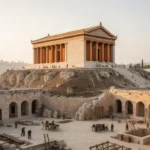
Jerusalem had been conquered, its temple destroyed, and many of its people taken to Babylon. Decades later, the Persian Empire defeated Babylon and allowed exiled communities to return. The first groups of Judeans went back to Jerusalem, rebuilt the altar, and eventually completed the temple during the leadership of figures such as Zerubbabel and Jeshua the high priest.
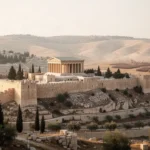
The rebuilt temple gave the community a center for worship, but Jerusalem itself remained vulnerable. Its walls and gates were damaged, leaving the city exposed to enemies and making it difficult for the returning population to establish a secure civic life. The people also faced internal problems involving poverty, intermarriage, injustice, discouragement, and inconsistent obedience to the Law of Moses.
Ezra and Nehemiah appear in this later period. The Book of Ezra focuses especially on the temple, the return of exiles, and the teaching of the Law. The Book of Nehemiah emphasizes Jerusalem’s walls, civic administration, opposition to the rebuilding project, and reforms within the community.
The central connection: Ezra and Nehemiah were not competing leaders with unrelated missions. Their work addressed two needs that belonged together: Jerusalem needed a functioning city, and its people needed a renewed life of faithfulness.
Who were Ezra and Nehemiah?
Ezra was a priest and expert teacher of the Law
Ezra is introduced as a priest and a skilled scribe devoted to the Law of Moses. He came from Babylon to Jerusalem with authorization from the Persian king. His responsibilities included teaching God’s commands, appointing judges, supporting temple worship, and helping the community live according to its religious obligations.
His influence came less from military or political power than from knowledge of Scripture and public instruction. Ezra studied the Law, practiced it, and taught it. That pattern matters because the biblical account presents his leadership as more than formal education: he was expected to embody the commands he explained.
When Ezra arrived, he discovered that some members of the community had formed marriages with people from surrounding nations. Ezra responded with grief and confession, and the community carried out a difficult process of addressing those relationships. Modern readers should handle this passage carefully. The concern in the text is presented as covenant loyalty and religious identity after exile, not as a general claim that one ethnic group is inherently superior to another.
Nehemiah was a royal official and governor
Nehemiah first appears serving as cupbearer to the Persian king. The position involved trust and access to the royal court, but it did not make Nehemiah a king or independent ruler. After hearing about Jerusalem’s broken walls and distressed population, he requested permission to travel there and lead the rebuilding effort.
Nehemiah combined prayer, planning, negotiation, construction, and administration. He inspected the walls, assigned families and groups to specific sections, responded to threats, confronted exploitation, and organized the city’s population. He later served as governor and worked to correct economic abuses and failures in religious practice.
His leadership style is personal and direct. Nehemiah frequently describes his prayers, decisions, conflicts, and appeals to God. The book portrays him as energetic and persistent, but also as someone who had to deal with fear, criticism, unfairness, and his own limits.
How do the stories of Nehemiah and Ezra fit together?
The books are closely connected, but they are not simply one continuous biography. Ezra’s account begins with the Persian policy that allowed exiles to return and continues through temple restoration and religious reform. Nehemiah’s account begins with his concern for Jerusalem’s walls and later includes public reading of the Law, confession, covenant renewal, and additional reforms.
The exact order of every event can be difficult because the biblical books do not present all the material as a modern chronological history. Ezra appears in Nehemiah 8, where he reads the Law to the gathered people, but Ezra’s own book describes earlier events from his return to Jerusalem. Many interpreters understand the narrative as presenting overlapping ministries rather than placing every episode in strict sequence.
A common traditional reconstruction places Ezra’s arrival before Nehemiah’s, during the reign of the Persian king Artaxerxes. Nehemiah then arrived later, in the king’s twentieth year, to rebuild the walls. The dates and sequencing are discussed by scholars, so it is wiser to focus on the clear relationship between their missions than to treat every proposed timeline as certain.
Ezra’s primary concern: teaching the Law, restoring proper worship, and addressing covenant disobedience.
Nehemiah’s primary concern: rebuilding Jerusalem’s walls, protecting the city, and strengthening its civic life.
Their shared concern: forming a faithful community centered on God’s promises and commands.
Their different strengths: Ezra worked as a priest and teacher, while Nehemiah worked as an administrator, governor, and builder.
What happened in Nehemiah’s rebuilding of Jerusalem’s walls?
1. Nehemiah heard the report and responded with prayer
Nehemiah learned from visitors that the survivors in Jerusalem were in serious trouble and that the city walls remained broken. He mourned, fasted, and prayed before asking the Persian king for permission to go to Jerusalem. His prayer acknowledged Israel’s sin, recalled God’s covenant promises, and asked for favor with the king.
This opening establishes a pattern found throughout the book: Nehemiah does not separate action from prayer. He plans carefully, but he also understands that success depends on God’s help. His prayer is not an alternative to organization. It is the foundation for responsible action.
2. He inspected the damage before announcing a plan
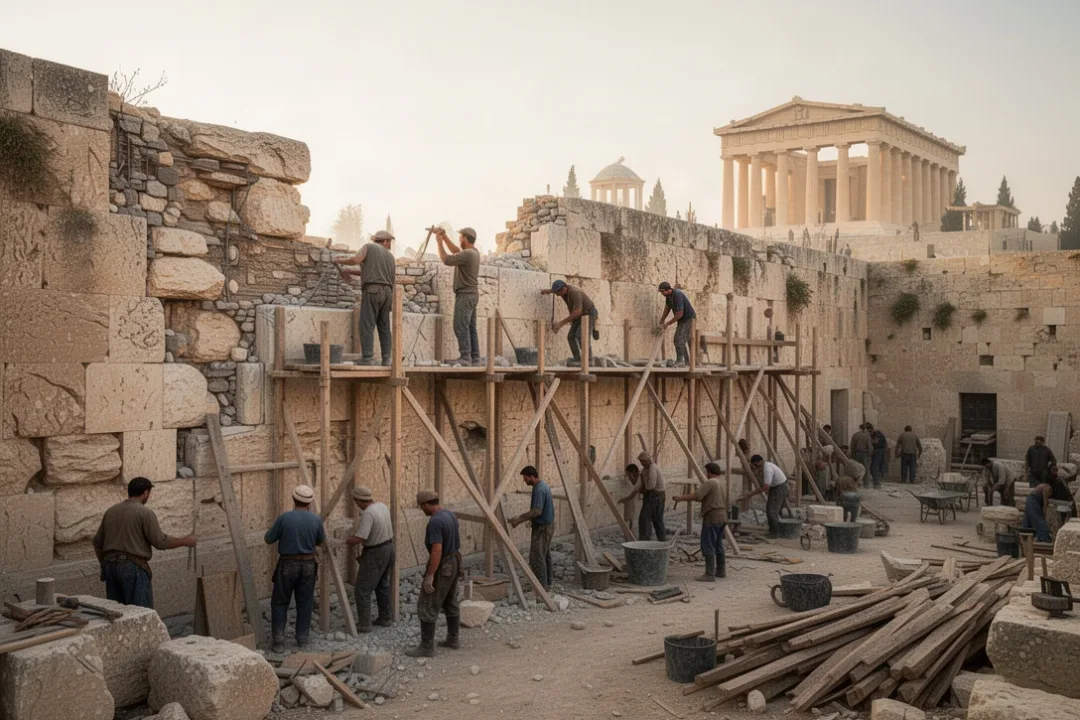
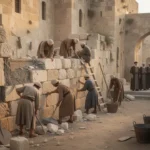
After reaching Jerusalem, Nehemiah did not immediately make a public speech or begin assigning blame. He spent time examining the walls and gates, sometimes at night, so he could understand the actual condition of the city. Only after this private inspection did he explain the situation to the leaders and propose rebuilding.
The sequence offers a practical leadership lesson. Before asking people to commit their labor, a leader should understand the problem, identify the resources available, and communicate a clear purpose. Nehemiah described the city’s condition honestly but also connected the work to God’s favor and the community’s shared responsibility.
3. Families and groups rebuilt assigned sections
The work was divided among many participants. Priests, rulers, craftsmen, merchants, and families repaired different portions of the wall and gates. This arrangement made a large project manageable and gave people a visible connection to the city’s restoration.
The list of workers can seem repetitive, but it communicates something important: restoration required broad participation. No single person rebuilt Jerusalem. Nehemiah provided direction, yet the project depended on many people accepting responsibility for a specific task.
4. The builders faced mockery, threats, and military pressure
Opponents such as Sanballat, Tobiah, and Geshem challenged the project. Their resistance included ridicule, accusations, threats, and attempts to draw Nehemiah away from the work. As the danger increased, the builders armed themselves while continuing to repair the wall.
Nehemiah responded with both spiritual confidence and sensible precautions. The people prayed, posted guards, organized communication, and adjusted their labor. The account does not portray faith as refusing preparation. Instead, trust in God and responsible vigilance appear together.
5. The wall was completed despite opposition
The rebuilding moved forward quickly, and the wall was completed. The achievement strengthened the city’s security and demonstrated that the opposition had not stopped the community’s work. The surrounding nations recognized that the project had succeeded with God’s help.
Finishing the wall did not solve every problem. A secure boundary could protect Jerusalem, but it could not by itself create justice, worship, or obedience. The later chapters therefore shift attention from construction to the people who lived inside the restored city.
How did Ezra teach the people the Law?
After the wall was completed, the community gathered in Jerusalem to hear the Book of the Law read publicly. Ezra stood in a prominent place, and Levites helped the people understand what was being read. The gathering was not merely a private study session. It was a public act of community formation.
The people listened, responded with worship, and wept as they recognized how far their lives fell short of God’s commands. Leaders then told them not to treat the holy day as a time of despair. They were instructed to celebrate, share food, and include those who had nothing prepared. Understanding the Law led to both repentance and communal joy.
This scene shows why Ezra’s ministry was essential after the wall’s completion. The wall could define a city, but Scripture had to shape its people. The public reading connected worship, moral responsibility, hospitality, and shared identity.
Ezra’s role also highlights the importance of explanation. The text describes Levites helping the people understand the reading. Hearing sacred words without grasping their meaning would not accomplish the intended renewal. Teaching required careful interpretation and patient guidance.
What covenant renewal took place under Ezra and Nehemiah?
After hearing the Law, the people gathered for confession and worship. They reviewed God’s faithfulness through Israel’s history, including the calling of Abraham, the exodus, the wilderness, the gift of the land, and the repeated pattern of disobedience and mercy. This prayer placed present problems inside a much larger story.
The community then made a written covenant. Its commitments included faithfulness to the Law, restrictions related to marriage with surrounding peoples, observance of the Sabbath, support for temple worship, and contributions for sacrifices and other needs. The covenant was a public promise that the restored community would not treat the return from exile as merely a change of location.
These promises reveal the breadth of biblical renewal. It involved personal behavior, economic decisions, worship schedules, family life, and care for the temple. The people were not only asked to feel remorse. They were asked to establish practices that would express their renewed commitments.
Practical principle: A lasting renewal needs both understanding and structure. The people heard the Law, confessed their failures, and created concrete commitments that could guide daily life.
What problems did Nehemiah confront inside the community?
Economic exploitation of poorer Judeans
One of the most serious internal crises involved debt. Poor families had mortgaged fields, borrowed money to pay taxes, and sometimes placed their children into servitude. Wealthier Judeans were charging interest and profiting from the hardship of their own neighbors.
Nehemiah confronted the nobles and officials publicly. He demanded that they return fields, houses, and excessive interest taken from the poor. He also set an example by refusing the governor’s food allowance, even though previous governors had imposed heavy demands on the population.
This episode makes clear that rebuilding a religious community did not excuse economic injustice. Faithfulness included treatment of vulnerable neighbors, not only temple attendance or public confession.
Failure to keep the Sabbath
Nehemiah later found people working on the Sabbath and merchants bringing goods into Jerusalem for sale. He challenged the officials, closed the gates during the holy day, and warned against allowing commercial activity to erode the community’s religious commitments.
The issue was not simply a rule about opening hours. Sabbath observance represented the community’s willingness to organize time around worship and covenant identity rather than economic pressure. Nehemiah regarded the failure as a serious threat to the distinct life the people had promised to maintain.
Problems connected with temple support
The Levites and singers responsible for temple service were not receiving adequate support, so they had returned to their fields. Nehemiah corrected the arrangement and restored the contributions needed for worship to continue.
This reform shows that institutions require practical support. The people could affirm the importance of worship in a public gathering, yet that worship would weaken if the workers who served the temple could not live. Commitment had to be expressed through dependable provision.
Religious identity and intermarriage
Nehemiah also confronted marriages that he believed threatened the community’s covenant identity. He found children who could not speak the language of Judah and feared that the people were losing their connection to the Law and inherited practices.
The response is forceful and can be troubling to modern readers. The passage belongs to a specific postexilic setting in which the community feared repeating the religious unfaithfulness that had preceded the exile. It should be read alongside the wider biblical witness, which includes foreigners who joined themselves to Israel’s worship and people from other nations who were welcomed through faithfulness to God.
What themes do Nehemiah and Ezra share?
Restoration requires more than repairing buildings
The repaired wall was a visible accomplishment, but the books do not treat construction as the final goal. Jerusalem needed worship, teaching, ethical conduct, economic fairness, and a stable population. The project moved from stones to Scripture, from public safety to public responsibility.
This movement gives the books their overall shape. External restoration and internal renewal belong together, but neither automatically produces the other. A rebuilt structure can house an unhealthy community, while sincere religious intentions can remain ineffective without responsible organization.
Prayer and planning work together
Both leaders model dependence on God while taking concrete steps. Nehemiah prays before approaching the king, during threats, and while confronting injustice. Ezra prepares himself to study and teach the Law, then uses the authority granted to him to appoint judges and establish order.
Their examples resist two opposite errors. Prayer is not presented as a reason to avoid work, and organization is not treated as a substitute for dependence on God. The books repeatedly join spiritual conviction to careful action.
Leadership involves courage and accountability
Nehemiah challenged foreign opponents, powerful Judean officials, wealthy lenders, merchants, and religious leaders. Ezra confessed the community’s sin rather than presenting himself as detached from its failures. Neither leader treated authority as personal privilege.
At the same time, their methods were not identical. Nehemiah often acted quickly and directly, while Ezra’s role centered on teaching, confession, and interpretation. Together they show that communities need different forms of leadership at different moments.
Public worship shapes public life
The gathering around the Law was not separated from issues such as debt, labor, family relationships, temple support, and the use of time. The people’s worship was meant to influence how they treated neighbors and managed shared resources.
That connection is one of the strongest ideas in the books. Religious renewal is measured not only by emotional response or public ceremony, but also by justice, reliability, generosity, and obedience in ordinary decisions.
What is the difference between the Books of Ezra and Nehemiah?
The Book of Ezra gives more attention to the return from exile, the rebuilding of the temple, opposition to that work, Ezra’s arrival, and the problem of intermarriage. It presents the Law as central to the restored community and highlights the need for religious separation and proper worship.
The Book of Nehemiah gives more attention to the rebuilding of Jerusalem’s walls, the organization of workers, external threats, economic injustice, population concerns, and reforms carried out by Nehemiah. It also contains the public reading of the Law and a major confession by the community.
Ezra’s narrative emphasis: temple restoration, priestly responsibility, Scripture, confession, and religious reform.
Nehemiah’s narrative emphasis: walls, civic security, administration, economic justice, and enforcing community commitments.
Ezra’s characteristic setting: gatherings for teaching, worship, confession, and interpretation.
Nehemiah’s characteristic setting: construction sites, city gates, government decisions, and public confrontations.
Even with these differences, the books are best read as complementary accounts of one broad period. Their shared concerns include Jerusalem, the returning exiles, Persian rule, covenant identity, temple worship, and the need to live according to God’s Law.
Why are Nehemiah and Ezra still studied together?
Readers often study them together because the books ask how a community can recover after judgment and displacement. The answer is not limited to returning home. Recovery involves rebuilding institutions, teaching truth, correcting exploitation, restoring worship, and creating habits that support long-term faithfulness.
Their stories also provide a balanced picture of leadership. Nehemiah shows the value of vision, delegation, courage, and administrative discipline. Ezra shows the value of learning, interpretation, confession, and moral formation. A leader who has only one of these strengths may accomplish part of the work but leave other needs unattended.
The books also warn against assuming that visible progress proves complete success. The wall was finished, yet the community still struggled with poverty, Sabbath violations, inadequate temple support, and family tensions. Completion of a project is not the same as completion of renewal.
For personal or community study, read the books with several questions in mind:
What damage needs honest inspection rather than quick explanation?
Which tasks require shared responsibility instead of dependence on one leader?
How should prayer influence planning, risk, and difficult decisions?
Where do religious commitments need to become practical policies or habits?
How should a community protect vulnerable people while pursuing its larger mission?
Nehemiah and Ezra ultimately present restoration as a sustained process. Walls can be rebuilt in a short period, but trust, justice, knowledge, and faithful habits require continued attention. Their partnership remains memorable because it joins strong structures with strong convictions and places both under the authority of God.
Frequently asked questions
Did Ezra and Nehemiah live at the same time?
Yes. Their ministries belong to the Persian period after the Babylonian exile, and Ezra appears with Nehemiah during the public reading of the Law in Jerusalem. The precise order and dates of every event are debated, but the biblical books clearly connect them to the same broad restoration era and community.
Who came first, Ezra or Nehemiah?
Many traditional chronologies place Ezra’s arrival before Nehemiah’s, but scholars debate the timeline because the books do not arrange every event as a modern chronological biography. The safest point is that their work overlapped or belonged to closely connected stages of postexilic restoration.
Did Nehemiah rebuild the temple?
No. Nehemiah’s main construction project was Jerusalem’s wall and gates. The temple had already been rebuilt by the time he arrived. Ezra’s work was more closely associated with priestly service, teaching the Law, and restoring the community’s religious practices.
What is the main lesson from Ezra and Nehemiah?
Their combined story shows that a healthy restoration needs both practical action and spiritual formation. Communities need secure structures, fair treatment of vulnerable people, informed worship, honest confession, and daily practices that support their stated commitments. One kind of renewal cannot replace the others.





Leave a Reply