Ezra in the Bible: his story, role, and lasting message
Ezra in the Bible: his story, role, and lasting message
Have you ever returned to a place after years away and realized that restoring the buildings is easier than restoring the community? That question helps explain Ezra in the Bible. Ezra was a priest and skilled scribe who traveled from Babylon to Jerusalem after the Jewish exile. He taught God’s Law, led spiritual reforms, and helped a displaced people recover their identity.
The Book of Ezra is not only about a rebuilt temple. It describes the difficult work of returning home, restoring worship, and rebuilding faithfulness. Ezra’s story also raises serious questions about leadership, repentance, marriage, community boundaries, and how people respond when they discover that their lives have drifted from their convictions.
Ezra was a priest descended from Aaron, the first high priest of Israel’s priestly line. The Bible also calls him a scribe skilled in the Law of Moses, meaning that he was trained to study, interpret, preserve, and teach the Scriptures. His family line is listed in Ezra 7:1-5.
Ezra’s personal appearance in the biblical story begins in Ezra 7, during the reign of Artaxerxes, king of Persia. By that time, some Jewish exiles had already returned to Jerusalem and had rebuilt the temple. Ezra came later with official permission and financial support from the Persian court.
The Book of Ezra has two connected parts:
Ezra 1–6 describes the first return from exile, the rebuilding of the temple, and opposition to that work.
Ezra 7–10 focuses on Ezra’s arrival, his teaching ministry, his prayer of confession, and reforms within the returned community.
Ezra is also closely related to the Book of Nehemiah. The two books describe overlapping events in the Persian period and share concerns about Jerusalem, worship, the temple, the Law, and the community’s identity. Jewish and Christian traditions have often treated Ezra as an important figure in the preservation and public teaching of Israel’s Scriptures, although the Bible itself gives the clearest details about his role in the events recorded in Ezra 7–10.
The central idea: Ezra’s work was not simply to bring people back to Jerusalem. He helped them become a covenant community again by placing God’s Law at the center of public and personal life.
How Ezra’s story fits the return from exile
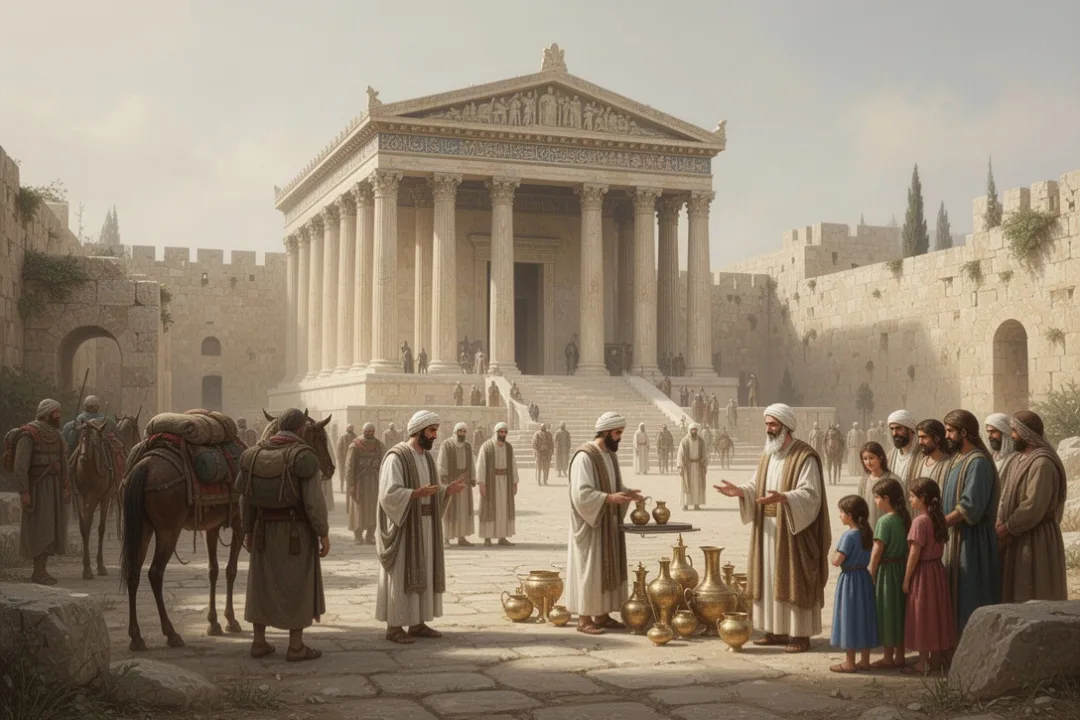
To understand Ezra, you need to know what happened before he arrived. Jerusalem had been conquered by Babylon, and many people from Judah were taken into exile. The temple was destroyed, the city was damaged, and the people lived far from the land associated with their history and worship.
Later, Persia conquered Babylon. The Persian king Cyrus permitted exiled peoples, including the Jews, to return to their lands and restore their sanctuaries. According to Ezra 1, Cyrus also authorized the return of temple vessels that Nebuchadnezzar had taken from Jerusalem.
The first group of Jewish returnees was led by figures including Sheshbazzar and Zerubbabel. The high priest Jeshua, also called Joshua in some translations, played a major role in restoring worship. The people rebuilt the altar, resumed sacrifices, and eventually completed the temple.
The temple’s rebuilding did not happen quickly or without conflict. Local opposition interrupted the project for a period, and official complaints were sent to Persian authorities. Under the later reign of Darius, the work resumed and the temple was completed. Ezra 6 places its completion in the sixth year of Darius, commonly dated to around 516 BC.
Ezra arrived after this earlier phase of restoration. His mission was different from Zerubbabel’s. Zerubbabel helped rebuild the temple; Ezra helped rebuild the community’s understanding and practice of God’s Law. The two responsibilities belonged together, but one could not substitute for the other.
The major stages of Ezra’s mission
Ezra’s story can be followed as a sequence of connected responsibilities. Each stage shows something about the kind of leader he was and the needs of the people he served.
He prepared himself through study. Ezra 7:10 describes a three-part pattern: he devoted himself to studying the Law, practicing it, and teaching it in Israel. His authority was rooted in both knowledge and obedience.
He received permission to travel. Artaxerxes granted Ezra permission to lead Jewish exiles to Jerusalem and provided support for temple worship. Ezra’s mission operated within the political realities of the Persian Empire.
He gathered people for the journey. Before leaving, Ezra assembled the returnees near the Ahava River. He discovered that no Levites had joined the group and took steps to bring temple servants into the mission.
He sought God’s protection. Ezra proclaimed a fast and prayed for safe travel. He had spoken to the king about God’s protection, so he did not request a military escort. This decision reflected his confidence in God, though it also involved genuine risk.
He delivered the resources safely. The silver, gold, and temple articles were carefully counted before and after the journey. This showed that spiritual leadership included practical accountability.
He taught the Law to the people. Ezra’s role was not merely administrative. He explained God’s commands and helped the community understand what covenant faithfulness required.
He responded to communal failure. When leaders reported marriages that threatened the community’s faithfulness, Ezra tore his clothing, prayed, and led the people through a painful process of confession and reform.
This sequence shows that Ezra combined scholarship, prayer, administration, teaching, and moral courage. He was not portrayed as a leader who relied on one gift alone. His work required careful preparation as well as decisive action.
What Ezra 7 says about his character
Ezra 7:10 is the clearest description of Ezra’s priorities. In paraphrased form, it says that Ezra had set his heart to study the Law of the Lord, to practice it, and to teach its statutes and judgments in Israel. This order matters.
Study came before teaching, and practice stood between the two. Ezra was not presented as someone who collected religious information simply to impress others. His learning was intended to shape his conduct, and his conduct gave credibility to his instruction.
The passage also helps distinguish a biblical scribe from the modern image of a copyist. Scribes could preserve written texts, but Ezra’s role included careful interpretation and public instruction. He knew that a community could possess sacred writings without living by them, so his task involved bringing the Law into the decisions of ordinary life.
Ezra’s character is also shown through his response to the king’s decree. He credited God with moving the king to support the mission, rather than presenting the opportunity as a personal achievement. Throughout Ezra 7 and 8, the narrative emphasizes God’s favor while still showing Ezra’s careful planning.
His leadership was not passive. He organized people, appointed responsible officials, managed valuable resources, and investigated a serious problem. Prayer and practical responsibility worked together in his ministry.
Why Ezra prayed and fasted before traveling
Ezra gathered the returnees by the Ahava River before their journey to Jerusalem. He realized that the group lacked enough Levites for temple service, so he sent representatives to find suitable ministers. This detail shows that Ezra was thinking about the community’s long-term worship, not only about reaching the destination.
He then announced a fast. The people humbled themselves and asked God to protect them, their children, and their possessions on the road. The journey involved vulnerable travelers carrying valuable temple gifts, so the request for protection was not abstract.
Ezra had told the king that God’s hand protects those who seek him. Because of that public confession, he did not ask the Persian king for soldiers and horsemen. He later acknowledged that God answered their prayer and guarded them from enemies and ambushes.
This episode does not mean that every faithful person must reject practical security or refuse assistance. The text presents a specific decision within Ezra’s circumstances. Its broader lesson is that Ezra tried to make his actions consistent with his stated faith. He did not want his public words about dependence on God to be empty claims.
How Ezra handled money and sacred objects
The Persian king authorized contributions of silver, gold, grain, wine, oil, and other supplies for worship in Jerusalem. Ezra received these resources on behalf of the temple and the returned community. Because the gifts were valuable and sacred, he treated their management as a serious trust.
Ezra selected priests and leaders to carry the treasures. Before departure, the items were weighed and recorded. After arrival, they were weighed again in Jerusalem and handed over to the temple personnel. The record of these procedures highlights transparency, shared responsibility, and careful stewardship.
Religious work still involves money, property, and institutional decisions. Ezra’s example suggests that trust in God does not remove the need for clear processes. Leaders should be willing to account for what they receive, especially when it belongs to a wider community or is dedicated to worship.
Practical lesson: Spiritual sincerity and good administration belong together. Ezra prayed for protection, but he also counted the temple treasures and assigned others to help carry them.
What happened when Ezra learned about forbidden marriages
After Ezra reached Jerusalem, officials told him that some Israelites, priests, and Levites had entered marriages with surrounding peoples. The concern in the text was not ethnicity alone. It centered on the danger that the returned community would adopt religious practices that conflicted with Israel’s covenant with God.
The report deeply distressed Ezra. He tore his clothing, pulled hair from his head and beard, and sat in shock. These actions expressed grief and alarm. He understood the problem as part of a larger history: the people had already experienced judgment and exile, and now they appeared to be repeating behavior that had contributed to earlier unfaithfulness.
Ezra’s prayer in Ezra 9 does not minimize the community’s wrongdoing. At the same time, he identifies with the people rather than presenting himself as morally separate from them. He speaks of collective guilt and acknowledges that God has shown mercy by allowing a remnant to survive and return.
His prayer follows a recognizable movement:
He acknowledges shame instead of defending the community.
He remembers God’s earlier judgment and the seriousness of disobedience.
He recognizes God’s mercy in preserving a remnant and restoring the temple.
He confesses the current failure without trying to make it seem smaller.
He leaves the community before God’s justice, admitting that no defense can excuse the breach.
The response to the problem was public and demanding. Shecaniah proposed a covenant process in which the men would separate from the foreign wives and children involved. Ezra accepted the proposal, required an oath, and called an assembly. The community investigated the cases and completed the process over time.
How to understand the difficult ending of Ezra
The final chapter can be painful for modern readers, especially because it describes families being separated. It should not be treated casually or used as a simple model for handling every interfaith or intercultural marriage. The passage belongs to a particular historical setting shaped by exile, covenant identity, temple restoration, and fears of religious assimilation.
Several details deserve attention. The concern was connected to idolatry and covenant unfaithfulness, not a theory of racial superiority. The book of Ruth, for example, presents a foreign woman who joins Israel and becomes part of the people. The biblical material does not support reducing every outsider to a threat.
At the same time, the narrative does portray the separation process as severe. Readers should acknowledge the human cost rather than smoothing it over. The book’s emphasis is that the returned community believed its survival depended on renewed loyalty to God, but the actions taken created real suffering within families.
For many readers today, the lasting application is not to reproduce the ancient policy mechanically. It is to examine how community identity, spiritual compromise, and leadership decisions interact. Ezra challenges people to take convictions seriously while also reminding interpreters to read difficult passages within their historical and canonical context.
What Ezra teaches about repentance
Repentance in Ezra is more than private regret. When the community’s failure became known, the people gathered, listened to the charge, confessed wrongdoing, and accepted a process for addressing it. The response involved public accountability and concrete change.
Ezra’s reaction also shows that repentance can begin with grief. He did not rush to protect the institution’s reputation or explain away the behavior of influential people. He allowed the seriousness of the situation to become visible.
Yet repentance in the book is not despair. Ezra’s prayer remembers that God had left a remnant, given the people a foothold, and allowed the temple to be restored. Mercy creates the possibility of reform. The people do not change in order to earn a second chance; they respond because they have already received one.
That pattern remains useful when a community discovers disobedience or institutional failure:
Tell the truth about what happened.
Refuse to excuse wrongdoing because respected people were involved.
Remember both the seriousness of judgment and the possibility of mercy.
Use a fair process rather than acting on rumor or anger.
Make changes that address the cause, not only the public appearance of the problem.
How Ezra and Nehemiah complement each other
Ezra and Nehemiah are often read together because their missions overlap. Nehemiah is especially associated with rebuilding Jerusalem’s walls and organizing civic leadership. Ezra is especially associated with teaching the Law and restoring religious faithfulness.
The distinction is useful, but it should not be exaggerated. Ezra also handled administration and public reform, while Nehemiah cared deeply about worship and covenant obligations. Both leaders faced opposition, addressed abuses, and depended on God while working within the Persian political system.
In Nehemiah 8, Ezra publicly reads and explains the Law while the people gather in Jerusalem. Levites help the people understand what is being read. The scene presents Scripture as something that must be explained so that the community can respond intelligently, not merely as a document to be displayed.
Together, the books suggest that a restored society needs both sound structures and spiritual formation. Walls can protect a city, but they cannot create faithfulness. Teaching can shape convictions, but a community also needs just administration and responsible leadership.
What Ezra in the Bible means for readers today
Ezra’s story speaks to people who are rebuilding after disruption. The disruption may be exile, migration, institutional failure, family conflict, or a long period of spiritual neglect. The book does not promise that restoration will be immediate. It shows that rebuilding usually involves several kinds of work at once.
First, restoration requires remembering what has been lost without allowing the past to become an excuse for inaction. The returned exiles inherited a damaged city and a difficult history, but they still rebuilt the altar and temple.
Second, restoration requires teaching. A community cannot preserve its identity through buildings, ceremonies, or labels alone. It needs people who understand its foundational convictions and can explain how those convictions apply to daily decisions.
Third, restoration requires leaders who practice what they teach. Ezra’s authority came from the relationship between his study, obedience, and instruction. Knowledge without obedience weakens leadership, while sincere obedience without careful understanding can also lead to confusion.
Fourth, restoration requires accountability. Ezra’s handling of temple resources and his response to communal wrongdoing show that spiritual language should not replace honest procedures. Faithful leadership includes both prayer and follow-through.
Finally, Ezra reminds readers that renewal can be uncomfortable. Correcting long-standing problems may expose respected people, complicate family relationships, and require decisions that no one would choose lightly. The book does not portray reform as painless, but it does portray truthfulness as necessary.
Common questions about Ezra’s identity and purpose
Ezra is sometimes confused with other leaders from the postexilic period, so several distinctions help. He was not the Persian king who authorized the return, and he was not the governor who rebuilt Jerusalem’s walls. He was a Jewish priest and scribe who came from Babylon to Jerusalem with authority to teach and enforce the Law.
His main contribution was spiritual and communal restoration. He helped organize worship, instructed the people, and confronted practices that threatened their covenant identity. His story is therefore more extensive than a brief biography: it is part of the Bible’s account of how a wounded people sought to live faithfully after judgment and displacement.
The Book of Ezra also emphasizes God’s providence through Persian rulers. The kings make decrees, provide resources, and authorize travel, yet the narrative repeatedly credits God with directing events. Ezra’s ministry therefore shows how religious communities may work within public institutions without confusing political permission with the source of their faith.
For a focused reading, begin with Ezra 7–10, then read Ezra 1–6 to understand the earlier restoration. After that, read Nehemiah 8 and the surrounding chapters to see how Ezra’s teaching ministry fits into the wider renewal of Jerusalem.
Frequently asked questions
Was Ezra a prophet in the Bible?
Ezra is identified primarily as a priest and scribe, not as one of Israel’s writing prophets. His authority came from his priestly ancestry, his knowledge of the Law, his obedience, and his responsibility to teach the people. He delivered no separate prophetic book, but his ministry carried a strong call to repentance and covenant faithfulness.
Did Ezra write the Book of Ezra?
The book does not directly state that Ezra wrote every part of it. Jewish and Christian traditions have associated the book with Ezra, and its later sections use first-person material connected with his mission. Modern readers generally recognize that the book has been shaped into a historical account using multiple sources and perspectives.
How long after the temple was rebuilt did Ezra arrive?
Ezra arrived after the temple had been completed, during the reign of Artaxerxes of Persia. The biblical account places the temple’s completion in the reign of Darius and Ezra’s journey much later. The exact number of elapsed years depends on how the Persian chronology and the book’s dates are interpreted.
Why is Ezra’s response to intermarriage so severe?
The issue in Ezra concerned the returned community’s fear of religious assimilation and renewed disobedience after exile. The passage reflects a specific covenant and historical setting, not a general permission to treat outsiders as inferior. Its family separations remain difficult, and responsible interpretation should acknowledge both the text’s concern about idolatry and the human cost of the action.







Leave a Reply