“Darius” was not necessarily a personal name used by only one ruler. The name appears in biblical books connected with different periods of the Persian Empire, and the Bible identifies some of these rulers by additional descriptions such as “the Mede” or “the Persian.”
The most familiar account is found in Daniel 6, where Darius the Mede becomes king after Babylon falls and places Daniel in danger by approving a decree that leads to the lions’ den. Other references occur in Ezra, Haggai, and Zechariah, where a Persian king named Darius supports or oversees the rebuilding of the temple in Jerusalem.
Most readers can organize the references into three categories:
Darius the Mede: the ruler connected with Daniel 5–9.
Darius I of Persia: the king during the temple’s reconstruction, especially in Ezra, Haggai, and Zechariah.
Darius the Persian: a later reference in Nehemiah 12:22, whose exact identification is discussed by interpreters.
Key distinction: Darius in Daniel 6 should not automatically be treated as the same person as Darius I, the Persian ruler who appears in the postexilic books.
How to identify each Darius in the biblical record
A helpful way to study the references is to follow the setting, the surrounding rulers, and the events associated with each name. The passages themselves provide several clues.
Check the book and chapter. Daniel’s Darius appears in the transition from Babylonian rule to the rule of the Medes and Persians. Ezra, Haggai, and Zechariah place their Darius during the restoration of Jerusalem and the temple.
Read the description attached to the name. Daniel calls one ruler Darius the Mede, while Nehemiah uses the expression Darius the Persian.
Observe the political setting. Daniel’s Darius rules after the fall of Babylon. Ezra’s Darius deals with correspondence about a temple project in the Persian province.
Compare the chronology. The rebuilding passages refer to the second, fourth, and sixth years of Darius. These details fit the reign of Darius I in the Persian period.
Keep disputed identifications separate from established events. The identity of Darius the Mede remains debated, but the biblical account of Daniel’s testing and the temple’s completion is clear within its own narrative.
Darius the Mede in Daniel 5 through 9
Darius the Mede enters the story at the end of Daniel 5. During a royal feast, King Belshazzar of Babylon sees mysterious writing appear on the wall. Daniel interprets the message as a warning that Babylon’s rule has been judged and will be given to the Medes and Persians. That same night, Belshazzar dies, and Darius the Mede receives the kingdom, according to Daniel 5:30–31.
Daniel 6 describes Darius organizing the kingdom with officials and administrators. Daniel stands out among them because of his integrity and competence. The other officials cannot find legitimate grounds for accusing him, so they target his faith. They persuade the king to approve a temporary law requiring everyone to petition the king alone rather than any god or human authority.
Darius signs the decree without recognizing how it will be used against Daniel. Daniel continues praying to God, as he had done before, and the officials report him. Because Persian royal decrees were treated as binding in the story, Darius cannot simply cancel the law. He reluctantly orders Daniel to be placed in a den of lions.
The king spends a troubled night and goes early to see whether Daniel’s God has rescued him. Daniel is found alive, and the king responds by punishing the officials who had plotted against him. Daniel 6 presents the episode as a demonstration of God’s ability to preserve a faithful servant even when an earthly ruler’s law has placed that servant in danger.
What Darius the Mede’s actions reveal about his rule
Darius is not portrayed as a consistently wise or independent ruler. He is powerful enough to issue a decree, but he is also vulnerable to pressure from court officials. His mistake is not open hostility toward Daniel; rather, it is allowing a flattering political proposal to become law without considering its consequences.
Once Daniel is condemned, Darius shows genuine distress. He does not celebrate the punishment or treat Daniel as an enemy. His reaction suggests that he respects Daniel and regrets the trap, but his understanding of royal law leaves him unable—or unwilling—to reverse the decision.
The account also contrasts human authority and divine authority. Darius’s decree appears irreversible, yet it cannot prevent God from protecting Daniel. At the end of the chapter, Darius issues a proclamation honoring Daniel’s God. The narrative moves him from confidence in royal power toward recognition that the God of Daniel rules beyond the reach of imperial commands.
Who was Darius the Mede?
The identity of Darius the Mede is one of the most discussed questions in the book of Daniel. The text gives several details: he was a Mede, he was sixty-two years old when he received the kingdom, and he was made ruler over the Chaldeans. Daniel 9:1 also calls him the son of Ahasuerus and describes him as of Median descent.
The biblical passage does not provide enough information to settle the identification for every reader. Several explanations have been proposed, including the possibility that Darius the Mede was:
A Median ruler known by another name in records outside the Bible.
A governor or subordinate ruler who governed Babylon under the larger Medo-Persian empire.
Another name or title for a ruler associated with the Persian conquest of Babylon.
A figure whose identity is preserved in the biblical account but is difficult to match with surviving ancient records.
Some interpreters have connected Darius the Mede with figures such as Gubaru, also called Gobryas in some historical discussions, or with a proposed Median king named Cyaxares II. Others have suggested that the name may relate to Darius I, though that view creates chronological and descriptive difficulties because Darius I is historically known as a Persian king who ruled later than the fall of Babylon.
These proposals should be distinguished from the central message of Daniel 6. The chapter’s main concern is not to provide a complete Persian succession list. It focuses on Daniel’s faithfulness, the danger of politicized law, and God’s deliverance. A reader can recognize the historical question without treating it as the entire meaning of the passage.
Reading tip: When a study Bible or commentary gives a proposed identity for Darius the Mede, treat it as an interpretation of the evidence rather than as a detail explicitly supplied by Daniel.
Darius I and the rebuilding of the Jerusalem temple
A different Darius appears in the books that describe the Jewish return from exile. Darius I, also called Darius the Great in historical writing, ruled the Persian Empire from the late sixth century into the early fifth century BC. The biblical references to his second, fourth, and sixth years fit the period when the temple in Jerusalem was restarted and completed.
After the Babylonian exile, Persian kings allowed Jewish exiles to return to Jerusalem and begin rebuilding the temple. The work did not proceed continuously. Opposition and official complaints interrupted the project, and Ezra 4:24 says the work stopped until the second year of the reign of Darius.
In Haggai 1, the prophet challenges the people because they have settled into their own houses while the temple remains unfinished. Haggai’s message calls the community to examine its priorities and resume the work. The people respond, and construction begins again during the second year of Darius.
Haggai 2 records further encouragement during that same reign. The prophet tells the leaders and people not to be paralyzed by the apparent weakness of the new temple compared with Solomon’s temple. The message directs their attention toward God’s presence and future purposes rather than toward the building’s immediate appearance.
Zechariah also dates several visions to the reign of Darius. In Zechariah 1 and 2, the prophet speaks to a community rebuilding after judgment and displacement. The visions address Jerusalem’s future, God’s concern for the city, and the hope that the restoration project represents.
How Darius I responded to the temple dispute in Ezra
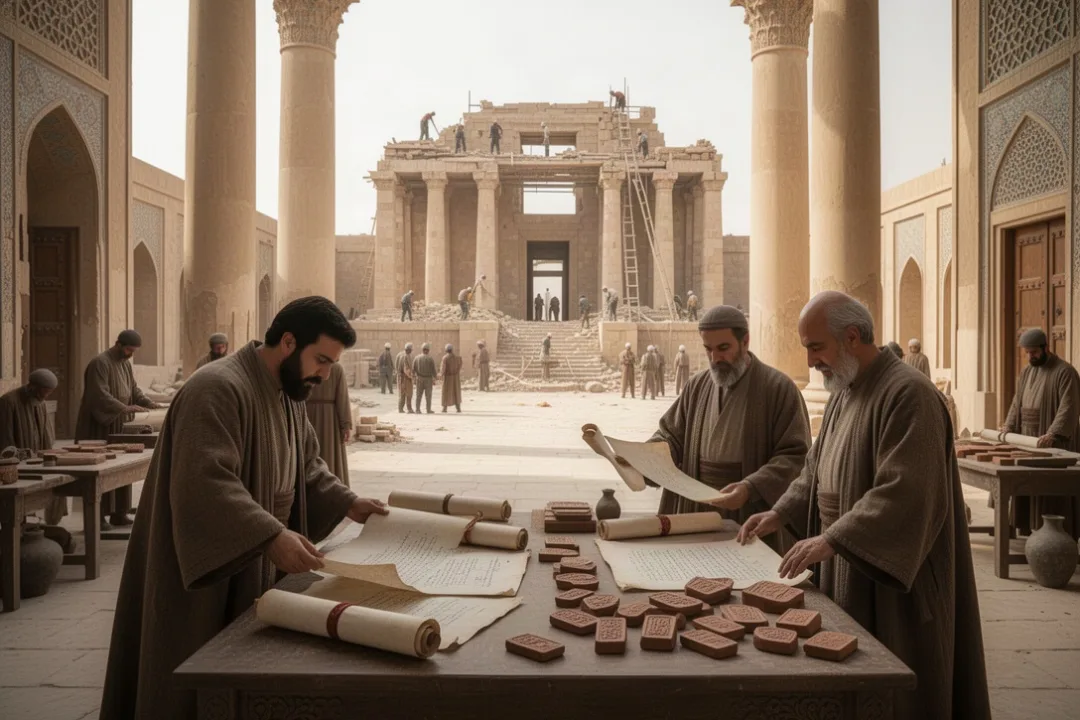
Ezra 5 describes a letter sent by Tattenai, a Persian official responsible for the region west of the Euphrates, to Darius. Tattenai asks whether the Jews have authorization to rebuild the temple. His letter does not simply report construction; it requests an official investigation into the earlier decree that supposedly permitted the work.
Darius orders a search of the royal archives. The records are found at Ecbatana, an important city associated with the Median and Persian realms. The document confirms that Cyrus had authorized the rebuilding of the temple and had provided instructions concerning its dimensions and expenses.
Darius then issues an order that protects the Jewish builders and prevents local officials from interfering. He instructs Tattenai to allow the work to continue and requires funding from the royal revenue of the province for the sacrifices connected with the temple. He also warns against changing the decree or obstructing the project.
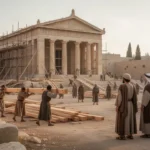
The story reaches its practical turning point in Ezra 6:15. The temple is completed in the sixth year of Darius’s reign. The dedication follows, and the returned exiles celebrate Passover. The biblical account therefore presents Darius I as the Persian king whose investigation ultimately confirmed Cyrus’s earlier authorization and enabled the temple project to reach completion.
Why Darius’s decree matters in Ezra
Darius does not become a worshiper of Israel’s God in the same way the Jewish community does. His role is that of an imperial king administering law and policy. Even so, his decision serves the restoration of Jerusalem and the temple.
Ezra emphasizes several ideas through this episode:
Past permissions still matter. The earlier decree of Cyrus had not disappeared simply because local opposition interrupted the work.
Archives can clarify contested authority. Darius orders a search rather than relying only on the current officials’ claims.
Imperial power can restrain local opposition. Once Darius confirms the record, officials must allow the project to continue.
Restoration unfolds through ordinary administration. The temple’s completion involves prophets, builders, local officials, written records, and royal commands.
The book of Ezra does not portray the rebuilding as effortless. The work depends on persistence and on the community’s response to prophetic instruction. Darius’s decree is significant because it removes a major administrative barrier and gives legal protection to the builders.
Darius in Haggai and Zechariah: the prophetic setting
Haggai and Zechariah name Darius mainly to establish the time of their messages. Their prophecies belong to the period when the returned Jewish community is rebuilding the temple and reestablishing life in Jerusalem.
Haggai’s message is direct: the people should not use economic hardship or personal priorities as reasons to postpone the temple indefinitely. The prophet connects their stalled work with a broader spiritual problem—God’s house has been neglected while private homes receive attention. The message is not a command to ignore ordinary responsibilities; it is a call to recognize the temple’s place in the community’s covenant life.
Zechariah’s visions add a broader perspective. They address guilt, restoration, leadership, protection, and Jerusalem’s future. The setting under Darius reminds the reader that the Jewish community is living under a foreign empire, yet the prophets insist that God remains active in the history of the city and its people.
Darius is therefore part of the political background rather than the theological center of these books. The prophets do not praise him as Israel’s covenant king. They locate God’s work within the reign of a Persian monarch, showing that the restoration of Jerusalem occurs under circumstances the community does not control.
Darius in Daniel compared with Darius in Ezra
The two main Darius figures occupy different narrative worlds. Daniel’s Darius rules immediately after Babylon’s fall and is associated with the Median identity. Ezra’s Darius rules during the later Persian period and is associated with the administrative process that confirms the temple’s rebuilding.
The contrast becomes clearer when the passages are read side by side:
Daniel 5–6: Darius receives Babylon after Belshazzar’s death, promotes Daniel, signs a dangerous decree, and witnesses Daniel’s rescue from the lions.
Daniel 9: Darius the Mede is named in connection with a prayer about Jerusalem’s desolation and the end of the exile.
Ezra 4–6: Darius investigates the imperial archives, confirms Cyrus’s temple decree, and supports the completion of the rebuilding.
Haggai and Zechariah: Darius provides the chronological setting for prophetic messages encouraging the returned community.
Nehemiah 12:22: Darius the Persian appears in a later genealogical or historical reference connected with priestly leadership.
The shared name can create confusion, but the surrounding details point to different contexts. Daniel focuses on Babylon’s transition and the testing of an individual servant. Ezra, Haggai, and Zechariah focus on the restoration of a worshiping community after exile.
What Nehemiah’s “Darius the Persian” may mean
Nehemiah 12:22 refers to records of priests and Levites being kept during the days of Eliashib, Joiada, Johanan, and Jaddua, “in the reign of Darius the Persian.” This reference occurs in a later priestly chronology than the main events of Ezra and Nehemiah.
Many interpreters associate this Darius with Darius II, a Persian king who ruled in the fourth century BC. The identification is not stated in a way that resolves every chronological question, and the verse has generated discussion because the list of high priests may extend beyond the period traditionally associated with Nehemiah.
This passage reinforces a useful principle: every occurrence of “Darius” must be read in its immediate setting. The name alone does not establish that the verse refers to Darius the Mede or Darius I.
What the Darius passages teach about power and faithfulness
The Darius narratives repeatedly place human government beside God’s larger purposes. In Daniel, a king’s decree cannot protect him from manipulation, and it cannot stop God from preserving Daniel. In Ezra, a Persian monarch’s archival investigation becomes the means by which a threatened building project receives legal protection.
The stories also show that political power is limited and morally complicated. Darius in Daniel has authority, yet he can be influenced by dishonest officials. Darius in Ezra has authority, yet he must investigate documents and rely on administrative information before deciding what to do.
For readers studying these passages, the most consistent themes include:
Faithfulness under pressure: Daniel continues his established practice of prayer even when a new law targets it.
Careful use of authority: rulers and officials are responsible for investigating claims rather than accepting convenient reports.
God’s sovereignty over empires: Babylonian and Persian rulers shape events, but they do not control the ultimate outcome.
Restoration after judgment: the temple and Jerusalem remain central to the hope of a community returning from exile.
The need for historical context: the same royal name can appear in different periods and serve different narrative purposes.
When you encounter “King Darius in the Bible,” begin by asking which book is speaking, what empire is in view, and what event surrounds the name. Darius the Mede belongs chiefly to Daniel’s account of Babylon’s fall and Daniel’s deliverance. Darius I belongs chiefly to the restoration account, where his reign provides the setting for the temple’s completion.
Frequently asked questions
Was Darius the Mede the same king as Darius I?
The Bible does not clearly identify them as the same person, and many interpreters distinguish them. Darius the Mede appears in Daniel as a Median ruler after Babylon’s fall, while Darius I was the historically well-known Persian king who reigned later and appears in Ezra, Haggai, and Zechariah. Several proposals exist for identifying Darius the Mede, but none is accepted by every scholar.
What did King Darius do to Daniel?
Darius approved a decree that temporarily restricted prayer to the king alone. Daniel continued praying to God, so officials accused him and forced Darius to apply the decree. The king ordered Daniel into a lions’ den but spent the night distressed. The next morning, he found Daniel alive and publicly acknowledged that Daniel’s God had rescued him.
Which Darius helped rebuild the temple in Jerusalem?
Darius I of Persia is the king connected with the temple’s completion in Ezra 4–6. When officials questioned the rebuilding project, Darius ordered a search of the royal archives. The records confirmed Cyrus’s earlier authorization, so Darius instructed local officials to let the work continue and help provide what was needed for the temple services.
Why are Haggai and Zechariah dated to Darius’s reign?
Their dates place the prophets’ messages during the period when the Jewish community had returned from exile and was rebuilding the temple. Haggai urged the people to resume the neglected work, while Zechariah encouraged them through visions of restoration and God’s continuing concern for Jerusalem. Darius’s reign provides the political and chronological setting for these messages.





Leave a Reply