If you are asking who built the Second Temple, the short answer is the Jewish community that returned from Babylonian exile, under the leadership of Zerubbabel and the high priest Joshua (also called Jeshua). Persian rulers made the rebuilding possible, but Jewish workers, priests, and worshipers carried it out.
The first structure was completed in the late sixth century BCE, commonly dated to 516 or 515 BCE. Centuries later, Herod the Great launched a massive reconstruction and expansion of the temple complex. That later work is why people sometimes refer to the building as Herod’s Temple, although it was an enlarged and renewed version of the Second Temple rather than an entirely separate temple.
Short answer: Zerubbabel organized the rebuilding, Joshua led the priesthood, and Jewish returnees did the work. Persian kings supported and protected the project; Herod later transformed the temple complex on a much larger scale.
How the Second Temple came after the Babylonian exile
The First Temple, traditionally associated with Solomon, stood in Jerusalem until the Babylonian conquest. Babylonian forces destroyed the city and temple in 586 BCE and deported many inhabitants to Babylon. The destruction ended the first temple period and left the Jewish community without its central sanctuary.
When the Persian king Cyrus the Great conquered Babylon in 539 BCE, the political situation changed. Persian policy allowed displaced peoples to return to their homelands and restore local religious institutions. According to the biblical books of Ezra and 2 Chronicles, Cyrus authorized the Jewish exiles to return to Jerusalem and rebuild their temple.
This permission did not mean that Cyrus personally designed or constructed the building. His role was primarily political and administrative: he allowed the return, supported the restoration of temple vessels, and authorized a rebuilding project. The actual work belonged to the returning Jewish community and its leaders.
Who led the rebuilding of the Second Temple?
The rebuilding depended on several leaders, each with a different responsibility. Zerubbabel served as the leading political figure among the returnees. He is described as a descendant of David and as the governor or appointed leader of the Persian province of Judah.
Joshua, or Jeshua, the high priest directed the religious leadership. He represented the priestly community and helped restore sacrifices and worship. Together, Zerubbabel and Joshua symbolized the cooperation of civil authority and religious authority in the restored community.
The prophets Haggai and Zechariah also played a major role. They encouraged the people to resume construction after the work had slowed or stopped. Their messages connected the rebuilding project with the community’s spiritual restoration and urged the leaders to continue despite opposition.
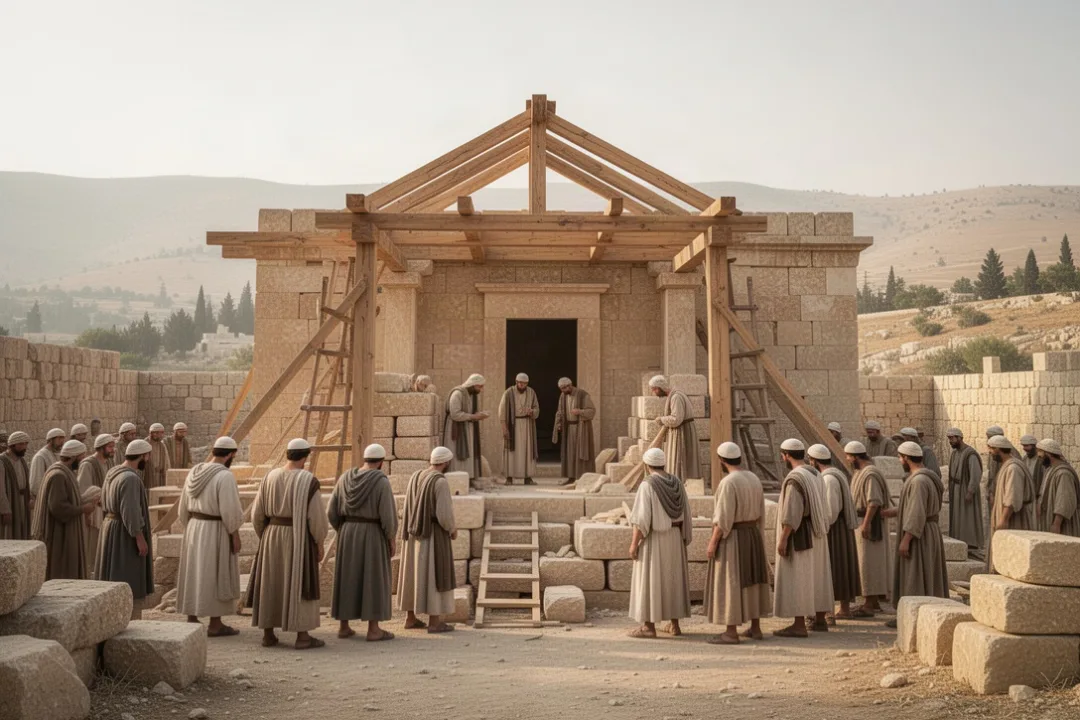
The workers themselves included priests, Levites, skilled craftsmen, laborers, and other Jewish families who had returned from exile. Some people came from Babylon and other parts of the former Judean population, while others were already living in the land. The project was therefore not the work of one ruler alone. It was a communal undertaking organized within the Persian imperial system.
How the rebuilding happened step by step
The biblical account presents the construction as a process rather than a single event. The main stages can be outlined as follows:
Persia conquered Babylon. Cyrus the Great took control of Babylon in 539 BCE, changing the political conditions for the exiled Jewish population.
Jewish exiles returned to Jerusalem. A group came back under Zerubbabel and Joshua, bringing temple vessels and resources connected with worship.
The altar was restored first. The returning community rebuilt the altar and resumed sacrifices before the sanctuary itself was finished.
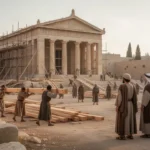
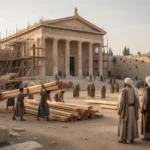
The temple foundations were laid. Construction began on the temple platform and foundation, prompting both celebration and grief among the people who remembered the First Temple.
Construction faced resistance and delay. Political complaints and local opposition contributed to a long interruption in the work.
Haggai and Zechariah encouraged the leaders. Their preaching helped restart the project during the reign of Darius I.
Persian authorities confirmed the earlier authorization. Darius ordered officials to allow the construction to continue and to provide support from provincial resources.
The temple was completed. The building was finished in the sixth year of Darius I, usually dated to 516 or 515 BCE.
The sequence matters because it shows that the Second Temple did not appear immediately after the return from exile. Restored worship came before completed construction, and the project moved through periods of enthusiasm, opposition, and delay.
What role did Cyrus the Great play?
Cyrus was the ruler who created the conditions for the Second Temple’s rebuilding. His decree is described in the Bible as permitting the Jewish exiles to return to Jerusalem and rebuild the house of their God. The account also says that temple vessels taken by Nebuchadnezzar were returned.
In practical terms, Cyrus acted as the imperial sponsor and authorizing ruler. The Persian Empire controlled Judah, so a major temple project required official approval. Without permission to return and build, Zerubbabel and the Jewish community would have faced a much more difficult political situation.
Cyrus should not be described as the temple’s builder in the same sense as the Jewish returnees. He did not lead the construction crew or serve as its religious head. His contribution was the authorization and support that allowed the community to undertake the work.
The rebuilding joined Persian authorization with Jewish leadership, labor, worship, and communal resources.
Why did the Second Temple take so long to finish?
The first returnees appear to have begun work with considerable energy, but construction later stalled. The biblical book of Ezra describes opposition from people in and around Judah who objected to the rebuilding. Complaints were sent to Persian officials, and the project was interrupted for a period.
The political setting also changed as Persian kings succeeded one another. Projects in a provincial capital could be affected by local disputes, changes in administration, funding questions, and uncertainty over imperial policy. Even when no single event explains every detail, the result was a long pause between the initial foundation work and final completion.
During the reign of Darius I, the prophets Haggai and Zechariah urged Zerubbabel, Joshua, and the people to resume construction. Their messages addressed discouragement as well as practical delay. Some members of the older generation remembered the grandeur of the First Temple and may have considered the new building disappointing by comparison.
Darius’s officials investigated the project and found the earlier authorization associated with Cyrus. The king then permitted the work to continue and directed that expenses be paid from the revenues of the region. This decision gave the builders legal protection and financial assistance within the Persian system.
What did the first Second Temple look like?
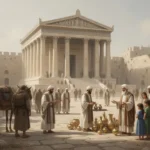
The earliest Second Temple was designed as a replacement sanctuary on the site traditionally associated with the First Temple in Jerusalem. Its essential function was to house the altar and support the sacrificial worship led by the priests. It also provided the central location for major Jewish festivals and communal religious life.
Precise details about its architecture are limited. The biblical sources describe the rebuilding and some of its measurements, materials, and furnishings, but they do not give a complete architectural plan that allows modern readers to reconstruct every feature with certainty.
The first Second Temple was likely more modest than the temple traditionally attributed to Solomon. That difference helps explain why some older people reportedly wept when they saw its foundations. Yet its size did not determine its religious significance. For the restored community, the sanctuary represented the return of Jewish worship in Jerusalem after the trauma of exile.
The temple served several connected purposes:
Sacrificial worship: priests offered sacrifices according to Jewish religious law.
Festival observance: major pilgrimage festivals centered on worship in Jerusalem.
Priestly service: priests and Levites organized the daily and seasonal duties of the sanctuary.
National and communal identity: the temple linked the returning population with Jerusalem and its ancestral traditions.
Religious teaching and memory: the restored sanctuary expressed continuity with earlier Jewish history while marking a new period after exile.
Who paid for and supplied the construction?
The returning community contributed labor, offerings, and local resources. The biblical accounts describe gifts from families and leaders, along with materials needed for construction. The Persian government also played a role, especially after Darius confirmed the project’s authorization.
Materials included stone and timber, with cedar associated with Lebanon and the surrounding region. Transporting such materials required organization and cooperation among local communities. The project also depended on people who understood construction, priestly service, administration, and supply management.
Persian support did not erase Jewish responsibility for the project. Imperial funding and authorization made the work possible, but the building expressed the priorities of the Jewish community. The temple was built for Jewish worship, by people connected to the restored community, under Jewish religious leadership.
Was the Second Temple built by Nehemiah or Ezra?
Neither Ezra nor Nehemiah is normally credited with building the original Second Temple. The first rebuilding phase is associated chiefly with Zerubbabel and Joshua, and the temple was completed before Ezra and Nehemiah appear in the biblical narrative.
Ezra was a priest and scribe who helped teach and apply the law of Moses among the Jewish community. Nehemiah served as a Persian-appointed governor and led the rebuilding of Jerusalem’s city wall in the fifth century BCE. Their work strengthened and reorganized the community after the temple had already been completed.
Ezra and Nehemiah were therefore important figures in the broader restoration of Jerusalem, but assigning the temple’s initial construction to them confuses separate stages of the postexilic period. The temple came first; later leaders helped establish the religious, civic, and social structures around it.
What did Herod the Great do to the Second Temple?
Herod the Great began a major renovation and expansion of the temple complex around 20 or 19 BCE. He was the Roman-backed king of Judea, and the project helped him strengthen his political position while presenting himself as a patron of Jewish worship and Jerusalem.
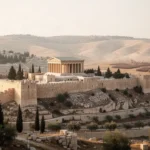
Herod’s work was extensive enough to transform the appearance and scale of the site. He enlarged the platform, rebuilt or improved the sanctuary, added courts and surrounding structures, and created monumental retaining walls. The western retaining wall visible today is commonly known as the Western Wall, although it is part of the larger supporting complex rather than the sanctuary building itself.
Construction continued beyond Herod’s lifetime. The temple complex became one of the most impressive architectural sites in the ancient Mediterranean world. Its courts could accommodate large numbers of pilgrims, and its expanded platform gave Jerusalem a monumental religious center.
Even so, Herod did not build the Second Temple from scratch. He renovated, enlarged, and beautified an existing temple whose history began with the return from Babylon. Calling the later structure “Herod’s Temple” is useful for identifying its final major form, but the building still belongs to the Second Temple period.
Keep the two phases separate: Zerubbabel’s community built the Second Temple after the exile; Herod later rebuilt and expanded that temple complex. Herod was not the original builder.
How the Second Temple differed from Solomon’s Temple
The First and Second Temples occupied the same general sacred location in Jerusalem, but they belonged to different historical periods. The First Temple was destroyed by Babylon in 586 BCE. The Second Temple was built after the Persian conquest of Babylon and remained in use for centuries.
The Second Temple period also involved different political rulers. The first temple was associated with the monarchy of Judah, while the rebuilt temple began under Persian rule. Later it stood under Hellenistic, Hasmonean, and Roman influence before its destruction by Roman forces.
Traditions also emphasize differences in the sacred furnishings and divine presence associated with the two buildings. The Second Temple did not simply reproduce every feature of the First Temple in an identical way. Its history was shaped by exile, foreign rule, changing priestly institutions, and the religious developments of the centuries that followed.
Its religious importance nevertheless remained immense. The temple became the center of Jewish pilgrimage, sacrifice, priestly service, and public worship. It also shaped the setting for many events described in later Jewish writings and the New Testament.
When was the Second Temple destroyed?
The Second Temple stood for roughly six centuries, although its final appearance reflected repeated repairs and Herodian expansion. In 70 CE, Roman forces captured Jerusalem during the First Jewish Revolt and destroyed the temple.
The destruction marked a profound change in Jewish religious and national life. With the sanctuary gone, Jewish communities developed forms of worship and study that did not depend on sacrifices in Jerusalem. Rabbinic Judaism eventually became the dominant framework of Jewish religious life, with prayer, Torah study, communal practice, and synagogue worship taking central roles.
The date 70 CE refers to the destruction of the Herodian form of the Second Temple. It does not mean that the original postexilic building had remained untouched for six hundred years. The structure had been expanded, repaired, and altered, especially during Herod’s building program.
What the biblical books say about the builders
The main biblical accounts appear in Ezra, Haggai, Zechariah, and parts of 2 Chronicles. These sources present the return from exile, the restoration of the altar, the laying of the foundation, the interruption of construction, and the eventual completion of the temple.
Ezra focuses on imperial authorization, the return of temple vessels, opposition, and the administrative steps that allowed construction to resume. Haggai addresses Zerubbabel and Joshua directly, urging them to give renewed attention to the temple. Zechariah presents visions and encouragement connected with the leaders and the restored community.
These books do not portray the project as the achievement of one heroic builder. They name leaders, but they also emphasize the participation of the wider community. Priests, Levites, family groups, officials, and workers all appear within the story of restoration.
Other historical details come from later sources and archaeological research, but the biblical narrative remains the principal ancient account of the Second Temple’s original construction. It should be read with attention to its religious purpose as well as its political and building history.
Why the answer depends on what “built” means
The question can produce different answers because “built” may refer to several stages. If you mean who initiated the postexilic rebuilding, the answer is Zerubbabel and Joshua with the returning Jewish community. If you mean who gave permission, Cyrus is central. If you mean who ensured the work could resume under Persian rule, Darius I is important.
If you mean the monumental form seen in the time of Jesus, then Herod the Great deserves attention. He did not establish the Second Temple period, but his building program reshaped its most famous version. If you mean who physically performed the labor, the answer includes many Jewish craftsmen, laborers, priests, and community members whose individual names are mostly not preserved.
Original postexilic builders: Jewish returnees from Babylon and their descendants.
Political leader: Zerubbabel.
Religious leader: Joshua, the high priest.
Imperial authorization: Cyrus the Great.
Imperial confirmation and support: Darius I.
Major later renovator: Herod the Great.
Final destroyer: Roman forces in 70 CE.
The most accurate one-sentence answer is therefore: the Second Temple was built by Jewish returnees from the Babylonian exile under Zerubbabel and Joshua, with Persian approval, and was later extensively rebuilt and expanded by Herod the Great.
How to remember the timeline
A simple timeline helps keep the different builders and rulers distinct:
586 BCE: Babylon destroys the First Temple and takes many Judeans into exile.
539 BCE: Cyrus the Great conquers Babylon.
Late sixth century BCE: Jewish exiles return and begin restoring worship and rebuilding the temple.
Reign of Darius I: construction resumes after delay and receives official confirmation.
516 or 515 BCE: the Second Temple is completed.
Fifth century BCE: Ezra and Nehemiah help strengthen the restored religious and civic community.
20 or 19 BCE: Herod begins his major renovation and expansion of the temple complex.
70 CE: Roman forces destroy the Herodian Second Temple.
This timeline separates the original rebuilding after exile from the later Herodian reconstruction. It also explains why several different names appear in answers to the same question.
What happened to the temple after its destruction?
After the Romans destroyed the temple, its central sacrificial system could no longer operate. Jewish communities faced the challenge of preserving religious identity without the sanctuary, priestly service, or pilgrimage system that had defined the Second Temple period.
Religious life increasingly centered on synagogues, prayer, Torah study, charity, and communal practice. Jewish mourning for the destroyed temple remained a significant feature of religious tradition, and Jerusalem continued to hold unique sacred importance.
The temple site also remained politically and religiously contested. The surviving retaining walls, especially the Western Wall, became an important place of Jewish prayer. They are remnants of the expanded platform associated with Herod’s temple complex, not surviving walls of the sanctuary’s inner building itself.
Understanding who built the Second Temple therefore requires more than naming Herod or Zerubbabel. The temple was a long historical project: begun by a returning Jewish community, authorized within the Persian Empire, completed under Darius, transformed by Herod, and destroyed by Rome.
Frequently asked questions
Was the Second Temple built by King Solomon?
No. Solomon is traditionally associated with the First Temple, which was destroyed by the Babylonians in 586 BCE. The Second Temple was built after the Babylonian exile by Jewish returnees led by Zerubbabel and the high priest Joshua. Herod the Great later expanded and renovated it, creating the monumental form known from the late Second Temple period.
Did Cyrus the Great build the Second Temple?
Cyrus did not personally construct it. As Persian king, he authorized Jewish exiles to return to Jerusalem and supported the restoration of their temple. The construction was carried out by the returning Jewish community, under Zerubbabel’s political leadership and Joshua’s priestly leadership. Cyrus’s role was crucial, but it was one of permission and imperial support.
Is Herod’s Temple the same as the Second Temple?
Herod’s Temple refers to the extensively rebuilt and enlarged version of the Second Temple. Herod began the project around 20 or 19 BCE, long after the original postexilic temple had been completed. Because the sanctuary remained part of the same historical temple tradition, Herod’s structure is generally treated as the final phase of the Second Temple.
How long did the Second Temple stand?
The original Second Temple was completed around 516 or 515 BCE and the Herodian version was destroyed by Roman forces in 70 CE. That means the Second Temple period lasted roughly six centuries, although the building changed substantially through repairs, renovations, and Herod’s large-scale expansion.



Leave a Reply