The Book of Tobit is a Jewish wisdom story about Tobit, a righteous Israelite living in exile, and his son Tobias, who travels with the archangel Raphael. Along the way, Tobias meets Sarah, a woman troubled by the demon Asmodeus, and the family experiences healing, marriage, and restored prosperity.
Tobit is included in the Catholic and Orthodox Old Testaments but is generally placed among the Apocrypha in Protestant Bibles. Its central message is that faithful living matters even during suffering, and that God’s care may work through ordinary acts of charity, family loyalty, prayer, and wise guidance.
The Book of Tobit is a short religious narrative written in the form of a family story. It combines historical settings, wisdom teaching, travel adventure, prayer, romance, and a dramatic healing. The book is not presented as a legal code or a collection of prophetic sermons. Instead, it teaches through the experiences of one family.
The story begins with Tobit, an Israelite from the northern kingdom, living among exiles in Nineveh. He identifies himself as a descendant of Naphtali and describes his commitment to practices such as giving food to the hungry, burying the dead, and observing religious customs while away from the land of Israel. These details establish him as a man who tries to remain faithful under difficult circumstances.
Different Christian traditions classify Tobit differently. It is part of the deuterocanonical books in Catholic Bibles and is accepted in the broader Old Testament tradition of Eastern Christianity. Many Protestant traditions do not treat it as Scripture, although some historic Protestant editions included it in a separate section called the Apocrypha.
The book survives in more than one textual form. The Greek text was especially influential in Christian transmission, while fragments of Tobit were also found among the Dead Sea Scrolls in Aramaic and Hebrew. Differences among surviving versions can affect wording, names, and certain details, but the main story and religious themes remain recognizable.
How to approach its authority: Read Tobit according to the Bible tradition you follow. Even where it is not included in the Protestant canon, it remains an important ancient Jewish work that shaped Christian reflection on prayer, charity, marriage, angels, and faithful life in exile.
The setting helps explain the book’s concerns. Tobit’s family is separated from Jerusalem and lives under foreign rule. The characters cannot simply assume that religious identity will be protected by their surroundings. Their faith is expressed through daily decisions: what they eat, how they treat the dead, whom they help, and how they respond when misfortune strikes.
What happens in the story of Tobit
Tobit’s righteousness and suffering
Tobit opens by presenting its main character as a generous and observant man. He gives alms, supports relatives, and buries Israelites who have been killed. These actions create conflict with the authorities, and Tobit eventually has to flee. After the danger passes, he returns to Nineveh but continues burying the dead in secret.
His devotion does not protect him from hardship. While sleeping outdoors near a wall, Tobit is blinded when bird droppings fall into his eyes. His blindness causes humiliation and tension at home. His wife, Anna, works to support the household, and when Tobit questions how she obtained a young goat, she answers sharply. The scene shows that even a faithful marriage can be strained by poverty, disability, and fear.
Tobit responds to his suffering with a prayer that expresses despair and asks God to end his life. His prayer is not treated as the final answer to his pain. At the same time, another prayer is being offered by Sarah, a young woman living in Media. Her situation is also desperate: seven husbands have died before the marriage could be consummated, and a demon named Asmodeus is blamed for their deaths.
Sarah’s prayer and Tobias’s journey
Sarah is mocked by one of her father’s servants, who accuses her of causing the deaths. In grief, she considers ending her life, but instead turns to prayer. She asks God to show mercy and to rescue her from disgrace. The parallel between Tobit’s prayer and Sarah’s prayer links the two households before the characters ever meet.
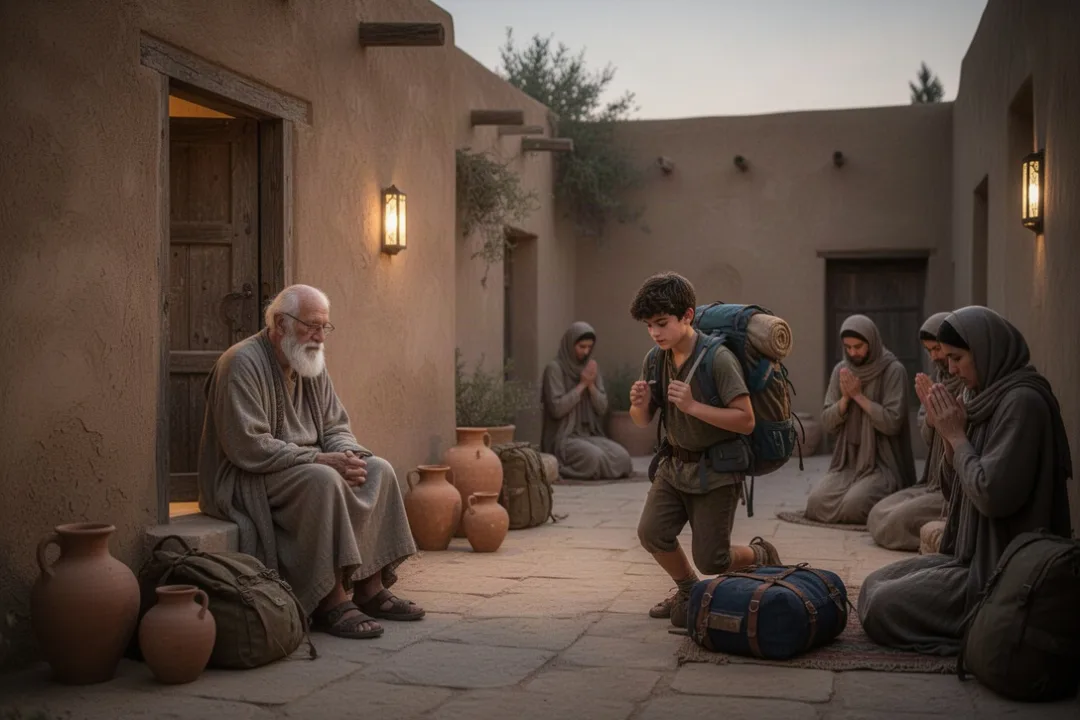
God hears both prayers and sends the angel Raphael. Raphael does not immediately appear as an angel. He takes the human name Azariah and presents himself as a traveling companion who can guide Tobias on a journey to Media.
Tobias needs to travel because Tobit remembers money that he deposited with a relative named Gabael in a distant city. Tobit sends Tobias to recover it. The trip is practical, but it also becomes the setting for Tobias’s spiritual education, his meeting with Sarah, and the family’s eventual healing.
A large fish attacks Tobias as he washes in a river. Raphael tells him to catch it and preserve its heart, liver, and gall. The organs later become instruments of healing: the heart and liver drive away the demon, while the gall helps restore Tobit’s sight. The story presents these actions as effective because of God’s providence working through Raphael’s instruction, not as a general formula for magical treatment.
Tobias and Sarah’s marriage
Raphael leads Tobias to Sarah’s home and explains that he should marry her. Tobias is afraid because he knows what happened to her previous husbands. Raphael instructs him to use the fish’s heart and liver in the bridal chamber. The smoke drives away Asmodeus, who is then pursued and restrained by Raphael.
The marriage scene emphasizes prayer before intimacy. Tobias and Sarah do not treat marriage as a way to escape fear or social shame. They pray together, asking God for mercy, protection, and a long life. Their prayer recognizes marriage as a relationship that should be grounded in faithfulness rather than driven only by physical desire.
Sarah’s parents fear that Tobias has also died, so they prepare a grave in advance. When Tobias survives the night, the household celebrates. The father-in-law, Raguel, had promised a large dowry, but the marriage also creates a deeper bond between two families that have endured grief and social pressure.
Healing, return, and Raphael’s identity
While Tobias and Sarah remain in Media, Raphael retrieves Tobit’s money from Gabael. The travelers then return to Nineveh. Anna sees Tobias approaching and runs to meet him, while Tobit, still blind, follows. Tobias applies the fish’s gall to his father’s eyes, and Tobit’s sight is restored.
The family’s happiness grows when Sarah arrives. Tobit praises God, welcomes his daughter-in-law, and celebrates the healing of both households. At the end, Raphael reveals that he is one of the angels who stand before God. He explains that the prayers and acts of charity had been remembered before God.
Raphael then tells the family to bless God and to make known what God has done. The book closes with Tobit’s praise and his reflections on Jerusalem, Israel, and the future restoration of God’s people. Its ending connects the private healing of one household with the larger hope of communal renewal.
What the main themes of Tobit mean
Faithfulness during exile
Tobit’s family lives outside the homeland and must maintain its identity in a foreign environment. The book repeatedly asks what faithfulness looks like when a person lacks political power or public security. Tobit’s answer is concrete: pray, give generously, honor family obligations, and care for vulnerable people.
The story does not suggest that religious devotion prevents suffering. Tobit is blinded despite his charitable life, and Sarah suffers despite her desire for a proper marriage. Their experiences challenge the assumption that hardship automatically proves someone has done wrong. The book allows faithful people to be wounded, discouraged, and confused while still remaining connected to God.
Charity and burial of the dead
Almsgiving is one of Tobit’s strongest moral themes. Tobit tells Tobias to give generously and to practice righteousness, linking charity with a life that is rightly ordered before God. His care for the dead is equally significant. He risks his safety to bury murdered Israelites, treating the dead as people who still deserve dignity.
These acts are not presented as ways to purchase divine favor. They reveal the kind of person Tobit is and show how faith becomes visible through treatment of other people. The book places mercy toward the poor and respect for the dead near the center of religious obedience.
Readers should also notice the cost of Tobit’s charity. He does not help others from a position of comfort and influence. His actions expose him to danger and contribute to his family’s insecurity. Tobit therefore presents generosity as a serious moral commitment rather than a decorative virtue.
Prayer as honest dependence on God
Prayer shapes the entire plot. Tobit and Sarah pray separately when they feel trapped, and their prayers become the point where their stories intersect. Tobias and Sarah pray together before their marriage, and Tobit prays in gratitude after his healing.
The book includes different forms of prayer:
Lament: Tobit and Sarah bring grief, shame, and exhaustion directly before God.
Petition: They ask for rescue, healing, and release from suffering.
Marriage prayer: Tobias and Sarah seek a faithful life together rather than relying only on desire.
Thanksgiving: Tobit praises God after discovering how his family has been helped.
Blessing: Raphael directs the family to acknowledge God’s work publicly.
Prayer in Tobit is not passive resignation. Tobias still travels, follows instructions, collects money, marries Sarah, and treats his father’s blindness. The story joins trust in God with responsible action.
Family loyalty and intergenerational wisdom
Tobit’s guidance to Tobias occupies a major part of the book. He teaches his son to honor parents, avoid sexual wrongdoing, practice fairness, give alms, and choose a suitable spouse. These instructions are practical rather than abstract. They describe the habits that should guide Tobias when he is far from home and no longer under his father’s direct supervision.
Family life is not idealized. Anna challenges Tobit, Tobias faces danger, and Sarah’s household carries deep fear. Still, the family members remain connected through concern, prayer, and mutual responsibility. Parental wisdom and marital fidelity become means through which God’s care is experienced.
Angels, healing, and divine providence
Raphael is one of the most memorable angels in biblical literature. He acts as a guide, messenger, healer, protector, and bringer of hidden knowledge. His disguised identity reinforces a central idea: divine help may be present before people recognize it.
The story’s fish episode can seem strange to modern readers. Its purpose is not to provide a medical textbook or a general recipe for curing blindness and spiritual oppression. The fish is part of the narrative’s symbolic and miraculous world, where God uses material means through Raphael’s direction to bring healing.
Read the healing carefully: Tobit distinguishes between the visible action and its deeper source. Tobias handles the fish and follows Raphael’s instructions, but the family ultimately credits God with healing, protection, and deliverance.
What Tobit teaches about marriage and moral life
Tobit gives unusual attention to the purpose of marriage. Tobias is warned against marrying only for wealth, appearance, or physical attraction. Sarah is presented as a person with dignity and faith, not merely as a solution to Tobias’s problem or a reward at the end of his journey.
The prayer of Tobias and Sarah before their marriage is central to this teaching. They ask for mercy and for a long life together, but they also acknowledge that marriage should reflect a lasting bond. Their relationship is connected with self-control, mutual respect, and a desire to build a household shaped by God.
The book also addresses sexual ethics through Tobias’s instruction. Marriage is not treated as a license for selfish behavior. Tobias is urged to act with honorable intentions, and the narrative contrasts faithful marriage with the destructive pattern associated with Sarah’s earlier husbands.
Readers should avoid reducing the story to a simple promise that good marriages will never face trouble. Sarah and Tobias still begin their life together under fear, financial uncertainty, and family anxiety. The book’s point is that a marriage can be placed within prayer, responsibility, and fidelity even when circumstances are not easy.
Tobit’s moral advice extends beyond marriage. His instructions to Tobias include several recurring principles:
Honor your parents and listen to trustworthy counsel.
Give to people in need instead of treating wealth as private property.
Pay workers fairly and do not exploit the vulnerable.
Avoid arrogance, dishonesty, and sexual misconduct.
Keep promises and fulfill responsibilities promptly.
Pray while also taking prudent, concrete action.
These teachings make Tobit resemble other Jewish wisdom writings. Like Proverbs and Sirach, it assumes that a good life involves habits, discipline, generosity, and wise relationships. Yet Tobit places those teachings inside an adventure story, allowing readers to see how moral choices affect an actual family.
How to read the Book of Tobit today
A useful reading begins with the book’s genre. Tobit contains recognizable places and historical references, but it is best read as a religious wisdom narrative rather than as a modern chronicle. Its dramatic coincidences, hidden angel, dangerous demon, and healing fish serve theological purposes within the story.
Pay attention to repeated patterns. Tobit and Sarah both pray in distress. Tobias receives guidance before he understands its importance. The family begins with separate wounds and ends with shared restoration. These patterns show that the book is carefully shaped around prayer, providence, and healing.
Several questions can help you read each chapter:
What kind of suffering is affecting the characters at this point?
How does each person respond: through fear, anger, prayer, courage, or generosity?
Which action protects another person’s dignity?
What does Tobias learn from Tobit and Raphael?
How does the family recognize God’s help after the danger has passed?
The book can also be read alongside other biblical passages about exile, almsgiving, marriage, angels, and healing. Its emphasis on burial and care for the dead connects with broader Jewish concerns about communal responsibility. Its prayers resemble the biblical pattern of bringing anguish honestly before God and then offering praise after deliverance.
Different translations may use slightly different spellings, including Tobit and Tobias or related forms for names in the story. The wording of prayers can also vary because the book comes through different ancient textual traditions. Comparing translations may clarify why a detail appears differently without changing the overall narrative.
The Book of Tobit is especially valuable for readers who want to explore how faith operates in ordinary family life. It does not place holiness only in dramatic public acts. It finds religious meaning in feeding someone who is hungry, burying someone who has been abandoned, listening to a parent, protecting a spouse, and giving thanks after recovery.
Its final vision is larger than one family’s happiness. Tobit’s praise looks toward the restoration of Jerusalem and the gathering of God’s people. Personal healing becomes a sign of a wider hope: suffering and displacement do not have the last word, and faithful actions remain meaningful even when their results are not immediately visible.
Frequently asked questions
Is the Book of Tobit part of the Bible?
It depends on the Christian tradition. Tobit is included in Catholic and Orthodox Bibles as a deuterocanonical book. Many Protestant Bibles exclude it from the Old Testament, although some editions print it separately among the Apocrypha. Jewish and Protestant traditions generally do not treat it as part of their scriptural canon.
Who is Raphael in the Book of Tobit?
Raphael is an angel sent by God to assist Tobit, Tobias, and Sarah. He travels with Tobias while appearing to be a human guide named Azariah. Raphael helps Tobias complete his journey, defeat the demon troubling Sarah, recover Tobit’s money, and restore Tobit’s sight before revealing his true identity.
What is the significance of the fish in Tobit?
The fish represents a means of healing and protection within the story. Raphael tells Tobias to preserve its heart, liver, and gall. The first organs help drive away Asmodeus, while the gall restores Tobit’s sight. The narrative attributes the healing ultimately to God’s providence rather than to an independent magical power.
What is the main lesson of Tobit?
Tobit teaches that faithful living includes prayer, charity, family responsibility, moral discipline, and trust during suffering. Its characters do not avoid hardship because they are righteous, but their prayers and actions lead toward healing. The book also emphasizes that God’s help may work through ordinary people, wise guidance, material actions, and unexpected circumstances.








Leave a Reply