Chronological Old Testament: A Practical Reading Order
Chronological Old Testament: A Practical Reading Order
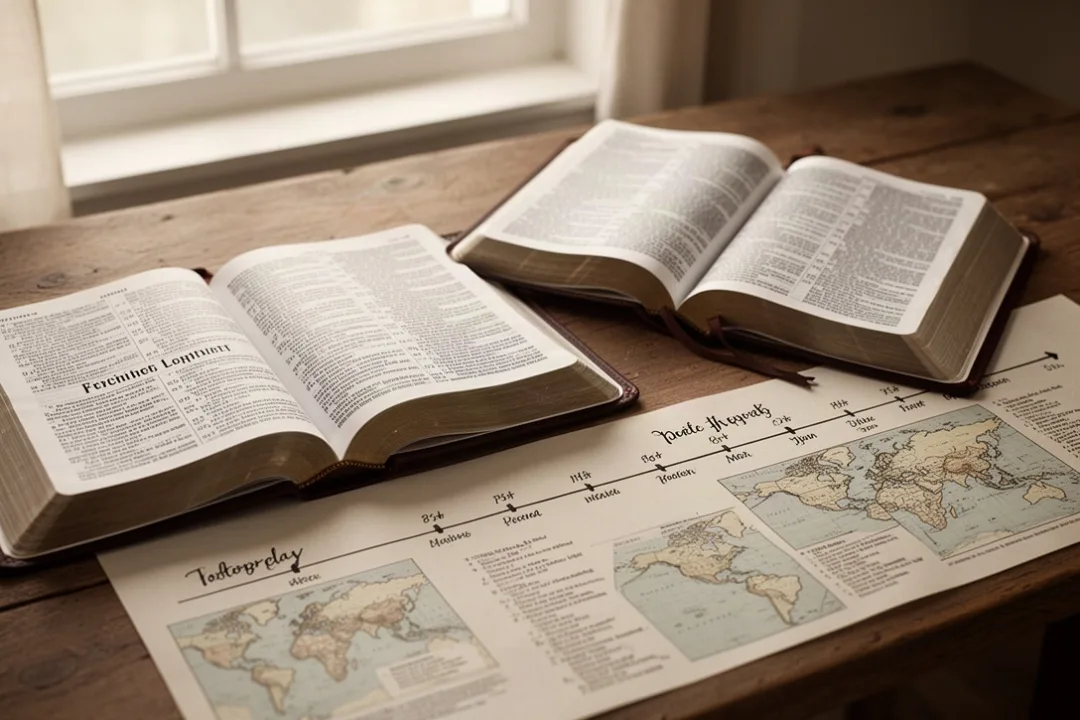
You may have started reading Genesis, Exodus, and Leviticus in order, then wondered why the Old Testament suddenly shifts between history, poetry, and prophecy. The answer is that the Bible’s canonical order is not the same as the order in which events happened. A chronological Old Testament reading plan places books and passages alongside the historical periods they describe or address.
That approach can make the storyline easier to follow, especially when you reach books such as Isaiah, Jeremiah, and the minor prophets. These writings often speak during events recorded in Kings and Chronicles, so reading them near those events can clarify their warnings, hopes, and historical setting.
Important distinction: No chronological arrangement is perfectly certain. Some books cover broad periods, some overlap, and the date of Job is debated. A useful reading order should show the main storyline clearly while acknowledging where the evidence is uncertain.
Why the Old Testament is not arranged in historical order
The Old Testament is organized according to several purposes rather than one continuous timeline. In many Christian Bibles, the books begin with the Law, continue through historical books, and then move to poetry and prophecy. That arrangement helps readers recognize different kinds of writing, but it does not place every book beside the events it describes.
For example, Isaiah appears long after the historical books, although he ministered during the reigns of several kings of Judah. Daniel is placed among the prophetic books in many Christian editions, but his life belongs mainly to the exile in Babylon. Ezra, Nehemiah, and Esther describe or reflect the Persian period, yet they are separated from one another in the biblical sequence.
The historical books themselves also vary in scope. Samuel and Kings tell the story from a prophetic and theological perspective, while Chronicles revisits much of the same history with a particular focus on David’s line, temple worship, and the community of Judah. These are not duplicate timelines with identical emphases.
A chronological reading therefore involves two kinds of judgment. First, you identify when the main events occurred. Second, you decide where a book or passage fits in relation to those events. The first task is often reasonably clear; the second may remain approximate.
The major historical periods in the Old Testament
The Old Testament storyline moves through several broad periods. These periods provide a framework for placing books in a sensible order without pretending that every date is exact.
Primeval history: Creation, humanity’s early history, the flood, and the nations after Babel are presented in Genesis 1–11.
The patriarchs: Abraham, Isaac, Jacob, and Joseph form the family story in Genesis 12–50.
The exodus and wilderness: Moses leads Israel from Egypt, and the nation receives covenant instructions before entering the land.
The conquest and judges: Joshua describes entry into Canaan, while Judges and Ruth belong to the less centralized period before Israel’s monarchy.
The united monarchy: Saul, David, and Solomon rule over the tribes before the kingdom divides.
The divided monarchy: Israel rules in the north and Judah in the south until Israel falls to Assyria and Judah later falls to Babylon.
The exile: Judeans live under Babylonian rule, while prophetic voices interpret judgment and promise restoration.
The Persian period: Exiles return to Jerusalem, rebuild the temple and walls, and live under Persian authority.
This framework helps explain why the prophetic books are best read alongside the kings and crises they address. It also prevents a common misunderstanding: a book’s position in the Bible does not necessarily tell you when its events occurred or when it was written.
A chronological Old Testament reading order
The following sequence is designed for readers who want the main story and its related writings to appear together. It uses broad historical placement rather than claiming that every passage can be assigned to a precise year.
Genesis 1–11: the earliest human story
Begin with Genesis 1–11, which presents creation, human rebellion, the flood, the spread of nations, and the tower of Babel. These chapters establish themes that continue through the Old Testament: blessing and judgment, human violence, divine patience, and the need for a people through whom blessing will reach others.
These chapters are not a substitute for every later biblical interpretation of creation or humanity. They are the opening part of the Old Testament’s theological narrative, setting the stage for the family of Abraham and the covenant promises that follow.
Genesis 12–50: Abraham through Joseph
Continue with Genesis 12–50. Abraham’s call, the stories of Isaac and Jacob, and Joseph’s descent into Egypt explain how a large biblical story begins with one family. The promises associated with Abraham’s descendants, land, and blessing become central to the rest of the Old Testament.
Job is sometimes placed near the patriarchal period because its social setting, family structure, and references to wealth can resemble that era. However, the book does not identify its historical date clearly. You can read Job after Genesis or reserve it for a separate study without damaging the main chronological sequence.
Exodus, Leviticus, Numbers, and Deuteronomy: deliverance and covenant
Read Exodus next, followed by Leviticus, Numbers, and Deuteronomy. Exodus tells how God delivers Israel from Egypt, establishes the covenant at Sinai, and gives instructions for worship and community life. Leviticus develops those instructions, Numbers follows the nation through the wilderness, and Deuteronomy records Moses’ covenant speeches before Israel enters the land.
Readers sometimes rush through these books because the legal and ritual material feels distant from the narrative. Yet they explain what kind of community Israel is meant to become. The laws address worship, justice, festivals, leadership, property, purity, and care for vulnerable people.
Deuteronomy also prepares you for the books that follow. Its warnings about idolatry, injustice, and covenant unfaithfulness help explain the theological interpretation of events in Joshua, Judges, Samuel, and Kings.
Joshua: entry into the land
Joshua describes Israel’s entry into Canaan, the allocation of territory, and the renewal of covenant commitment. It is closely connected to Deuteronomy, both in its themes and in its account of what follows Moses’ leadership.
The book should be read as more than a military record. It emphasizes divine promise, Israel’s responsibilities, the distribution of land among the tribes, and the danger of turning away from covenant loyalty. Its presentation of conquest also raises difficult moral questions, so careful readers should avoid reducing the book to a simplistic formula.
Judges and Ruth: life before the monarchy
After Joshua, read Judges and Ruth. Judges presents a repeated pattern of Israel’s unfaithfulness, oppression, cries for help, and temporary deliverance. Its episodes become increasingly troubled, showing the social and spiritual instability of a nation without consistent leadership.
Ruth is set during the same general period, although it tells a quieter story. The book follows Ruth, Naomi, and Boaz through loss, loyalty, agricultural work, and family redemption. It also connects the period of the judges to David’s family line, making it especially useful immediately before the books of Samuel.
1 Samuel and 2 Samuel: Saul and David
Read 1 Samuel and 2 Samuel as one extended account of Israel’s transition from judges to monarchy. Samuel serves as prophet and leader, Saul becomes the first king, and David rises from shepherd to king of Israel.
The narrative does not present David as flawless. It shows his faith, courage, political skill, failures, family conflicts, and repentance. That complexity matters because later biblical writers appeal to the Davidic covenant while also acknowledging the serious consequences of David’s sin.
Psalm placement during David’s life is often approximate. Many psalms are associated with David or with situations resembling episodes in his life, but not every psalm can be securely assigned to a specific event. You can read selected Psalms alongside Samuel, or read the Psalter separately as a collection of worship and reflection.
1 Kings 1–11 and 2 Chronicles 1–9: Solomon’s reign
Continue with 1 Kings 1–11 and, if desired, the parallel account in 2 Chronicles 1–9. These chapters describe Solomon’s accession, wisdom, administration, wealth, construction of the temple, and eventual religious compromise.
Reading both accounts together shows how biblical history can be retold with different emphases. Kings highlights the consequences of Solomon’s divided heart and prepares the reader for the kingdom’s division. Chronicles gives sustained attention to temple worship, priests, Levites, and the proper ordering of national worship.
You do not need to read every parallel passage consecutively. One practical method is to finish the account in Kings, then consult the corresponding chapters in Chronicles while the details are still familiar.
1 Kings 12–22 and 2 Kings 1–17: the divided kingdom
After Solomon’s death, read 1 Kings 12–22 and 2 Kings 1–17. The kingdom divides into northern Israel and southern Judah. Both kingdoms experience political instability, competing worship practices, foreign pressure, and prophetic confrontation.
The prophets Elijah and Elisha belong especially in this period. Their stories are found within Kings, so no separate insertion is needed. The northern kingdom eventually falls to Assyria, while Judah continues for a longer period.
This is a helpful place to read portions of Amos, Hosea, and Jonah. Amos and Hosea are commonly associated with the northern kingdom before its fall. Jonah is connected with the same broad era, although the book’s exact date and literary setting are discussed by interpreters. Read these prophets with attention to their concerns about idolatry, injustice, mercy, and national pride.
Judah’s later kings and the prophets before exile
Read 2 Kings 18–23 and the corresponding material in 2 Chronicles 29–35 for the reigns of Hezekiah, Manasseh, Josiah, and the kings who followed. Judah survives the Assyrian crisis for a time, experiences reform under Josiah, and then moves toward the Babylonian catastrophe.
Several prophetic books fit within this broad setting. Isaiah belongs mainly to the period of Assyrian expansion and speaks to Judah’s political fears, religious failure, judgment, and future hope. Micah is also associated with the Assyrian-era kings and addresses oppression, corrupt leadership, judgment, and restoration.
Nahum focuses on the downfall of Nineveh, the Assyrian capital. Zephaniah is generally associated with the days before Josiah’s reforms, while Habakkuk wrestles with the rise of Babylon and the problem of injustice. These books are easier to understand when read against the international pressures described in Kings.
Jeremiah, Lamentations, and the fall of Jerusalem
Place Jeremiah near the final years of Judah and the destruction of Jerusalem. Jeremiah speaks during the approach of Babylonian conquest and continues addressing the people through the crisis. His book includes sermons, symbolic actions, personal struggles, political encounters, and promises of future restoration.
Lamentations belongs beside the fall of Jerusalem. Its poems mourn destruction, displacement, hunger, and grief while still wrestling with hope and divine mercy. Reading it after the relevant chapters of Kings can prevent the destruction from feeling like a distant historical footnote.
Obadiah is associated with judgment against Edom, but its precise date is debated. Many readers place it near the Babylonian destruction because of its references to Jerusalem’s suffering. Treat it as a prophetic text connected to the crisis rather than forcing it into an exact position.
Daniel and Ezekiel: the Babylonian exile
Read Daniel and Ezekiel during the exile. Daniel presents stories and visions connected with Jewish life under foreign empires. Ezekiel, a priest and prophet among the exiles, addresses judgment, responsibility, the departure and return of God’s glory, and the hope of restoration.
The exile is a major turning point. Jerusalem and the temple have been destroyed, the monarchy has been broken, and many Judeans live far from their land. These books show that faithfulness and divine purpose continue even when familiar political and religious structures have collapsed.
Psalm 137 is often read in relation to the Babylonian exile, while other psalms may reflect communal crisis, worship, kingship, or later settings. The Psalms should not be treated as one dated narrative. Their value lies partly in giving language to grief, trust, repentance, praise, and hope across many periods.
Ezra, Haggai, Zechariah, Esther, and the return from exile
After Babylon falls to Persia, read Ezra 1–6 alongside Haggai and Zechariah. These books belong to the period when exiles return and work begins again on the temple. Haggai addresses discouragement and misplaced priorities, while Zechariah uses visions and symbolic imagery to encourage the restored community.
Esther also belongs to the Persian period, but its story takes place among Jews who remain in the empire rather than returning to Jerusalem. The book describes a political threat, courageous action, communal fasting, and deliverance. Because it does not focus on the temple or the return, it can be read after Ezra 1–6 as a complementary view of Jewish life under Persian rule.
Continue with Ezra 7–10 and Nehemiah. These sections describe Ezra’s teaching ministry, efforts to address covenant violations, Nehemiah’s leadership in rebuilding Jerusalem’s walls, and the community’s public renewal. The books show that returning to the land did not instantly solve every spiritual, social, or economic problem.
Malachi is commonly placed late in the postexilic period. It confronts careless worship, priestly failure, divorce, injustice, and doubts about God’s justice. Its setting fits naturally after the rebuilding period, although the exact date is not certain.
Where the Psalms and wisdom books fit
The wisdom books do not form a single chronological block. Psalms, Proverbs, Ecclesiastes, Song of Songs, and Job use poetry, reflection, sayings, and dialogue rather than continuous historical narrative. Their themes often reach beyond one ruler or generation.
A useful approach is to place them in broad settings while allowing some flexibility:
Job: Read near Genesis and the patriarchs if you want a traditional ancient setting, but keep its date open.
Psalms: Read selected psalms alongside David, the temple, exile, and restoration, or read the collection separately.
Proverbs: Associate much of its royal wisdom tradition with Solomon, while recognizing that the book includes later collections and editors.
Ecclesiastes: Read near the wisdom tradition associated with Solomon, without assuming every detail gives a precise historical biography.
Song of Songs: Place it near the Solomonic tradition, while treating it primarily as poetic literature rather than a dated event record.
Chronology can help you understand a book’s setting, but it should not control every interpretation. Poetry frequently compresses experience, uses imagery, and speaks across generations. Its meaning is not limited to the moment in which a poem may have been written.
Practical tips and common mistakes in chronological reading
A chronological plan works best when it gives you context without turning uncertain dates into rigid rules. The following practices help keep the reading manageable and accurate.
Use broad periods first. Start by identifying creation, patriarchs, exodus, monarchy, exile, and restoration before worrying about exact years.
Read prophets with their historical setting. Check which king, kingdom, or international crisis each prophet addresses.
Keep parallel accounts together. Compare Samuel and Kings with Chronicles, but remember that each writer emphasizes different details.
Do not force Job into a precise slot. Its historical date is uncertain, so treat its placement as a reading choice.
Expect overlap. A prophet may speak across several kings, and a historical book may summarize events that another book expands.
Separate event order from writing order. A book can describe earlier events while being compiled or shaped later.
Read difficult laws in context. Ask what problem a command addresses and how it fits Israel’s covenant community rather than isolating one line.
Use a simple checklist. Mark each book as narrative, poetry, wisdom, or prophecy and record the historical period it most closely touches.
A practical starting plan: Read the main narrative from Genesis through Kings, pause to add the prophets connected to each period, then read Chronicles, Ezra, Nehemiah, Esther, and the wisdom books as complementary perspectives.
One common mistake is treating the chronological order as more authoritative than the Bible’s canonical arrangement. The placement of a book in your reading plan is a tool for understanding context, not a claim that the Bible’s original arrangement was disorganized.
Another mistake is assuming that every prophetic book belongs neatly before or after one major event. Prophets often address several issues at once, and their books may preserve messages from different moments. A flexible sequence is more responsible than an artificially exact one.
How to choose between a strict and flexible reading plan
A strict chronological plan works well if you enjoy timelines and want to place each passage as close as possible to its historical setting. You might read a section of Kings, then insert Isaiah, Micah, or another prophet before continuing with the next king. This method offers strong historical context but can interrupt the flow of a book.
A flexible chronological plan keeps the main books intact. You read Genesis through Deuteronomy, Joshua through Kings, and then add related prophets at natural stopping points. This approach is usually easier for sustained reading because you experience each book as a complete work.
For many readers, a hybrid method is most useful. Read the historical narrative in order, use cross-references or a study Bible to identify contemporary prophets, and then read those prophetic books in a second pass. You gain context without constantly switching between unrelated sections.
Whichever method you choose, keep three questions in view: What is happening historically? What does the writer emphasize? How does this book contribute to the larger story of covenant, judgment, mercy, and hope? These questions preserve both the historical setting and the distinctive voice of each book.
What a chronological reading reveals about the Old Testament
Reading chronologically makes several patterns more visible. The Old Testament is not merely a series of unrelated episodes; it repeatedly returns to promise, failure, judgment, and restoration. The same covenant concerns appear in wilderness instructions, royal histories, prophetic warnings, exile poetry, and postexilic reforms.
You can also see why the prophets speak so strongly about justice. Their messages arise within concrete settings: wealthy people exploiting the poor, rulers making dangerous alliances, worship becoming empty, or communities ignoring the covenant obligations they claim to honor. Chronology connects prophetic language with the social and political problems behind it.
The exile becomes more understandable as well. It is not an isolated disaster introduced suddenly in Kings. The historical books, prophets, and poems build toward it through repeated warnings, political choices, idolatry, and injustice. At the same time, the exile does not end the biblical story; restoration remains partial, difficult, and full of expectation.
Finally, a chronological plan shows the value of reading different genres together. Narrative tells you what happened in the national story. Prophecy interprets why it happened and what it may mean. Poetry gives voice to worship, grief, fear, wisdom, and hope. Together, these writings offer a fuller view than any single sequence can provide.
A manageable four-stage way to begin
If a full chronological plan feels too complicated, divide it into four reading stages. This keeps the main storyline intact while allowing you to add context gradually.
Read the foundational narrative: Genesis through Deuteronomy, followed by Joshua, Judges, Ruth, Samuel, and Kings.
Add the prophets by era: Read Isaiah, Micah, Amos, Hosea, and the other prophets near the kings or crises they address.
Read exile and restoration: Study Jeremiah, Lamentations, Ezekiel, Daniel, Ezra, Nehemiah, Esther, Haggai, Zechariah, and Malachi in their broad historical settings.
Read wisdom and poetry with context: Return to Job, Psalms, Proverbs, Ecclesiastes, and Song of Songs, using their themes and traditional associations as guides rather than strict dates.
This approach gives you the benefits of chronology without requiring a perfect answer to every dating question. The goal is clearer context, not a timetable that leaves no room for uncertainty or literary design.
Frequently asked questions
Is there one universally accepted chronological order for the Old Testament?
No. Scholars generally agree on the broad sequence of major periods, such as the exodus, monarchy, exile, and Persian restoration, but some books and passages cannot be dated precisely. Job’s setting is especially uncertain, and several prophets span more than one political crisis. Most chronological plans are therefore informed arrangements rather than official Bible orders.
Should I read Chronicles immediately after Samuel and Kings?
You can, but you do not have to. Chronicles retells much of Israel’s history with special attention to David’s dynasty, temple worship, and the community of Judah. Reading it after Kings helps you compare perspectives while the events are familiar. Some readers prefer to save Chronicles for the restoration period because its ending connects naturally with the return from exile.
Where should I place the minor prophets?
Place each one near the historical period it most likely addresses. Amos and Hosea are commonly associated with the northern kingdom before its fall, while Micah and Zephaniah belong broadly to Judah’s monarchy. Habakkuk relates to the rise of Babylon, and Haggai, Zechariah, and Malachi belong to the postexilic period. A study Bible can help with individual settings.
Is a chronological plan better than reading the Old Testament in canonical order?
Neither method is automatically better. Chronological reading clarifies historical connections, especially between prophets and Kings. Canonical reading preserves the Bible’s traditional sequence and lets you experience its arrangement of Law, history, poetry, and prophecy. Many readers benefit from using chronology for a first overview and canonical order for slower study and reflection.









Leave a Reply