Nineveh: History, Bible, Location, and Lasting Legacy
Nineveh: History, Bible, Location, and Lasting Legacy
Nineveh was the last great capital of the Assyrian Empire, built on the eastern bank of the Tigris River opposite modern Mosul in northern Iraq. It became especially powerful under King Sennacherib in the seventh century BCE, but a coalition of Babylonians and Medes captured and destroyed it in 612 BCE.
Nineveh is also the city associated with the biblical story of Jonah. Its history, however, reaches far beyond that account. The site preserves evidence of ancient urban planning, royal palaces, monumental sculpture, advanced irrigation, and one of the most important surviving collections of cuneiform literature.
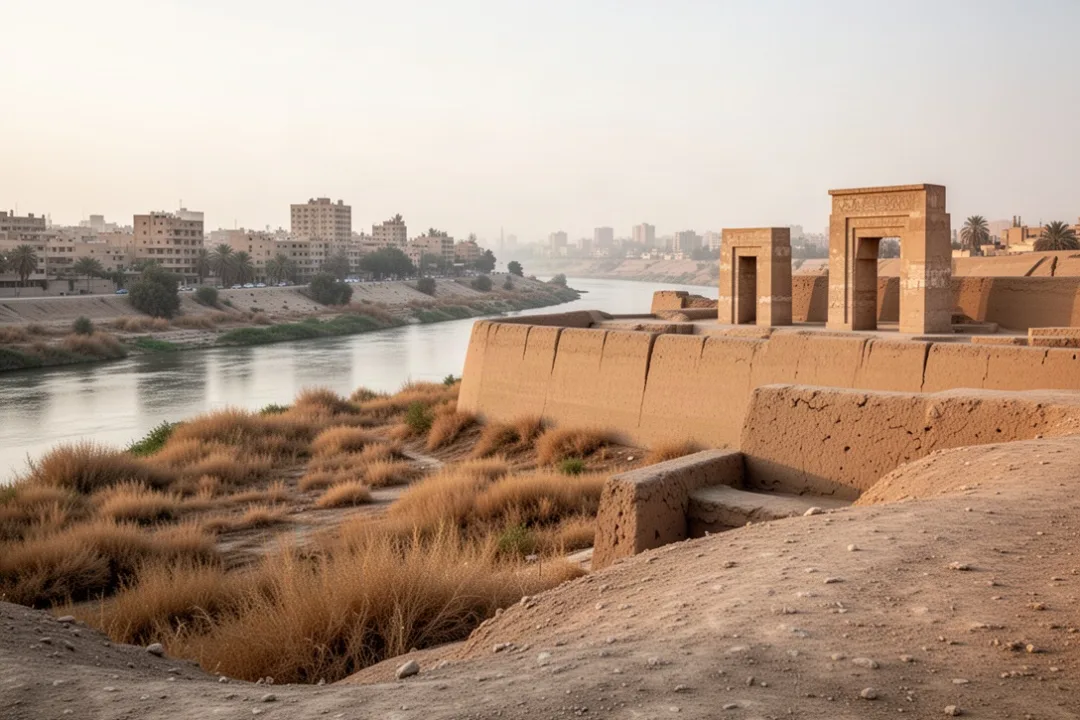
Ancient Nineveh stood along the east bank of the Tigris River, near the modern Iraqi city of Mosul. The city occupied a broad area enclosed by defensive walls, with the principal mounds known as Kuyunjik and Nebi Yunus. The Tigris provided water and transportation, while nearby plains supported farming and animal husbandry.
The site’s position connected northern Mesopotamia with regions farther south and east. Armies, merchants, officials, and messages could move along the river corridors and overland routes that crossed the Assyrian heartland. Nineveh was therefore more than a ceremonial capital: it was a center for administration, military planning, trade, and communication.
Ancient writers often treated Nineveh as a single city, but the urban area included several settlements and monumental districts. Its walls enclosed a large zone, and the surrounding landscape contained canals, gardens, roads, villages, and royal estates. The city’s scale reflected the reach of the Neo-Assyrian Empire, which controlled territory stretching from the Iranian plateau toward the eastern Mediterranean and Egypt at its height.
Location in brief: Nineveh’s ruins lie near Mosul in present-day Iraq, on the eastern side of the Tigris. The archaeological site is associated especially with Kuyunjik and Nebi Yunus, two major mounds within the ancient urban area.
Water management was essential to the city’s survival. Assyrian rulers built and maintained canals that brought water from streams and distant sources into the capital’s fields, gardens, and neighborhoods. Sennacherib’s inscriptions describe major hydraulic works, including channels and aqueducts designed to supply Nineveh and support its expanding population.
These projects required surveying, labor organization, engineering, and political control. They also show why the city could not be understood only through its palaces. Nineveh depended on a wider system of agricultural land, reservoirs, canals, roads, and settlements that fed and supplied the capital.
How Nineveh grew into the Assyrian capital
Nineveh was inhabited long before the Assyrian Empire reached its greatest power. Archaeological evidence indicates settlement in the area from very early periods of Mesopotamian history. The city’s importance increased over centuries as Assyria developed in northern Mesopotamia and its rulers expanded their authority.
The city became the principal Assyrian capital during the reign of Sennacherib, who ruled from 705 to 681 BCE. Earlier Assyrian kings had used other royal centers, particularly Ashur and Kalhu, also called Nimrud. Sennacherib made Nineveh the focus of an ambitious building program and presented it as a city worthy of imperial rule.
Royal inscriptions describe the rebuilding of walls, gates, temples, streets, palaces, and gardens. Sennacherib also expanded the city and reshaped its infrastructure. Some inscriptions use highly idealized royal language, so they should be read as political records as well as descriptions of construction. Even so, the surviving remains confirm that the building program was extensive.
The king’s principal palace at Kuyunjik is often called the Southwest Palace. Its rooms were decorated with carved stone reliefs showing military campaigns, royal ceremonies, hunting scenes, religious imagery, and the transport of monumental objects. These reliefs were not neutral illustrations. They communicated the king’s power, the empire’s victories, and the consequences of resisting Assyria.
After Sennacherib, the capital continued to grow under rulers including Esarhaddon and Ashurbanipal. Esarhaddon rebuilt parts of the city and maintained the imperial system. Ashurbanipal became known both for military campaigns and for his interest in collecting texts. During his reign, Nineveh reached one of its most important cultural and political phases.
The capital’s design projected a clear message: the king stood at the center of an ordered world. Monumental gateways controlled movement into the city, palaces placed the ruler in a dominant position, and carved reliefs linked military success with divine approval. Propaganda was built into the architecture.
Assyrian art frequently portrays the king as the person who protects the land, defeats enemies, and maintains proper relations with the gods. Images of winged protective figures, sacred trees, royal hunts, and defeated armies appeared in palace spaces. Visitors who entered these rooms encountered a carefully arranged statement about imperial authority.
The city also displayed the wealth produced by conquest. Assyrian rulers relocated skilled workers, administrators, and entire communities from conquered regions. These populations contributed to construction, agriculture, crafts, and administration. Such forced movements were a major feature of imperial policy and helped Assyria develop a diverse but tightly controlled state.
That wealth came at a severe human cost. Assyrian records celebrate campaigns using language about captured cities, tribute, deportation, and punishment. The reliefs and inscriptions provide valuable historical evidence, but they also reflect the viewpoint of the conquerors. Reading Nineveh’s history responsibly means recognizing both the empire’s administrative achievements and the violence that sustained them.
What happened at Nineveh according to the Bible
Nineveh appears most famously in the Book of Jonah. In that narrative, God sends Jonah to warn the city, but Jonah initially attempts to flee. After a series of events at sea, he reaches Nineveh and announces that the city faces judgment. The people respond with repentance, and the threatened destruction does not take place in the story’s immediate setting.
The account presents Nineveh as a city recognized for its size and moral failure. Its importance to biblical readers comes from the contrast between imperial power and the possibility of repentance. The story also challenges Jonah’s reluctance to show mercy to people he regards as enemies.
The biblical text does not provide a modern archaeological description of streets, buildings, or neighborhoods. Its purpose is theological and literary rather than a complete urban survey. Still, the choice of Nineveh is historically meaningful because the city represented the strength and reputation of Assyria.
Other biblical books present Nineveh differently. Nahum announces judgment against the city and portrays its fall as a reversal of Assyrian violence. The book uses vivid poetic imagery to describe collapse, fear, plunder, and destruction. Zephaniah also refers to Nineveh’s future desolation.
These different portrayals are not necessarily contradictory. Jonah focuses on a warning and a response to repentance, while Nahum and Zephaniah address the later destruction of the Assyrian capital. The historical fall of Nineveh occurred generations after the period usually associated with the prophet Jonah.
Reading the biblical accounts: Jonah, Nahum, and Zephaniah use Nineveh for different purposes. Jonah emphasizes repentance and divine mercy; Nahum emphasizes judgment on imperial violence; Zephaniah presents the city’s downfall within a broader prophetic vision.
For many readers, Nineveh’s biblical importance rests on this tension. It was a real imperial capital with immense power, but the biblical tradition also makes it a place where outsiders can respond to warning and where political dominance does not guarantee permanence.
What archaeologists discovered in Nineveh’s palaces and libraries
Modern archaeological work at Nineveh began in the nineteenth century, when excavators uncovered major Assyrian buildings and transported many reliefs and inscriptions to museums. The discoveries transformed knowledge of the ancient Near East. They also raised difficult questions about the removal of artifacts, the division of archaeological collections, and the protection of heritage in modern conflict zones.
The palace reliefs are among the site’s most recognizable remains. They include detailed scenes of soldiers crossing rivers, besieging cities, transporting prisoners, hunting lions, and presenting tribute. Carved lines show muscles, clothing, weapons, horses, chariots, plants, and landscape features with remarkable precision.
The scenes can be studied as art, historical evidence, and royal messaging. A relief of a siege may preserve information about military equipment and battle methods, but it also presents the Assyrian king as victorious and unstoppable. The absence of the enemy’s viewpoint is part of the message.
One of Nineveh’s greatest contributions to scholarship came from the collection associated with Ashurbanipal’s library. The “library” was not a public institution in the modern sense. It was a collection of clay tablets assembled for the royal court, scribes, and learned specialists. The tablets contain literary works, myths, prayers, rituals, royal records, lexical lists, medical knowledge, omens, and administrative information.
Many tablets were written in cuneiform, a script made by pressing a reed stylus into wet clay. As the clay dried, it preserved the wedge-shaped marks. Some texts were copied from older works, which means Nineveh’s collection provides evidence for traditions that originated centuries earlier in Mesopotamia.
The best-known literary work connected with the collection is the Epic of Gilgamesh. Fragments found at Nineveh include a version of the flood story in which a survivor receives a divine warning, builds a vessel, preserves life, and sends out birds after the waters recede. The text is not the same as the biblical account, but the similarities have made it central to comparisons of ancient Near Eastern literature.
The tablets also reveal practical concerns. Scribes recorded lunar observations, omens, treatments, vocabulary, royal correspondence, and legal or administrative matters. A royal court needed specialists who could interpret signs, preserve traditions, train scribes, and advise the king. Knowledge at Nineveh was closely connected with government and religious authority.
Royal inscriptions recorded building projects, victories, titles, and claims about the king’s relationship with the gods.
Literary tablets preserved myths, epics, hymns, prayers, and wisdom compositions.
Scientific and scholarly texts covered astronomy, omens, medicine, mathematics, and language.
Administrative records documented supplies, personnel, land, tribute, and official correspondence.
Clay tablets survived partly because fired or dried clay is durable, especially when buildings burned. A destructive event that ended a palace could therefore preserve objects that would otherwise have disappeared. Modern scholars can join fragments from different locations, compare duplicate copies, and reconstruct parts of Assyrian intellectual life.
How and why Nineveh fell in 612 BCE
Nineveh fell in 612 BCE after a coalition of Babylonians and Medes attacked the Assyrian heartland. The assault came during a period when Assyria was under severe pressure from multiple enemies. Its empire had been weakened by succession struggles, military exhaustion, rebellion, and the growing strength of Babylon and the Medes.
The fall was not an isolated event. Assyria had already lost important territories and faced repeated attacks on its major centers. The coalition’s capture of Nineveh dealt a decisive blow to Assyrian power, although Assyrian resistance continued for several years from other locations.
Ancient sources describe the city as captured, looted, and destroyed. Archaeological evidence includes destruction layers in parts of the site, but the exact sequence and character of damage varied across the city. Large capitals are not erased in one uniform moment: some buildings burn, others are abandoned, and valuable materials may be removed or reused.
Assyrian forces continued the struggle from Harran and later from other strongholds. The remaining Assyrian political order was finally defeated in the early sixth century BCE. Nineveh’s fall therefore marked the collapse of the empire’s central authority rather than the instant disappearance of every Assyrian community.
Several factors help explain the city’s defeat:
Military pressure: Babylonian and Median forces attacked Assyria from different directions and challenged its ability to defend the heartland.
Political instability: Disputes over succession weakened coordination within the royal system.
Imperial overextension: Governing distant territories required large armies, reliable tribute, and continuous administrative effort.
Loss of strategic centers: The fall of other Assyrian cities reduced resources and narrowed the empire’s options.
Coalition warfare: Enemies were able to combine their strength against a state that had previously defeated opponents separately.
Later generations remembered Nineveh as a symbol of sudden reversal. The city had seemed permanent because its walls, palaces, armies, and wealth were so imposing. Its defeat showed that imperial power depended on political institutions and supply networks that could fail under sustained pressure.
Today, the remains of Nineveh consist primarily of large earthen mounds, traces of walls and gates, architectural fragments, and buried archaeological layers. The ancient landscape has changed, and modern development around Mosul has placed additional pressure on the site. Agricultural activity, construction, erosion, looting, and armed conflict have all threatened its preservation.
Some features remain especially significant. The city walls help communicate its enormous scale, while the mounds preserve the locations of palaces, temples, and other buildings. The Nergal Gate and other gateways have become important reference points, although their condition and accessibility can change over time.
The mound of Nebi Yunus is associated in later tradition with the prophet Jonah. It contains remains connected with Assyrian occupation, but its significance has also been shaped by later religious history. Sacred traditions and archaeological evidence overlap at the site without being identical.
Damage to Nineveh and other cultural sites in Iraq has shown how vulnerable archaeological heritage can be during war and political instability. Destruction can affect not only standing monuments but also excavation records, museum collections, local historical memory, and the ability of specialists to study artifacts in context.
Preserving Nineveh requires more than protecting a few visible sculptures. Archaeologists need the broader setting: the position of buildings, layers of occupation, canal systems, roads, objects, and traces of ordinary domestic life. Context can reveal how the city worked and how different groups experienced imperial rule.
Current knowledge comes from several kinds of evidence that must be compared carefully:
Excavated architecture reveals walls, rooms, gates, temples, palaces, and construction phases.
Inscriptions provide royal claims about events, projects, titles, and religious obligations.
Reliefs and sculpture show how Assyrian rulers wanted warfare, ritual, hunting, and kingship to be seen.
Cuneiform tablets preserve literature, correspondence, scholarship, administration, and daily concerns.
Environmental evidence helps researchers study water management, agriculture, climate, and landscape change.
Nineveh matters because it brings together several major themes in ancient history: the rise of imperial states, the organization of large cities, the use of art as political communication, the preservation of literature, and the limits of military power. It is both a historical place and a powerful cultural memory.
For biblical readers, Nineveh remains the city of Jonah and the subject of prophetic judgment. For historians, it is a capital that shaped the ancient Near East. For archaeologists, it is a layered site whose ruins continue to provide evidence about kings, scribes, soldiers, deported populations, farmers, craftspeople, and the systems that connected them.
Frequently asked questions
Is Nineveh the same city as Mosul?
No. Nineveh was an ancient city located beside modern Mosul, across the Tigris River. Mosul is a later city with its own history and urban center. Because the two are close together, modern roads, neighborhoods, and development surround parts of the ancient site, but Nineveh and Mosul should not be treated as the same settlement.
Did Jonah really go to Nineveh?
The Book of Jonah presents Jonah’s visit as a prophetic narrative, while historians cannot independently verify the episode. Nineveh was a real and prominent Assyrian capital, so the story uses a historically meaningful setting. Its central concerns are warning, repentance, mercy, and the response of outsiders rather than a detailed record of an individual mission.
Who destroyed Nineveh?
A coalition led by the Babylonians and Medes captured Nineveh in 612 BCE. Their victory came after years of Assyrian military and political strain. Assyrian resistance continued after the city’s fall, especially from Harran, but the capture of Nineveh effectively ended the empire’s role as the dominant power in the Near East.
What was found in the library of Nineveh?
The collection associated with Ashurbanipal contains thousands of cuneiform tablets and fragments. They preserve myths, prayers, royal records, scholarly works, omen texts, medical material, administrative documents, and versions of older Mesopotamian compositions. Fragments of the Epic of Gilgamesh are among the most famous finds connected with the collection.








Leave a Reply