Solomon’s Portico: location, history, and biblical meaning
Solomon’s Portico: location, history, and biblical meaning
Solomon’s Portico was a covered walkway, or colonnade, on the eastern side of the Temple complex in Jerusalem. It is mentioned by name in the New Testament in John 10:23, Acts 3:11, and Acts 5:12.
The name connects the portico with Solomon’s Temple, but the structure seen in the first century was part of the later Temple complex associated with Herod’s rebuilding program. The biblical accounts present it as a public place where Jesus taught, Peter addressed a crowd after a healing, and the apostles gathered as their ministry expanded.
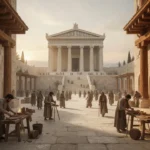
A portico is a covered walkway supported by columns or pillars. In a large religious complex, such a space could provide shade, shelter from rain, and a convenient place for people to meet, teach, or pass through. Solomon’s Portico was not a small porch attached to a private house; it was a substantial public colonnade within the wider Jerusalem Temple precincts.
The portico is generally understood to have stood along the eastern side of the Temple platform. The Temple itself occupied the central sacred area, while courts, gates, walls, and covered walkways surrounded it. Visitors moving through the complex could gather in these outer areas without entering the most restricted parts of the sanctuary.
The New Testament does not give a complete architectural description. It assumes that readers know the place and identifies it as a recognizable location in the Temple grounds. John says that Jesus was walking in Solomon’s Portico during the Feast of Dedication, while Acts places the apostles there during important public events.
The word translated as portico, porch, or sometimes colonnade reflects the function of the space more than a modern building category. It was likely an open-sided, roofed walkway rather than an enclosed room. The columns created a defined place for movement and gathering while leaving the area connected to the larger courts.
Location in brief: Solomon’s Portico was probably an eastern colonnade of the Temple complex, near an outer court and accessible to large numbers of worshipers and visitors.
Its location also explains why it appears in scenes involving crowds. A covered public walkway offered enough space for people to assemble, hear a teacher, or observe the apostles. It was a natural setting for public religious discussion, especially during festival periods when Jerusalem was crowded.
Why it was called Solomon’s Portico
The name suggests a connection with King Solomon, who built the first Temple in Jerusalem according to the biblical account. Yet the portico mentioned in the New Testament should not automatically be identified as an untouched surviving section of Solomon’s original building. The first Temple was destroyed centuries before the time of Jesus, and the Temple complex of the first century belonged to a later period of construction and expansion.
Several explanations have been proposed for the name. One possibility is that the eastern side incorporated or was believed to preserve parts of an older structure connected with Solomon’s Temple. Another is that the name preserved a traditional association with Solomon even if the visible colonnade had been rebuilt. Ancient buildings and local landmarks often retained older names after repairs, expansions, or complete reconstruction.
The first-century Temple was connected with the work of Herod the Great, who greatly enlarged and beautified the Temple platform and its surrounding courts. Construction continued beyond Herod’s lifetime. The result was a monumental complex built for Jewish worship, pilgrimage, teaching, and public gathering.
That later complex could carry forward memories of earlier sacred history. Calling a section “Solomon’s” may have emphasized continuity with the first Temple and with Jerusalem’s royal and worship traditions. The name therefore tells us something about how people understood the site, even though it does not prove that every stone belonged to Solomon’s era.
Josephus, a Jewish historian writing about the history of Jerusalem and the Jewish people, also refers to a Solomon’s Porch in connection with the Temple area. His description is one reason scholars take the location seriously as a known feature of the first-century complex. The exact construction history, however, remains less certain than the name and general placement.
Careful wording matters here. It is reasonable to say that Solomon’s Portico was associated with an older Temple tradition and stood on the eastern side of the later Temple precinct. It is not reasonable to state with certainty that the entire colonnade was an original surviving structure built by Solomon.
Solomon’s Portico in the Gospel of John
John 10:23 places Jesus in Solomon’s Portico during the Feast of Dedication, commonly known as Hanukkah. The setting is significant because the feast recalled the rededication of the Jerusalem Temple after it had been defiled and then reclaimed during the Maccabean period.
John describes Jesus as walking in the portico when people gathered around him and asked him to speak plainly about his identity. The location is therefore more than a background detail. Jesus is teaching in the Temple environment, in a place associated with Jewish worship, memory, and public debate.
The conversation concerns Jesus’ works, his identity, and the relationship between him and his followers. Rather than presenting the exchange as a private discussion among a few disciples, John places it in a public setting where religious questions could be raised openly. The portico gives the scene a distinctly Temple-centered context.
The timing during the Feast of Dedication also adds historical and theological weight. Hanukkah remembered the restoration of the Temple, while the Gospel scene focuses attention on Jesus’ authority within the Temple precincts. Readers are invited to consider how the meaning of sacred space, God’s presence, and the identity of God’s chosen people relate to Jesus’ claims.
The passage also helps explain why a colonnade would be useful for teaching. It was sheltered but public, allowing a teacher to speak to people moving through the complex. A walkway of this kind could support both informal conversation and a larger gathering without requiring access to the innermost sanctuary.
John places Jesus in Solomon’s Portico during the Feast of Dedication, making the setting part of the passage’s Temple-centered meaning.
The immediate response in John’s account is tense. Some listeners react strongly to Jesus’ words, and the scene moves toward conflict. The portico is thus presented as a place where public teaching could bring serious religious disagreement into the open.
Solomon’s Portico in Acts 3 and the healing of the lame man
Acts 3 gives Solomon’s Portico a central role in the account of the healing of a man who had been unable to walk. Peter and John encounter him at the Temple area, and Peter announces healing in the name of Jesus Christ. After the man begins walking, leaping, and praising God, people recognize him and gather around the apostles.
The account identifies the healed man as someone known to those who regularly entered the Temple. His condition had led him to depend on others for assistance, and his presence at the Temple gate made him visible to worshipers. The healing therefore becomes a public event rather than a private recovery witnessed by only a few people.
Acts says that the man held on to Peter and John in Solomon’s Portico, and that the crowd was astonished. This detail places the apostles and the healed man in a recognizable gathering area where many people could see what had happened. The architecture serves the narrative: a public healing leads naturally to a public explanation.
Peter uses the crowd’s amazement as an opportunity to speak about Jesus. He does not present the miracle as a display of his own power or religious status. Instead, he points beyond himself and John to the God of Israel and to Jesus, whom he identifies as the one through whom the healing occurred.
His speech also connects the event with the history and promises of Israel. Peter refers to the God of Abraham, Isaac, and Jacob and explains the healing in relation to Jesus’ death and resurrection. The setting matters because the message is delivered in the Temple complex, among people familiar with Israel’s Scriptures and worship traditions.
Acts 3:11-26 therefore uses Solomon’s Portico as both a physical meeting place and a setting for interpreting a sign. The miracle draws attention, but Peter’s speech directs attention toward repentance, restoration, and the prophetic hope associated with God’s purposes for Israel.
The passage shows several features of public life in the Temple precinct:
People with different needs could be present near the entrances and courts.
Religious teachers and worshipers could encounter one another in open, accessible areas.
Large crowds could gather quickly when an unusual event occurred.
Public teaching could connect a recent event with Israel’s Scriptures and faith.
The location also emphasizes continuity and tension. The apostles remain in the Temple environment associated with Israel’s worship, yet they proclaim that God has acted decisively through Jesus. Solomon’s Portico becomes a place where the early Christian message is announced within the setting of Jewish religious life.
Solomon’s Portico in Acts 5 and the early Christian community
Acts 5 mentions Solomon’s Portico again after describing the apostles’ signs and the growing response to their ministry. The apostles are said to gather in the portico, while others may have hesitated to join them openly. At the same time, people continued to hold them in high regard, and more men and women were associated with the community of believers.
This scene presents the portico as a regular meeting place rather than a location used only for one dramatic healing. The apostles’ presence there made the space a recognizable point of contact for people seeking teaching, prayer, healing, or information about the new movement centered on Jesus.
Acts also describes a cautious public response. Some people did not feel free to identify closely with the apostles, perhaps because of social or religious pressure. Yet the movement continued to attract people. The open setting of the portico allowed the apostles to remain visible without requiring every interested person to enter a formal private gathering.
The reference is significant for understanding the early Christian community’s relationship to Jerusalem. The believers were not initially portrayed as operating in isolation from the city’s Jewish religious life. They prayed, taught, and met in places connected with the Temple, even as their proclamation about Jesus created opposition.
The portico could serve several practical functions:
A gathering point: the apostles could meet together in a recognizable public place.
A teaching setting: visitors could hear their message without arranging a private appointment.
A place of witness: signs and healings became visible to residents and pilgrims.
A point of community contact: people could approach the apostles and learn about the movement.
Acts does not say that every Christian lived in the Temple precincts or that the portico was an exclusive church building. It was a public area within a larger sacred complex. The believers’ use of it shows that early Christian proclamation could take place in shared civic and religious spaces.
The repeated references also establish a pattern: Jesus teaches there, and later his apostles minister there. John and Acts are different works with different literary purposes, but together they associate Solomon’s Portico with public teaching, controversy, healing, and communal witness.
Reading Acts carefully: Solomon’s Portico was a public Temple colonnade used by the apostles, not a separate Christian church building in the modern sense.
What can be known about its archaeology today
Identifying the exact remains of Solomon’s Portico is difficult. The Temple complex was destroyed by Roman forces in the first century, and the area has undergone major changes over many centuries. Later construction, repairs, political changes, and restrictions on archaeological investigation make it difficult to connect surviving stones securely with a particular first-century colonnade.
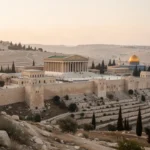
The eastern side of the Temple platform is generally considered the most likely location. Scholars have discussed the possibility that parts of the eastern retaining wall or earlier construction were incorporated into the later complex. Even so, the surviving evidence does not allow every visible structure in the area to be labeled confidently as the Solomon’s Portico mentioned in the New Testament.
Ancient descriptions can help establish the portico’s general setting, but they do not provide a complete plan that can be matched perfectly to modern ground conditions. Terms such as porch, colonnade, court, and wall may describe related parts of a large complex, and ancient writers did not always use architectural language with the precision expected in modern archaeological reports.
It is also useful to separate three questions that are sometimes combined:
Where was it? Most evidence points to the eastern side of the Temple complex.
What did it look like? It was likely a roofed walkway supported by columns or pillars.
Which stones survive? No surviving structure can be identified with complete certainty as the New Testament portico.
This uncertainty does not weaken the biblical references. The New Testament’s use of the name shows that the location was known to its original audience. Archaeology can clarify the broader setting, but it cannot always recover the exact appearance or construction history of a building that no longer stands intact.
Modern visitors may see sections of Jerusalem’s Temple Mount and surrounding ancient remains, but those views should not be presented as a guaranteed reconstruction of Solomon’s Portico. Drawings and models can illustrate a plausible arrangement, yet reconstructions necessarily depend on interpretation.
The most responsible description is therefore both clear and measured: Solomon’s Portico was a prominent eastern colonnade of the first-century Temple precinct, remembered by name because of its association with Solomon and the earlier Temple tradition. It was a public place where Jesus and the apostles taught and where the early Christian message became visible within Jerusalem’s Temple environment.
Frequently asked questions
Was Solomon’s Portico built by King Solomon?
Probably not in the direct sense suggested by the name. Solomon’s original Temple had been destroyed long before the time of Jesus, while the portico known from the New Testament belonged to the later Temple complex. The name may have reflected an older tradition, an association with surviving or remembered Temple structures, or the belief that the eastern area preserved a link with Solomon’s building.
Where was Solomon’s Portico located?
It was most likely along the eastern side of Jerusalem’s Temple platform. The structure appears to have been a roofed, open-sided colonnade within the outer Temple precincts, where large groups could gather. The exact position and architectural details cannot be established with complete certainty because the ancient Temple complex was destroyed and the site has changed substantially.
What happened at Solomon’s Portico in Acts 3?
After Peter and John healed a man who had been unable to walk, the man clung to them in Solomon’s Portico. A crowd gathered because people recognized him and were amazed by the change. Peter then addressed the crowd, explaining the healing in relation to Jesus and calling his listeners to respond to God’s message.
Why is Solomon’s Portico important to Christians?
It connects Jesus’ public teaching with the apostles’ early ministry in Jerusalem. In John, Jesus teaches there during the Feast of Dedication. In Acts, Peter and the apostles preach, heal, and gather there. The setting highlights how the earliest Christian witness emerged within the public religious life of the Jerusalem Temple rather than in isolation from it.








Leave a Reply