The Book of Jonah is a short biblical story about a prophet who runs from God, is rescued from the sea, and is sent to warn the city of Nineveh. Its central message is that God’s mercy reaches beyond Israel, even to people Jonah considers enemies, while the prophet himself struggles to accept that mercy.
Jonah contains four chapters and appears among the Minor Prophets of the Hebrew Bible and Christian Old Testament. Unlike many prophetic books, it focuses less on a collection of speeches and more on the prophet’s actions, arguments, fears, and changing relationship with God.
God commands Jonah, the son of Amittai, to go to Nineveh and announce a warning against the city. Nineveh was associated with the Assyrian Empire, a powerful foreign nation remembered in the biblical world for violence and oppression. Instead of traveling east toward Nineveh, Jonah goes in the opposite direction and boards a ship bound for Tarshish.
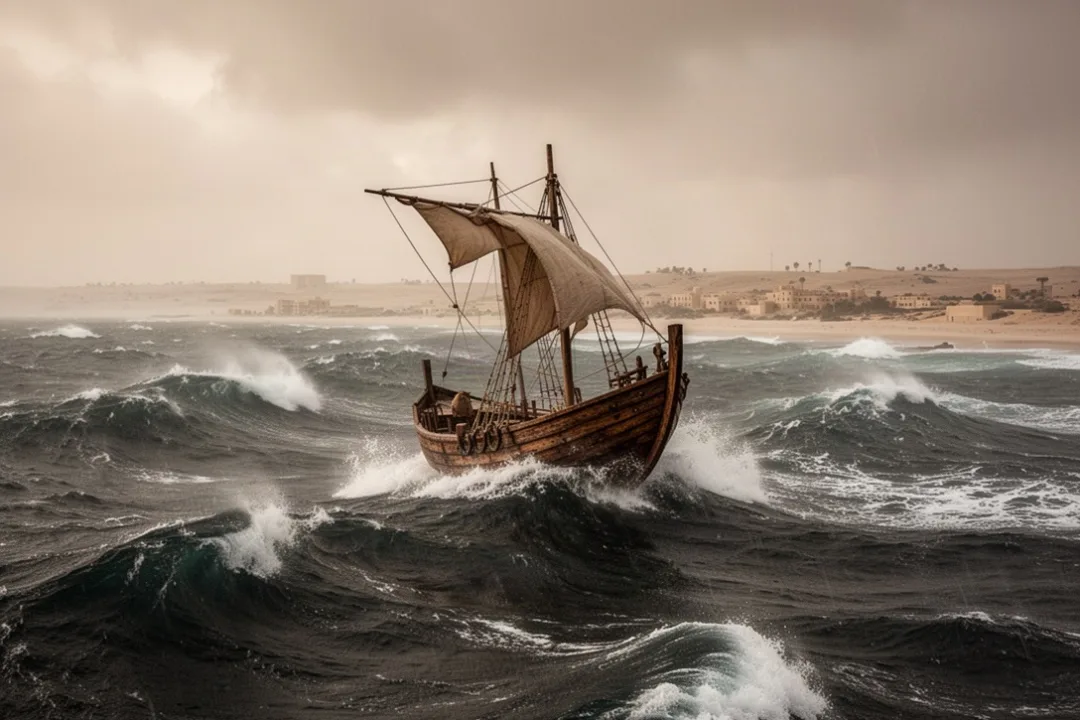
A violent storm threatens the ship. The sailors discover that Jonah is connected to the crisis, and Jonah tells them to throw him into the sea. The sailors resist at first, but the storm grows worse. After Jonah is cast overboard, the sea becomes calm, and the sailors respond with fear and worship toward the Lord.
God appoints a great fish to swallow Jonah. Jonah remains inside the fish for three days and three nights, where he prays and recognizes that deliverance comes from God. The fish then releases him onto dry land. The story does not identify the animal by species; the familiar phrase “whale” comes from later interpretation, while the biblical text speaks more generally of a large fish.
God gives Jonah the same command a second time. This time, Jonah goes to Nineveh and announces that the city faces destruction because of its wrongdoing. The warning is brief, but the response is immediate and widespread.
The people of Nineveh believe the warning.
They fast and put on sackcloth as signs of grief and repentance.
The king leaves his throne, humbles himself, and calls the entire city to turn from violence.
God sees their change of behavior and does not bring the announced disaster.
Jonah is not pleased that Nineveh is spared. He becomes angry and tells God that this outcome is exactly what he feared. Jonah had understood God as compassionate and patient, willing to forgive those who turn from evil. Rather than celebrating the city’s repentance, he leaves the city and waits to see what will happen.
God provides a leafy plant to give Jonah shade, then allows a worm to damage the plant. A hot wind makes Jonah miserable, and he again wishes to die. God uses the plant to expose Jonah’s narrow concern: Jonah mourns the loss of a plant he did not create, while God cares about the many people and animals in Nineveh.
The ending matters: Jonah stops before giving a final answer. God’s question about compassion is left for the reader to consider, making the book a challenge to the audience as much as a story about the prophet.
Who Jonah was and why Nineveh mattered
Jonah is identified as the son of Amittai. Another biblical reference places a prophet named Jonah in the reign of Jeroboam II, king of Israel, where Jonah spoke about the restoration of Israel’s territory. That brief reference appears in 2 Kings 14:25. The Book of Jonah does not directly explain whether every detail of the narrative should be read as a historical report, a prophetic teaching story, or a combination of historical and literary traditions.
The name Nineveh carries substantial weight in the biblical imagination. It was an important Assyrian city and is presented in the story as a place marked by extensive wickedness. Assyria was a major power in the ancient Near East, and its conflicts with Israel and Judah shaped the political setting of several biblical books.
For an Israelite audience, God’s concern for Nineveh would have been difficult and even offensive. Nineveh represented a foreign enemy, not a harmless neighboring town. Jonah’s reluctance therefore is more than ordinary stage fright. He does not merely fear that the mission will fail; he fears that it will succeed and that God will forgive people he believes deserve judgment.
The book deliberately contrasts Jonah’s response with the responses of other characters. The pagan sailors show concern for human life and call on God during the storm. The people of Nineveh respond to the warning with humility. Even the king publicly admits the need for change. Jonah, who knows the Lord and speaks as a prophet, is the character most resistant to compassion.
The sailors, the city, and the animals
The sailors are initially described as frightened by the storm, but their fear develops into concern for Jonah’s life. They try to row back to shore instead of immediately throwing him into the water. When that effort fails, they ask God not to hold them guilty for Jonah’s death and then respond with reverence after the sea becomes calm.
The people of Nineveh also respond in a way that challenges Jonah. Their repentance is shown through fasting, sackcloth, prayerful humility, and changed conduct. The king’s decree specifically calls for people to turn away from violence. The text does not present repentance as a private feeling only; it is connected to behavior.
Animals appear repeatedly in the book’s closing movement. Livestock are included in the city’s mourning, and God’s final question refers to people who do not fully understand right from wrong as well as many animals. This broad concern emphasizes the scale of divine compassion. God’s care is not limited to one ethnic group, one city, or one class of people.
What the major symbols in Jonah mean
The story uses physical movement to express spiritual conflict. Jonah goes down to Joppa, down into the ship, and down into the sea before the fish carries him back toward land. This repeated descent reflects his attempt to escape God’s command and avoid the moral problem raised by Nineveh.
The sea and storm represent danger that humans cannot control. In many ancient traditions, the sea suggested chaos and threat. Yet in Jonah, the storm is not outside God’s authority. God sends it, calms it, and uses it to reveal Jonah’s disobedience to the sailors.
The great fish is an instrument of both judgment and rescue. Jonah is not simply punished by being swallowed; he is preserved from drowning. The fish creates an enclosed place where Jonah can pray, recognize his dependence on God, and receive another opportunity to obey.
The phrase three days and three nights highlights Jonah’s unusual deliverance and gives the episode a memorable shape. The text does not provide a scientific description of how Jonah survived. Its emphasis is theological: God can save a person even after that person has entered a situation that appears fatal.
The plant in chapter four is a temporary gift that exposes Jonah’s priorities. Jonah becomes deeply upset when the plant withers, although he did not cultivate it and could not preserve it. God contrasts that distress with divine concern for an entire population and its animals.
The storm reveals the consequences of Jonah’s flight.
The fish represents unexpected rescue and a second chance.
Nineveh becomes a test of whether mercy can cross ethnic and political boundaries.
The plant exposes Jonah’s limited compassion.
The open ending invites readers to examine their own responses to forgiveness.
These symbols do not need to be treated as coded messages with only one meaning. They work together within the story. The storm, fish, city, plant, worm, and wind all become ways for God to teach Jonah something that a direct command alone did not accomplish.
The main themes of the Book of Jonah
God’s mercy extends beyond expected boundaries
The strongest theme is divine compassion for outsiders. God sends Jonah to warn Nineveh rather than destroying it without notice. The warning gives the city an opportunity to change, and God responds when the people turn away from violence.
This mercy does not mean that wrongdoing is ignored. Nineveh is condemned for its evil, and the city is called to change. The story holds judgment and compassion together: God takes violence seriously but remains willing to forgive those who genuinely turn from it.
Religious knowledge does not guarantee a merciful heart
Jonah knows what God is like. He can describe God as gracious, compassionate, patient, and unwilling to delight in punishment. Yet this knowledge becomes part of his complaint because Jonah does not want those qualities applied to Nineveh.
The tension is uncomfortable because Jonah’s theology is accurate while his attitude is resistant. He understands the character of God but does not want to imitate that character. The story therefore asks whether belief can remain merely intellectual when it challenges a person’s loyalties and resentments.
Repentance requires a change in conduct
Nineveh’s response is not presented as a vague expression of regret. The people fast, humble themselves, and turn away from violence. Their actions show that repentance involves a changed direction, not just anxiety about consequences.
The book does not describe a long process of reform within Nineveh. Instead, it gives a compressed picture of a city responding to warning. That compression keeps attention on the surprising fact that outsiders respond more readily than the prophet expects.
God remains sovereign over creation
God appoints the fish, plant, worm, and scorching wind. These natural elements are not random decorations; each one advances the lesson. The created world responds to God’s purposes more readily than Jonah does.
This theme also shapes the opening storm. God’s authority reaches across the sea, the weather, the animal world, and human politics. Jonah can travel to another port, but he cannot travel beyond God’s presence or responsibility.
The reader must answer the final question
Many biblical narratives end by stating what happened next. Jonah ends with God asking whether Jonah should not care about Nineveh. The absence of Jonah’s reply is deliberate. It turns the reader into a participant who must consider whether compassion for enemies is reasonable, difficult, or required.
Reading tip: Pay attention to who shows compassion in each scene. The sailors, God, the people of Nineveh, Jonah, and even the animals are presented in ways that make the prophet’s anger increasingly difficult to defend.
How different traditions understand Jonah
Jewish and Christian communities have read Jonah in several ways across history. Some readers treat it primarily as a historical account of a prophet and a city. Others emphasize its literary design, irony, satire, and open-ended moral question. These approaches are not always mutually exclusive, but they place emphasis on different aspects of the text.
In Jewish practice, Jonah is read during Yom Kippur, the Day of Atonement. Its themes of repentance, responsibility, and God’s willingness to forgive make it especially fitting for a day focused on turning from wrongdoing and seeking reconciliation.
In Christian interpretation, Jonah is often connected with Jesus’ references to “the sign of Jonah” in the Gospels. Because Bible translations differ and the wording is protected in many modern versions, the connection is best described rather than reproduced as a quotation. Jesus refers to Jonah’s time in the fish as a sign and contrasts Nineveh’s response with the response of people who hear his message.
Christian readers have also connected Jonah’s descent, rescue, and return to mission with themes of death, deliverance, and renewed obedience. These connections should not erase the book’s own central concern: Jonah’s resistance to God’s mercy toward a hated foreign city.
Readers who approach the book historically may ask whether a person could survive inside a great fish or whether Nineveh’s repentance occurred exactly as described. Readers who approach it as prophetic narrative may focus more on how the story teaches through exaggeration, irony, and dramatic reversal. Either way, the text’s theological challenge remains clear: God’s compassion is wider than Jonah wants it to be.
A practical guide for reading Jonah today
The Book of Jonah can be read in one sitting, but its short length does not make it simple. A careful reading benefits from noticing repeated words, changes in direction, and the contrast between what characters say and what they do.
Read all four chapters without stopping. The narrative depends on its progression from flight to mission, from repentance to anger, and from the plant to the final question.
Mark every command and response. Compare God’s commands with Jonah’s actions, the sailors’ actions, and Nineveh’s response.
Track movement. Notice Jonah’s descent, the fish’s return of him to land, and his movement away from the city after its repentance.
Compare the prayers. Jonah’s prayer inside the fish and his complaint outside Nineveh reveal different sides of his relationship with God.
Ask what changes. The sea calms, the sailors respond, Nineveh turns from violence, and the plant withers. Jonah’s inner attitude is the least settled part of the story.
Several questions can help connect the book with modern life without reducing it to a simple moral lesson:
Do you believe some people are beyond forgiveness?
How do you respond when an opponent admits wrongdoing and changes?
Can concern for justice coexist with compassion?
Are there situations in which you want mercy for yourself but judgment for others?
What does genuine repentance look like when harm has affected a community?
Jonah should not be used to dismiss the pain caused by violence or oppression. The book does not say that victims must pretend harm never happened. Instead, it challenges the desire to control who may receive mercy and reminds readers that repentance must involve turning away from violence.
The story also offers a careful view of mission. Jonah’s task is to deliver a warning, not to control the result. Once the people respond, Jonah must face the fact that God’s purpose is restoration rather than the prophet’s preferred punishment. That distinction remains relevant wherever people speak about justice, faith, or social change.
At its deepest level, the Book of Jonah is a story about a prophet who wants God to be predictable and exclusive, while God acts with freedom and compassion. Jonah receives rescue, another opportunity, and patient instruction. The book does not tell readers that wrongdoing is unimportant; it asks whether they can accept a mercy that is serious about wrongdoing and still open to repentance.
Frequently asked questions
Is the Book of Jonah a true story?
Readers have understood Jonah in different ways. Some regard it as a historical account, while others emphasize its carefully shaped prophetic storytelling, irony, and teaching purpose. The text itself focuses on God’s mercy, Nineveh’s repentance, and Jonah’s resistance rather than explaining how modern readers should classify every event. Its message can be studied seriously under either approach.
Why did Jonah run from God?
Jonah appears to run because he does not want Nineveh to receive mercy. He knows God is compassionate and fears that the city will repent and be spared. His resistance is connected to Nineveh’s identity as a threatening foreign power, so his flight reflects moral and political hostility, not simply fear of public speaking or travel.
What kind of fish swallowed Jonah?
The biblical account calls it a great fish but does not identify its species. Later readers sometimes described it as a whale, but that detail is not supplied by the book itself. The fish’s main function in the story is to preserve Jonah from drowning and return him to the mission he abandoned.
What is the main lesson of Jonah?
The book emphasizes that God’s compassion is broader than human preferences, including compassion for enemies who turn away from violence. It also shows that repentance involves changed behavior and that knowing religious truths does not automatically produce a merciful character. The unanswered final question asks readers to examine whom they believe deserves forgiveness.







Leave a Reply