If you have encountered the Ark of the Covenant in the Bible, a museum display, or a historical film, you may wonder what it actually was. Was it a treasure chest, a religious symbol, or something more? The Ark was a <strongsacred wooden chest covered with gold that held a central place in ancient Israelite worship. According to the Hebrew Bible, it represented God’s presence and covenant with the Israelites.
The Ark was not simply an ornament kept in a temple. It accompanied Israel during important stages of its early history, stood at the center of the worship tent known as the tabernacle, and was later placed in Solomon’s Temple in Jerusalem. Biblical accounts connect it with the giving of the covenant, Israel’s wilderness travels, the crossing of the Jordan River, the fall of Jericho, and the monarchy of David.
Short answer: The Ark of the Covenant was a gold-covered chest made according to instructions given to Moses. It symbolized the covenant between God and Israel and was kept in the most sacred area of the tabernacle and later the Temple.
The Ark was built after the Israelites left Egypt and entered into a covenant with God at Mount Sinai. In the biblical account, Moses received instructions for constructing a portable sanctuary so the Israelites could worship during their journey through the wilderness. The Ark formed the innermost and most sacred object in that sanctuary.
The instructions for its construction appear primarily in Exodus 25. It was made from acacia wood and covered inside and outside with gold. The chest had gold rings and poles so it could be carried without being touched directly. Its lid, often called the mercy seat or atonement cover, was also made of gold.
Two cherubim were placed on the lid, facing one another with their wings spread above it. In biblical imagery, cherubim are heavenly beings associated with God’s throne and presence. The design communicated that the Ark was not an ordinary container; it was connected symbolically with the place where God met with Israel.
What the Ark contained according to the Bible
The Bible gives more than one description of the Ark’s contents, so the answer requires some care. The most consistent tradition is that it held the tablets of the covenant, the stone tablets associated with the Ten Commandments. These tablets represented the agreement between God and Israel.
Other passages associate the Ark with a jar of manna and Aaron’s staff. Hebrews 9:4 describes these objects as being connected with the Ark. However, 1 Kings 8:9 says that when the Ark was placed in Solomon’s Temple, it contained only the two stone tablets. These passages may reflect different traditions or moments in the Ark’s history.
The stone tablets: They represented the covenant and the laws given to Israel at Sinai.
A jar of manna: Manna recalled the food the Israelites received during their wilderness journey.
Aaron’s staff: The staff represented Aaron’s priestly authority and the confirmation of his role.
The Ark’s contents mattered because they connected Israel’s worship with specific acts of God: establishing the covenant, providing food, and confirming religious leadership. The chest was therefore both a sacred object and a physical reminder of Israel’s shared history.
How the Ark was designed and carried
The Ark was rectangular, relatively compact, and made to travel with the Israelites. The biblical description gives its size as two and a half cubits long, one and a half cubits wide, and one and a half cubits high. The exact length of a cubit varied, but these measurements suggest a chest roughly four feet long and a little over two feet wide and high.
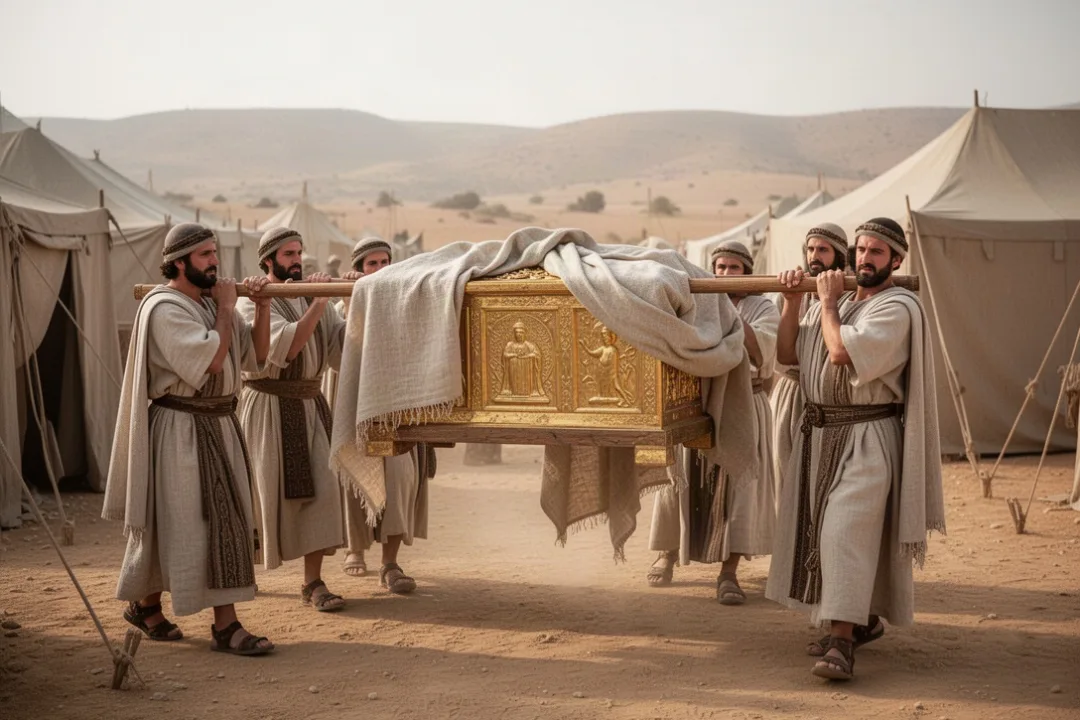
Gold-covered carrying poles passed through rings attached to the corners. The poles were meant to remain in place, allowing the Ark to be transported without direct contact. This arrangement reinforced the distinction between ordinary objects and a vessel regarded as exceptionally holy.
Special priests and Levites were responsible for transporting the Ark. Before it moved, the priests covered the sacred furnishings with protective layers, including a veil and other coverings, according to the instructions in Numbers 4. The Kohathite Levites carried the covered objects, but the text warns them not to touch or look directly at the holy items.
These rules were not merely practical handling instructions. They expressed the biblical idea that God’s holiness was powerful and not to be treated casually. The Ark’s presence brought comfort and confidence to Israel, but the narratives also show that approaching it improperly was considered dangerous.
How the Ark functioned in Israelite worship
The Ark stood in the Most Holy Place, the innermost room of the tabernacle. A curtain separated this room from the larger sanctuary. According to Exodus 25, God would meet with Moses above the Ark’s cover, between the cherubim, and give instructions for the people of Israel.
This language does not mean that the Ark was thought to contain or limit God. Rather, it served as a designated sign of divine presence. The Ark made the covenant visible and gave Israel a focal point for worship while also emphasizing that God could not be reduced to an image or statue.
The high priest entered the Most Holy Place on the Day of Atonement, described in Leviticus 16. This was a highly restricted ritual associated with atonement for the sins of the people. The ceremony involved sacrifices and the application of blood in the sanctuary, including the area around the atonement cover.
The Ark therefore belonged within a larger religious system that included the tabernacle, priests, sacrifices, purity rules, festivals, and covenant laws. Removing the Ark from that setting can make it seem like an independent magical object, but the biblical accounts present it as one part of Israel’s worship and relationship with God.
What happened to the Ark during Israel’s wilderness years
During the wilderness journey, the Ark traveled with the Israelites as they moved from one camp to another. Numbers 10 describes it setting out before the people, while other passages show it being carried in the middle of the community’s ordered procession. Its movement signaled that God was guiding and accompanying Israel.
When the Israelites approached the Jordan River under Joshua’s leadership, priests carried the Ark into the water. The biblical account in Joshua 3 says that the river stopped flowing while the priests stood with the Ark, allowing the people to cross on dry ground. The story portrays the Ark as a sign of God’s presence leading Israel into the promised land.
The Ark also appears in the account of Jericho. The Israelites marched around the city with priests carrying the Ark, along with horns and other ritual elements. After the prescribed process, the city’s defenses collapsed, according to Joshua 6. The narrative emphasizes obedience to God’s instructions rather than military strength alone.
These stories explain why the Ark became associated with divine guidance, victory, and covenant faithfulness. They do not present it as a device that could be used at will. Its meaning depended on Israel’s relationship with God and its obedience to the covenant.
How the Ark was captured and returned
One of the most dramatic Ark narratives appears in 1 Samuel 4–6. During a conflict with the Philistines, the Israelites brought the Ark to the battlefield, apparently hoping its presence would guarantee victory. Israel was defeated, and the Philistines captured the Ark.
The capture did not bring the Philistines the benefit they expected. The Ark was placed in the temple of the Philistine god Dagon at Ashdod. In the story, Dagon’s image repeatedly fell before the Ark, and the Philistine cities experienced severe affliction. The Philistines eventually returned the Ark to Israel with offerings and sent it back on a cart pulled by cattle.
When it arrived in Israel, the Ark was kept at Beth-shemesh. The account includes a severe judgment against people who treated the holy object improperly. Because of this, the people of Beth-shemesh asked for it to be moved, and it was taken to Kiriath-jearim, where it remained for many years.
The episode makes two points that recur throughout the Bible. First, Israel could not treat the Ark as a portable guarantee of success. Second, the Ark’s holiness was not dependent on Israel’s political power; even when captured, it remained a symbol of the God of Israel rather than becoming a trophy belonging to the Philistines.
Why King David brought the Ark to Jerusalem
After David became king, he sought to bring the Ark to Jerusalem, the city that became the political and religious center of his kingdom. The move was meant to unite the royal capital with Israel’s worship and establish the city as the home of the nation’s most sacred object.
The first attempt ended in tragedy when Uzzah reached out to steady the Ark as the oxen pulling the cart stumbled. According to 2 Samuel 6, Uzzah died after touching it. David became afraid and temporarily left the Ark at the house of Obed-edom.
Afterward, David brought the Ark to Jerusalem with greater care and celebration. The account describes sacrifices, music, dancing, and public rejoicing. David’s response shows both sides of the Ark’s meaning: it represented joy and God’s blessing, but it also demanded reverence and obedience to the established instructions.
David placed the Ark in a tent in Jerusalem. He wanted to build a permanent temple for it, but the biblical account says that his son Solomon would carry out that project. When Solomon’s Temple was completed, the Ark was brought into its inner sanctuary.
Solomon’s Temple had an inner chamber called the Most Holy Place, or Holy of Holies. The Ark was placed there beneath the wings of large cherubim made for the Temple. A curtain separated the chamber from the main sanctuary, reinforcing its restricted and sacred character.
When the Ark entered the Temple, the biblical account describes a cloud filling the sanctuary. This cloud represents God’s glory and presence in several parts of the Hebrew Bible. The priests could not continue their usual service while the cloud filled the Temple, according to 1 Kings 8.
The Temple gave the Ark a permanent setting after centuries of travel. It also connected the covenant with Jerusalem, the Davidic monarchy, and the national worship centered on sacrifice. The Ark was no longer moving through the wilderness or being kept in a temporary tent; it occupied the most sacred location in Israel’s central sanctuary.
Even there, however, the Ark was not presented as a god or an idol. Israel’s law rejected the worship of physical images as representations of God. The Ark functioned as a covenant sign and meeting place, while God remained greater than any object or building.
What happened to the Ark after the Babylonian conquest
The Bible does not give a definitive account of the Ark’s final fate. In 586 BCE, the Babylonian army conquered Jerusalem, destroyed Solomon’s Temple, and carried away many valuable objects. The biblical books that describe the destruction list various Temple furnishings, but they do not clearly state what happened to the Ark.
That silence has led to centuries of speculation. Some theories suggest that the Ark was destroyed, taken as plunder, hidden before the conquest, or preserved in an unknown location. None of these proposed locations has been established by reliable historical or archaeological evidence.
Several later traditions offer possible explanations. One passage in 2 Maccabees says that the prophet Jeremiah hid the tent, the Ark, and the altar of incense in a cave, but this account belongs to a later Jewish work and does not provide a verifiable location. Other traditions connect the Ark with Ethiopia or other places, but these claims remain matters of tradition rather than confirmed history.
What can be said with confidence: The Ark’s last clearly described biblical setting is Jerusalem’s Temple. No physical Ark has been authenticated by archaeology, and no current claim about its location is universally accepted.
Why the Ark’s location remains unknown
The uncertainty surrounding the Ark is partly caused by the loss of the First Temple and the limited historical records about its final days. Later biblical writers focus more on Jerusalem’s destruction, exile, covenant failure, and restoration than on documenting every Temple object.
The Ark also disappears from the biblical narrative as a central public object. In the Second Temple period, which followed the return from Babylonian exile, the rebuilt Temple did not clearly contain the original Ark. Some Jewish traditions held that the Holy of Holies lacked the Ark, while still treating the site as sacred.
Jeremiah 3:16 describes a future time when people will no longer speak of the Ark or make another one. The passage suggests that the covenant relationship with God would not always depend on the Ark as a physical object. Its disappearance may therefore have been interpreted theologically as well as historically.
How Jewish, Christian, and popular interpretations differ
In Jewish tradition, the Ark is closely connected to the covenant, the Torah, the holiness of the Temple, and God’s presence among Israel. Its significance cannot be separated from the broader story of the Jewish people, the Temple, and the commandments.
Christian interpretation often reads the Ark in relation to Jesus, Mary, the Church, or themes of covenant and divine presence. These interpretations vary among denominations and are theological readings rather than descriptions of the Ark’s original historical function.
Popular culture often presents the Ark as a mysterious weapon or supernatural artifact. The biblical stories do describe extraordinary events associated with it, but they do not portray it as a machine that humans could operate for unlimited power. Its role is fundamentally religious and covenantal, not technological.
Historical perspective: The Ark was a central sacred object in ancient Israelite worship.
Biblical perspective: It symbolized God’s presence, covenant, holiness, and guidance.
Jewish perspective: It belongs to the story of the Torah, the Temple, and Israel’s relationship with God.
Christian perspective: It may be interpreted as a sign pointing toward later ideas about covenant and divine presence.
Popular-culture perspective: It is often treated as a lost artifact with extraordinary powers, a portrayal that simplifies its religious meaning.
What the Ark symbolizes in the biblical story
The Ark carries several connected meanings rather than only one. It represents the covenant, because it held the tablets associated with the agreement between God and Israel. It represents presence, because the sanctuary was described as the place where God met with Moses and the people.
It also symbolizes holiness. The rules governing its construction, covering, transport, and access show that sacred things were not to be handled as common property. The stories of Uzzah and the men of Beth-shemesh make this point especially strongly.
At the same time, the Ark represents guidance. It traveled before the Israelites, stood with the priests at the Jordan, and accompanied the community during key moments. Its presence reminded the people that their identity was shaped by a covenant, not merely by territory, military power, or royal authority.
Finally, the Ark symbolizes both nearness and mystery. It marked a place where God’s presence was encountered, yet it did not contain God. The combination is central to the biblical picture: God is near to the covenant people but cannot be controlled, reduced to an image, or possessed as an object.
How to understand the Ark without treating it as a magic object
A useful way to read the Ark narratives is to ask what each story says about Israel’s relationship with God. When the Israelites carry it into battle as though it guarantees victory, the story ends in defeat. When the Ark is transported without proper care, the result is disastrous. When it is placed at the center of worship, it represents covenant order and divine presence.
The biblical writers consistently place the Ark within a network of responsibilities. Israel must follow the covenant, priests must observe sacred procedures, kings must respect the limits of their authority, and worship must not become a way to manipulate God.
Identify the setting: Ask whether the Ark is in the wilderness, at the tabernacle, on a battlefield, in a city, or in the Temple.
Notice how people treat it: Reverence, obedience, misuse, fear, and celebration all reveal something about the story.
Separate symbol from superstition: The Ark signifies God’s covenant presence, but it is not presented as a tool that humans control.
Read the surrounding passage: The meaning often depends on the actions of Israel’s priests, leaders, and people.
Is the Ark of the Covenant still on Earth?
No authenticated Ark has been found, and its present location is unknown. Archaeological discoveries have confirmed many features of the ancient Near Eastern world described in the Bible, but no object has been accepted as the original Ark of the Covenant.
Claims about its survival in a particular country, church, cave, or hidden chamber should be treated cautiously. A genuine identification would require strong evidence, a credible archaeological context, and careful examination by qualified scholars. At present, no such evidence has established the Ark’s location.
The Ark’s historical importance does not depend on finding the chest today. Its lasting significance comes from the role it plays in the biblical account of covenant, worship, leadership, holiness, and the presence of God among the people of Israel.
Frequently asked questions
Was the Ark of the Covenant a real historical object?
The biblical texts describe it as a specific sacred object used in Israelite worship, and its design fits the broader setting of ancient Near Eastern religious furniture. However, no surviving artifact has been conclusively identified as the Ark. Its historical existence cannot currently be confirmed through independent archaeological evidence.
Did the Ark contain the Ten Commandments?
Biblical passages consistently connect the Ark with the stone tablets of the covenant, commonly associated with the Ten Commandments. Other passages also connect it with manna and Aaron’s staff, although 1 Kings says only the tablets were inside when the Ark was placed in Solomon’s Temple.
Why was touching the Ark considered dangerous?
The Ark represented an exceptionally holy aspect of God’s presence, so Israelite religious laws restricted who could approach it and how it could be transported. The warnings were meant to preserve the boundary between ordinary activity and sacred worship, not to suggest that the chest was an independently magical object.
Where do people believe the Ark is today?
Several traditions propose locations in Ethiopia, the Middle East, or a hidden chamber near ancient Jerusalem. None has been verified. The Bible does not clearly describe the Ark’s fate after Jerusalem’s First Temple was destroyed by Babylon, making any modern location claim uncertain.








Leave a Reply