Machpelah is the traditional burial place of Abraham and several other biblical patriarchs and matriarchs in Hebron. The site is known in Hebrew as the Me’arat HaMachpela, or Cave of Machpelah, and in Arabic as the Haram al-Ibrahimi, the Sanctuary of Abraham. It is one of the most important sacred places in Judaism and Islam, and it also carries deep significance for Christians familiar with the Hebrew Bible.
The cave lies beneath a large ancient enclosure in the center of Hebron, in the West Bank. For centuries, religious tradition has identified the complex with the burial site described in Genesis, especially the account of Abraham purchasing a field and cave from Ephron the Hittite. The present building, however, reflects many historical periods: its foundations and outer walls are associated with the late Second Temple era, while its interior has been shaped by Byzantine, Islamic, Crusader, and later rulers.
The name Machpelah comes from the Hebrew term used in Genesis for the burial property Abraham acquired near Hebron. The word is commonly connected with the idea of “double” or “folded,” although the precise meaning and origin remain uncertain. Some interpretations relate it to a double cave, a cave with multiple chambers, or a distinctive feature of the burial site.
The most detailed biblical account appears in Genesis 23. After Sarah dies, Abraham negotiates publicly with Ephron, a Hittite landowner, for the field and the cave at Machpelah. The text emphasizes that Abraham pays for the property rather than receiving it as a gift, establishing a permanent family burial place and recording the transaction before local witnesses.
That purchase has both a personal and symbolic importance. Abraham is described as a resident alien in Canaan, yet owning this small piece of land gives his family a lasting connection to the region. The burial site becomes an early sign of the family’s relationship with the land later associated with Israel and Judah.
Sarah is the first person explicitly buried there in the biblical narrative. Genesis says that Abraham buries her in the cave, and later passages identify Machpelah as the place where other members of the family are laid to rest. The references are not all presented in one single list, so the site’s traditions are assembled from several passages.
Abraham is buried there by Isaac and Ishmael, according to Genesis 25.
Isaac and Rebekah are associated with the same family burial place in Genesis 49.
Jacob asks to be buried in the cave and is carried there from Egypt in Genesis 50.
Leah is named by Jacob as buried in the field and cave at Machpelah.
Rachel is not traditionally buried at Machpelah. Genesis places her burial near Bethlehem, on the road from Bethel to Ephrath. This distinction matters because the Machpelah complex is connected with most of the matriarchs in the traditional list, but not with Rachel.
Key distinction: Machpelah refers both to the biblical cave and, in everyday usage, to the larger sanctuary built around the traditional burial site. The modern structure is not simply an exposed cave entrance.
Why the site is sacred to Jews, Muslims, and Christians
For Jews, Machpelah is one of the holiest places connected with the ancestors of the Jewish people. The traditional association with Abraham, Sarah, Isaac, Rebekah, Jacob, and Leah makes the site a place of prayer, remembrance, and connection with biblical history. It is also one of the few locations where Jewish tradition preserves a direct link to the family narratives in Genesis.
Muslims know the sanctuary as the Haram al-Ibrahimi, or Sanctuary of Abraham. Abraham, called Ibrahim in Islam, is an important prophet, and the complex is connected with him and his family. Islamic tradition also honors several of the same figures, though religious interpretations and devotional practices differ between communities.
The building contains cenotaphs, or symbolic monuments, associated with the biblical figures. These structures help identify the traditional burial locations for visitors, but they should not automatically be understood as exposed graves. The actual cave is beneath or within the complex, and much of its interior has not been publicly accessible.
Christians generally approach Machpelah through the Hebrew Bible and the shared history of the patriarchs. Abraham, Isaac, Jacob, and their families are central figures in Christian scripture and theology. Although the site does not have the same liturgical role for most Christian communities that it has for Jews and Muslims, it remains an important place in biblical geography and pilgrimage.
The sanctuary’s shared significance also explains why access, administration, and prayer arrangements have been sensitive issues. A building connected with several traditions cannot be understood only as an archaeological monument. It is an active religious site where historical interpretation, communal identity, and present-day politics overlap.
What the Machpelah complex looks like
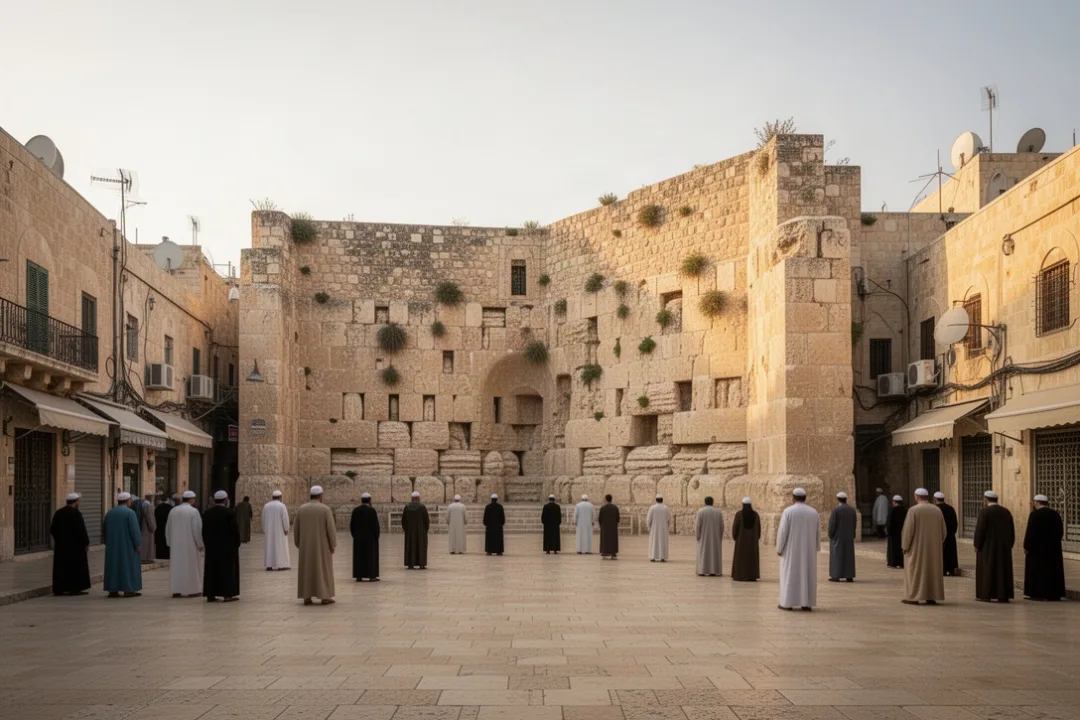
The most visible part of Machpelah is a large rectangular enclosure built from carefully cut stone blocks. Its massive walls are widely associated with Herodian architecture, meaning construction from the period connected with Herod the Great and the late Second Temple era. Scholars commonly compare the masonry and monumental style with other major building projects from that period.
The enclosure is one of the clearest ancient features at the site. It has tall stone walls, projecting elements, and a formal design that gives the complex the appearance of a monumental precinct rather than an ordinary tomb. The original builder and exact construction date are not established with complete certainty, so descriptions generally refer to the structure as Herodian or Herodian-period rather than treating every detail as proven.
Inside, the building has been adapted for worship over many centuries. Visitors may see prayer halls, arches, screens, carpets, lamps, inscriptions, and cenotaphs connected with the revered figures. The appearance of individual spaces reflects the fact that different communities and rulers have used or modified the complex at different times.
The traditional cenotaphs are especially prominent. They are enclosed or decorated memorial structures that mark the supposed positions of the patriarchs and matriarchs. Their design and placement help organize the interior for prayer and visitation, but they do not provide a simple archaeological map of the underlying cave.
A small opening historically associated with the cave has attracted attention from pilgrims and researchers. Access below the visible sanctuary has been restricted, and accounts of what lies beneath are shaped by limited observation, religious custom, and historical reports. No complete modern archaeological investigation has established every chamber or burial arrangement under the complex.
How the building changed across different periods
After the ancient enclosure was built, the site passed through periods of religious and political change. The Roman and Byzantine eras brought new forms of administration and worship to the region. Later, Muslim rulers developed the sanctuary as an Islamic holy place, and the building has continued to retain that identity alongside its Jewish associations.
During the Crusader period, the complex was adapted for Christian use and was associated with a church. Subsequent Muslim rulers restored and reconfigured the site. Ottoman authorities also maintained the sanctuary, leaving architectural and decorative traces that visitors may still encounter.
These layers do not form a neat sequence in which one tradition completely erased the previous one. Some changes were destructive, while others preserved earlier walls or incorporated existing spaces. The result is a building in which ancient masonry, medieval alterations, Islamic features, and modern security arrangements exist side by side.
What history can and cannot prove about the cave
The biblical account gives a detailed tradition about the purchase of the field and cave, but a religious text and an archaeological excavation answer different kinds of questions. Genesis explains who is believed to have acquired the property and why it mattered. Archaeology examines surviving structures, building materials, inscriptions, soil layers, and other physical evidence.
The large enclosure provides strong evidence for an ancient monumental building at the location. Its stonework is consistent with the architectural practices of the late Second Temple period. That evidence supports the antiquity of the sanctuary, but it does not independently verify every biblical detail about the individuals buried beneath it.
The identities of the buried figures remain matters of religious tradition rather than fully demonstrated archaeological fact. There are no publicly available discoveries that conclusively identify the remains of Abraham, Sarah, Isaac, Rebekah, Jacob, or Leah. The sacred status of the site, the sensitivity of the location, and restrictions on investigation all limit what researchers can test directly.
That limitation does not make the site historically unimportant. A location can be valuable evidence for ancient architecture, later pilgrimage, religious memory, and political history even when the original burials cannot be scientifically confirmed. Machpelah is significant on all of those levels.
Researchers also have to distinguish between several claims that are sometimes blended together:
The biblical claim: Genesis identifies a particular field and cave near Hebron as a family burial place.
The architectural claim: a large ancient enclosure stands at the location traditionally associated with that burial place.
The traditional claim: Jewish and Muslim communities have preserved the site as the resting place of revered ancestors.
The archaeological claim: physical remains must be examined using evidence and methods that are limited at this sacred site.
Keeping those categories separate allows visitors to respect religious belief without presenting tradition as a type of proof it cannot provide. It also avoids the opposite mistake of treating the site as meaningful only if every story can be confirmed through excavation.
Machpelah in the history of Hebron
Machpelah is located in Hebron, one of the oldest continuously inhabited cities in the region. The city’s Arabic name is Al-Khalil, meaning “the friend,” a reference to Abraham’s honored status. Its location in the southern hill country made it important in biblical narratives, regional politics, pilgrimage, and trade.
The sanctuary became a focal point within the city because sacred geography and urban life developed together. Roads, markets, residential areas, religious institutions, and political authority all affected the experience of visiting the complex. Machpelah was never an isolated monument disconnected from its surrounding city.
Hebron’s modern history has made the site especially contested. The city is divided into areas governed under different arrangements established through Israeli-Palestinian agreements, and security control is not uniform throughout the city. The area containing the sanctuary is subject to particularly complex arrangements involving Israeli security control, Palestinian urban surroundings, and religious administration.
Prayer access and movement through the building can change according to religious holidays, security decisions, local conditions, and administrative rules. At some times, particular spaces are available to one community; at other times, arrangements may be adjusted to accommodate different worshippers. Visitors should not assume that access described by an older guidebook will remain the same.
For visitors: Check current travel advisories, local opening information, dress requirements, photography rules, and access arrangements before traveling to Hebron. Carry identification and expect security procedures at entrances or checkpoints.
Visitors should dress modestly and behave as they would in any active place of worship. Clothing that covers shoulders and knees is generally the safest choice, and quiet conduct is appropriate. Photography may be restricted in certain rooms or during prayer, so follow posted instructions and directions from site personnel.
The sanctuary can be meaningful even for people who do not belong to one of its principal faith communities. A respectful visit involves learning which spaces are open, avoiding disruption during worship, and recognizing that the building is a living religious site rather than only an ancient attraction.
How to understand Machpelah today
Machpelah brings several kinds of history into one place. It is a site described in Genesis, a monument with ancient stonework, a center of Jewish and Muslim devotion, a destination for pilgrims, and a location within one of the most politically sensitive cities in the region.
Its importance does not depend on reducing those dimensions to one explanation. The biblical narrative gives the site its foundational story. The surviving enclosure provides architectural evidence of a major ancient precinct. Later communities added their own forms of worship, memory, and interpretation.
The word “cave” can also create a misleading mental picture. Most visitors encounter a substantial enclosed sanctuary with monumental walls and religious furnishings, not an open archaeological cavern. The underground burial space is central to the site’s identity, but its limited accessibility means that the visible building is the main part experienced by modern visitors.
For a reader studying the Bible, Machpelah helps clarify the geography and family relationships in Genesis. For a student of architecture, it offers an example of a monumental enclosure reused across centuries. For a traveler, it demonstrates how sacred places can remain active, contested, and historically layered at the same time.
The most careful way to describe Machpelah is therefore as the traditional burial site of the biblical patriarchs and matriarchs, preserved within an ancient sanctuary in Hebron. That wording respects the enduring religious tradition while acknowledging the limits of what archaeology can establish about the burials themselves.
Frequently asked questions
Is Machpelah the same place as the Cave of the Patriarchs?
Yes. “Machpelah” refers to the cave and burial property described in Genesis, while “Cave of the Patriarchs” is the common English name for the same traditional site. The larger building around it is also called the Sanctuary of Abraham or Haram al-Ibrahimi. Different names reflect the site’s Hebrew, Christian, and Islamic contexts rather than separate locations.
Who is believed to be buried at Machpelah?
Jewish and Muslim traditions associate the site with Abraham, Sarah, Isaac, Rebekah, Jacob, and Leah. Rachel is generally excluded because Genesis places her burial near Bethlehem. The visible monuments inside the sanctuary are cenotaphs, or memorial markers, and the identities of the actual remains have not been independently confirmed through modern archaeological investigation.
Can visitors enter the actual cave beneath Machpelah?
Ordinary visitors generally experience the above-ground sanctuary and its memorial areas rather than entering the cave itself. Access below the building has been restricted and has varied across history. Religious, security, and administrative rules can also affect which parts of the complex are open, so current local information is essential before planning a visit.
Why is Machpelah politically sensitive?
The sanctuary stands in Hebron, a city with divided governance and a long history of Israeli-Palestinian conflict. It is sacred to both Jews and Muslims, and control, security, prayer arrangements, and movement around the site are deeply contested. Holiday schedules and security conditions may change access, sometimes with little notice.





Leave a Reply