Tamar in the Bible: Her story, meaning, and legacy
Tamar in the Bible: Her story, meaning, and legacy
Tamar is the name of several women in the Bible, not just one. The best-known Tamar is Judah’s daughter-in-law in Genesis 38, but the Bible also describes Tamar, the daughter of King David, and another Tamar connected with Absalom’s family. Reading their stories together reveals recurring questions about justice, family authority, sexual violence, grief, and survival.
The name Tamar comes from a Hebrew word associated with a date palm. In the biblical world, the name could suggest beauty, fruitfulness, or flourishing, although the text does not give each Tamar a separate explanation of her name. These women appear in different settings and should not be merged into a single character.
The Bible mentions at least three significant women named Tamar. Their stories occur in different books and generations, so the first step is to identify which one a passage means.
Tamar, Judah’s daughter-in-law: Her story appears in Genesis 38. After being denied the family protection she was owed, she disguises herself and becomes pregnant by Judah, her father-in-law.
Tamar, David’s daughter: Her story appears in 2 Samuel 13. Her half-brother Amnon sexually assaults her, and the royal family fails to provide meaningful justice.
Tamar, Absalom’s daughter: She is named in 2 Samuel 14:27. The verse identifies her as Absalom’s daughter, but gives no extended account of her life.
Matthew 1:3 also refers to Tamar in the genealogy of Jesus. Most readers understand this reference as Tamar from Genesis 38, because Matthew names Judah and Tamar together. The genealogy places her within the family line that leads to King David and, in Matthew’s presentation, to Jesus.
Keep the stories separate: Genesis 38 concerns Judah’s daughter-in-law, while 2 Samuel 13 concerns David’s daughter. Both stories involve serious injustice, but they are not accounts of the same woman.
What happens to Tamar in Genesis 38?
Tamar’s story begins with her marriage to Er, Judah’s firstborn son. Genesis says that Er was wicked and that God put him to death, but it does not explain the specific nature of his wrongdoing. Tamar then becomes part of a family system governed by levirate-like duties, in which a deceased man’s brother may be expected to provide offspring for the dead man’s household.
Judah tells his second son, Onan, to fulfill a family obligation connected with Tamar. Onan has sexual relations with her but deliberately prevents a child from being conceived. Genesis describes this act as wrong and says that Onan also dies. The passage does not frame Tamar as responsible for either man’s death.
Judah then tells Tamar to remain a widow in her father’s household until his youngest son, Shelah, is old enough to marry her. This promise appears to offer Tamar a future within Judah’s family, but Judah does not keep it. He fears that Shelah may die as his brothers did, so Tamar remains without the husband, child, and security that the family arrangement had implied.
By this point, Tamar occupies a vulnerable position. She is a widow who has returned to her father’s household, yet Judah has not released her from the expectation that she belongs to his family. She has little apparent control over property, marriage, or public reputation.
Why does Tamar disguise herself?
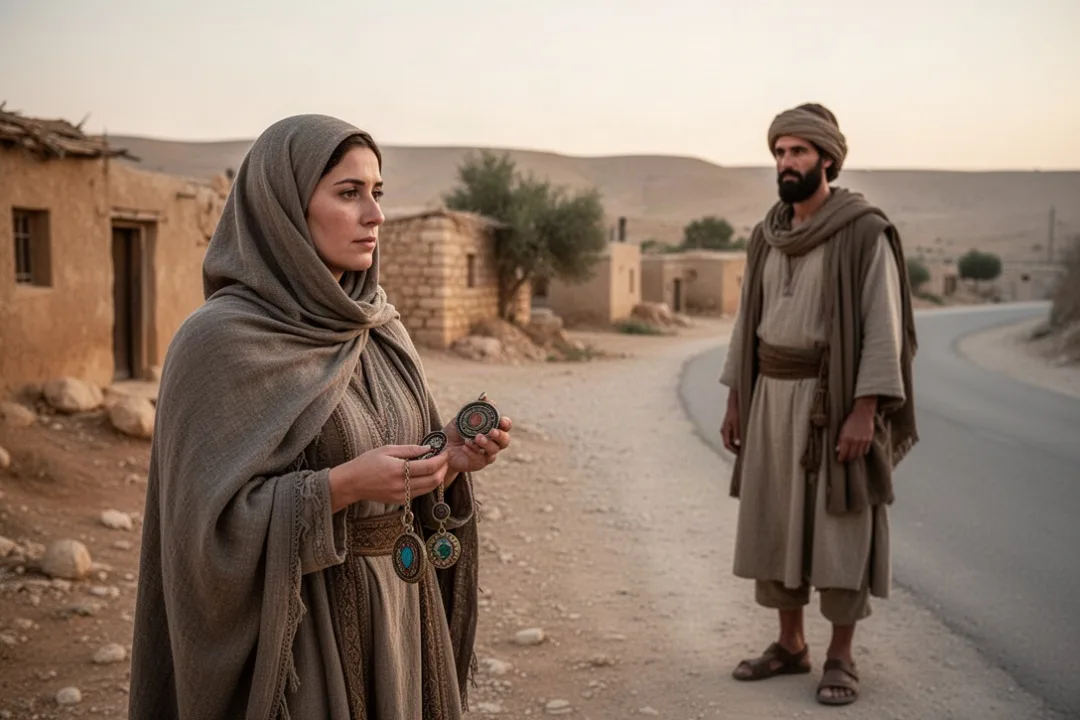
When Tamar learns that Judah is traveling to Timnah for sheep shearing, she removes her widow’s clothing and covers herself. She sits near the road where Judah is likely to pass. Judah sees her and assumes that she is a prostitute, because her face is covered. Genesis 38 records their encounter without presenting it as a romantic relationship.
Judah offers payment, but Tamar asks for a pledge until he sends the promised payment. She requests his seal, cord, and staff—personal items that can identify him. Judah gives them to her, and she becomes pregnant.
Tamar then returns to her widow’s clothing. When Judah later sends payment, the woman cannot be found, and the local people say that no shrine prostitute was there. Judah decides to leave the matter alone rather than risk public embarrassment.
Three months later, Judah is told that Tamar has become pregnant through sexual immorality. He orders that she be brought out and punished. His judgment is striking because he does not yet know that he is the father. Tamar then sends him the personal items and asks him to identify their owner.
Genesis 38 presents Tamar’s reply as a restrained demand for recognition: the man who owns these objects is the father of her child.
Judah recognizes the items and admits that Tamar is more righteous than he is, because he failed to give her Shelah. The chapter then names Tamar’s twin sons, Perez and Zerah. Perez becomes especially important in the biblical family line, since Ruth 4 traces the line from Perez through later generations to David.
What does Genesis 38 say about Tamar’s actions?
Readers have interpreted Tamar’s disguise in different ways. Some view her behavior as a carefully planned effort to claim the family protection Judah had denied her. Others focus on the moral complications of her deception and sexual encounter. The text itself does not provide a modern legal or ethical analysis, so interpretations should avoid pretending that every question has a simple answer.
What the chapter does make clear is that Judah holds power and fails to use it justly. He promises Shelah but does not honor the promise. He treats Tamar as guilty before examining the evidence. When the evidence points to his own conduct, he acknowledges his responsibility.
Tamar’s action is also not the same as an accusation against every widow or every woman in a vulnerable position. The story belongs to an ancient family and social system in which a woman’s future could depend heavily on male relatives. Its details should be understood in that setting rather than copied as a general model for behavior.
The chapter’s emphasis falls on the exposure of hypocrisy and unequal judgment. Judah is ready to condemn Tamar for a sexual offense while failing to recognize his own role in the situation. Tamar’s evidence forces him to confront the consequences of his neglect.
How is Tamar connected to the genealogy of Jesus?
Matthew 1 begins by tracing Jesus’ ancestry through Abraham and David. In that list, Matthew names Tamar alongside Judah. This is unusual because biblical genealogies often emphasize male ancestors, yet Matthew includes several women in the genealogy.
The women named in Matthew’s genealogy include Tamar, Rahab, Ruth, and “the wife of Uriah,” who is generally understood to be Bathsheba. Each name brings a complicated story into the family history. Tamar is associated with a disputed sexual encounter and a struggle for justice; Ruth is a foreign widow who joins Israel; Rahab is linked with Jericho; and Bathsheba is connected to David’s abuse of royal power and the death of her husband.
Matthew’s choice to mention Tamar shows that the line leading to Jesus includes people whose stories involve scandal, vulnerability, foreignness, and moral failure. Her place in the genealogy does not erase the difficult details of Genesis 38. Instead, it preserves her identity and acknowledges her role in the family line.
Matthew 1:3 does not retell Tamar’s story. Readers who want to understand the reference must look back to Genesis 38. The genealogy assumes that names carry histories, and Tamar’s name brings Judah’s failure and eventual admission into the ancestry Matthew records.
What happens to Tamar, David’s daughter, in 2 Samuel 13?
The second major Tamar appears in the royal family of David. She is described as a beautiful young woman and as the full sister of Absalom. Amnon, David’s son by another mother, becomes obsessed with her. He presents his desire as love, but the narrative shows that his desire is coercive and destructive.
Amnon devises a plan to get Tamar alone. He pretends to be ill and asks David to send Tamar to prepare food for him. When she brings the food, Amnon refuses to listen to her protests and assaults her. The biblical narrative describes the event with disturbing directness, but it does not place blame on Tamar.
Tamar immediately identifies the wrong done to her. She tells Amnon not to send her away because doing so would make the situation even worse. She also points out that his actions would be treated as a disgrace in Israel. Her words show that she understands the social and legal danger created by his assault.
Amnon then turns against her with intense hatred. He orders his servant to put her out and bolts the door behind her. Tamar tears her special garment, places ashes on her head, and goes away crying. These actions visibly express mourning, humiliation, and loss.
How do David and Absalom respond to Tamar’s assault?
Absalom tells Tamar to remain silent and not let the matter consume her. He brings her into his household, where she lives as a desolate woman. Absalom is angry with Amnon, but he does not immediately create a public process that protects Tamar or addresses the crime.
David hears what happened and becomes angry, yet the narrative does not show him disciplining Amnon. This failure matters because David is both Tamar’s father and the king. His authority could have been used to defend her, but the story records anger without effective justice.
Two years later, Absalom arranges for Amnon to be killed at a feast. The assassination is an act of revenge, not a transparent legal remedy. It also begins a larger cycle of violence within David’s family. The chapter therefore shows how unaddressed sexual violence can deepen family conflict rather than disappear.
2 Samuel 13 does not describe Tamar marrying, having children, or returning to public life. Her silence in the remainder of the chapter should not be mistaken for approval or resolution. It reflects the limits of the narrative and the fact that the family’s powerful men fail to restore what was taken from her.
Read Tamar’s story with care: The assault in 2 Samuel 13 is Amnon’s responsibility. Tamar’s clothing, presence, words, or relationship to the royal family do not cause or justify his violence.
Who is Tamar, Absalom’s daughter?
A third Tamar is mentioned briefly in 2 Samuel 14:27. The verse says that Absalom had three sons and one daughter named Tamar, and that she was beautiful. The reference may seem easy to overlook, but it connects her to the wider family story shaped by the earlier assault of her aunt, David’s daughter Tamar.
The Bible does not provide a separate narrative about Absalom’s daughter. It does not tell readers whom she married, where she lived, or how she experienced the turmoil surrounding her father. Her appearance in the text is limited to a genealogical notice and a comment about her beauty.
Some readers wonder whether 2 Samuel 14:27 refers to the same Tamar who was assaulted by Amnon. The family relationships make that impossible: Absalom’s daughter belongs to a later generation, while the assaulted Tamar is Absalom’s sister. The shared name reflects the family’s reuse of a name, not the identity of one woman.
What themes connect the different Tamar stories?
The Tamar narratives are not identical, but they share a concern with how families and institutions treat women who have limited power. Genesis 38 shows a woman denied the future promised to her. Second Samuel 13 shows a woman harmed by a powerful man and then abandoned by the people who should protect her.
Justice can require exposing unequal standards
Genesis 38 contrasts Judah’s quick condemnation of Tamar with his reluctance to examine his own responsibility. The story does not praise superficial respectability. It exposes the danger of judging a vulnerable person while excusing the person with greater authority.
Silence does not mean that harm was minor
In 2 Samuel 13, Tamar’s story ends without a public declaration of justice. That lack of resolution should not be used to minimize the assault. Biblical narratives sometimes record injustice without approving it, allowing the reader to see how badly leaders and relatives fail.
Family power can protect or endanger
Judah, David, Amnon, and Absalom all possess social power that affects Tamar’s options. Some use authority selfishly, some delay action, and some respond through retaliation. The stories invite careful attention to the difference between authority that protects and authority that controls.
A person’s dignity is not defined by public shame
Both major Tamars are placed in situations where others could label them disgraceful. Genesis 38 shows Tamar’s evidence overturning Judah’s accusation. Second Samuel 13 shows Tamar grieving after violence done to her. Neither story gives readers grounds to treat shame as proof of guilt.
Practical tips and common mistakes when studying Tamar
Tamar’s stories contain unfamiliar customs, complicated family relationships, and painful subject matter. A careful reading benefits from slowing down and checking the details rather than combining separate passages.
Start with the reference: Genesis 38 means Judah’s daughter-in-law; 2 Samuel 13 means David’s daughter; 2 Samuel 14:27 means Absalom’s daughter.
Track the family relationships: Judah is not David, and the Tamar in Genesis is not the Tamar in the royal family.
Do not blame Tamar for Amnon’s assault: The narrative presents Amnon as the aggressor and Tamar as the person harmed.
Separate description from approval: A biblical text may report revenge, deception, or a leader’s failure without endorsing it.
Read Genesis 38 with its surrounding genealogy: Ruth 4 and Matthew 1 help explain why Perez and Tamar matter in the larger family line.
Avoid forcing modern categories onto ancient customs: Ask what the text says about widowhood, inheritance, family duty, and public reputation before drawing conclusions.
Notice who speaks and who stays silent: Tamar speaks clearly in Genesis 38 and protests in 2 Samuel 13, while the men around her often control the public response.
Handle the assault narrative pastorally: Survivors may find the passage distressing. Do not use it to pressure someone to forgive, remain silent, or reconcile with an abuser.
A common mistake is to treat Tamar’s disguise in Genesis 38 as the main moral issue while ignoring Judah’s broken promise. Another is to read David’s anger in 2 Samuel 13 as though it automatically equals justice. The narratives ask readers to examine what people do after wrongdoing is exposed, not only what happened at the beginning.
What can Tamar’s stories mean for readers today?
Tamar’s stories can prompt questions about the responsibilities of families, religious communities, and leaders when someone is vulnerable. A promise that affects another person’s future should not be made casually or abandoned without explanation. Authority should be used to create safety and accountability, not to protect reputation.
Genesis 38 also shows why public appearances can be misleading. Tamar is initially treated as a sexual offender, but the objects she presents reveal a different story. The chapter warns against assuming that the person accused is the person most responsible.
Second Samuel 13 raises a different but related concern: the harm caused when a family knows about violence yet does not provide meaningful accountability. Anger alone does not repair damage. Retaliation may create more suffering without giving the survivor security, recognition, or a voice in what happens next.
For Christian readers, Tamar’s inclusion in Matthew’s genealogy can be significant. Her presence means that the family history leading to Jesus is not presented as polished or free from disgrace. It includes women who endured vulnerability and men whose actions required exposure. The genealogy preserves the truth that redemption does not depend on pretending the past was clean.
How should Tamar be remembered?
Tamar from Genesis should be remembered as a woman who confronted a family system that had denied her a promised future. She acted within a dangerous situation, produced evidence, and forced Judah to recognize his responsibility. Her story ends with her sons and with her place in the ancestry later connected to David and Jesus.
Tamar, David’s daughter, should be remembered as a victim of sexual violence whose protest was clear and whose surrounding family failed her. The absence of a satisfying resolution is part of the tragedy, not evidence that the assault was unimportant. Her story deserves to be read with compassion, moral clarity, and rejection of victim-blaming.
Absalom’s daughter Tamar is remembered only briefly, but even that brief notice reminds readers that names can carry family memory. Together, the three accounts show that a biblical character’s importance is not measured only by how many verses describe her. Tamar’s name remains connected with truth brought into the open, suffering that should not be hidden, and a family history that includes both wrongdoing and resilience.
Frequently asked questions
Is Tamar in Genesis the same person as Tamar in 2 Samuel?
No. Genesis 38 describes Judah’s daughter-in-law, while 2 Samuel 13 describes David’s daughter. They lived in different generations and belonged to different families. A third Tamar, Absalom’s daughter, appears briefly in 2 Samuel 14:27. Their shared name can cause confusion, but the biblical relationships clearly distinguish them.
Was Tamar wrong to disguise herself in Genesis 38?
The passage presents a morally complicated situation rather than a simple rule about deception. Tamar had been denied the future Judah had promised, and Judah then judged her without recognizing his own responsibility. Readers disagree about the ethics of her method, but the text clearly highlights Judah’s failure and records his admission that Tamar was more righteous than he was.
Does the Bible blame Tamar for Amnon’s assault?
No. In 2 Samuel 13, Amnon plans the encounter, ignores Tamar’s objections, and uses force. Tamar protests and identifies the disgrace caused by his actions. Her clothing, presence, or relationship to the royal family does not make her responsible. The failure afterward belongs to the men who do not provide effective justice or protection.
Why is Tamar named in Matthew’s genealogy of Jesus?
Matthew names Tamar as part of the line from Judah to Jesus. Her inclusion preserves a family story involving vulnerability, sexual scandal, and Judah’s wrongdoing rather than presenting Jesus’ ancestry as flawless. Alongside other women with complicated histories, Tamar shows that Matthew’s genealogy includes people whose lives do not fit a simple picture of respectability.











Leave a Reply