The First Jewish Temple was traditionally built in Jerusalem by King Solomon during the 10th century BCE, often dated around 957 BCE in traditional biblical chronology. Historians cannot establish one exact year with complete certainty, so modern discussions usually describe its construction as occurring sometime in the 10th or possibly early 9th century BCE.
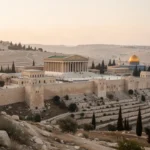
The First Temple, also called Solomon’s Temple or the Temple in Jerusalem, was the central sanctuary of ancient Israel and Judah. It stood on the elevated site later known as the Temple Mount, where the Second Temple and, much later, Herod’s expanded Temple also stood.
The Temple served as a permanent center for worship, sacrifices, priestly service, festivals, and national religious life. Before it was built, the Israelites’ main sanctuary was the Tabernacle, a portable worship tent associated with the wilderness period and the early settlement in the land of Israel.
The Temple was not simply an ancient building used for regular gatherings. Its innermost room, known as the Holy of Holies, represented the most sacred presence of God. According to the biblical account, the Ark of the Covenant was placed there after the Temple was completed.
Short answer: The First Temple was built under Solomon in the 10th century BCE, traditionally around 957 BCE. The exact date is uncertain because the surviving evidence does not provide a universally accepted construction year.
Why the construction date is difficult to establish
The commonly cited date comes from a combination of biblical chronology and later historical calculations. The biblical narrative connects the Temple’s construction with Solomon’s reign and gives a time interval between the Exodus from Egypt and the beginning of the building project. Interpreting those chronological details literally produces a date in the mid-10th century BCE.
That calculation is not accepted by every historian. Biblical chronology contains passages whose numbers and historical relationships are interpreted in different ways. Scholars also compare the biblical account with archaeological remains, inscriptions, regional history, and the dates assigned to neighboring kingdoms.
The main dating questions include:
How long did Solomon reign? The biblical account presents a reign of about four decades, but the absolute dates of his reign depend on how earlier events are dated.
How should the 480-year interval be understood? Some readers treat it as a literal total, while some scholars view it as a rounded or symbolic chronological framework.
How much archaeological evidence survives? The original Temple site has been heavily altered over many centuries, making direct excavation and identification difficult.
How should the biblical account be compared with external sources? Neighboring kingdoms and later empires provide useful chronological anchors, but they do not give a simple, direct date for the Temple’s construction.
For that reason, a careful answer distinguishes between traditional biblical dating and historical certainty. Around 957 BCE is a familiar traditional estimate, while “10th century BCE” is a safer broad date for general historical writing.
How the First Temple was built according to the biblical account
The biblical story presents the Temple as the result of a project begun during Solomon’s reign after earlier preparations by David. David is described as wanting to build a permanent sanctuary, but the task is assigned to his son Solomon. David’s role is presented as preparing materials, organizing resources, and establishing plans, while Solomon oversees the actual construction.
The construction process can be outlined in several stages:
Jerusalem became the royal and religious center. David established Jerusalem as the capital after capturing it and brought the Ark of the Covenant to the city.
Materials and skilled workers were assembled. The account describes stone, timber, metal, fabrics, and specialized craftsmanship being gathered for the project.
Foreign trade and labor agreements supported the work. The biblical narrative associates Solomon with a relationship with Hiram, king of Tyre, whose kingdom was known for its timber and skilled artisans.
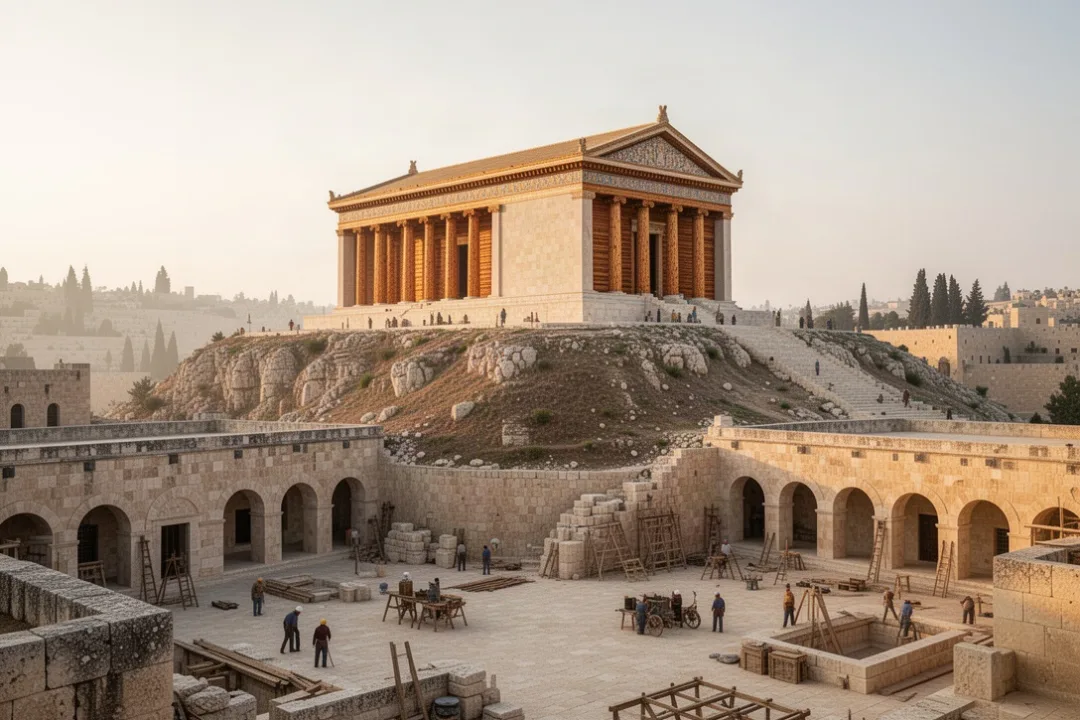
The main structure was erected on the designated height. The Temple included an entrance area, a larger sanctuary, and the innermost Holy of Holies.
Furnishings and sacred objects were installed. These included altars, lampstands, tables, basins, decorative elements, and the Ark of the Covenant.
The Temple was dedicated through prayer and ceremony. The dedication marked the building as the national sanctuary of the Israelite people.
The biblical description says the building project took seven years. It also places the beginning of construction in the fourth year of Solomon’s reign and the completion in his eleventh year. Those details are the basis for calculating a date from the traditional chronology.
What the biblical text says about its date
The main account of the Temple’s construction appears in 1 Kings 5–8, with additional descriptions in 2 Chronicles. The narrative links the project to Solomon’s reign, gives the length of the building period, and describes the dedication ceremonies.
One passage in 1 Kings places the start of construction 480 years after the Israelites left Egypt. If that number is read as a precise chronological figure and combined with other traditional dates, the project is often placed around 957 BCE. Some traditional chronologies use slightly different calculations and arrive at nearby dates.
The number has generated considerable discussion. Some biblical interpreters accept it as a straightforward historical figure. Others observe that long chronological periods in ancient texts can be organized into symbolic groupings or rounded totals. As a result, historians do not all use the same calculation.
The biblical account also provides a relative sequence that is more secure than the absolute year: the Temple was built after David established Jerusalem as the capital, during Solomon’s reign, before the kingdom divided into Israel and Judah, and centuries before the Babylonian destruction.
What the Temple probably looked like
No complete architectural plan of the First Temple has survived, and the site cannot be inspected in the same way as an undisturbed ancient building. Most reconstructions therefore combine the biblical descriptions with comparisons to temples and palaces from the ancient Levant.
The building is generally understood as having a long, rectangular layout organized along a central axis. It likely included:
An entrance porch or vestibule at the front of the structure.
The main sanctuary, where priests performed regular duties and maintained sacred equipment.
The Holy of Holies, a smaller inner chamber considered the most sacred area.
Side rooms or surrounding chambers used for storage and priestly functions.
An outer courtyard containing large ritual installations, including an altar for sacrifices.
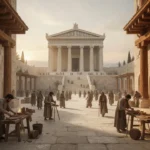
The biblical account emphasizes cedar wood, carved decorations, gold-covered surfaces, bronze furnishings, and elaborate artistic details. These features fit the broader architectural traditions of the ancient Near East, where royal sanctuaries often combined religious symbolism with displays of wealth and political authority.
Descriptions of the Temple should not be treated as a surviving architectural blueprint. Some measurements and furnishings are clearly described in the biblical books, but scholars still debate how those details corresponded to an actual building plan. Reconstructions can therefore differ in proportions, room arrangements, and the appearance of the surrounding complex.
Why Solomon built the Temple
Building the Temple served several connected purposes. Religiously, it provided a permanent home for the central sanctuary and a fixed location for major sacrificial and festival rites. Politically, it reinforced Jerusalem as the capital and linked the royal house with the worship of Israel’s God.
The Temple also helped express national identity. A permanent sanctuary could unify communities that had previously worshiped at multiple local sites. It created a visible center for priestly authority and gave the monarchy a major public institution through which it could organize labor, wealth, and ceremonial life.
The project likely required substantial resources. Large quantities of timber and worked stone, as well as skilled metalworkers and builders, would have demanded an organized administration. The biblical account presents Solomon’s reign as a period of wealth and international connections, although the scale of the project and the size of the kingdom remain subjects of historical debate.
It is useful to separate the religious meaning of the Temple from modern assumptions about a single centralized government. Ancient sanctuaries were places of worship, but they were also connected to royal power, economic administration, priestly institutions, and public ceremony.
How the First Temple relates to earlier worship sites
The First Temple was not the first place associated with Israelite worship. Before Jerusalem became the permanent center, the biblical tradition refers to the Tabernacle and to various local or regional sanctuaries. Places such as Shiloh, Bethel, Dan, and Gibeon appear in biblical accounts of earlier religious activity, although the history of each site is complex.
The Tabernacle was described as a portable sanctuary that accompanied the Israelites during their travels. It included sacred furnishings and a restricted inner area, making it a conceptual and ritual predecessor to the Temple. The major difference was that the Temple was a permanent monumental structure tied to Jerusalem.
David’s movement of the Ark to Jerusalem was especially significant in the biblical narrative. It connected the city, the royal dynasty, and the central sanctuary before the building itself existed. Solomon’s Temple then gave that arrangement a permanent architectural form.
This distinction helps answer a common source of confusion: the First Temple was not the same as the Tabernacle, and it was not the first location where Israelites worshiped. It was the first permanent Temple in Jerusalem associated with the Israelite monarchy.
What archaeology can and cannot confirm
Archaeology confirms that Jerusalem was an important settlement and political center during the Iron Age, the period that includes the traditional reigns of David and Solomon. Excavations and discoveries from the wider region also show that monumental construction, royal administration, and elaborate temples were possible in the 10th and 9th centuries BCE.
However, archaeology has not produced an intact foundation inscription that says, in effect, “Solomon built this Temple in a particular year.” The Temple Mount has been occupied, rebuilt, expanded, damaged, and modified repeatedly. Modern access and religious sensitivities also limit archaeological investigation in important areas.
Evidence from nearby sites can still be useful. Ancient Levantine temples often shared design features such as a central hall, a restricted inner chamber, monumental entrances, and rich decorative materials. These comparisons support the plausibility of the biblical architectural description without proving every detail of the account.
Evidence and tradition are not identical: The biblical sources provide the clearest surviving account of Solomon’s Temple, while archaeology helps establish the wider historical setting but does not currently fix an exact construction year.
Scholars also disagree about the size and power of the united monarchy traditionally associated with David and Solomon. Some view the biblical descriptions as broadly historical but shaped by later editing. Others argue that the kingdom may have been smaller than the account suggests. These debates affect how confidently historians reconstruct the Temple’s scale and the resources used to build it.
How the First Temple period ended
The First Temple stood for several centuries after its construction. The biblical books describe changes, repairs, religious reforms, and periods when worship practices were contested. The Temple remained the main sanctuary of the kingdom of Judah after the northern kingdom of Israel separated from Judah.
In the early sixth century BCE, Babylon conquered Jerusalem. The Babylonian king Nebuchadnezzar II is traditionally associated with the destruction of the city and the Temple in 586 BCE, although some chronological systems place the event in 587 BCE. The destruction marked the end of the First Temple period and was followed by the exile of many people from Judah.
The loss of the Temple had religious and political consequences. Sacrificial worship at the central sanctuary could no longer continue in the same way, and the community had to preserve its identity under foreign rule and away from Jerusalem. Biblical books written or shaped during and after this period reflect on the meaning of destruction, exile, covenant, and restoration.
Some accounts describe sacred objects being carried away to Babylon, including the Temple’s valuable vessels. The biblical narrative also describes the Temple as burned and its furnishings removed or destroyed. No complete set of First Temple objects has been securely identified in modern collections.
How the First Temple differs from the Second Temple
The Second Temple was built after the Persian Empire allowed exiled Judeans to return and rebuild in Jerusalem. Work began in the late sixth century BCE, and the rebuilt sanctuary was completed around 516 BCE. This was several decades after the First Temple’s destruction.
The Second Temple was not simply the original building restored. It occupied the same sacred site but belonged to a later political and religious period. It was associated first with Persian rule, later with Hellenistic kingdoms, and eventually with the Hasmonean and Roman eras.
Herod the Great undertook a massive rebuilding and expansion of the Second Temple complex beginning in the late first century BCE. Because Herod’s Temple became famous in the time of Jesus and the Roman period, people sometimes confuse it with Solomon’s Temple. They were separate structures separated by centuries of history.
The sequence is:
First Temple: traditionally built by Solomon in the 10th century BCE.
Babylonian destruction: Jerusalem and the First Temple were destroyed in the early sixth century BCE.
Second Temple: rebuilt after the return from exile and completed around 516 BCE.
Herodian expansion: the Second Temple complex was greatly enlarged and renovated in the late first century BCE.
Roman destruction: the Second Temple was destroyed in 70 CE during the Roman siege of Jerusalem.
Which date should you use?
The best date depends on how precise your purpose is. For a short answer, say that the First Temple was built by Solomon in the 10th century BCE. This is historically cautious and communicates the central fact without suggesting that scholars have established an exact year.
If you are describing traditional biblical chronology, you can give the more specific estimate of around 957 BCE. It helps to label that date as traditional or approximate because different chronological systems produce somewhat different results.
For academic or museum-style writing, a sentence such as this is appropriate: “According to the biblical account, Solomon built the First Temple in Jerusalem during the 10th century BCE; the exact date is debated.” That wording distinguishes the ancient source, the broad period, and the limits of current evidence.
Avoid saying that the Temple was built in 957 BCE as an unquestioned archaeological fact. The year is a calculation based on a particular reading of biblical chronology, not a date confirmed by a surviving construction inscription or universally accepted archaeological sequence.
Why the First Temple still matters
The First Temple remains central to Jewish history and religious memory because it represented Jerusalem as the sacred center of ancient Israel. Its destruction became a defining event associated with exile, mourning, and the hope of restoration.
Its influence also extends beyond the biblical period. The Temple shaped Jewish ideas about holiness, pilgrimage, priesthood, sacrifice, kingship, and the relationship between worship and community. Later Jewish tradition preserved detailed memories of the Temple even after the Second Temple was destroyed.
Jerusalem’s Temple site continues to hold profound significance for Jews, Christians, and Muslims. Discussions about the ancient Temple can therefore involve archaeology, biblical interpretation, religious tradition, and modern political sensitivity at the same time.
The most reliable direct answer remains clear: the First Jewish Temple was built in Jerusalem under Solomon during the 10th century BCE, traditionally around 957 BCE. The broad period is widely used, while the exact year depends on chronology and remains open to debate.
Frequently asked questions
Who built the first Jewish Temple?
King Solomon is traditionally credited with building the First Temple in Jerusalem. The biblical account says that David prepared for the project but that Solomon carried out the construction during his reign. Solomon is also associated with organizing the workers, materials, furnishings, and dedication ceremonies that established the Temple as Israel’s central sanctuary.
Was the First Temple built before or after the Tabernacle?
It was built after the Tabernacle. The Tabernacle was described as a portable sanctuary used before Jerusalem had a permanent Temple. Solomon’s Temple replaced that temporary arrangement with a fixed, monumental sanctuary in Jerusalem, although the Temple’s design and sacred functions were connected to earlier Israelite worship traditions.
Where was the First Temple located?
The First Temple stood in Jerusalem on the elevated sacred site later called the Temple Mount. The same general site was used for the Second Temple and its later Herodian expansion. Because the area has undergone extensive construction and remains religiously sensitive, the exact surviving traces of Solomon’s building cannot be easily isolated.
When was the First Temple destroyed?
The First Temple was destroyed when Babylon conquered Jerusalem in the early sixth century BCE. The event is commonly dated to 586 BCE, although some chronological systems use 587 BCE. The Babylonian destruction ended the First Temple period and was followed by the exile of many inhabitants of Judah.






Leave a Reply