Judah the southern kingdom: History, kings, and significance
Judah the southern kingdom: History, kings, and significance
If you are trying to place Judah on a Bible map, the quickest answer is this: Judah was the southern kingdom of the divided Israelite monarchy. It formed after the united kingdom under Saul, David, and Solomon split into two kingdoms, with Judah centered on Jerusalem and the northern kingdom generally called Israel centered first at Shechem and later Samaria.
Judah lasted from the division of the monarchy after Solomon until Babylon captured Jerusalem and destroyed the temple in 586 BCE, although the exact dates can vary slightly among chronologies. Its story includes faithful and unfaithful kings, military threats from Assyria and Babylon, prophetic warnings, the exile, and the beginning of restoration under Persian rule.
Before Judah existed as an independent kingdom, the Israelites were presented as a single monarchy. David established Jerusalem as his capital, and Solomon expanded the kingdom and built the first temple there. The kingdom’s unity depended heavily on the royal house, the central sanctuary, and cooperation among the tribes.
After Solomon’s death, his son Rehoboam inherited the throne. The northern tribes objected to heavy labor demands and taxation associated with the royal administration. Rehoboam rejected their request for relief, and most of the tribes followed Jeroboam, creating a separate northern kingdom.
The tribes and territories that remained loyal to David’s dynasty became the kingdom of Judah. Judah and Benjamin formed its core, while priests, Levites, and other Israelites also lived in or moved toward the southern kingdom because Jerusalem remained the authorized temple center in the biblical account.
Key distinction: “Judah” can refer to the tribe, the southern kingdom, the region around Jerusalem, or the Jewish people in later periods. The meaning depends on the historical setting.
The split did not mean that every person in the south belonged only to the tribe of Judah, or that every person in the north belonged to one other tribe. The political division was more complicated. Biblical genealogies, migration accounts, and later references reflect a mixed population, even though the southern state retained the name Judah.
Judah and Israel at a glance
Judah: the southern kingdom ruled by David’s descendants.
Israel: the northern kingdom formed by most of the tribes after the division.
Judah’s capital: Jerusalem, which also housed the temple.
Israel’s capitals: the northern kingdom used several centers, including Shechem, Tirzah, and Samaria.
Judah’s main territory: the hill country around Jerusalem, the southern highlands, and parts of the Negev and Shephelah, with borders changing over time.
Israel’s fall: Assyria conquered the northern kingdom and captured Samaria in 722 BCE.
Judah’s fall: Babylon captured Jerusalem, destroyed the temple, and exiled many Judeans in 586 BCE.
These two kingdoms shared language, ancestry, religious traditions, and much of their early history. They also competed with one another and sometimes fought wars. Their separate political paths explain why biblical books may use “Israel” in different ways: it can mean all the descendants of Jacob, the northern kingdom, or the people of God as a whole.
The main stages in Judah’s history
A useful way to follow Judah is to divide its history into several stages. The dates are approximate because scholars use different systems for reconciling biblical and ancient Near Eastern chronologies, but the broad sequence is clear.
The divided monarchy: Judah and Israel developed as separate states after Solomon’s death.
Judah’s consolidation: Jerusalem and the Davidic dynasty gave the southern kingdom a strong political and religious center.
Assyrian pressure: Judah survived the fall of Israel but became subject to Assyrian power for periods of time.
Reform and renewed crisis: kings such as Hezekiah and Josiah attempted major religious reforms amid international danger.
Babylonian conquest: Babylon defeated Judah, destroyed Jerusalem and the temple, and carried many people into exile.
Persian restoration: after Babylon fell, exiled Judeans were permitted to return and rebuild the temple, though Judah did not regain full independence.
This sequence shows why Judah is more than a list of kings. Its history is shaped by the connection between political survival, covenant faithfulness, the temple, and the decisions of larger empires.
Where Judah was located
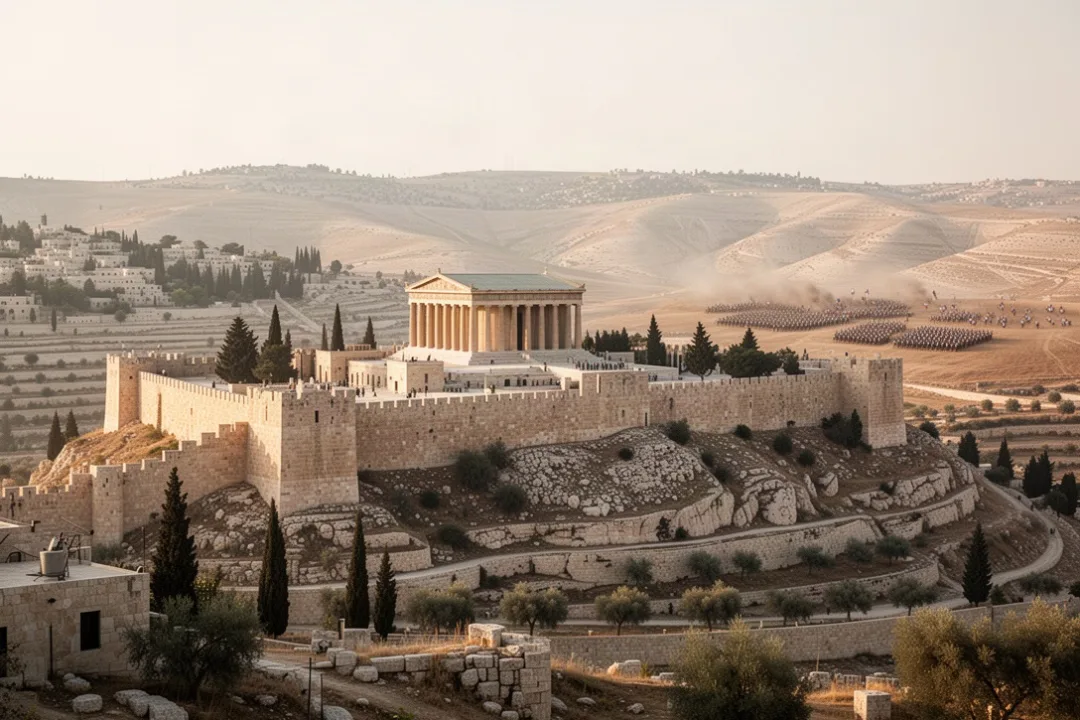
Judah occupied the southern portion of the former united monarchy. Jerusalem stood in the central hill country, where ridges and valleys created both defensive advantages and travel challenges. The kingdom also included important areas west of the hills, such as the Shephelah, and extended southward toward the Negev, although its effective control varied from one period to another.
The land was not uniformly fertile. The central highlands supported farming and settlement, while the western foothills connected Judah with the coastal plain. Routes leading toward Egypt, the Mediterranean coast, and the inland kingdoms made the region strategically important. Those same routes exposed Judah to armies moving between the great powers of the ancient Near East.
Jerusalem’s importance came from more than its location. It was the royal capital and the site of the temple built under Solomon. Because the temple represented God’s dwelling among the people in the biblical narrative, threats against Jerusalem carried religious meaning as well as military danger.
How the kings of Judah shaped the kingdom
Judah had a single ruling dynasty for most of its history: the house of David. That continuity contrasted with the frequent changes of dynasty in the northern kingdom. The biblical books of Kings and Chronicles evaluate Judah’s rulers not only by military success or economic strength but also by their relationship to worship, justice, and the covenant.
Rehoboam and the first generation after the split
Rehoboam was Judah’s first king after the division. His harsh response to the northern tribes helped produce the separation, and the early years included conflict between Judah and Israel. Jerusalem remained Judah’s capital, while the northern kingdom developed a separate political and religious structure.
Judah’s early rulers faced a basic challenge: preserve the Davidic kingdom while managing pressure from the north and from neighboring states. Egypt, Philistia, Edom, Moab, and Aram-Damascus all appear at different points in the political landscape surrounding Judah and Israel.
Asa and Jehoshaphat
Asa is remembered in the biblical account for opposing certain forms of idolatrous worship and for relying on God during some conflicts. His long reign helped stabilize Judah, although it also involved political maneuvering with foreign powers.
Jehoshaphat strengthened Judah through administration, military organization, and alliances. His cooperation with the northern kingdom produced mixed results. The narrative presents him as a generally faithful king while also criticizing particular partnerships, showing that political prudence and religious judgment were not always easy to separate.
Uzziah, Jotham, and the rise of Assyria
Uzziah, also called Azariah, presided over a period of strength and expansion in the biblical record. The kingdom developed its defenses and agricultural resources. His reign illustrates that Judah could be prosperous while still facing internal religious and social problems.
Jotham continued many of his father’s policies, but the international situation was changing rapidly. Assyria was becoming the dominant imperial power in the region. Smaller kingdoms could no longer assume that local rivalries would remain local.
Ahaz and the Syro-Ephraimite crisis
Ahaz ruled when Judah faced a military alliance between Aram-Damascus and the northern kingdom of Israel. This conflict is often called the Syro-Ephraimite crisis. Ahaz sought Assyrian assistance, and Assyria attacked Judah’s enemies but also made Judah dependent on the empire.
The prophets Isaiah and Micah addressed this period. Their messages combined warnings about political fear, foreign alliances, idolatry, and injustice with promises concerning Jerusalem and the Davidic line. The biblical account does not treat military survival as proof that every royal decision was wise.
Hezekiah and the Assyrian invasion
Hezekiah is one of Judah’s most prominent kings. He pursued religious reforms, strengthened Jerusalem’s defenses, and prepared for the danger posed by Assyria. The biblical narrative associates him with efforts to centralize worship in Jerusalem and remove unauthorized shrines and images.
Assyria invaded Judah during Hezekiah’s reign and captured many fortified cities. Jerusalem itself came under severe pressure, but the city was not taken in the account preserved in Kings, Chronicles, and Isaiah. Assyrian records from the reign of Sennacherib also describe a campaign against Judah and the confinement of Hezekiah in Jerusalem, though they present the outcome from an imperial perspective.
Why Hezekiah matters: His reign shows that Judah could resist an empire without escaping its reach. Assyria devastated much of the countryside, even though Jerusalem survived the campaign.
Manasseh and Amon
Manasseh ruled for a long time and is portrayed in Kings as reversing many of Hezekiah’s reforms. The account connects his reign with idolatry, religious practices condemned by the biblical writers, and grave injustice. Chronicles presents a tradition of his later humbling and repentance, while Kings emphasizes the damage associated with his policies.
Amon followed Manasseh but ruled only briefly before being assassinated by officials. The people of the land then killed the conspirators and placed Amon’s son Josiah on the throne. This succession brought Judah to one of its most important periods of reform.
Josiah and the religious reform
Josiah became king as a child and later led a broad reform movement. The biblical account says that a scroll or book of the law was found during temple repairs. After hearing it, Josiah responded with mourning and renewed covenant commitments.
His reforms targeted idolatrous objects, unauthorized worship sites, and practices associated with neighboring religions. He also attempted to extend reform into parts of the former northern kingdom. The account links Josiah especially with the celebration of Passover in Jerusalem.
Josiah’s reign was also shaped by the collapse of Assyria. He died at Megiddo while confronting Pharaoh Neco, whose forces were moving north. His death weakened Judah politically, and the kingdom soon became caught between Egypt and Babylon.
The final kings before Jerusalem fell
After Josiah, Judah’s rulers reigned under foreign pressure. Jehoahaz was taken to Egypt, and Jehoiakim became king under Egyptian influence before Babylon defeated Egypt’s regional power. Jehoiakim later rebelled against Babylon, contributing to the crises that followed.
Jehoiachin ruled briefly and was taken to Babylon during an early stage of the conquest. Zedekiah, installed by Babylon, eventually rebelled. Babylonian forces then besieged Jerusalem, breached the city, destroyed the temple, and carried many inhabitants into exile.
Why Jerusalem and the temple were central to Judah
Jerusalem gave Judah a focus that the northern kingdom did not share in quite the same way. The temple served as the central sanctuary for sacrifices and national worship in the biblical tradition. The city was also the location of the Davidic throne, so religious and royal authority were closely connected.
This centralization created both strength and danger. It gave Judah a clear identity and a powerful symbol of continuity. At the same time, some people treated the temple as a guarantee that Jerusalem could never fall, even while the prophets accused the nation’s leaders of oppression, corruption, and false worship.
Jeremiah challenged the assumption that the temple protected the city regardless of how the people lived. His temple sermon, recorded in Jeremiah 7, argues that worship in a sacred building cannot substitute for justice, honest conduct, and obedience. The message became especially significant when Babylon later destroyed the temple.
What the prophets said to Judah
Judah’s history is closely linked with the prophetic books. Prophets did not simply predict distant events. They addressed the immediate choices of kings, priests, merchants, landowners, and ordinary communities. Their messages often joined faithfulness to God with care for vulnerable people.
Isaiah: challenged Judah’s political fear, idolatry, pride, and injustice while speaking of God’s purposes for Jerusalem and the Davidic line.
Micah: condemned corrupt leaders, dishonest wealth, and the abuse of rural families, while holding out hope for restoration.
Zephaniah: warned of judgment against Judah and surrounding nations and called for humility and renewed obedience.
Jeremiah: warned that Babylon would conquer Jerusalem and urged the people to respond honestly rather than trust misleading assurances.
Habakkuk: wrestled with the question of why God would use Babylon, a violent empire, to judge Judah.
Ezekiel: spoke among the exiles and interpreted Jerusalem’s fall while also presenting visions of renewal.
The prophets’ criticism was not aimed only at private religious habits. They condemned dishonest courts, exploitation of workers, seizure of land, violence, empty ritual, and leaders who benefited while the poor suffered. In the biblical view, Judah’s national crisis had a moral and spiritual dimension.
Why Judah survived Assyria but fell to Babylon
The northern kingdom of Israel fell to Assyria in 722 BCE. Assyria destroyed Samaria and reorganized the region, while Judah remained as a smaller state. Judah’s survival may be connected to geography, political circumstances, the outcome of Assyrian campaigns, and the changing balance among Egypt, Assyria, and Babylon.
Survival did not mean Judah was independent or secure. Assyria demanded tribute, and Judah’s territory suffered during military campaigns. Later, Babylon replaced Assyria as the dominant empire. Judah’s leaders had to make decisions in a far more dangerous environment than the early kings had faced.
Babylon captured Jerusalem in stages. The first deportations occurred before the city’s final destruction, and more followed afterward. In 586 BCE, the temple and royal palace were burned, the city walls were damaged, and many Judeans were taken to Babylon. A remnant remained in the land, but the kingdom had ceased to function as an independent Davidic state.
What exile meant for Judah
Exile disrupted nearly every institution that had defined Judah: the monarchy, the temple, the capital, the land, and the social structure of the kingdom. Yet exile did not erase Judean identity. Communities in Babylon preserved traditions, remembered Jerusalem, and developed forms of worship and teaching that did not depend entirely on sacrifices at the temple.
The exile also forced difficult theological questions. If Jerusalem had been chosen and the temple was sacred, why had Babylon been allowed to destroy them? Biblical books respond in different ways, but several themes recur: Judah’s covenant violations had consequences, God’s presence was not limited to one building, and judgment did not necessarily mean permanent abandonment.
The book of Lamentations gives voice to grief over the ruined city. Psalm 137 remembers the pain of exile and the longing for Jerusalem. Daniel, Ezekiel, and other texts portray life under foreign rule while keeping alive hope for God’s future action.
How Persian rule began Judah’s restoration
Babylon’s empire fell to the Persians under Cyrus the Great. Persian policy allowed displaced peoples to return and restore sanctuaries in their homelands. For the Judeans, this opened the way for return to Jerusalem and the rebuilding of the temple.
The return was not a simple reversal of the exile. Judah did not regain the independent monarchy of the earlier period. It became a province within the Persian Empire, often called Yehud. Governors, priests, scribes, and local communities helped organize life around the restored temple and the law.
The books of Ezra and Nehemiah describe major stages of this restoration. The temple was rebuilt, Jerusalem’s walls were repaired, and the community renewed its commitment to the law. Haggai and Zechariah encouraged the builders, while later traditions associated with Ezra and Nehemiah emphasize teaching, communal boundaries, and religious reform.
The restored community faced poverty, opposition, internal disputes, and questions about who belonged. Its experience shaped the later development of Jewish religious identity. Although the monarchy had ended, Judah’s traditions continued through Scripture, worship, family life, priestly service, and communal memory.
How “Judah” connects to later Jewish history
After the exile, the term Judah remained associated with the land and its people, while “Jew” developed from terms related to Judah and Judea. Over time, the identity that had once described people connected with one kingdom came to refer more broadly to the Jewish people.
Judah later passed under Persian, Greek, and Roman control. In the Hellenistic period, the region was known as Judea. The Hasmonean revolt eventually produced a period of Jewish political independence, but that later kingdom should not be confused with the original Davidic kingdom of Judah.
The memory of Judah remained influential because its history connected Jerusalem, the temple, the Davidic line, and the prophetic hope of restoration. Later Jewish and Christian writings interpret those themes in different ways, but both traditions treat the history of Judah as a major part of the biblical story.
What Judah teaches readers of the Bible
Judah’s story resists a simple message that good kings always prospered and bad kings always fell immediately. Some faithful rulers faced invasion, and some prosperous periods contained serious injustice. The biblical writers present history as a place where political decisions, spiritual commitments, social ethics, and imperial power intersect.
Several recurring lessons help explain why Judah remains important:
Religious symbols cannot replace faithful conduct. The temple mattered deeply, but the prophets rejected confidence in sacred places without justice and obedience.
Political survival is not the same as moral health. Judah survived Assyria but still faced criticism for exploitation and idolatry.
Leadership shapes national life. Kings influenced worship, foreign policy, administration, and the treatment of vulnerable people.
Empires affect small kingdoms. Judah’s choices were constrained by Assyria, Egypt, Babylon, and Persia, but its leaders were still held responsible for their decisions.
Exile can reshape identity. The loss of land and monarchy did not end the community; it encouraged new forms of Scripture, worship, and communal life.
Hope appears alongside judgment. The biblical account takes Jerusalem’s destruction seriously while also describing return, rebuilding, and future restoration.
When you see “Judah the southern kingdom” in a Bible study, think of more than a location south of Israel. It was the kingdom that preserved the Davidic royal line, centered worship in Jerusalem, survived the northern kingdom’s collapse, endured Assyrian and Babylonian pressure, and carried its identity through exile into the postexilic period.
Frequently asked questions
When did Judah become the southern kingdom?
Judah became the southern kingdom after the united monarchy divided following Solomon’s death, usually dated around 930 BCE. Rehoboam ruled Judah, while Jeroboam led the northern tribes in the kingdom commonly called Israel. Judah included the territory centered on Jerusalem and remained under Davidic rule for most of its existence.
What was the difference between Judah and Israel?
After the monarchy divided, Judah was the southern kingdom and Israel was the northern kingdom. Judah’s capital was Jerusalem, while Israel eventually centered on Samaria. The two kingdoms shared Israelite heritage and religious traditions but had separate rulers, political institutions, and military histories. Assyria conquered Israel in 722 BCE, while Babylon conquered Judah in 586 BCE.
Who was the best king of Judah?
The biblical accounts commonly present Hezekiah and Josiah among Judah’s most faithful kings. Hezekiah promoted religious reform and faced the Assyrian invasion, while Josiah led an extensive reform connected with the temple and the law. Their reigns were not identical, and both operated under serious political pressures, but each is remembered for seeking major religious renewal.
Why did Babylon destroy Judah?
The biblical writers explain Judah’s fall through both imperial politics and covenant judgment. Babylon had become the region’s dominant power, and Judah rebelled against Babylonian control. Prophets also accused Judah’s leaders and people of idolatry, injustice, violence, and misplaced trust in the temple. Babylon captured Jerusalem, destroyed the temple, and deported many Judeans in 586 BCE.






Leave a Reply