The biblical history of Rahab: faith, courage, and legacy
The biblical history of Rahab: faith, courage, and legacy
Rahab was a woman in Jericho who protected Israelite spies and chose to trust Israel’s God before the city fell. Her story appears mainly in Joshua 2 and Joshua 6, then receives further attention in the New Testament. Scripture remembers her not only as a resident of Canaan but as a person whose faith led to courageous action.
Rahab lived in Jericho, a fortified city near the Jordan River. The Israelites had reached the edge of Canaan after years of wilderness travel, and Moses had died. Joshua was now leading the people, preparing them to cross the Jordan and begin taking possession of the land promised to Israel’s ancestors.
Before Israel attacked Jericho, Joshua secretly sent two men to investigate the city. The spies entered Rahab’s house, which stood within or against the city wall. The biblical account describes Rahab as a prostitute, using the Hebrew term zonah. Some interpreters have proposed that she may have operated as an innkeeper, but the most direct traditional reading understands her as a sex worker.
Rahab’s occupation is part of the story’s point. The biblical writers do not present her as a prominent leader, soldier, or member of Israel’s covenant community. Instead, a woman from a condemned city becomes a central example of faith expressed through risk. Her past does not prevent her from acting decisively when she recognizes what God is doing.
The central fact: Rahab did not merely hide the spies; she protected them, redirected the king’s agents, acknowledged the power of Israel’s God, and arranged for the safety of her family.
The historical setting behind Rahab’s story
Rahab’s account belongs to the larger biblical narrative of Israel’s entrance into Canaan. According to the book of Joshua, Israel had crossed the Jordan River and camped near Jericho. The city controlled an important route through the Jordan Valley, making it a strategic location for movement into the land.
Jericho is associated with the archaeological site commonly called Tell es-Sultan, near modern Jericho. Archaeological investigations have uncovered remains from several periods, including ancient fortifications and evidence of destruction at different times. However, archaeology has not established a single universally accepted date that confirms every detail of the biblical conquest account.
Scholars continue to debate how the archaeological evidence relates to the book of Joshua. Proposed dates for the Israelite entry into Canaan differ, and excavated remains do not provide a simple, uncontested identification of Rahab’s house. A careful account of biblical history should therefore distinguish between what the text says and what archaeology can independently demonstrate.
The biblical narrative emphasizes a theological explanation for Jericho’s fall: Israel’s God gave the city into Israel’s hands. The story also shows that the city’s destruction was not presented as an arbitrary military victory. Rahab and those under her protection were spared because she recognized Israel’s God and acted on that recognition.
Rahab’s story in Joshua, step by step
The sequence of events in Joshua gives the clearest picture of Rahab’s actions. Each stage shows her moving from awareness to decision, and then from decision to active protection.
The spies arrive in Jericho. Joshua sends two men to examine the land, especially Jericho. They enter Rahab’s house, likely because its location and function made it a place where travelers could arrive without immediate suspicion.
The king hears about the visitors. The king of Jericho is told that Israelite men have entered the city. He sends a message to Rahab, ordering her to bring them out.
Rahab hides the spies. She has already concealed the men on her roof beneath stalks of flax. This detail places her in direct conflict with the city’s authorities.
She misdirects the king’s representatives. Rahab tells them the men had come but had left before the city gate closed. She advises the searchers to pursue them quickly along the road toward the Jordan.
She explains her conviction. After the king’s men leave, Rahab tells the spies that the people of Jericho have heard how Israel’s God brought Israel out of Egypt and gave victory over other kings.
She asks for protection. Rahab requests safety for herself, her parents, her siblings, and everyone connected to her household when Israel takes the city.
The spies give her a sign. They instruct her to keep a scarlet cord at the window and gather her family inside the house. The agreement depends on secrecy and on keeping the family together.
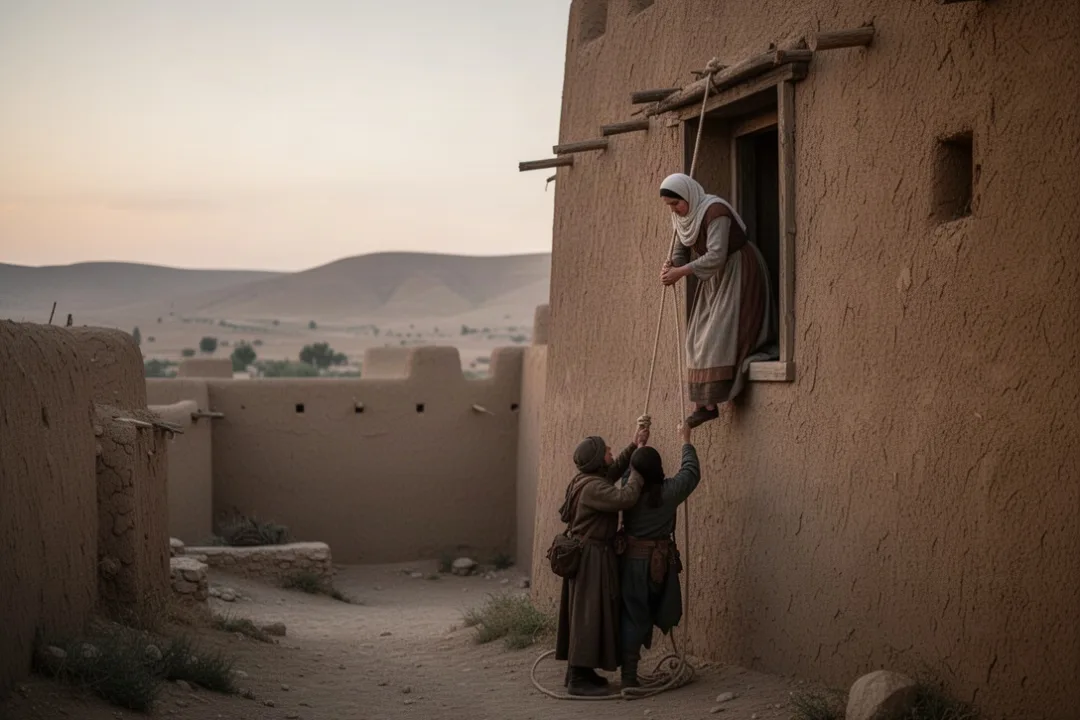
She helps the spies escape. Because her house is built into the city wall, Rahab lowers them by a rope through the window. She directs them toward the hill country, where they can hide from their pursuers.
She follows the agreement. During Jericho’s fall, Rahab gathers her family in the house marked by the cord. Joshua’s forces rescue her and those with her.
She becomes part of Israel’s community. Joshua 6 says that Rahab and her family were brought out safely and that she lived among the Israelites afterward.
This sequence shows that Rahab’s contribution involved more than a single moment of bravery. She made a plan, controlled a dangerous conversation, gave practical advice, negotiated protection, and carried out the agreed sign. Her faith appears through deliberate and costly decisions.
Why Rahab hid the spies
Rahab tells the spies that the people of Jericho were afraid because they had heard what Israel’s God had done. She refers to Israel’s escape from Egypt, the crossing of the sea, and victories over kings east of the Jordan. These reports had created fear throughout the city.
Her words show that Rahab had reached a conclusion about the God of Israel: He is God in heaven above and on earth below. She does not speak as though Israel’s success were merely the result of superior military strength. She connects Israel’s victories with the identity and power of Israel’s God.
The biblical account does not give Rahab a long conversion narrative or describe every stage of her religious understanding. It records a short confession followed by action. She protects the spies because she believes that the God they serve will give Israel the land.
Her decision also involved serious danger. Helping enemy agents could have led to punishment by the king. Rahab had to choose between loyalty to the authorities of Jericho and allegiance to what she believed God was doing through Israel. The narrative portrays her choice as an act of faith under pressure, not as a comfortable religious preference.
Rahab’s faith is shown through what she does with the knowledge she has received.
Rahab and the meaning of the scarlet cord
The spies tell Rahab to place a scarlet cord in the window and keep her family inside the house. This cord identifies the household to be spared when the Israelite army enters the city. It functions first as a practical marker within the story.
Later readers have connected the scarlet cord with themes such as rescue, blood, and Passover. Those associations can be meaningful in Christian interpretation, but Joshua itself does not explicitly explain the cord as a symbol of Christ’s sacrifice or as a direct repetition of the Passover sign. The safest reading begins with its narrative purpose: it marks Rahab’s house for protection.
The agreement also includes boundaries. The spies tell Rahab that anyone who leaves the house will not be covered by the oath. The family members must be brought together in the marked dwelling, and Rahab must not reveal the spies’ mission. Protection is promised within the terms of the covenant she makes with them.
This detail adds realism to the story. Rahab’s rescue is not presented as vague or automatic. It depends on communication, trust, obedience, and the cooperation of her household. Her faith creates a concrete plan for survival.
What happened to Rahab after Jericho fell
Joshua 6 states that Rahab, her family, and those belonging to her were spared. The text then says that she lived among Israel. This is a significant development because Rahab began the story as a woman from Jericho, outside Israel’s national and religious community.
The passage does not provide a full biography of her later life. It does not explain where she settled, what work she did, or how her relatives adjusted to life among the Israelites. Those details should not be supplied as though Scripture recorded them.
What the text does make clear is that Rahab was not merely rescued temporarily and then forgotten. She was incorporated into Israel. Her story therefore challenges a narrow idea of belonging based only on birthplace or previous identity. The woman who had lived in Jericho became part of the people whom Jericho’s destruction might otherwise have left with no place among them.
Joshua 6 also says that Rahab lived among Israel “to this day,” referring to the period of the text’s composition or preservation rather than giving a precise modern date. That wording emphasizes the continuing recognition of her rescue within Israel’s historical memory.
Rahab in the genealogy of Jesus
The Gospel of Matthew places Rahab in the genealogy of Jesus. Matthew identifies Salmon as the father of Boaz and names Rahab as Boaz’s mother. Boaz later becomes the husband of Ruth, and their family line leads to King David and, in Matthew’s presentation, to Jesus.
This genealogy gives Rahab a place in the royal line of David. It also connects several people whose backgrounds stand outside a narrow Israelite ideal: Rahab is from Jericho, while Ruth is a Moabite woman. Matthew’s genealogy includes women in a way that highlights unexpected turns in the history leading to the Messiah.
Some questions remain about the genealogy’s historical details. The Old Testament does not explicitly identify Boaz’s mother as Rahab, and the genealogical lists may omit generations. The names Salmon and Rahab are linked in Matthew, but readers should avoid forcing the genealogy into a complete modern-style family register.
The theological point is clear even while some historical details are debated: Matthew presents Rahab as part of the ancestry of Jesus. Her former identity does not disqualify her from a central place in the story of redemption. She becomes an ancestor associated with David’s line and the Messiah.
Rahab in Hebrews and James
Two New Testament writers use Rahab as an example, but they emphasize different aspects of her story.
Hebrews remembers Rahab’s faith
Hebrews 11 lists Rahab among people who acted by faith. It explains that she welcomed the spies peacefully and was not destroyed with those who refused to believe. The passage focuses on her response to what she had heard about God.
In this setting, faith does not mean passive agreement. Rahab heard reports about Israel’s God, trusted what those reports revealed, and took action that placed her at risk. Hebrews therefore treats her as a model of faith that produces a decision.
James remembers Rahab’s actions
James 2 refers to Rahab when discussing the relationship between faith and works. James points to her receiving the messengers and sending them away by another route. His emphasis is that genuine faith is demonstrated by conduct.
James does not present Rahab’s actions as an alternative to faith. Instead, her actions reveal the reality of her faith. She believed enough to hide the spies, deceive the search party, help them escape, and align her future with Israel’s God.
Hebrews emphasizes belief: Rahab trusted God’s revealed power and acted from that trust.
James emphasizes conduct: her decisions showed that her faith was active rather than merely verbal.
Joshua emphasizes the event: Rahab protected the spies and her household was spared.
Matthew emphasizes her legacy: Rahab became part of the genealogy leading to Jesus.
Was Rahab a prostitute or an innkeeper?
The Hebrew description of Rahab in Joshua is commonly translated as prostitute. Ancient Jewish and Christian translations generally preserve that meaning. Some interpreters have suggested that the term could describe an innkeeper because Rahab housed travelers, but the linguistic evidence for replacing the usual meaning is contested.
The story’s setting does not require Rahab to be an innkeeper. A house associated with prostitution could also receive travelers, and the spies’ presence there would not necessarily seem unusual. The text describes her occupation without making it the focus of moral condemnation.
Rahab’s designation raises a broader interpretive issue. Biblical narratives often identify people by their social position or past without reducing the whole person to that label. Rahab is called a prostitute, but the rest of the biblical testimony presents her as a woman who showed courage, wisdom, hospitality, loyalty, and faith.
It is best to acknowledge both facts: Rahab had a stigmatized occupation, and Scripture honors the choices she made. Neither romanticizing her past nor ignoring the wording of the text gives a faithful account of her history.
Did Rahab lie, and how should her deception be understood?
Rahab tells the king’s representatives that the spies had already left, even though she has hidden them on her roof. Her statement sends the authorities away from the men she is protecting. The question of whether this was morally right has attracted discussion for centuries.
Some interpreters argue that Rahab’s deception was wrong in itself, even though God later used the situation to rescue the spies and her family. Others point to Hebrews 11 and James 2, noting that the New Testament praises Rahab’s faith and actions without directly condemning her for the deception.
A careful reading should avoid claiming that the Bible gives a simple, universal rule through this scene. Joshua presents Rahab as acting against authorities who intend to capture the spies, and the narrative approves her loyalty to them. At the same time, the passage does not pause to develop a complete ethical theory about deception.
Rahab’s story is therefore best understood in its narrative setting: she protected vulnerable people from hostile officials and accepted personal danger to do so. Readers who apply the story to modern situations should consider the difference between ordinary dishonesty for personal advantage and resistance to unjust violence or persecution.
Use caution with applications: Rahab’s account is not a blanket endorsement of lying. Its clear emphasis is her courageous protection of the spies and her trust in God amid a conflict involving war, judgment, and competing authorities.
What Rahab’s history reveals about biblical faith
Rahab’s story shows that biblical faith can begin with limited information. She does not know Israel’s entire law, history, or worship practices. She has heard reports, interpreted them, and responded to what she understands about God’s power.
Her faith is also publicly costly. Rahab’s decision changes her relationship with the king and with Jericho’s society. She does not keep her conviction private. Her words to the spies explain her allegiance, while her actions make that allegiance visible.
The story further shows that courage can involve intelligence and preparation. Rahab does not confront the king’s representatives with force. She uses her knowledge of the city, the timing of the gates, the surrounding terrain, and the construction of her house. Her resourcefulness becomes part of the means by which the spies escape.
Her concern for her parents, siblings, and extended household also matters. Rahab does not seek rescue for herself alone. She negotiates for an entire family network and then brings them into the house marked for protection. Her faith becomes a form of responsibility toward others.
How Rahab’s story has been interpreted through history
Jewish and Christian readers have long treated Rahab as an example of repentance, faith, hospitality, and courage. Some traditions have emphasized her movement from a disreputable life into a new community. Others have focused on her recognition of the true God despite living among people who opposed Israel.
Christian interpretation often connects Rahab with the theme that God welcomes outsiders who respond in faith. Her presence in Matthew’s genealogy strengthens that reading. She is not merely permitted to survive; she becomes part of the family history through which the biblical writers trace the arrival of Jesus.
At the same time, Rahab should not be used to erase the difficult features of the conquest narrative. Joshua describes the destruction of Jericho and the rescue of Rahab’s household in the same account. Readers have wrestled with questions about warfare, divine judgment, civilian suffering, and the place of Canaanite peoples in the biblical story.
A responsible reading holds these elements together. Rahab’s rescue is a powerful account of mercy and inclusion, but it occurs within a narrative that contains severe judgment. Her history invites theological reflection without requiring readers to pretend that the surrounding ethical questions are easy.
Important facts to remember about Rahab
Rahab lived in Jericho, a fortified city in the Jordan Valley.
Joshua describes her as a prostitute; the alternative “innkeeper” interpretation is debated.
She hid two Israelite spies from the king’s agents.
She expressed confidence in the power and sovereignty of Israel’s God.
She asked for protection for her parents, siblings, and household.
She helped the spies escape by lowering them through a window in the city wall.
A scarlet cord identified her house during Jericho’s fall.
She and her family were spared and later lived among the Israelites.
Matthew places her in the genealogy leading to Jesus.
Hebrews presents her as an example of faith, while James presents her actions as evidence of living faith.
Where to read Rahab’s story in the Bible
The main account is found in Joshua 2, which covers the spies’ arrival, Rahab’s protection, her confession, and the agreement involving the scarlet cord. Joshua 6 describes Jericho’s fall, Rahab’s rescue, and her continued life among Israel.
For later interpretations, read Matthew 1:5 for Rahab’s place in the genealogy of Jesus, Hebrews 11:31 for the emphasis on her faith, and James 2:25 for the emphasis on her actions. Together, these passages present Rahab as a historical figure remembered through several complementary lenses.
Read as a whole, the biblical history of Rahab moves from Jericho’s threatened household to Israel’s community and then to the genealogy of Jesus. Her story is short, but its themes are substantial: trust expressed through action, protection of family, inclusion of an outsider, and a legacy shaped by choices made under pressure.
Frequently asked questions
Was Rahab an Israelite?
No. Rahab was from Jericho, a city in Canaan, and the biblical account presents her as an outsider to Israel when the story begins. After helping the spies, she and her household were spared and she lived among the Israelites. Her later place in Matthew’s genealogy shows that her identity became connected with Israel’s royal and messianic history.
Did Rahab marry Salmon?
Matthew 1:5 names Rahab as the mother of Boaz and Salmon as Boaz’s father. This creates the traditional identification of Rahab as Salmon’s wife. The Old Testament does not provide a separate account of their marriage, and biblical genealogies may omit generations, so the relationship is based specifically on Matthew’s genealogy rather than a full biographical record.
What happened to Rahab’s family?
Rahab’s parents, siblings, and other relatives were brought out of Jericho when the city fell, provided they remained within the household identified by the scarlet cord. Joshua says they were placed outside Israel’s camp initially and that Rahab later lived among the Israelites. Scripture does not give individual names or detailed accounts of their later lives.
Why is Rahab important in the New Testament?
Rahab is important because New Testament writers use her story to illustrate different dimensions of faith. Matthew includes her in Jesus’ genealogy, Hebrews remembers her trust, and James points to her courageous actions. Together, these references show that her past and nationality did not prevent her from becoming an honored figure in biblical history.








Leave a Reply