The Passover story is the Bible’s account of God rescuing Israel from slavery in Egypt and establishing a yearly memorial of that deliverance.
It begins in the book of Exodus, where the Israelites live under Pharaoh’s control and endure forced labor. God sends Moses to demand their release, brings a series of judgments on Egypt, and gives Israel a specific ceremony to observe on the night before freedom arrives. The story later becomes the foundation for Israel’s annual Passover festival.
Passover is both a historical rescue story and a theological pattern. It centers on judgment, protection, sacrifice, remembrance, and freedom. In the New Testament, the Gospel writers place Jesus’ death near Passover, and other New Testament authors use Passover language to explain the meaning of his sacrifice.
The story of Passover grows out of Israel’s suffering in Egypt. According to Exodus, the descendants of Jacob had become a large population, and a new Pharaoh feared their strength. He reduced them to forced labor and ordered harsh measures intended to control their growth, including the killing of Hebrew baby boys.
Moses survived this threat as an infant and was raised in Pharaoh’s household. As an adult, he fled Egypt after defending a Hebrew slave and later encountered God in the wilderness. At the burning bush, God commissioned Moses to return to Egypt and lead the Israelites out of slavery.
God’s purpose was broader than simply changing Israel’s working conditions. He promised to bring the people out of Egypt, make them his own people, and lead them toward the land promised to Abraham, Isaac, and Jacob. The Passover event is therefore part of the fulfillment of a much older promise.
Moses and Aaron repeatedly approached Pharaoh with God’s demand: let the Israelites leave so they can worship their God. Pharaoh refused. In response, Egypt experienced a series of signs and plagues, including water turned to blood, darkness, disease, hail, locusts, and the death of livestock. These judgments exposed the weakness of Egypt’s power and showed that Pharaoh could not prevent Israel’s release.
The earlier plagues distinguish between Egypt and Israel in various ways, but the final judgment introduces a specific act of protection. God announces that the firstborn in Egypt will die, from the firstborn of Pharaoh to the firstborn of servants and animals. The Israelites must respond with careful instructions rather than assume that their ethnic identity alone will protect them.
The central movement of the story: God does not merely tell Israel that freedom is coming. He gives the people a concrete act of trust to perform, and the Passover meal becomes the sign that they are ready to leave.
What happened on the first Passover night
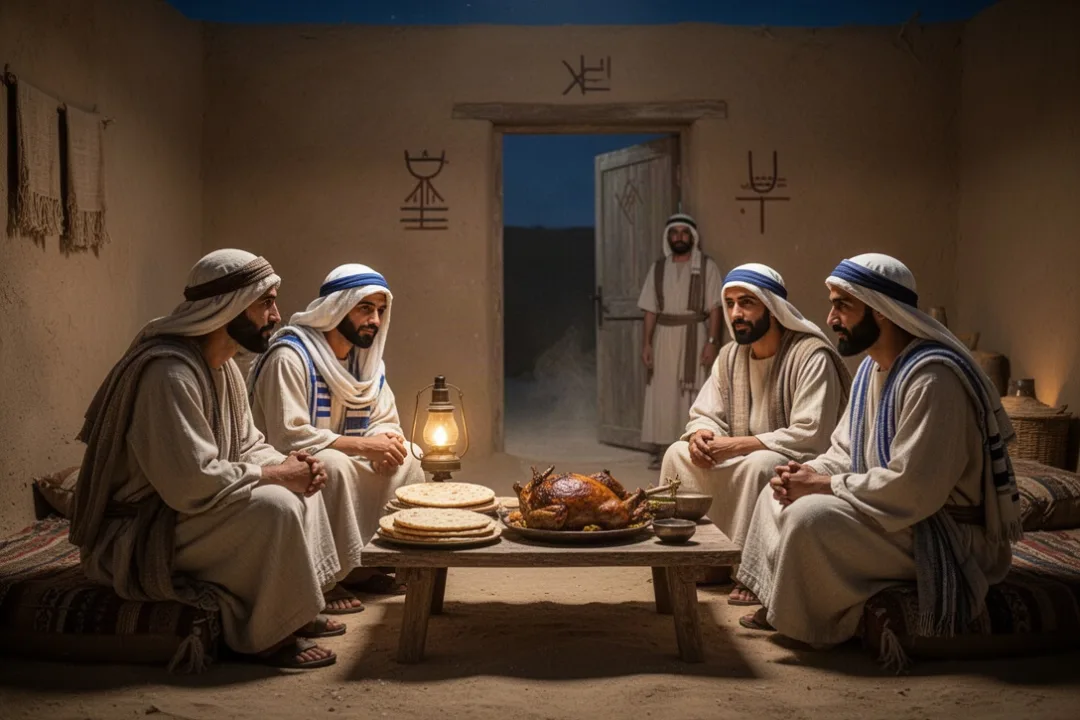
Exodus 12 gives the instructions for the first Passover. Each household, or households joined together when necessary, was to select a healthy male lamb or goat. The animal was kept until the appointed day and then slaughtered at twilight. The people were to place some of its blood on the two doorposts and the upper beam of the doorway.
The meal had several required elements. The meat was roasted rather than boiled, and it was eaten with unleavened bread and bitter herbs. The people were told to prepare the food for immediate departure, with their clothes arranged for travel, sandals on their feet, and staffs in hand. The meal was not a relaxed feast after arrival; it was a meal eaten in readiness to leave.
The blood on the doorway served as a sign. When God passed through Egypt in judgment, the marked houses were spared from the plague against the firstborn. Exodus describes this as the Lord passing over those homes, which gives the festival its name. The sign did not function as a magical substance. It represented obedience to God’s command and marked the households that trusted his provision.
At midnight, the firstborn throughout Egypt died. A great cry rose across the land because no household was untouched by loss. Pharaoh summoned Moses and Aaron during the night and ordered the Israelites to leave. The Egyptians also urged them to go quickly, fearing that continued delay would bring further disaster.
The Israelites left before their dough could rise. They carried unleavened dough, along with possessions and valuables that the Egyptians gave them. Exodus presents this departure as a dramatic reversal: the people who had been forced to build for Pharaoh now leave as a people released from his authority.
The Passover meal was not only a private household event. It formed a boundary around the community. Foreigners could not simply participate on their own terms, while a foreign resident who joined Israel’s covenant community could observe the Passover under the stated requirements. Every male who ate the meal was also associated with Israel’s covenant sign, circumcision.
Several details communicate urgency and separation from Egypt:
Unleavened bread recalled the haste of the departure, since there was no time to wait for dough to rise.
Bitter herbs brought the bitterness of slavery into the meal’s memory.
The lamb or goat was the central sacrificial food for the household celebration.
The marked doorway identified the protected household during the final plague.
Travel clothing and a staff showed that the people were prepared to move immediately.
How Passover became a lasting memorial
God commanded Israel to remember this night every year. Passover was not intended to remain only a story about the generation that left Egypt. Parents were expected to explain the ceremony to their children, especially when children asked what the ritual meant.
The answer was to point back to God’s rescue: Israel was once enslaved in Egypt, and God brought the people out with power. In that way, the annual meal made the past present for later generations. Israelites who had not personally stood before Pharaoh could still understand themselves as members of the people God had redeemed.
The festival lasted seven days when counted with the Feast of Unleavened Bread. During that period, the people removed leaven from their homes and avoided eating leavened products. The first and seventh days were set apart for special observance, and ordinary work was restricted in ways described in the law.
Passover also shaped Israel’s calendar. Exodus presents the month of the deliverance as the beginning of the year for the nation’s religious life. The rescue from Egypt became the event by which Israel measured its identity and remembered the source of its existence as a covenant people.
The memorial had a strong ethical and communal purpose as well. Because Israel had experienced oppression as an enslaved people, the law repeatedly reminded them to treat vulnerable people fairly. Foreigners, widows, orphans, and the poor were not to be ignored. Remembering Egypt was meant to influence how Israelites behaved toward others.
Passover was therefore more than a religious ceremony with historical references. It taught a complete way of seeing the community:
God hears suffering and acts to fulfill his promises.
Deliverance creates responsibility, not merely relief from danger.
Families teach faith through memory, meals, questions, and repeated practices.
Freedom from oppression should shape treatment of others.
The people remain dependent on God even after leaving Egypt.
Later laws refined how Passover was to be celebrated at the place God chose for worship. Deuteronomy connects the festival with the central sanctuary rather than allowing every household to sacrifice independently in any location. This reflects Israel’s developing worship life after the wilderness period and settlement in the land.
How later biblical events remember Passover
Passover appears at several important points after the Exodus. In Numbers 9, the Israelites celebrate the festival in the wilderness at the time appointed by God. Some people were ceremonially unclean because they had been near a dead body and could not participate at the normal time. God provided a second opportunity one month later for those who were prevented from observing it properly.
This provision shows that Passover was treated seriously without being made impossible for people facing a legitimate ritual barrier. At the same time, Numbers warns that a person who was eligible to keep Passover but deliberately refused to do so would bear responsibility for that choice.
After Israel entered the promised land, Joshua 5 describes a Passover celebrated near Jericho. The timing matters: the wilderness generation has passed away, a new generation has entered the land, and the people eat produce from the land. The meal marks a transition from wandering to settlement.
During periods of spiritual decline, Passover could also become a sign of renewal. In 2 Kings 23, King Josiah leads reforms after the discovery and public reading of the Book of the Law. The Passover celebrated in Jerusalem is presented as unusually significant because it accompanies the removal of idolatrous practices and a renewed commitment to the covenant.
After the exile, the returning community again celebrates Passover. Ezra 6 describes the restored Israelites observing the feast after the temple in Jerusalem had been rebuilt. The event links national restoration with the original story of rescue: God had once brought Israel out of Egypt, and now he had brought a remnant back from exile.
These later celebrations show that Passover could speak to more than one crisis. It remembered the first exodus, but it also helped Israel interpret new experiences of danger, judgment, return, and restoration. The festival kept asking the same question: Has the community remembered who delivered it, and is it living as a people shaped by that deliverance?
The prophets also use exodus language when speaking about future restoration. Some passages describe a coming act of salvation as comparable to, or even surpassing, the rescue from Egypt. The original Passover remains the basic pattern: God confronts oppression, preserves a people, leads them out, and brings them toward a promised future.
How the New Testament connects Passover with Jesus
The New Testament presents Jesus in a Passover setting. The Gospel accounts describe Jesus going to Jerusalem for the Passover season, sharing a final meal with his disciples, and being arrested and executed during the same period. The meal includes bread and wine, which Jesus connects with his coming death and the covenant relationship God is establishing through him.
The Gospel of John gives Jesus’ death a particularly strong Passover association. Jesus is executed as Passover preparations are taking place, and John includes details that echo the Exodus instructions, including the statement that none of Jesus’ bones were broken. The other Gospels place the final meal in a Passover context and describe Jesus’ death as occurring during the feast. Readers should recognize that the Gospel writers emphasize the connection in different ways.
Jesus’ Last Supper does not simply repeat the Exodus meal. He uses the setting to interpret what is about to happen. The bread and cup point to his body and blood, his sacrificial death, and the covenant God is making with his people. The disciples are told to remember him, much as Israel was commanded to remember the Exodus through Passover.
The connection becomes explicit in 1 Corinthians 5:7, where Paul identifies Christ as the Passover sacrifice and uses that image to call the Christian community to live differently. Paul’s point is not only that Jesus died; it is that Jesus’ death creates a new identity and demands a changed way of life.
Paul then uses the imagery of leaven. In the Passover setting, removing leaven symbolized separation from the old situation. In his letter, Paul tells the church to reject malice and wrongdoing and to live with sincerity and truth. The image turns the festival’s household practice into an ethical challenge for the congregation.
The Letter to the Hebrews does not center its argument on Passover in the same direct way, but it develops related themes of sacrifice, covenant, blood, access to God, and release from slavery to sin and death. The New Testament as a whole presents Jesus as the one through whom God’s saving work reaches its intended fulfillment.
Christian interpretation: The Exodus Passover provides the pattern, while Jesus’ death is presented as its fulfillment: protection from judgment, release from bondage, covenant relationship, and a life shaped by grateful obedience.
What the Passover story means for readers today
The story’s first meaning comes from its original setting. It tells how God delivered Israel from Egypt and formed a people through covenant. Christian readers may also see Jesus’ death through the Passover pattern, but those later connections should not erase the story’s own historical and theological message.
One major theme is that salvation involves both God’s action and human response. God announces the judgment and provides the means of protection, but the Israelites must follow the instructions, mark their homes, eat the meal, and leave when the command comes. The story does not describe passive spectators; it describes a people acting in trust.
Another theme is the importance of remembered deliverance. The Israelites are not told to remember slavery as an abstract concept. They remember through food, family instruction, a calendar, and a repeated retelling. Faith is passed on through practices that help children and adults locate their lives inside a larger story.
The story also holds together judgment and mercy. Egypt’s oppression is not treated as insignificant, and Pharaoh’s resistance has consequences. At the same time, God provides a way for the Israelite households to be spared. Passover therefore presents deliverance as rescue from a real danger, not simply as a symbol of personal improvement.
The lamb is central because the meal is built around it and because its blood marks the doorway. In the Old Testament, Passover is not a general statement that every sacrifice has the same meaning. It is a specific memorial connected to the tenth plague and Israel’s departure from Egypt. The New Testament then uses that specific image to interpret Jesus.
Passover also teaches that freedom has a destination. Israel is not released merely to wander without purpose or to replace Pharaoh with self-rule. The people are brought into covenant with God and directed toward worship, community, obedience, and the promised land. Biblical freedom means release from one master so that life can be ordered under God.
For Christians, the New Testament’s Passover imagery makes Jesus’ death central to understanding salvation. For Jewish readers, Passover remains the foundational festival of the Exodus and the continuing remembrance of liberation from Egypt. Respectful reading keeps these contexts clear while recognizing the deep biblical continuity between the Exodus story, Israel’s worship, and the Gospel message.
The Passover story can be read as a sequence of five connected movements:
Oppression: Israel suffers under a ruler who refuses to release the people.
Confrontation: God challenges Pharaoh and judges the powers that sustain slavery.
Protection: The Passover sign marks households that follow God’s command.
Departure: Israel leaves Egypt in haste, carrying the beginnings of a new life.
Remembrance: Later generations repeat the story so deliverance shapes their identity and conduct.
Those movements explain why Passover remains one of the Bible’s most important stories. It is about a particular night in Egypt, but it also establishes a language for speaking about God’s faithfulness, the cost of oppression, the meaning of sacrifice, and the hope of a people set free.
Frequently asked questions
Where is the Passover story found in the Bible?
The main account is in Exodus 12, within the larger story of Israel’s slavery and deliverance in Exodus 1–15. Instructions for later observance appear in Leviticus, Numbers, and Deuteronomy. Historical celebrations are described in Joshua, 2 Kings, and Ezra, while the New Testament connects Passover with Jesus in the Gospels and Paul’s letters.
Why did the Israelites put blood on their doorframes?
The blood served as a sign identifying the Israelite homes during the final plague in Egypt. When judgment came upon the firstborn, God passed over the marked households. In the story, the sign represents obedient trust in God’s instructions, not a magical property of the blood or a guarantee based only on ethnic identity.
What foods were eaten during the first Passover?
The meal included a roasted lamb or goat, unleavened bread, and bitter herbs. The lamb was prepared as the central food, while the unleavened bread recalled the Israelites’ hurried departure because they did not have time to let dough rise. The bitter herbs brought the hardship of slavery into the meal’s remembrance.
How does Passover relate to Jesus?
The Gospels place Jesus’ final days and death during the Passover season. At his final meal, Jesus uses bread, wine, and covenant language to explain the significance of his death. Paul makes the connection direct in 1 Corinthians 5:7 by describing Christ as the Passover sacrifice and linking that sacrifice with a transformed life.









Leave a Reply