The birth of Jesus in the Bible: What Scripture says
The birth of Jesus in the Bible: What Scripture says
The birth of Jesus in the Bible is described mainly in Matthew 1–2 and Luke 1–2. Together, these chapters present Jesus’ conception by the Holy Spirit, his birth in Bethlehem, the visit of the shepherds, the visit of the Magi, Herod’s threat, and Joseph and Mary’s care for the child.
Matthew emphasizes Jesus as the promised king connected with Israel’s story, while Luke highlights God’s favor toward the humble and the good news announced to ordinary people. The two accounts share central facts but include different details, so they should be read as complementary accounts rather than as identical retellings.
The clearest birth narratives are found in the opening chapters of Matthew and Luke. Matthew begins with Jesus’ genealogy and Joseph’s discovery that Mary’s child was conceived through the Holy Spirit. Luke begins before the birth, introducing the angel Gabriel’s announcement to Mary and then describing the events surrounding Jesus’ arrival.
Several other New Testament passages refer to Jesus’ origin without narrating the birth scene. John 1 presents Jesus as the eternal Word who entered human life. Paul refers to God sending his Son and to Jesus being born of a woman in Galatians 4:4. Philippians 2 describes Jesus’ humble movement from divine glory into human existence, though it does not provide a manger scene or a date.
The four Gospels have different purposes and emphases. Mark begins with Jesus’ public ministry, so it does not include a birth narrative. John begins with theological reflection on Jesus’ identity. Matthew and Luke are the Gospel writers who give the events and people most readers associate with the nativity.
Matthew 1–2: Joseph, the genealogy, the Magi, Herod, the flight to Egypt, and the return to Nazareth.
Luke 1–2: Mary, Gabriel’s announcement, the birth in Bethlehem, the manger, the shepherds, and the presentation at the temple.
John 1: Jesus’ eternal identity and his coming into the world in human form.
Galatians 4:4–5 and Philippians 2:5–11: brief theological references to Jesus’ humanity and humble mission.
Reading tip: Matthew and Luke do not give the exact date of Jesus’ birth, and neither Gospel says that the event occurred on December 25. That date belongs to later Christian tradition and church practice, not to an explicit biblical statement.
What happened before Jesus was born
Luke’s account begins with a message to Mary, a young woman living in Nazareth and pledged in marriage to Joseph. Gabriel tells her that she will bear a son who will be called Jesus. The announcement identifies the child with David’s royal line and says that his kingdom will have no end. Mary responds with trust, even though the circumstances are beyond ordinary human experience.
Luke explains that Mary’s pregnancy would come through the Holy Spirit, not through Joseph. This point also appears in Matthew, where Joseph learns in a dream that Mary’s child has been conceived by the Spirit. Matthew connects the child’s name, Jesus, with his mission to save his people from their sins.
Before Jesus’ birth, Luke also records the pregnancy of Elizabeth, Mary’s relative. Elizabeth and her husband, Zechariah, are expecting John, who will later be known as John the Baptist. When Mary visits Elizabeth, the unborn John responds to Mary’s arrival, and Elizabeth recognizes the significance of Mary’s child. Mary then praises God for showing mercy and lifting up the lowly, as described in Luke 1:46–55.
Matthew tells the story primarily through Joseph’s perspective. Joseph discovers that Mary is pregnant before they live together as husband and wife. He plans to end the engagement quietly, but an angel tells him in a dream not to fear taking Mary as his wife. Joseph accepts the responsibility and names the child Jesus.
Joseph’s obedience matters throughout Matthew’s account. He follows divine instructions to protect Mary and Jesus, later takes the child to Egypt to escape Herod, and finally settles with his family in Nazareth. These decisions show Joseph acting as the child’s legal and practical guardian, even though Jesus’ conception is attributed to the Holy Spirit.
How Matthew and Luke describe Jesus’ identity
Matthew opens with a genealogy that traces Jesus’ family line through David and Abraham. The list places Jesus within the history of Israel and presents him as the heir of promises associated with David’s royal house. Matthew also includes women in the genealogy whose stories involve unexpected or difficult circumstances, reinforcing the Gospel’s attention to God’s work through surprising people and events.
Luke’s genealogy appears later, in chapter 3, after Jesus’ baptism. Luke’s opening chapters instead focus on the announcements, hymns, and worship surrounding Jesus’ birth. The angel’s message to Mary, Mary’s praise, Zechariah’s prophecy, and Simeon’s blessing all interpret the birth as part of God’s saving purpose.
The name Jesus is related to the idea that God saves. Matthew emphasizes this meaning directly. Luke also presents the child as a Savior, but the announcement is made to shepherds and describes good news intended for all people. The birth is therefore connected both with Israel’s hope and with a wider mission.
Where Jesus was born and why Bethlehem matters
Both Matthew and Luke identify Bethlehem as the place where Jesus was born. Bethlehem was a town in Judea associated with King David. Its connection with David gives the location significance because the Hebrew Scriptures had linked future royal hope with David’s line and with Bethlehem.
Matthew connects Bethlehem with a prophecy cited from Micah 5:2. The passage points to Bethlehem as the source of a ruler for Israel. Matthew’s wording combines themes from the prophetic tradition and presents Jesus’ birthplace as part of God’s continuing plan.
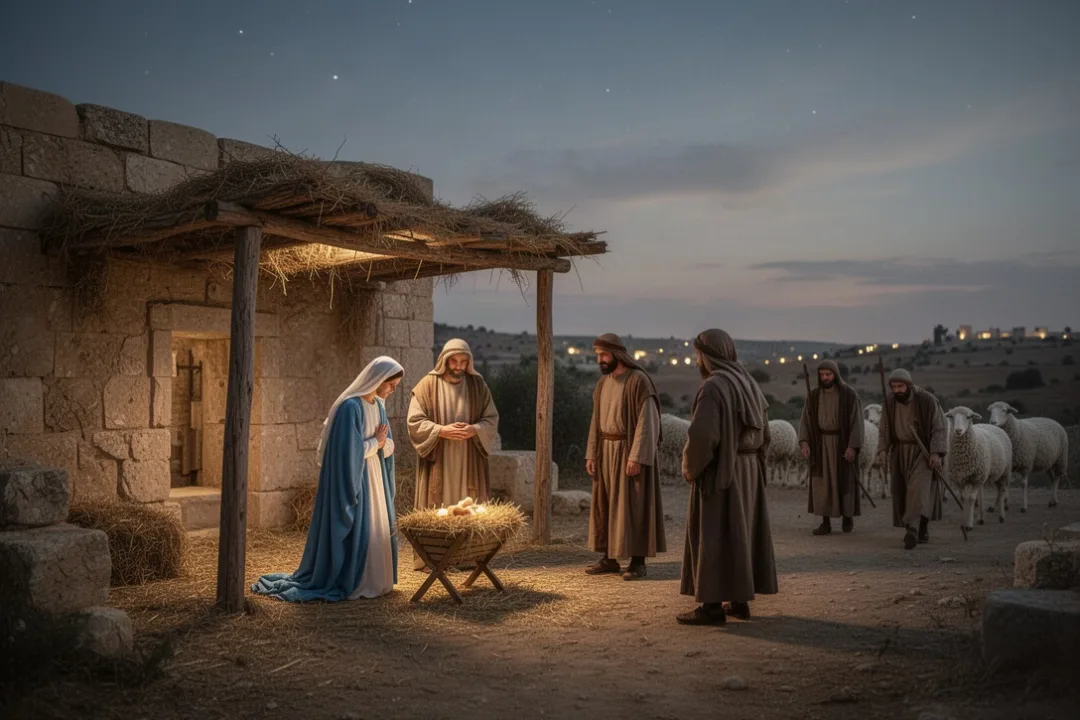
Luke explains that Joseph and Mary travel from Nazareth to Bethlehem because of an enrollment ordered by the Roman authorities. Joseph goes because he belongs to David’s family line. While they are there, Mary gives birth to Jesus. Luke does not describe a decorated stable, animals gathered around the child, or a specific type of building; it says that Mary places Jesus in a manger because there was no suitable guest space available.
The word often translated as inn can also refer to a guest room or lodging area. For that reason, the precise setting is not completely clear. The text does clearly state that Jesus is laid in a manger, a feeding trough, which suggests a place where animals were present or kept nearby. Popular nativity scenes combine this detail with later artistic traditions.
Luke’s description creates a striking contrast. Jesus is presented as the promised Savior, yet his first resting place is a manger rather than a royal chamber. The humble setting does not diminish his identity in Luke’s account; it becomes part of the way the Gospel shows God’s work appearing among ordinary people and circumstances.
What the Bible actually says: Jesus was born in Bethlehem and placed in a manger. Scripture does not specify the exact type of shelter, the number of animals present, or the exact hour and date of the birth.
Who visited Jesus after his birth
Luke records a visit from shepherds. They are watching their flocks at night when an angel announces Jesus’ birth. A larger heavenly host praises God, and the shepherds go to Bethlehem to see what has happened. They find Mary, Joseph, and the infant lying in a manger, just as they were told.
After seeing the child, the shepherds tell others what they have heard and witnessed. They return glorifying and praising God. Their role is meaningful because they are not presented as political leaders, scholars, or wealthy patrons. They are working people who receive the announcement and become early witnesses to the child.
Matthew describes a different group: Magi from the east. The text does not call them kings, does not give their names, and does not say that there were exactly three of them. The number three comes from the three gifts they bring: gold, frankincense, and myrrh.
The Magi see a star connected with the birth of a Jewish king and travel to Jerusalem. They ask where the child is, which alarms Herod and the people around him. Herod consults religious experts, who identify Bethlehem as the expected birthplace. The Magi then continue to Bethlehem, find Jesus with Mary, worship him, and present their gifts.
Matthew says that the Magi enter a house and see the child with Mary. This detail differs from Luke’s immediate birth scene, where shepherds find a baby in a manger. The Gospel accounts do not require the shepherds and Magi to have arrived at the same time. Matthew’s wording also calls Jesus a child rather than specifically describing him as a newborn.
The shepherds: They receive the announcement from angels and visit Jesus soon after the birth.
The Magi: They travel from the east, follow a star, bring gifts, and visit Jesus at a house.
The gifts: Gold, frankincense, and myrrh are valuable and symbolically meaningful, but Matthew does not explain each gift individually.
The warning: The Magi are told in a dream not to return to Herod, so they go home by another route.
These visitors also reflect the different emphases of the two Gospels. Luke shows the good news coming first to shepherds within Israel. Matthew shows Gentile visitors recognizing the significance of Israel’s king. Together, the scenes suggest a message that reaches both the overlooked and the nations beyond Israel.
How Herod threatened the child and Joseph protected him
Matthew presents Herod as a ruler threatened by news of another king. After the Magi fail to return, Herod orders the killing of boys in and around Bethlehem who fall within the age range he has calculated. Matthew calls this event the slaughter of the infants and connects it with a lament from Jeremiah 31:15.
The account is one of the darkest scenes in the birth narratives. It shows that Jesus’ arrival is not presented as free from danger or political conflict. From the beginning, Matthew portrays a clash between Herod’s violent power and the child whose kingship is associated with God’s purposes.
Joseph receives another dream warning and takes Mary and Jesus to Egypt. Matthew presents this journey as fulfilling the Scripture reference in Hosea 11:1, which originally describes Israel’s calling out of Egypt. The Gospel applies that pattern to Jesus, portraying him as reliving and representing Israel’s story.
After Herod dies, Joseph is instructed to return. Because Herod’s son is ruling Judea, Joseph settles the family in Galilee, in the town of Nazareth. Matthew connects this move with the prophetic expectation that Jesus would be called a Nazarene, although the Gospel does not identify one single Old Testament verse that uses that exact title in the same way.
Luke does not include the flight to Egypt or Herod’s massacre. Instead, after Jesus is presented at the temple, Mary and Joseph return to Nazareth. Luke emphasizes the family’s participation in Jewish religious practice and the child’s growth in wisdom and strength.
What the birth of Jesus means in the Bible
The birth narratives present Jesus as both fully human and uniquely connected with God’s saving work. He is born to a human mother, enters a real family, and lives under the conditions of an occupied land. At the same time, Matthew and Luke attribute his conception to the Holy Spirit and give him a role that reaches beyond that of an ordinary child.
Matthew highlights several themes through names and prophecy. Jesus is connected with David, called the one who saves his people, and associated with the name Emmanuel, which Matthew explains as meaning that God is with his people. The Gospel’s use of Scripture presents the birth as a continuation of Israel’s history rather than an isolated miracle.
Luke emphasizes good news for the humble. Mary is a young woman without political status. Joseph is a craftsman from Nazareth. Shepherds are the first visitors named in Luke’s birth account. Simeon and Anna, two older worshipers at the temple, recognize the child’s significance when he is brought there.
The temple scene in Luke 2 adds another layer to the story. Mary and Joseph follow the requirements associated with a firstborn son and bring the child to Jerusalem. Simeon praises God after seeing Jesus and speaks of him as a means of salvation prepared for all peoples. He also warns Mary that opposition and grief will touch her life.
Anna, a prophet who worships in the temple, speaks about the child to people waiting for Jerusalem’s redemption. Luke therefore surrounds Jesus’ birth with people who pray, listen, and recognize God’s activity. The story is not only about the moment of delivery; it is about how different witnesses understand what the child means.
John’s Gospel offers a broader theological frame. John 1 does not mention Bethlehem, Mary, Joseph, shepherds, or Magi. Instead, it describes Jesus as the Word who was with God and who was God, then says that the Word became flesh and lived among humanity. This language explains the Christian belief that Jesus’ human birth is also the coming of God’s presence into the world.
The birth accounts also establish themes that continue through Jesus’ ministry:
God works through humble circumstances: The child is born away from royal privilege and first announced to people of modest social standing.
Jesus belongs within Israel’s story: His ancestry, birthplace, name, and encounters with the temple all connect him with Jewish Scripture and hope.
His mission extends beyond one group: Luke speaks of salvation for all people, while Matthew includes foreign visitors who honor Jesus.
Opposition begins early: Herod’s response anticipates the conflict that will continue throughout Jesus’ life.
God’s presence is central: Matthew’s Emmanuel theme and John’s teaching about the Word point to Jesus as the visible expression of God’s saving presence.
For Christians, the birth of Jesus is therefore more than the beginning of a human biography. It marks the arrival of the promised Savior in a vulnerable human life. The Bible presents that arrival through a combination of promise, humility, danger, worship, and hope, giving readers several perspectives on why Jesus’ birth matters.
Frequently asked questions
Was Jesus born on December 25?
The Bible does not provide a calendar date for Jesus’ birth. December 25 became the date used by many Christian churches through later tradition, but Matthew and Luke do not identify that day. The Gospel accounts focus on the location, circumstances, witnesses, and meaning of the birth rather than establishing an annual birthday.
Were there exactly three wise men?
Matthew names three gifts—gold, frankincense, and myrrh—but it never states that only three Magi traveled to Jesus. The traditional number probably developed from the number of gifts. The Bible also does not give the visitors names or call them kings; it describes them as Magi from the east.
Did the shepherds and Magi visit Jesus at the same time?
The text does not say they arrived together. Luke describes shepherds finding a baby in a manger, while Matthew describes Magi visiting a child in a house. These details may indicate different visits. Nativity displays often place everyone together for convenience, but the Gospel narratives do not require that arrangement.
Why is Jesus called Emmanuel?
Matthew uses Emmanuel as a name or description connected with the meaning “God with us.” It expresses the belief that Jesus’ arrival reveals God’s presence among his people. Jesus is also given the name Jesus, which Matthew connects with saving people from their sins. The two designations emphasize related but distinct aspects of his identity and mission.








Leave a Reply