Book of Genesis summary: Stories, themes, and meaning
Book of Genesis summary: Stories, themes, and meaning
The book of Genesis explains the biblical beginnings of the world, humanity, sin, family, nations, and God’s covenant people. Its 50 chapters move from creation and the garden of Eden to the lives of Abraham, Isaac, Jacob, and Joseph, ending with Jacob’s family settled in Egypt.
Genesis has two broad movements: chapters 1–11 describe humanity’s early history, while chapters 12–50 focus on the patriarchal family through whom God promises blessing to the nations. The book combines theology, family conflict, judgment, mercy, migration, and faith rather than presenting a simple list of isolated stories.
Genesis begins with the creation of the heavens and earth and ends with the death of Joseph in Egypt. The first section repeatedly shows human rebellion spreading outward: from Adam and Eve’s disobedience, to Cain’s murder of Abel, to widespread violence before the flood, and finally to the pride represented by Babel.
After Babel, the narrative narrows from all humanity to one family. God calls Abraham, promises him land and descendants, and says that his family will become a source of blessing. The rest of Genesis follows that promise through Isaac, Jacob, and Jacob’s twelve sons.
Genesis 1–2: Creation and the special place of human beings.
Genesis 3–5: The fall, exile from Eden, Cain and Abel, and the growth of human sin.
Genesis 6–9: Noah, the flood, judgment, deliverance, and God’s covenant with creation.
Genesis 10–11: The nations, the tower of Babel, and the transition to Abraham’s family.
Genesis 12–25: Abraham’s calling, journeys, covenant, failures, and the birth of Isaac.
Genesis 26–36: Isaac, Jacob, Esau, the name Israel, and the family’s growing tensions.
Genesis 37–50: Joseph’s suffering, rise in Egypt, reconciliation with his brothers, and Jacob’s family relocation.
The book’s repeated family records and genealogies connect one generation to the next. They also show that Genesis is concerned with both individual lives and the larger development of peoples and nations.
What Genesis 1–2 says about creation
Genesis opens with God creating an ordered world from darkness and disorder. Light, sky, land, seas, vegetation, heavenly bodies, animals, and human beings appear within a structured sequence. The repeated assessment that creation is good presents the world as intentional rather than accidental or meaningless.
Human beings receive a distinctive role as those made in the image of God. Genesis connects that status with responsibility: people are to exercise wise stewardship over other living creatures and the earth. Both male and female are included in this dignity, and both participate in humanity’s calling.
Genesis 2 retells the creation of humanity with a closer focus on the garden of Eden. The man is formed from the ground, placed in the garden to work and care for it, and given a partner. The chapter emphasizes human dependence on God, the goodness of work, the importance of companionship, and the boundaries established by God’s command.
Readers differ over how the creation accounts relate to scientific questions, literary structure, and chronology. The text itself chiefly emphasizes God as Creator, the goodness of creation, human accountability, and the relationship between freedom and obedience. Those central claims should not be lost when readers argue over interpretive details.
How Genesis 3–11 describes sin and its consequences
Genesis 3 tells of the serpent’s deception, the woman and man eating from the forbidden tree, and their attempt to hide from God. Their disobedience brings shame, blame, broken trust, painful consequences, and exile from Eden. The chapter explains why the human relationship with God, other people, work, and the natural world is marked by conflict.
Cain and Abel show how sin develops within the first family. Cain becomes jealous of Abel, kills him, and then resists responsibility when questioned. The story exposes the danger of unchecked anger and presents violence as a deepening expression of alienation from God.
As Genesis 4–5 traces early generations, human creativity and culture appear alongside moral failure. People build settlements, raise livestock, make music, and work with tools, yet the narrative also points toward increasing violence. Human achievement does not automatically produce righteousness.
The flood story presents a world corrupted by violence. Noah is described as a righteous man who trusts God, builds the ark, and protects his household and representatives of living creatures. The flood is an act of judgment, but the survival of Noah’s family also shows divine preservation and the possibility of a new beginning.
After the flood, God makes a covenant with Noah and the living world. The rainbow serves as a sign of that promise. God does not promise that humanity will never again sin; instead, the covenant emphasizes the preservation of the earth and the continuation of life despite human corruption.
The tower of Babel explains the scattering of peoples and the diversity of languages through a story about collective pride. The builders seek a lasting name and a centralized monument, but God frustrates their plan. The episode contrasts human attempts to secure greatness with God’s authority over nations.
A useful pattern in Genesis 1–11: human beings receive a good gift, misuse it, experience judgment or disorder, and then receive some form of preservation. The pattern prepares the reader for God’s covenant with Abraham.
Why Abraham matters in Genesis 12–25
Genesis 12 marks a major turning point. God calls Abram to leave his homeland and promises to make him into a great nation, bless him, make his name significant, and use his family to bless other peoples. The promise includes land, descendants, and blessing, though its fulfillment unfolds slowly and often appears impossible.
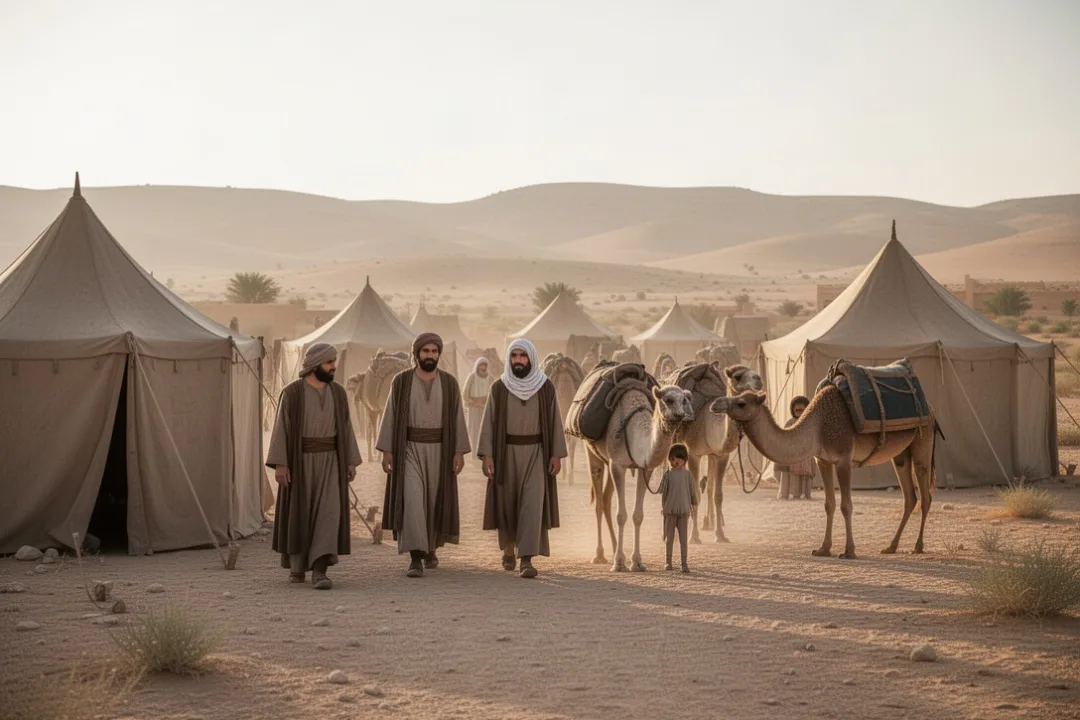
Abraham responds by traveling through Canaan and building altars. His faith is real, but it is not flawless. He and Sarah face famine, uncertainty, danger, and long delays. On more than one occasion, Abraham presents Sarah as his sister to protect himself, creating serious risks and showing that the person chosen by God still acts from fear.
Abraham’s separation from Lot reveals competing ways of pursuing prosperity. Lot chooses the fertile region near Sodom, while Abraham remains in the land God has promised. Later, Abraham rescues Lot after a regional conflict and refuses to build his wealth through the king of Sodom’s offer.
God’s covenant with Abraham becomes more specific through the promise of descendants. Because Sarah remains childless for many years, she gives Hagar to Abraham, and Ishmael is born. Genesis treats this decision as part of the family’s complicated history rather than as a clean solution to the promise. God later promises that Sarah herself will have a son.
Isaac’s birth brings joy and confirms that the promised family will come through Sarah. The account of Abraham being commanded to offer Isaac tests Abraham’s trust and ends with God stopping the sacrifice. The passage is difficult, but within Genesis it emphasizes testing, provision, and the preservation of the promised son.
Sarah dies, and Abraham purchases a burial place for her in Canaan. This detail matters because the family still lives as a vulnerable group in a land promised to their descendants. Abraham’s servant later finds Rebekah as a wife for Isaac, connecting the next generation to the covenant family.
What Isaac, Jacob, and Esau reveal about family conflict
Isaac’s story is shorter than Abraham’s or Jacob’s, but it carries the promise forward. Isaac and Rebekah have twin sons, Esau and Jacob, whose rivalry begins before birth. Esau becomes associated with hunting and the open country, while Jacob is portrayed as a more calculating figure who values the birthright and later obtains the paternal blessing through deception.
Jacob’s name is associated with grasping or supplanting, fitting the early stories in which he takes advantage of Esau’s hunger and deceives Isaac. Yet Genesis does not leave Jacob unchanged. After fleeing from Esau, Jacob dreams at Bethel of a connection between heaven and earth and hears God reaffirm the promise given to Abraham and Isaac.
Jacob works for Laban and marries Leah and Rachel, while also fathering children through their servants. The household becomes deeply divided by competition, favoritism, and struggles over affection. From this complicated family come the sons who will become the ancestors of the tribes of Israel.
Jacob eventually leaves Laban and returns toward Canaan, afraid of meeting Esau. During the night, he wrestles with a mysterious figure and receives the name Israel. The encounter marks a turning point: Jacob remains imperfect, but he emerges with a new identity tied to struggle with God and dependence on divine blessing.
Jacob and Esau meet without the expected revenge, though their relationship remains complex. Jacob settles in the land, but the family’s problems continue through the actions of his sons. Genesis shows that receiving a promise does not remove the consequences of favoritism, deceit, resentment, or poor decisions.
How Joseph’s story connects Genesis to Egypt
Joseph is Jacob’s favored son, and Jacob’s special treatment provokes resentment among Joseph’s brothers. Joseph’s dreams suggest that his family will one day bow before him, but the brothers interpret them as arrogance and sell him to traveling merchants. They deceive Jacob into believing Joseph has died.
In Egypt, Joseph serves in Potiphar’s household but is falsely accused after rejecting Potiphar’s wife. He is imprisoned, yet his ability to interpret dreams eventually brings him before Pharaoh. Joseph explains Pharaoh’s dreams as a warning of years of abundance followed by severe famine.
Pharaoh appoints Joseph to manage Egypt’s food supply. Joseph’s administrative work saves many lives, including those of his own family. When Jacob’s sons come to Egypt for grain, they do not recognize Joseph, creating a long period of testing and emotional tension.
Joseph eventually reveals his identity. He does not deny the brothers’ wrongdoing, but he interprets the outcome through God’s providence: their evil action became part of a larger means of preserving life. That does not make the sale of Joseph morally good. Instead, Genesis holds together human responsibility and God’s ability to work through terrible circumstances.
Jacob and the entire household move to Egypt during the famine. Before Jacob dies, he blesses his sons and speaks about their future. Joseph later reassures his brothers that he will not seek revenge. The book ends with Joseph’s death and his request that his bones eventually be carried back to the land promised to the family.
Major themes that shape the book of Genesis
God creates order and gives life
Genesis begins with God bringing order from formlessness and life from barrenness. Creation is not presented as divine competition or a struggle among rival gods. The narrative centers on one God who speaks, separates, names, blesses, and assigns purpose.
Human beings have dignity and responsibility
People are made in God’s image, but Genesis never treats them as morally harmless. Human dignity and human accountability appear together. The same people who cultivate land, build communities, and preserve life can also deceive, exploit, murder, and pursue power without regard for others.
God works through covenant promises
Covenant is one of Genesis’s central organizing ideas. God makes promises to Noah, Abraham, Isaac, and Jacob, using signs and repeated assurances to establish continuity. These promises remain active despite delays, family failures, and circumstances that seem to threaten their fulfillment.
Blessing often comes through unlikely people
Genesis repeatedly places important roles in the hands of people who appear vulnerable or unexpected: younger sons, barren women, foreigners, outsiders, and prisoners. Isaac rather than Ishmael carries the covenant line; Jacob rather than Esau becomes Israel; Joseph rises from slavery and imprisonment to authority.
God’s purposes include the nations
The promise to Abraham is not merely about private family prosperity. His descendants are connected to blessing for other peoples. Genesis begins with all humanity and then narrows to one family in order to show how that family’s calling has implications beyond itself.
Providence does not erase moral responsibility
Joseph’s story is the clearest example. God uses Joseph’s suffering to preserve life, but the brothers are still accountable for selling him. Genesis avoids two opposite errors: assuming suffering proves that God has abandoned a person, or assuming that a good outcome makes wrongdoing acceptable.
Women and family relationships in Genesis
Women in Genesis are central to the continuation and tension of the family story. Eve, Sarah, Hagar, Rebekah, Leah, Rachel, Tamar, and other women make decisions that shape the narrative. Their experiences include infertility, displacement, rivalry, exploitation, courage, and participation in God’s unfolding purposes.
Sarah’s long infertility creates pressure around the promise of descendants. Hagar suffers after becoming involved in Abraham and Sarah’s attempt to secure an heir. Rebekah actively shapes the future of her sons, while Leah and Rachel live within a painful marriage marked by competition and unequal affection.
Tamar’s story in Genesis 38 exposes the vulnerability of a widow within the ancient family system. She takes decisive action to secure justice and descendants. The chapter interrupts Joseph’s story, but it also shows that Genesis is willing to expose the failures of its leading men and to preserve the stories of women whose circumstances are easily overlooked.
These accounts should not be read as simple approval of every family arrangement described. Genesis often records polygamy, deception, coercion, and favoritism without presenting them as models to copy. Description and moral endorsement are not the same thing.
Practical tips and common mistakes when reading Genesis
Genesis contains familiar stories, but familiarity can make readers overlook context. These approaches help you read the book with greater care.
Read the whole narrative arc. Do not treat creation, Abraham, Jacob, and Joseph as unrelated Bible stories. Each section contributes to the movement from universal human history to a particular covenant family.
Separate description from instruction. Genesis reports deception, polygamy, violence, and favoritism without automatically approving those actions.
Track the promises. Mark references to descendants, land, blessing, protection, and God’s presence. These repeated ideas connect chapters that otherwise seem distant.
Notice repeated failures. Abraham, Isaac, Jacob, Joseph’s brothers, and others make serious mistakes. The story emphasizes God’s faithfulness without pretending the characters are perfect.
Pay attention to geography. Eden, Canaan, Haran, Egypt, and other locations show how movement, famine, exile, and settlement affect the characters.
Do not reduce Genesis to a morality lesson. Jacob is not simply “the clever one,” Joseph is not merely “the dreamer,” and Noah is not only a flood survivor. Their stories include ambiguity, suffering, and transformation.
Compare parallel scenes. Stories of brothers, barren women, threatened families, wells, journeys, and blessings echo one another and reveal changing patterns.
Keep later interpretation in context. Jewish and Christian traditions read Genesis in different ways. Begin with what the passage says within Genesis before applying later theological conclusions.
Reading tip: Keep a simple character and promise chart while reading. Record who is speaking, what is promised, what threatens the promise, and how the conflict changes.
Questions Genesis leaves for the rest of the Bible
Genesis closes several stories while leaving the larger promise unfinished. Abraham’s descendants are in Egypt rather than securely established in Canaan. Joseph dies expecting a future return to the land. The final scene therefore creates anticipation for the book of Exodus.
The book also establishes questions that later biblical writings continue to explore: How will humanity’s alienation from God be addressed? How will the promise to Abraham bless the nations? What will happen to the family of Israel in Egypt? How will God remain faithful when human beings repeatedly fail?
The ending is deliberately forward-looking. Genesis does not provide a complete account of redemption, national life, or the law. Instead, it supplies the foundational stories of creation, fall, covenant, family, promise, and providence that shape the rest of the Bible.
Why the book of Genesis still matters
Genesis gives readers a framework for understanding human identity and history. It portrays people as made for relationship with God and one another, yet capable of profound harm. It explains why families, societies, work, and the natural world can contain both beauty and conflict.
Its central hope is not based on human consistency. Abraham lies, Jacob deceives, Joseph’s brothers betray him, and families repeatedly fracture. Still, God continues to preserve life and carry forward the promise. Genesis therefore presents faith as a response to a God whose purposes remain active through uncertainty, delay, and human weakness.
For a concise reading plan, start with Genesis 1–3, then read chapters 6–9, 12, 15, 17, 22, 27–33, 37, 39–45, and 50. Those passages capture the major movements, but reading all 50 chapters reveals the repetitions, family connections, and gradual development that make the book coherent.
Frequently asked questions
How long does it take to read the book of Genesis?
Genesis contains 50 chapters, and many readers can complete it in several sittings or over two to four weeks. A slower reading pace helps you follow the family relationships, repeated promises, and changes in location. Reading a few chapters at a time while keeping track of major characters can make the longer genealogies and family transitions easier to understand.
What is the main message of Genesis?
Genesis presents God as the Creator who judges evil, preserves life, and establishes covenant promises despite human rebellion. The book explains the brokenness of the world while tracing God’s promise through Abraham’s family. Its main movement is from universal human history toward the formation of a particular family intended to bring blessing beyond itself.
Is Genesis meant to be read as history, poetry, or symbolism?
Genesis contains different literary forms, including genealogies, family narratives, speeches, genealogical formulas, and highly structured creation material. Readers and religious traditions disagree about how every passage relates to modern historical and scientific categories. A careful reading considers the text’s theological purpose, literary design, and ancient setting rather than forcing every chapter into only one modern genre.
Who wrote the book of Genesis?
Genesis does not identify its author within the text. Jewish and Christian traditions have long connected Genesis with Moses and the Pentateuch, while modern scholars discuss how earlier traditions and written sources may have been shaped into the final book. Regardless of the view of composition, Genesis functions as the opening book of the Torah and the foundation of the biblical story.






Leave a Reply