Jacob in the Bible: His story, family, and meaning
Jacob in the Bible: His story, family, and meaning
Jacob was the patriarch God renamed Israel, and his twelve sons became the ancestors of Israel’s twelve tribes.
His story in Genesis is long, emotionally complex, and central to the Bible’s account of God’s covenant people. Jacob is not presented as a flawless hero. He begins as a determined younger twin who takes advantage of his brother, Esau, and later uses shrewd methods to prosper while working for his uncle Laban. Yet his life also shows fear, prayer, endurance, repentance, reconciliation, and a growing dependence on God.
Jacob’s account appears mainly in Genesis 25–50. It connects the promises made to Abraham and Isaac with the later story of Israel. His family includes Isaac and Rebekah as parents, Esau as his twin brother, Leah and Rachel as wives, and Joseph and Benjamin among his sons. Understanding his relationships helps explain why Jacob’s story has such a lasting place in Scripture.
Jacob was the second son born to Isaac and Rebekah, and the younger twin of Esau. His grandfather was Abraham, making Jacob part of the family through which God had promised to bless many nations. Before Jacob was born, Rebekah experienced a difficult pregnancy and sought God’s guidance. The response described in Genesis indicated that the older son would serve the younger, pointing to an unexpected reversal of family order.
At birth, Jacob was described as holding Esau’s heel. His Hebrew name is connected with the idea of the heel and, in some contexts, with acting deceptively or trying to overtake someone. The name becomes especially meaningful because Jacob repeatedly seeks the advantages normally associated with the firstborn. His ambition is not hidden, but the early part of his life shows him pursuing God’s blessing through manipulation rather than trust.
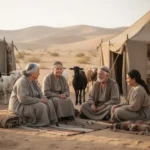
Esau became a skilled hunter and outdoorsman, while Jacob was described as a quieter man who stayed among the tents. Their parents also had different preferences: Isaac favored Esau, and Rebekah favored Jacob. These divided loyalties created a tense household in which love, inheritance, spiritual promise, and parental influence became closely entangled.
How Jacob obtained Esau’s birthright and blessing
Jacob’s first major conflict with Esau concerns the birthright. In the ancient family structure, the firstborn normally received special status and a larger share of the inheritance. Genesis says Esau returned from the field exhausted and asked Jacob for some stew. Jacob agreed only if Esau would sell him his birthright, and Esau accepted the exchange.
The story presents Esau as treating the birthright lightly, but it also shows Jacob exploiting his brother’s immediate hunger. The transaction was legally and morally significant, even though it involved a simple meal. Jacob wanted the future privilege, yet he pursued it through a bargain that exposed the rivalry between the brothers.
Later, Isaac prepared to give Esau the special blessing traditionally associated with the family heir. Because Isaac was old and his eyesight had failed, Rebekah developed a plan for Jacob to impersonate Esau. She prepared food, dressed Jacob in Esau’s clothes, and covered his hands and neck with goat skins so that he would seem hairy like his brother.
Jacob approached Isaac while pretending to be Esau. Isaac recognized Jacob’s voice but was persuaded by the disguise and the meal. He then gave Jacob the blessing, asking God to grant him prosperity, authority, and a place among those who would receive blessing. When Esau discovered what had happened, he was furious and planned to kill Jacob after their father’s death.
A crucial distinction: Jacob’s later role in God’s covenant does not make his deception acceptable. The biblical narrative records his dishonesty honestly and also shows that his choices brought fear, family separation, and years of painful consequences.
What happened to Jacob at Bethel
Jacob fled toward Haran, where his mother’s family lived. During the journey, he stopped for the night and used a stone as a pillow. There he dreamed of a stairway or ramp reaching from earth to heaven, with angels moving upon it. God stood above or near it and reaffirmed the promises given to Abraham and Isaac.
God promised Jacob land, descendants, protection, and a role through which all families of the earth would be blessed. The promise was not presented as a reward for Jacob’s honesty. Instead, it showed that God’s covenant purposes continued despite Jacob’s serious failures.
When Jacob awoke, he recognized the place as holy and named it Bethel, meaning “house of God.” He set up the stone as a memorial and made a vow concerning God’s protection and provision. Jacob’s response combined reverence with bargaining language, revealing a man who had encountered God but was still learning what genuine trust meant.
The Bethel dream is important for several reasons:
It connects Jacob personally with the covenant promises given to Abraham and Isaac.
It shows that God’s presence is not limited to one family home or one familiar location.
It gives Jacob assurance while he is vulnerable, alone, and fleeing from his brother.
It marks the beginning of a long process in which Jacob’s identity changes through hardship and divine encounters.
How Laban deceived Jacob and shaped his family
When Jacob reached Haran, he met Rachel, the daughter of his uncle Laban, at a well. Jacob loved Rachel and agreed to work for Laban for seven years in exchange for marrying her. Genesis describes those years as seeming short to Jacob because of his love for her.
At the wedding, however, Laban gave Jacob his older daughter Leah instead of Rachel. Jacob discovered the deception the next morning. Laban defended the arrangement by appealing to the local custom that the older daughter should marry before the younger. Jacob then married Rachel as well after agreeing to work another seven years.
The reversal is striking: Jacob, who had deceived Isaac by pretending to be Esau, was himself deceived through a disguise and a wedding arrangement. The parallel does not mean the two situations were identical, but it highlights the way Jacob’s earlier conduct echoes through his later life. He learned what it felt like to be manipulated by someone he trusted.
Jacob’s household became complicated and painful. Leah had children, while Rachel initially struggled with infertility. Rachel gave her servant Bilhah to Jacob, and Leah later did the same with her servant Zilpah. Through Leah, Rachel, Bilhah, and Zilpah, Jacob became the father of twelve sons and at least one daughter mentioned by name, Dinah.
Jacob’s sons were born into a household marked by competition between sisters, unequal affection, and rivalry over children. The names given to many of the sons reflect their mothers’ emotions and struggles. These family tensions later contributed to the brothers’ hatred of Joseph, Rachel’s first son.
Why Jacob wrestled with God at Peniel
After many years with Laban, Jacob returned toward Canaan with his wives, children, servants, and substantial flocks. He was afraid of meeting Esau. Reports suggested that Esau was coming with four hundred men, and Jacob feared that his brother might attack the entire household.
Jacob divided his people and possessions into groups, hoping to preserve at least part of what he had if Esau attacked. He also sent generous gifts ahead of him and prayed for protection. His prayer acknowledged God’s past faithfulness and Jacob’s unworthiness, making it one of the clearest moments in his life when he admits that he cannot secure the future through strategy alone.
That night, Jacob was left alone and wrestled with a mysterious man until daybreak. The passage in Genesis describes the encounter in human terms, but Jacob later understood that he had encountered God. The struggle ended with Jacob’s hip injured, yet he refused to let go without receiving a blessing.
The mysterious figure gave Jacob a new name: Israel. The name is associated with striving or struggling with God, though its precise meaning has been discussed in different ways. Jacob named the place Peniel, saying he had seen God face to face and lived.
The encounter captures the tension in Jacob’s character. He is wounded but blessed, persistent but dependent, and no longer able to move through life with the same physical confidence. His limp becomes a lasting reminder that the blessing he sought came through surrender as well as struggle.
What the name Israel means in the story: Israel does not erase Jacob’s past, but it marks a new stage in his identity. He remains the same person with the same history, yet his relationship with God has been reshaped through fear, struggle, and grace.
How Jacob and Esau were reconciled
After wrestling at Peniel, Jacob saw Esau approaching. Instead of hiding behind his family or sending gifts alone, Jacob went ahead of them and bowed repeatedly. Esau ran to meet him, embraced him, and wept. The brothers’ reunion is one of the Bible’s clearest scenes of reconciliation after prolonged hostility.
Jacob urged Esau to accept the gifts he had sent. He described seeing Esau’s face as though seeing the face of God, probably recognizing unexpected mercy in his brother’s welcome. The language does not mean Esau was divine. It expresses Jacob’s astonishment that the brother he feared had received him with kindness rather than violence.
The reconciliation did not erase every difference between them. They eventually went separate ways, with Esau returning toward Seir and Jacob continuing through Canaan. Still, the meeting ended the immediate threat and allowed Jacob to enter the land without the revenge he had expected.
This part of the story offers a careful picture of forgiveness. Jacob prepared for danger, acted with humility, and took responsibility for restoring the relationship. The narrative does not suggest that every damaged relationship can or should be resumed in the same way, especially where serious danger remains. It does show the value of truthful humility, practical steps, and a willingness to stop repeating old patterns.
What Jacob’s family reveals about favoritism and grief
Jacob’s family continued to experience conflict after his reunion with Esau. He settled in the land of Canaan, but several tragedies followed. Dinah’s experience in Shechem led to violent retaliation by her brothers Simeon and Levi. Rachel died while giving birth to Benjamin, Jacob’s youngest son. Reuben, Jacob’s firstborn, later committed an act that damaged his standing within the family.
Jacob’s strongest parental attachment was directed toward Joseph, Rachel’s firstborn, and later toward Benjamin. Genesis says Jacob made Joseph a special garment, traditionally associated with his visible preference for him. The exact nature of the garment is debated, but its symbolic meaning is clear: Joseph held a place of distinction that his brothers noticed and resented.
Joseph’s dreams intensified the tension. His brothers interpreted them as claims that they would bow to him. While Joseph’s later rise in Egypt becomes central to preserving the family during famine, the route there began with his brothers selling him and deceiving Jacob into believing that he had died.
Jacob’s grief was profound. He refused comfort and said he would mourn Joseph for the rest of his life. The irony is painful: Jacob had once used a garment and a prepared deception to mislead Isaac, and now his own sons used Joseph’s clothing to mislead him. His earlier actions do not cause every later event in a simple one-to-one way, but the narrative repeatedly shows deception spreading through the family.
How Jacob’s sons became the tribes of Israel
Jacob fathered twelve sons, whose families became the foundation of the twelve tribes of Israel. Their names are Reuben, Simeon, Levi, Judah, Dan, Naphtali, Gad, Asher, Issachar, Zebulun, Joseph, and Benjamin. Their mothers were Leah, Rachel, Bilhah, and Zilpah.
Joseph’s place among the tribes requires some care. Joseph’s two sons, Ephraim and Manasseh, were adopted and blessed by Jacob as his own sons. In later tribal listings, Ephraim and Manasseh can appear in Joseph’s place, while Levi may be treated separately because of its priestly role. For that reason, different biblical lists of the tribes do not always look identical.
Jacob’s final blessings in Genesis 49 address his sons individually. These statements reflect their character, past actions, and future significance. Judah receives especially prominent language, contributing to the later biblical association between Judah’s line, kingship, and the Davidic monarchy.
Jacob’s family was not formed through ideal circumstances. It grew amid favoritism, rivalry, infertility, grief, deception, and reconciliation. Yet the biblical account presents God as continuing to work through this imperfect family, preserving the covenant promise across generations.
What Jacob did in Egypt before his death
A severe famine eventually brought Jacob’s sons to Egypt, where Joseph had risen to authority under Pharaoh. The brothers did not recognize Joseph at first, but Joseph eventually revealed his identity. He explained that God had used the circumstances to preserve life, though this did not make the brothers’ original actions right.
Jacob was overjoyed to learn that Joseph was alive. He traveled to Egypt with his household after receiving assurance from God that the move was permitted. The family settled in Goshen, where they could maintain their flocks and survive the famine.
Before Jacob’s death, Joseph brought his sons Ephraim and Manasseh to him. Jacob crossed his hands while blessing them, giving the greater blessing to the younger Ephraim rather than the older Manasseh. This repeated a pattern visible throughout Jacob’s own life: God’s purposes often moved through the younger child instead of following ordinary expectations of rank.
Jacob also gathered his sons and spoke about their futures. His words included blessings, warnings, and evaluations of their past conduct. He asked to be buried in the family burial place in Canaan, the cave of Machpelah, where Abraham, Sarah, Isaac, Rebekah, Leah, and others in the family line had been buried.
Jacob died in Egypt at an advanced age. Joseph arranged for his father’s body to be carried to Canaan and buried at Machpelah. The burial connected Jacob’s death with the land promised to Abraham’s family, even though Jacob himself had spent his final years outside Canaan.
Practical lessons and common mistakes when reading Jacob’s story
Jacob’s life can be misread if his success is separated from his failures or if every action is treated as a model to imitate. The narrative is descriptive before it is prescriptive: it tells what Jacob and his family did, including actions that caused real harm.
Do not treat Jacob’s deception as a virtue. His cleverness sometimes helped him survive, but his lies also fractured relationships and created fear.
Do not confuse election with moral approval. God’s choice of Jacob for the covenant does not mean God approved every choice Jacob made.
Read the family story as a whole. Jacob’s favoritism, Laban’s manipulation, the rivalry between Leah and Rachel, and Joseph’s brothers’ actions all affect one another.
Pay attention to repeated patterns. Clothing, deception, younger sons receiving prominence, and fear of family members recur throughout the narrative.
Remember the difference between Jacob and Israel. Israel is Jacob’s new name, but the text continues to show his weaknesses, growth, and dependence.
Do not force every detail into a simple moral lesson. Some events reveal consequences, some reveal grace, and some remain painful without an easy explanation.
Notice the role of prayer. Jacob increasingly brings his fear and need before God instead of relying only on plans, gifts, and negotiation.
Read reconciliation with wisdom. Jacob’s reunion with Esau involved humility and preparation, but reconciliation does not require ignoring safety or pretending that harm never occurred.
A helpful way to read Jacob is to follow the changes in his posture. Early in life, he grasps for blessing through bargains and disguise. Later, he prays before meeting Esau, wrestles through the night, accepts a wound, and walks forward with a new name. His transformation is gradual rather than instant.
What Jacob’s story says about God’s covenant
The covenant promises associated with Jacob include land, descendants, divine presence, protection, and blessing for the nations. These promises do not rest on Jacob’s ability to control events. He loses his home, becomes vulnerable to Laban, fears Esau, grieves Joseph, and spends his final years in Egypt. Through each disruption, the covenant continues.
Jacob’s story also emphasizes that God works through families that are morally and emotionally complicated. Abraham, Isaac, Jacob, and Jacob’s sons all make serious mistakes. The biblical presentation of the patriarchs is unusually candid: their faith is real, but it exists alongside fear, favoritism, impatience, and wrongdoing.
The name Israel eventually describes not only Jacob personally but also the people who come from him. That makes Jacob’s personal transformation significant for the larger biblical story. His struggle becomes connected with the identity of a nation that will itself repeatedly struggle with God, faithfulness, injustice, repentance, and hope.
For readers, Jacob’s life offers neither a picture of effortless faith nor a promise that every conflict will resolve quickly. It presents a man who is changed over time. He begins by trying to secure the blessing through his own schemes and ends by blessing others, entrusting his burial to God’s promise, and looking beyond his immediate circumstances toward the future of his family.
Frequently asked questions
Why did God choose Jacob instead of Esau?
Genesis presents God’s choice of Jacob before the twins were born, within the larger covenant promise given to Abraham’s family. The text does not portray this choice as a reward for Jacob’s better behavior; Jacob often acted dishonestly. It shows that God’s purposes are not always determined by birth order or human expectations, while still holding Jacob accountable for his choices.
Was Jacob’s new name Israel given because he defeated God?
No. The wrestling account portrays Jacob as persisting through a mysterious encounter with God and receiving a blessing while also being wounded. The name Israel is associated with struggling or striving with God, but the scene emphasizes dependence rather than victory through strength. Jacob leaves changed, limping, and aware that the blessing came through an encounter he could not control.
How many wives and children did Jacob have?
Jacob had two wives, Leah and Rachel, and fathered children through their servants, Bilhah and Zilpah. He had twelve sons who became associated with Israel’s tribes, along with a daughter named Dinah in the Genesis account. Rachel gave birth to Joseph and Benjamin, while Leah and the two servants also had sons for Jacob.
Where is Jacob buried?
Jacob was buried in the cave of Machpelah near Hebron in Canaan. He specifically asked his family to return his body there after his death in Egypt. The burial place connected him with Abraham, Sarah, Isaac, Rebekah, and Leah, and it symbolized his continuing connection to the land promised to his family.









Leave a Reply