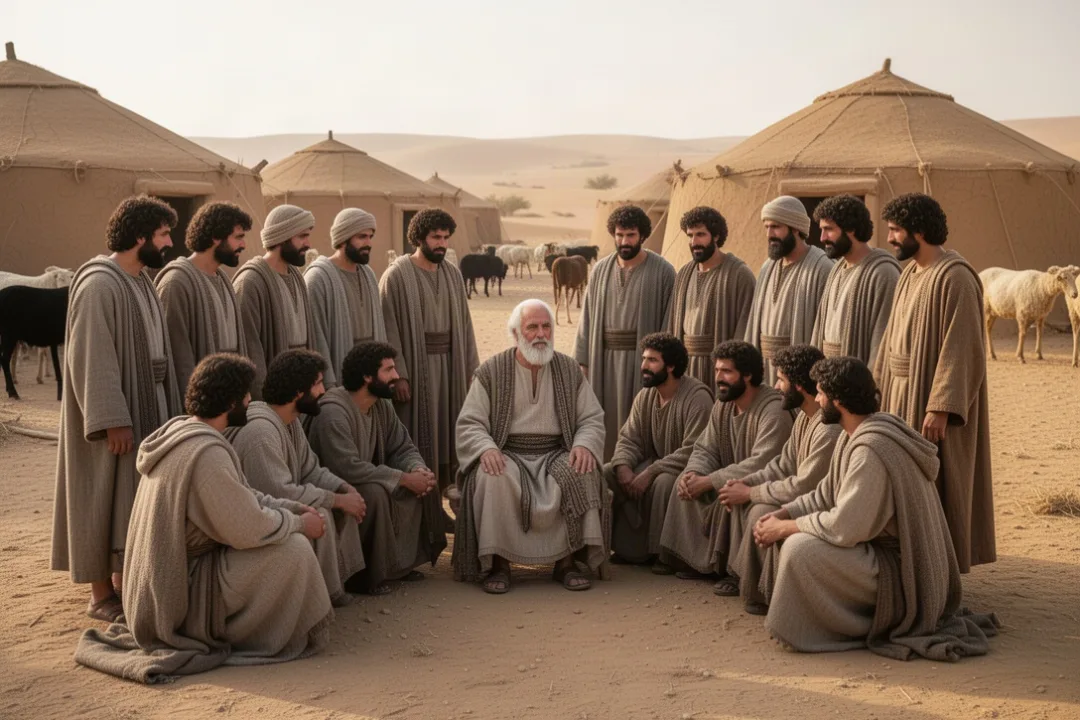
If you are trying to remember the 12 sons of Jacob, the family tree can seem confusing because Jacob had children with four women, and later tribal lists do not always use the names in exactly the same way. The sons were Reuben, Simeon, Levi, Judah, Dan, Naphtali, Gad, Asher, Issachar, Zebulun, Joseph, and Benjamin.
Jacob was also called Israel, so his sons became the founders or ancestors of the tribes of Israel. Their names and stories appear mainly in Genesis, especially chapters 29–35 and 37–50. One daughter, Dinah, is also named in the same family record.
The Bible presents the sons in a birth sequence connected to their mothers. Leah was Jacob’s first wife, Rachel was his beloved second wife, and Bilhah and Zilpah were their servants, whom Jacob also took as secondary wives according to the customs described in Genesis.
Reuben — Jacob’s firstborn son by Leah.
Simeon — Leah’s second son.
Levi — Leah’s third son.
Judah — Leah’s fourth son.
Dan — born to Bilhah, Rachel’s servant.
Naphtali — Bilhah’s second son.
Gad — born to Zilpah, Leah’s servant.
Asher — Zilpah’s second son.
Issachar — Leah’s fifth son.
Zebulun — Leah’s sixth son.
Joseph — Rachel’s first son.
Benjamin — Rachel’s second son and Jacob’s youngest.
This order follows the births described in Genesis. It is different from lists that group the brothers by mother, age, or tribal importance. In several passages, the names appear in another order because the writer is arranging the tribes for a particular purpose rather than retelling the births.
Remember the family pattern: Leah was the mother of six sons, Bilhah of two, Zilpah of two, and Rachel of two. The 12 sons were Jacob’s children, but they were not all born to the same woman.
Which mother gave birth to each son?
The family story begins with Jacob working for Laban, the father of Leah and Rachel. Jacob intended to marry Rachel, but Laban gave him Leah first and later allowed him to marry Rachel as well. The rivalry between the sisters is reflected in the names and circumstances surrounding many of the children.
Leah’s six sons
Reuben, Simeon, Levi, Judah, Issachar, and Zebulun were Leah’s sons. Genesis describes Leah as having children while Rachel remained unable to conceive for a period of time, creating deep tension between the sisters.
Several of Leah’s names are connected in the biblical text with her hopes and emotional experience. Reuben’s name is associated with the idea that God had seen Leah’s misery. Judah’s name is linked with praise, and Issachar and Zebulun are connected with Leah’s understanding of God’s provision and her relationship with Jacob.
Leah’s sons became especially significant in Israel’s later history. Judah became the ancestor of the royal line associated with David, while Levi became the ancestor of the priestly and religious servants of Israel. Reuben, Simeon, Issachar, and Zebulun also became tribal ancestors, although their later political and territorial influence varied.
Bilhah’s two sons
Dan and Naphtali were born to Bilhah, Rachel’s servant. Rachel gave Bilhah to Jacob because Rachel was unable to have children at that stage, and she regarded Bilhah’s children as connected to her household.
Dan’s name is associated with judgment or vindication in the naming account. Naphtali’s name is connected with Rachel’s struggle with her sister. These traditional explanations come from Genesis itself, where the naming of a child often reflects the mother’s circumstances or feelings at the time.
Zilpah’s two sons
Gad and Asher were born to Zilpah, Leah’s servant. Leah presented Zilpah to Jacob after her own childbearing had paused, and she considered these sons part of her family line.
Gad’s name is associated with fortune or good fortune in the biblical naming explanation. Asher’s name is connected with happiness or being considered fortunate. The names should be understood within the story’s ancient family setting rather than treated as exact modern translations.
Rachel’s two sons
Joseph and Benjamin were Rachel’s sons. Joseph was born after a long period in which Rachel had no children, and his birth brought her great relief. His name is connected with the hope that God would add another son, a hope that was later fulfilled with Benjamin’s birth.
Rachel died while giving birth to Benjamin. She named him Ben-Oni, a name associated with her suffering, but Jacob called him Benjamin, commonly understood as “son of the right hand” or “son of the south,” depending on how the Hebrew expression is interpreted.
What the names of Jacob’s sons mean
The names of the 12 sons are not merely labels in the Genesis narrative. Many are explained through word associations, family circumstances, and statements made at the time of birth. Some meanings are debated because ancient Hebrew names can carry more than one possible nuance.
Reuben: commonly connected with seeing or being seen, reflecting Leah’s belief that God had noticed her hardship.
Simeon: associated with hearing, because Leah said God had heard that she was unloved.
Levi: linked with attachment or joining, reflecting Leah’s hope that Jacob would become more closely attached to her.
Judah: associated with praise or thanksgiving.
Dan: connected with judging or vindication.
Naphtali: associated with struggle or wrestling.
Gad: connected with fortune, a troop, or a similar term depending on interpretation.
Asher: associated with happiness or good fortune.
Issachar: traditionally linked with reward or wages.
Zebulun: connected with honor, dwelling, or habitation.
Joseph: associated with adding or increasing.
Benjamin: commonly understood as son of the right hand, though another geographic interpretation is possible.
These explanations come from different kinds of evidence: the naming comments in Genesis, Hebrew word roots, and later Jewish and Christian tradition. A name’s traditional meaning can help explain the story, but it should not be treated as a complete biography of the person who carried it.
The names also show how personal the family story is. Leah named children while dealing with rejection, Rachel named children in the middle of rivalry and longing, and the servants’ children were born into a complicated household structure. The twelve names therefore preserve not only ancestry but also the emotional tension of Jacob’s family.
How the 12 sons became the tribes of Israel
Jacob’s sons are called the ancestors of the 12 tribes of Israel, but the relationship is not always a simple one-to-one list. Joseph’s two sons, Ephraim and Manasseh, later received tribal status, while Levi was set apart for religious service and did not receive a standard territorial inheritance in the same way as the other tribes.
This means that some lists count Joseph as one tribe, while others count Ephraim and Manasseh separately. When Joseph’s two sons are counted separately and Levi is excluded from the land allotment, the number of territorial tribes remains twelve.
Reuben: received territory east of the Jordan River.
Simeon: received towns within the territory associated with Judah.
Levi: served in religious roles and was assigned towns rather than one unified tribal territory.
Judah: held a large southern territory and became associated with the Davidic royal line.
Dan: received territory that later became difficult to retain, leading part of the tribe to migrate north.
Naphtali: held territory in the northern region of Canaan.
Gad: received land east of the Jordan.
Asher: was associated with the northern coastal and hill regions.
Issachar: received territory in the fertile area near the Plain of Esdraelon.
Zebulun: received land in the northern part of Canaan.
Joseph: was represented through the tribes of Ephraim and Manasseh.
Benjamin: held a smaller territory between Judah and the northern tribes.
The tribal lists in the Pentateuch, Joshua, Chronicles, and later biblical books can differ in their order and emphasis. That variation does not mean the family tradition has changed completely. It reflects different questions: ancestry, military organization, land distribution, worship, or the political importance of a tribe at a particular time.
A useful distinction: Jacob’s 12 sons are the family ancestors, while the later “12 tribes” may include Ephraim and Manasseh in Joseph’s place or leave Levi out of the territorial count.
What the Bible says about each son’s story
The sons do not all receive the same amount of attention. Joseph dominates the final part of Genesis, Judah becomes increasingly important, and several brothers appear mainly in group scenes. Their stories nevertheless form a connected account of a divided family becoming the foundation of Israel.
Reuben, Simeon, and Levi
As the firstborn, Reuben might have been expected to receive special authority. However, Genesis records that he slept with Bilhah, his father’s concubine, and later Jacob’s blessing indicates that Reuben had lost the stability and honor expected of the firstborn. His actions affected his standing within the family.
Simeon and Levi are remembered together because of their violent response to the assault of their sister Dinah in Shechem. They deceived the men of the city and attacked them after requiring circumcision. Jacob later criticized their anger and violence in his final blessings, and the two tribes did not develop identical futures.
Levi’s descendants eventually became associated with the tabernacle and priestly service. This later role is striking because Jacob’s earlier words about Levi focused on violence, showing that biblical family histories can include both severe failure and a changed communal vocation.
Judah and the family line of kings
Judah first appears in the Joseph story as one of the brothers involved in deciding what to do with Joseph. Rather than kill him, the brothers sold him to passing traders, according to Genesis 37. Judah’s role becomes more constructive later, especially when he offers himself in place of Benjamin before the Egyptian ruler in Genesis 44.
Judah’s earlier story involving Tamar in Genesis 38 also reveals a major moral turning point. Judah initially acts unjustly toward Tamar, but later admits that she was more righteous than he had been. The narrative presents him as a flawed man who grows into a responsible leader.
Jacob’s blessing in Genesis 49 gives Judah a prominent place among the brothers. Later biblical history connects Judah with the kingdom in the south and with David’s royal family. Christian readers also connect Jesus’ ancestry with Judah through genealogies in the New Testament, although those genealogies serve theological and literary purposes as well as family-record purposes.
Joseph and Benjamin
Joseph was Jacob’s favored son, and his brothers’ jealousy led them to sell him into slavery. In Egypt, Joseph eventually rose to authority after interpreting Pharaoh’s dreams, and he managed preparations for a severe famine. When his brothers came to Egypt for food, they did not recognize him at first.
The family is reunited only after a series of tests, particularly involving Benjamin. Joseph eventually reveals his identity and interprets the family’s suffering within God’s larger purpose, while still recognizing the brothers’ responsibility for what they did. Genesis does not erase the harm caused by the sale, but it shows reconciliation taking place through truth, provision, and forgiveness.
Benjamin receives less individual attention than Joseph, but his tribe later becomes important. Israel’s first king, Saul, is identified as a Benjaminite, and the apostle Paul later identifies himself as a member of the tribe of Benjamin in Philippians 3 and Romans 11.
Jacob’s final blessings and the legacy of his sons
Near the end of Genesis, Jacob gathers his sons in Egypt and speaks about what will happen to them. Genesis 49 presents these words as blessings, but they include praise, warnings, poetic images, and predictions about the brothers’ future. The passage is not a simple list of compliments; it evaluates character as well as describing tribal destiny.
Reuben is reminded of his loss of firstborn status. Simeon and Levi are rebuked for violence. Judah is given a place of leadership, while Joseph receives extended praise for endurance and fruitfulness. Benjamin is pictured with imagery of a strong, aggressive wolf, reflecting the later reputation of his descendants for military ability.
Jacob’s blessing also demonstrates that birth order did not determine every son’s future. Reuben was the firstborn, but Judah became the royal ancestor and Joseph received an especially prominent blessing. Family position mattered, yet the biblical narrative repeatedly shows that character, providence, and later actions shaped each tribe’s legacy.
Jacob himself received the name Israel after wrestling with a mysterious figure at Peniel, as recorded in Genesis 32. His sons therefore became the foundation of a people whose identity was tied to both family descent and covenant history. The phrase “sons of Jacob” points to individuals, while “tribes of Israel” points to the larger communities that developed from them.
For a quick memory aid, group the brothers by mother: Leah’s six are Reuben, Simeon, Levi, Judah, Issachar, and Zebulun; Bilhah’s two are Dan and Naphtali; Zilpah’s two are Gad and Asher; and Rachel’s two are Joseph and Benjamin. That pattern makes the full list easier to reconstruct without relying only on memorization.
Frequently asked questions
Who was Jacob’s firstborn son?
Reuben was Jacob’s firstborn son and Leah’s first child. As the eldest, he would normally have been expected to hold special authority in the family. However, Genesis records an offense involving Bilhah that damaged his position. Later tribal history also shows that Reuben did not become the dominant royal or priestly tribe.
How many wives or mothers did Jacob’s sons have?
Jacob’s sons were born to four women: Leah, Rachel, Bilhah, and Zilpah. Leah gave birth to six sons, Rachel to Joseph and Benjamin, Bilhah to Dan and Naphtali, and Zilpah to Gad and Asher. The biblical household was therefore larger and more complex than a family with one mother and 12 children.
Was Joseph one of the 12 tribes of Israel?
Joseph was one of Jacob’s 12 sons, but tribal lists often represent him through his two sons, Ephraim and Manasseh. When Ephraim and Manasseh are counted separately, Levi is usually excluded from the territorial count because of its religious duties. This explains why different passages may arrange or name the tribes differently.
Which son of Jacob became the ancestor of the kings of Israel?
Judah became the ancestor of the royal line associated with David and the kingdom of Judah. Jacob’s blessing in Genesis 49 gives Judah a leadership role among the brothers. The first king of the united monarchy, Saul, came from Benjamin, so Judah’s royal importance developed after Saul’s reign rather than meaning every king came from Judah.





Leave a Reply