Levites were members of the tribe of Levi, one of the twelve tribes of Israel. Their main responsibility was to assist with Israel’s worship, care for the tabernacle and later the Temple, and support the priests in carrying out sacred duties. They were not all priests: the priests were a specific family within the tribe of Levi, descended from Aaron.
The tribe’s responsibilities changed as Israel moved from the wilderness tabernacle to a permanent Temple in Jerusalem. Levites served as caretakers, musicians, gatekeepers, teachers, administrators, and assistants to the priests. Their story explains how worship was organized and why the Bible distinguishes between Levites generally and Aaronic priests specifically.
Levi was the third son of Jacob and Leah, according to Genesis. His descendants became one of Israel’s tribal groups, but they received a different role from most of the other tribes. Rather than being assigned a large territorial region in the land, the Levites were distributed among towns located within the territories of the other tribes.
Their special status is connected with Israel’s worship after the exodus from Egypt. In the account of the golden calf, members of the tribe of Levi responded to Moses’ call for loyalty to the Lord. Later biblical passages present the Levites as set apart for service connected with the tabernacle.
Being set apart did not mean every Levite performed the same task. The tribe included several family branches, and each branch had assigned duties. The distinction between these roles helped protect the sacred objects and gave the portable sanctuary an orderly system of care.
Core distinction: Every priest was a Levite, but not every Levite was a priest. Priests descended from Aaron, a descendant of Levi, while other Levites performed supporting duties.
How the Levites served Israel’s worship
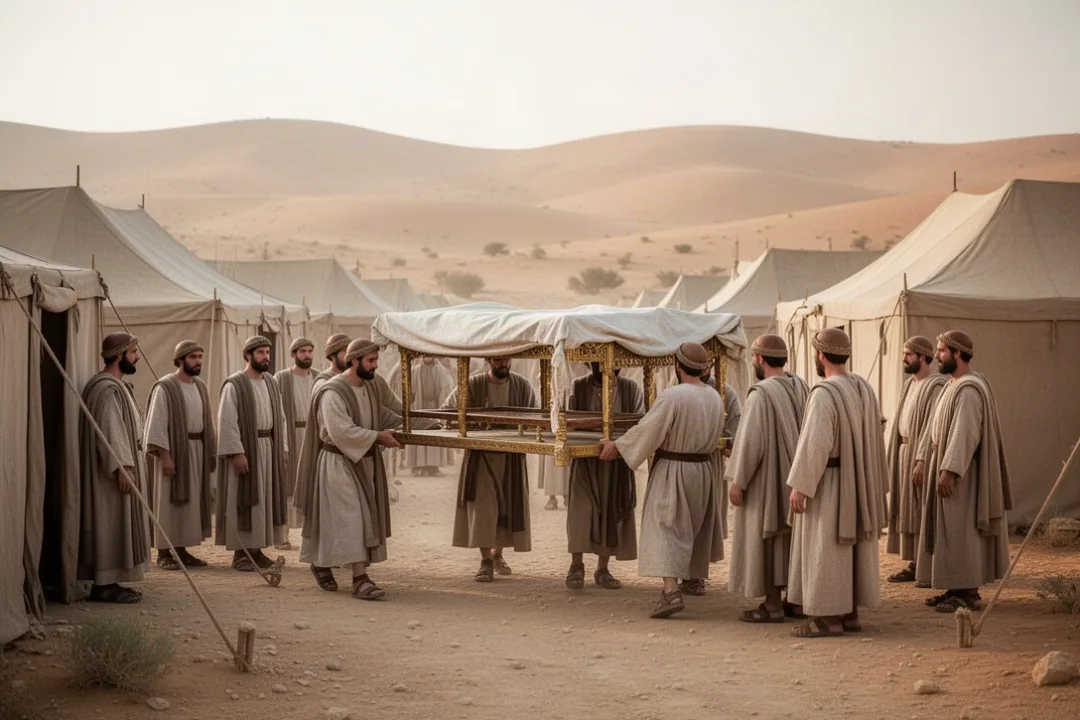
The Levites’ first major assignment was service at the tabernacle, the movable sanctuary Israel carried during its wilderness years. Their work included dismantling, transporting, guarding, and reassembling the sanctuary and its equipment. They served under the authority of the priests, who were responsible for the most restricted sacred duties.
Numbers describes the Levites as being given to Aaron and his sons for service. This arrangement made them assistants to the priestly family rather than independent priests. Their duties were practical and religious at the same time: caring for sacred objects was part of preserving Israel’s worship.
Their work included several important responsibilities:
Transporting the tabernacle: Levites carried designated parts of the sanctuary when Israel moved from one encampment to another.
Guarding the sanctuary: They helped prevent unauthorized people from entering restricted areas or mishandling sacred objects.
Preparing worship spaces: They assisted with the physical arrangements required for sacrifices and communal worship.
Supporting the priests: They handled tasks that allowed the priests to focus on the altar and priestly rituals.
Leading music and praise: In the Temple period, Levites served as singers and instrumentalists.
Teaching and administration: In later periods, they helped explain the law and manage aspects of Temple service.
These assignments were not simply private occupations. The biblical system treated worship as a shared responsibility with different levels of access and authority. The priests performed certain ceremonies, while the Levites maintained the wider structure that made those ceremonies possible.
The three main Levitical families
Levi’s descendants were organized into three major family groups: the Gershonites, the Kohathites, and the Merarites. Numbers assigns each group different responsibilities in caring for the tabernacle. These assignments show that the word “Levite” referred to a broad community with a detailed internal structure.
The Gershonites cared for coverings and curtains
The Gershonites were responsible for parts of the tabernacle’s fabric and outer coverings. Their duties included the curtains, coverings, screens, and related materials used to enclose or protect the sanctuary. They transported these items under the supervision of the priestly leadership.
Their work could appear less prominent than handling the altar or sacred vessels, but the sanctuary could not function without its curtains and coverings. The Gershonite assignment demonstrates that the biblical system valued both visible ceremonies and the less visible labor required to maintain them.
The Kohathites carried the most sacred objects
The Kohathites were assigned to carry many of the sanctuary’s most sacred furnishings, including the ark, the table, the lampstand, and the altars after the priests had covered them. They were not allowed to touch or look at the holy objects while they were uncovered. The priests first prepared the objects for transport, and the Kohathites then carried them using poles.
This division emphasized both responsibility and limits. The Kohathites had an honored assignment, but they could not enter the inner sanctuary or handle the objects in whatever way they wished. Numbers 4 describes the seriousness of these boundaries and connects improper contact with the danger of death.
The Merarites transported the framework
The Merarites cared for the heavy structural elements of the tabernacle. Their responsibilities included boards, pillars, bases, pegs, cords, and related components. Because these materials were heavy, the Merarites were assigned wagons and oxen to help move them.
Their work illustrates the practical side of worship in the wilderness. A sanctuary required careful logistics, skilled labor, and reliable coordination. The Merarites’ duties were physical and demanding, yet they were treated as a formal part of sacred service.
Why Aaron’s descendants were priests
Aaron was a descendant of Levi and the brother of Moses. His sons were appointed to serve as priests, creating a hereditary priesthood within the larger tribe. This means that the priesthood was Levitical in origin but Aaronic in family descent.
The priests had responsibilities that other Levites did not. They presented offerings on the altar, entered designated parts of the sanctuary, maintained certain sacred rituals, and represented the people in specific acts of worship. The high priest held an especially restricted and important position in the tabernacle and Temple system.
Other Levites could assist the priests but could not take over priestly authority. The biblical narrative makes this distinction clear in accounts involving Korah’s rebellion, King Saul’s unlawful sacrifice, and later controversies over unauthorized priestly duties. These stories present priestly service as an assigned office rather than a role someone could claim for personal status.
Numbers 18 explains the relationship between priests and Levites: Aaron and his sons were responsible for priestly service, while the Levites assisted them and guarded the sanctuary. The arrangement provided a chain of responsibility rather than treating every sacred worker as interchangeable.
How the Levites were counted and dedicated
The Levites were counted separately from the other Israelite tribes. In the wilderness census, the general military count included men of fighting age from the tribes, but the Levites were counted for sanctuary service. Their separate census reflected their different vocation.
Numbers records the dedication of the Levites as a group given to God in place of the firstborn of Israel. The biblical explanation connects this with the Lord’s claim on the firstborn after the exodus. The Levites therefore represented a whole tribe assigned to sacred service on behalf of the nation.
Levites began formal service at a specified age, and later instructions adjusted the age range for active work. These age limits applied to demanding sanctuary duties and should not be treated as a universal rule for every later form of Levitical service. The biblical text presents a structured system that developed as the needs of worship changed.
The dedication ceremony included purification, washing of clothing, sacrifices, and presentation before the Lord. These actions showed that service required preparation and that the Levites’ work belonged to the community’s covenant worship rather than to ordinary employment.
Where the Levites lived in Israel
The Levites did not receive one large, continuous tribal territory like Judah, Ephraim, or Naphtali. Instead, they received designated towns within the territories of the other tribes. Their lack of a single territorial inheritance is expressed in the biblical idea that the Lord was their inheritance.
This did not mean Levites had no homes, farmland, or local communities. They lived in towns and could possess surrounding pastureland for their livestock. Their communities were spread throughout Israel, allowing them to serve and teach people in different regions.
Joshua 21 lists Levitical towns assigned among the tribes. These towns included the cities of refuge, which provided legal protection for a person who had accidentally caused a death while the case was being examined. The presence of these cities among Levitical settlements connected the tribe with justice, law, and public order as well as with worship.
The distribution of Levitical towns also gave Israel access to people trained in religious instruction. Although not every Levite served as a full-time teacher, the tribe had a recognized responsibility to help preserve knowledge of the law and the practices of worship.
How Levites received support
Because the Levites did not receive a normal tribal inheritance, the other Israelites supported them through tithes. Numbers 18 describes the tithe from Israel as an inheritance given to the Levites in return for their service at the tent of meeting. The Levites then gave a tenth of what they received to the priests.
This system connected material support with public religious work. Levites needed food and resources, and their service required them to be available for sanctuary duties. The tithe was therefore presented as part of Israel’s organized worship rather than as a private payment to individual religious officials.
Deuteronomy also emphasizes that Levites lived among the other tribes and should not be neglected. Several passages group Levites with foreigners, orphans, and widows when describing communal celebrations and charitable obligations. These instructions recognized that the Levites’ scattered status could leave them vulnerable when communities failed to share their resources.
Not every reference to a tithe describes exactly the same practice or purpose. Some passages focus on support for Levites, while others describe communal meals, festival observance, or aid for those without land. The broader principle is that Israel’s worship included a responsibility to provide for those assigned to religious service.
What Levites did during the Temple period
After Solomon’s Temple was built in Jerusalem, the Levites’ work changed because the sanctuary was no longer transported through the wilderness. They continued to guard and maintain the Temple, but they also developed roles connected with music, gates, storage, administration, and instruction.
First Chronicles organizes Levites into divisions and records families associated with different Temple duties. Some served as singers and musicians, using instruments and vocal praise during worship. Others guarded entrances, managed chambers, supervised supplies, or helped prepare offerings.
Levites also assisted with the religious reforms of kings such as Hezekiah and Josiah. In these accounts, they helped cleanse the Temple, organize worship, teach the people, and restore practices that had been neglected. Their work extended beyond ceremony into national religious administration.
Not every assignment was equally visible. Temple worship depended on gatekeepers, treasurers, cleaners, musicians, porters, and officials as well as priests. The biblical lists of names and divisions preserve the idea that each family’s task mattered to the operation of the sanctuary.
Levites as teachers of the law
The Levites had an educational role in addition to their Temple duties. Deuteronomy assigns the priests and Levites responsibility for teaching Israel, and later passages describe Levites reading or explaining the law to the people.
During King Jehoshaphat’s reign, officials, priests, and Levites traveled through Judah to teach from the Book of the Law, according to 2 Chronicles. After the exile, Ezra and Nehemiah describe Levites helping the returned community understand the law and observe its requirements.
Nehemiah 8 presents the Levites as assisting with public reading by helping people understand what was being read. The passage does not require the assumption that every Levite was a professional scholar. It does show that the tribe had an acknowledged place in transmitting religious knowledge.
This teaching role helps explain why Levites were spread across the country. Their presence in different towns allowed the law and worship practices to be reinforced beyond Jerusalem. They served not only at the central sanctuary but also as a connection between national worship and local communities.
What happened to the Levites after the exile
The Babylonian exile disrupted Jerusalem’s Temple service and displaced many families. When groups returned to Judah, priests and Levites were needed to reestablish worship. Books such as Ezra and Nehemiah distinguish between priests, Levites, singers, gatekeepers, and other Temple personnel.
The returning community faced practical challenges. Some families could not prove their ancestry, some Levites were slow to return, and the Temple required organized staffing. The records show how strongly the postexilic community valued documented lineage and proper assignments.
In the Second Temple period, Levites continued to serve as singers, gatekeepers, and assistants. Their duties were more closely tied to the Temple in Jerusalem than to a portable sanctuary, but the distinction between priests and Levites remained. The tribe’s service continued within the worship system established by the Torah and developed in Israel’s later history.
The New Testament refers to Levites in several settings without presenting a full description of their Temple duties. The parable of the Good Samaritan includes a priest and a Levite as travelers on the road from Jerusalem to Jericho. John’s Gospel also mentions priests and Levites sent to question John the Baptist. These references assume that readers knew Levites as a recognized religious group connected with Jerusalem’s worship.
What the Levites teach about biblical service
The Levites’ history presents service as both spiritual and practical. Their work involved prayer, music, teaching, guarding, carrying, cleaning, accounting, and organizing. The biblical picture does not limit religious importance to the most visible ceremony.
It also shows that sacred responsibility came with boundaries. Levites were honored for their service, but they were not permitted to perform every task. Priests had one set of duties, other Levites had another, and family divisions created further assignments.
Several principles emerge from the Levites’ story:
Different roles can support one purpose: Worship required priests, musicians, guards, teachers, laborers, and administrators.
Authority was connected with calling: A person’s desire for religious status did not automatically authorize a particular duty.
Unseen work mattered: Transporting equipment, protecting entrances, and managing supplies were treated as part of service to God.
Communities had obligations to religious workers: Israel’s laws provided material support for Levites who did not hold a normal tribal territory.
Teaching preserved covenant life: Levites helped connect public worship with knowledge of the law.
For readers studying the Bible, the Levites are easiest to understand by keeping three categories separate: the tribe of Levi, the nonpriestly Levites, and the Aaronic priests. Many confusing passages become clearer once those distinctions are in place.
Reading tip: When a passage mentions Levites, check the setting. A wilderness passage may focus on transport and guarding, while a Temple passage may describe music, gates, storage, teaching, or administration.
Where to read about the Levites in the Bible
Several groups of biblical passages provide the clearest information about the tribe and its responsibilities. Reading them together gives a fuller picture than relying on a single reference.
Genesis 29: Introduces Levi as one of Jacob’s sons and identifies the family line.
Exodus 32: Describes the Levites’ response during the golden calf crisis.
Numbers 1–4: Records the Levites’ census, dedication, family divisions, and tabernacle duties.
Numbers 8: Describes the purification and presentation of the Levites for service.
Numbers 18: Explains the relationship between priests and Levites and the support provided through tithes.
Joshua 21: Lists the Levitical towns, including cities of refuge.
1 Chronicles 23–26: Organizes Levites for Temple service, music, gatekeeping, and administration.
Ezra and Nehemiah: Show the role of priests and Levites in restoring worship after the exile.
These passages also reveal that the Levites were not a single uniform group. Their identity came from descent from Levi, while their particular responsibilities depended on family line, period, location, and appointment.
How Levites differ from modern uses of the name
In Jewish tradition, a person identified as a Levi is understood to belong to the tribe of Levi. The term can refer to a non-Aaronic member of the tribe, distinguishing that person from a kohen, or priest descended from Aaron. Customs and practices associated with these identities vary among Jewish communities.
A modern person’s use of the surname Levi, Levy, or a similar form does not by itself prove descent from the biblical tribe. Surnames can have different origins, and family identity requires more than the spelling of a name. Biblical Levites were identified through genealogical and communal structures that cannot automatically be established from a modern surname.
The central biblical meaning remains clear: Levites were the descendants of Levi who were set apart for supporting Israel’s worship. Their service included the physical care of the sanctuary, musical praise, public teaching, legal and administrative assistance, and protection of sacred boundaries. Priests belonged to this tribe, but the wider Levitical community had its own essential work.
Frequently asked questions
Were all Levites priests?
No. Priests were descendants of Aaron, who belonged to the tribe of Levi. Other Levites assisted the priests by transporting and guarding the tabernacle, maintaining Temple areas, leading music, teaching, and handling administrative duties. The Bible consistently treats the priesthood as a particular family within the larger tribe.
Why did the Levites not receive a normal tribal territory?
The Levites lived in towns distributed among the other tribes instead of receiving one large region. Their support came partly through tithes and designated pasturelands. This arrangement allowed them to serve communities throughout Israel while expressing the biblical idea that their inheritance was connected to the Lord and their religious vocation.
What were the three Levitical families?
The three principal family groups were the Gershonites, Kohathites, and Merarites. Gershonites cared for curtains and coverings, Kohathites carried sacred furnishings after priests prepared them, and Merarites transported the tabernacle’s structural framework. Each group had a distinct assignment during Israel’s wilderness travels.
Can someone prove they are a Levite from the surname Levi?
A surname alone cannot establish biblical descent. Names such as Levi or Levy may be associated with Levitical identity, but surnames can have multiple origins and may have changed over time. Traditional Jewish communities generally rely on family and communal recognition rather than the surname by itself.











Leave a Reply