The intertestamental period: History between the Testaments
The intertestamental period: History between the Testaments
If you have ever wondered why the New Testament begins in a world shaped by Greek language, Roman power, synagogues, Pharisees, and messianic expectation, the answer lies partly in the intertestamental period. This era bridges the final writings of the Old Testament and the opening events of the New Testament.
The term usually refers to the centuries between the completion of the Old Testament and the beginning of the New Testament period. Many Protestant writers date it broadly from about 400 BC to the birth of Jesus, although the boundaries depend on which biblical canon and historical events a person is using. The period was not an empty gap. Jewish communities experienced foreign rule, cultural pressure, religious debate, political independence, civil war, and the rise of institutions that appear throughout the Gospels.
Intertestamental means “between the Testaments.” In this context, “Testaments” refers to the Old Testament and New Testament as collections of Scripture. The period is also called the Second Temple period, especially when historians are describing the era from the rebuilding of Jerusalem’s temple after the exile until its destruction by the Romans in AD 70.
The two terms overlap but are not identical. The Second Temple period begins earlier, with the temple’s reconstruction under Persian rule, while the intertestamental period usually focuses on the time after the last Old Testament books and before the New Testament era. This distinction helps prevent a common mistake: treating the period as a precise, universally agreed block of years.
The Old Testament does not end with every later development already explained. For example, the books of Ezra and Nehemiah describe Persian-era restoration, but the New Testament opens under Roman rule. Between those settings, the Jewish people encountered several empires and political systems. Those changes shaped the vocabulary, institutions, expectations, and conflicts found in the first century.
A helpful perspective: “Intertestamental” does not mean that God was absent or that nothing spiritually significant happened. It describes a period between two collections of biblical writings, not a period without faith, prayer, worship, suffering, or divine activity.
Why the period is sometimes called the “400 silent years”
Some Christian traditions call this era the 400 silent years because no universally recognized prophetic book was added to the Protestant Old Testament during the time between Malachi and the ministry of John the Baptist. The phrase is useful when it refers to the lack of new canonical prophetic books, but it can be misleading if it suggests that no religious writing, revelation claim, or spiritual reflection existed.
Jewish authors produced historical works, wisdom literature, apocalyptic writings, prayers, and translations during these centuries. Some Christian traditions include several of these works in the Old Testament or place them in a secondary collection called the Deuterocanon. Other traditions call them the Apocrypha and do not treat them as Scripture in the same way.
The period also contains major historical events that help explain the New Testament. Greek became widely used across the eastern Mediterranean. Jewish communities developed different responses to foreign culture. The temple became the center of worship and national identity, while local synagogues became important settings for teaching and prayer. By the first century, Rome governed Judea, and many Jews were looking for God’s intervention.
How Persian rule shaped the earliest part of the period
After the Babylonian exile, the Persian Empire allowed many Jewish exiles to return to Judah. Jerusalem and the temple were rebuilt, although the restored community remained politically subordinate to Persia. The books of Ezra, Nehemiah, Haggai, Zechariah, and Malachi reflect parts of this restoration era and its continuing struggles.
Persian rule did not create Jewish independence. Local leaders operated within imperial limits, and the community had to deal with economic hardship, opposition from neighboring groups, and the challenge of rebuilding religious life. The temple was central, but restoration was incomplete from the perspective of many Jewish hopes. The Davidic monarchy had not been restored, and foreign powers still controlled the land.
Persian influence continued until Alexander the Great defeated the Persian Empire in the fourth century BC. The resulting transition introduced a new political and cultural force: Hellenism, the spread of Greek language, education, art, political ideas, and social customs across the region.
How Alexander and the Hellenistic kingdoms changed Jewish life
Alexander’s conquests connected a large territory under Greek influence, but his empire did not remain united after his death. His generals divided control among successor kingdoms. Judea came under the influence of the Ptolemies of Egypt for a time and later the Seleucids of Syria.
Greek culture offered practical advantages as well as serious religious challenges. A shared language made trade and administration easier and helped Jewish communities communicate across different regions. The Hebrew Scriptures were eventually translated into Greek, producing the Septuagint, a translation widely used by Greek-speaking Jews and frequently reflected in early Christian Scripture quotations.
At the same time, Hellenistic customs could conflict with Jewish practices. Some Jews adopted Greek names, education, clothing, and civic habits. Others feared that accommodation would weaken covenant faithfulness. The disagreement was not simply between “religious” and “nonreligious” people. Jewish groups could differ over which forms of cultural participation were acceptable while still caring deeply about Israel’s God and Scriptures.
Greek influence also affected the names used for Jewish institutions and ideas. The New Testament itself was written in Greek, apart from debates about the language behind particular sayings and sources. Readers who understand the Hellenistic setting can better see why Greek terms, cities, philosophies, and forms of public life appear so naturally in the Gospel accounts and Acts.
Why the Maccabean Revolt became a turning point
The most dramatic crisis of the intertestamental period began under Antiochus IV Epiphanes, a Seleucid ruler. His policies and actions in Jerusalem intensified conflict over Jewish worship and identity. Ancient sources describe restrictions on Jewish practices and the desecration of the temple, including the installation of pagan worship.
A priest named Mattathias and his sons led a revolt against Seleucid control. Judas Maccabeus became the most prominent military leader in the early stages of the rebellion. The rebels eventually regained Jerusalem and rededicated the temple. Jewish communities commemorate this event through Hanukkah, the Festival of Dedication.
The revolt did not instantly create complete independence, and the political story continued through shifting alliances, military campaigns, and internal disputes. Still, it established the Hasmonean dynasty and led to a period of Jewish self-rule. The Maccabean books preserve different perspectives on these events and provide valuable evidence for the religious and political pressures of the era.
The revolt also left a complicated legacy. Resistance to foreign domination became associated with faithfulness for some Jews, while others worried about the concentration of religious and political authority in Hasmonean rulers. Questions about legitimate priesthood, kingship, compromise, and armed resistance remained active long after the revolt itself.
What the Hasmonean period reveals about Jewish divisions
The Hasmonean rulers combined political leadership with priestly authority, and at times they claimed royal status. That arrangement created opposition among Jews who believed the ruling family lacked the proper qualifications or had become too comfortable with Hellenistic practices.
Historical sources suggest that disagreements about the temple, the priesthood, purity, law, and political alliances contributed to the formation or sharpening of distinct Jewish groups. These communities were not always fixed denominations with clear membership rolls. They were movements, schools, priestly networks, and social groups that could overlap in complicated ways.
The Pharisees emphasized careful observance of Jewish law and traditions for daily life. The Sadducees were associated with priestly and aristocratic circles connected to the temple and held distinctive positions on matters such as resurrection. The Essenes, as they are often identified, appear connected to separatist communities that valued strict purity and expected God to judge a corrupt religious establishment.
These groups should not be reduced to simple stereotypes. The Gospels present disputes with Pharisees and other leaders, but they also show shared beliefs, shared Scriptures, and occasional agreements. The first-century Jewish world contained several interpretations of faithfulness rather than one uniform viewpoint.
How Rome entered the story before Jesus was born
Hasmonean rule eventually weakened through family conflict and competing claims to power. Roman general Pompey entered Jerusalem in 63 BC, bringing Judea under Roman influence. Rome did not always govern every area in the same way, but its military presence and political authority shaped the environment into which Jesus was born.
Herod the Great became king of Judea with Roman support. He was an effective builder and administrator, and he expanded and renovated the Jerusalem temple on a grand scale. The temple complex described in the Gospels was strongly associated with Herod’s building program.
Herod’s rule was also marked by fear, violence, and political suspicion. His relationship with Rome gave him power, but it also meant that his authority depended on imperial approval. After his death, his territory was divided among successors, and Roman officials governed some areas directly. These arrangements explain why the Gospels refer to different rulers and administrative regions.
Roman taxation, military occupation, local aristocracy, and social inequality contributed to public frustration. Not every Jew favored rebellion, and not every person expected the Messiah to be a military leader. Still, the political setting made promises of a coming kingdom, a restored Israel, or a deliverer especially charged with meaning.
Which writings help explain the intertestamental period
No single source tells the complete story. Historians compare biblical books, Jewish writings, Greek and Roman accounts, inscriptions, archaeological remains, and later references. Each source has a purpose, perspective, and limitation.
The Apocrypha and Deuterocanonical books are especially useful for understanding the period. Books such as 1 and 2 Maccabees describe persecution, revolt, temple restoration, and political change. Tobit presents a story shaped by exile, family faithfulness, prayer, and divine providence. Sirach offers wisdom teaching from a Jewish perspective, while Wisdom of Solomon reflects on justice, immortality, and the fate of the righteous.
Other writings, sometimes grouped as pseudepigrapha, use the names of earlier biblical figures or present visions and teachings in an ancient setting. Examples include 1 Enoch, the Book of Jubilees, and several apocalyptic works. Their dates, contents, and levels of influence vary. They can illuminate Jewish hopes and concerns, but they should not be treated as identical to the canonical books of every Christian tradition.
The Dead Sea Scrolls, discovered near the Dead Sea in the twentieth century, include biblical manuscripts, community rules, prayers, interpretations, and apocalyptic texts. They provide evidence for the diversity of Jewish belief and practice before and during the early Roman period. They also show that some Jewish groups expected an approaching conflict between good and evil and placed strong emphasis on purity, communal discipline, and Scripture.
Josephus, a first-century Jewish historian, wrote important accounts of Jewish history and the revolt against Rome. His works must be read critically because he wrote for particular audiences and had his own political circumstances. Even so, he remains a major source for the Hasmonean and Herodian periods.
How language and translation prepared the way for the New Testament
The spread of Greek created a communication network that crossed ethnic and geographic boundaries. Many Jews spoke or read Greek, especially outside Judea. Aramaic remained important in Jewish life and is commonly associated with the everyday speech of many people in the region. Hebrew continued to carry religious and scholarly importance.
This multilingual environment helps explain the New Testament’s setting. Jesus and his disciples lived in a region where people could encounter several languages in worship, commerce, administration, and public life. Place names and personal names could appear in different forms, and concepts from Hebrew Scripture were communicated through Greek vocabulary.
The Septuagint also shaped early Christian interpretation. New Testament writers often refer to Israel’s Scriptures in Greek forms, though their methods of quotation and interpretation vary. A passage that sounds slightly different from a familiar English Old Testament translation may reflect the Greek wording available to the writer or audience.
Translation did not erase Jewish identity. It allowed Jewish Scripture and theological ideas to travel across the Mediterranean while raising questions about how terms such as law, righteousness, spirit, wisdom, and kingdom should be understood in different languages.
Which religious ideas became more visible during the period
The intertestamental period saw increased attention to themes that are prominent in the New Testament, although these ideas did not suddenly appear from nowhere. Jewish texts from the era discuss resurrection, final judgment, angels, demons, messianic figures, wisdom, martyrdom, the afterlife, and the restoration of Israel.
These themes developed in more than one direction. Some writings describe a future resurrection of the righteous and judgment of the wicked. Others focus on the immortality of the soul or the vindication of faithful people after suffering. Expectations about a Messiah also varied: some emphasized a royal descendant of David, while others envisioned a priestly or heavenly figure, a prophetic leader, or a period of divine rule without one single dominant description.
Apocalyptic literature often uses visions, symbolic animals, cosmic conflict, heavenly messengers, and dramatic judgment scenes. Its purpose was not merely to predict a timetable. It gave suffering communities a way to understand oppression within the larger conviction that God remained sovereign and would ultimately judge injustice.
These developments help explain why the Gospels contain debates about resurrection, the age to come, angels, purity, and the kingdom of God. They also explain why different people could hear the word “Messiah” and imagine different kinds of deliverance.
How synagogues, the temple, and Scripture shaped daily faith
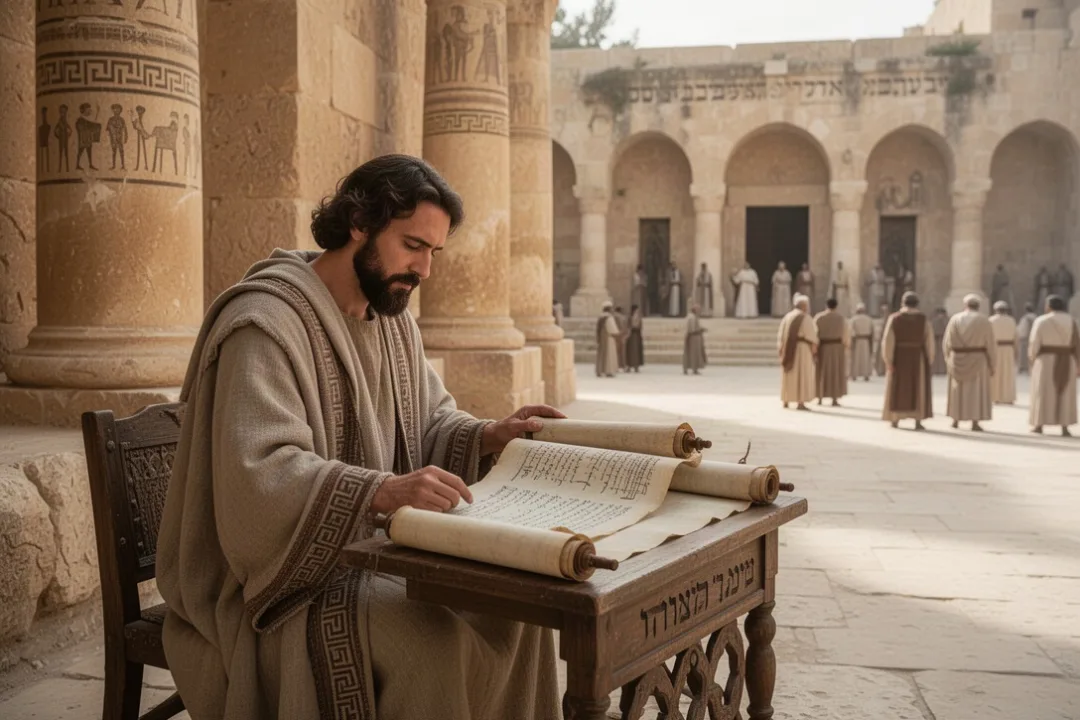
The Jerusalem temple remained the central place for sacrifices and major pilgrimage festivals. Priests served there, and its worship represented the covenant identity of the people. At the same time, local synagogues provided settings for reading Scripture, teaching, prayer, and communal life in towns and Jewish communities throughout the region.
The synagogue was not simply a smaller version of the temple. The two institutions served different functions. Their coexistence allowed Jewish communities to maintain religious identity when they lived far from Jerusalem or could not participate in temple worship regularly.
Scripture shaped education, debate, prayer, and ethical practice. Teachers and communities discussed how commandments should apply to changing circumstances. Questions about Sabbath observance, food, purity, oaths, marriage, almsgiving, and relations with outsiders were not abstract matters; they affected ordinary decisions.
When Jesus teaches in synagogues, debates religious authorities, attends festivals, and speaks about the temple, he is participating in a world formed by these institutions. The New Testament’s conflicts make more sense when read as disputes within a shared Jewish scriptural and religious environment rather than as arguments between people with no common foundation.
Common mistakes when studying the intertestamental period
Calling the period spiritually empty: The lack of a universally accepted new prophetic book does not mean that Jewish prayer, wisdom, scholarship, worship, and hope disappeared.
Using “400 years” as an exact measurement: The dates are approximate, and different traditions define the starting and ending points differently.
Treating all Jewish people as one group: Pharisees, Sadducees, Essenes, apocalyptic communities, diaspora Jews, priests, farmers, artisans, and political factions did not share identical views.
Assuming Hellenization meant immediate abandonment of Judaism: Greek language and customs could be adopted selectively, while Jewish people continued to practice covenant traditions.
Reading later Christian categories back into every earlier source: A Jewish text about a coming deliverer, resurrection, or kingdom may not use those ideas in precisely the same way as the New Testament.
Confusing historical usefulness with canonical status: A writing can illuminate the period without being accepted as Scripture by every Jewish or Christian tradition.
Reducing the Maccabean Revolt to a simple story of good people and bad outsiders: The crisis also involved Jewish disagreements over law, identity, leadership, and cooperation with foreign powers.
Study tip: Read a historical event alongside a biblical passage, a Jewish source from the period, and a map of the region. Comparing setting, audience, and purpose usually produces a clearer picture than relying on one source alone.
How to study the period without losing its historical complexity
Begin with a basic timeline, but do not let dates become the whole subject. Place the major powers in order: Persian rule, Alexander’s conquest, the Ptolemaic and Seleucid kingdoms, the Maccabean revolt, Hasmonean rule, Roman intervention, and Herodian leadership.
Then ask who produced each source and what problem it addresses. A wisdom book may focus on faithful living, while a historical book may defend a family’s leadership. An apocalyptic vision may encourage persecuted people through symbolic promises of judgment. Understanding purpose helps you avoid reading every text as though it were a neutral modern history.
It also helps to separate three questions:
What happened politically? Identify rulers, wars, alliances, taxation, and changes in control.
How did communities respond religiously? Look for arguments about law, purity, worship, priesthood, wisdom, and hope.
How does this illuminate the New Testament? Connect the background to terms, institutions, expectations, and conflicts without assuming that every later teaching was fully formed in exactly the same way.
Maps are particularly valuable because geography shaped politics. Judea sat between major powers and near important trade routes. Galilee, Samaria, Judea, the Decapolis, Egypt, and Syria had different histories and social conditions. Jewish communities in the diaspora also developed far from the temple while remaining connected to Jewish Scripture and tradition.
Why this history matters for reading the New Testament
The New Testament does not begin in a vacuum. Its authors write about a world shaped by the temple, synagogues, Roman administration, Greek language, Jewish Scripture, and debates among Jewish groups. The intertestamental period explains how those features came together.
It also clarifies why the arrival of Jesus is presented as an answer to long-standing hopes rather than as an isolated event. The language of kingdom, redemption, resurrection, Messiah, covenant, wisdom, and Spirit carried centuries of meaning. First-century listeners brought expectations formed by their history, even when Jesus challenged or redirected those expectations.
The period further shows why the New Testament’s message was both local and international. It emerged from Jewish Scripture and the history of Israel, yet it traveled through Greek-speaking cities and Roman roads to communities throughout the Mediterranean world.
Studying the intertestamental period therefore does more than fill a chronological gap. It reveals the political pressures, cultural encounters, religious debates, and enduring hopes that made the first-century setting recognizable. The centuries between the Testaments were not an empty hallway between two rooms; they were formative years in which the world of the New Testament took shape.
Frequently asked questions
When did the intertestamental period take place?
It is commonly dated from about 400 BC, around the era associated with the final Old Testament prophets, to the beginning of the New Testament era. These boundaries are approximate. Some scholars use broader dates connected to the Second Temple period, which began with the temple’s rebuilding after the Babylonian exile and continued until its destruction in AD 70.
Is the intertestamental period mentioned in the Bible?
The Bible does not present the entire period as one continuous historical section. However, some biblical books overlap with its events or reflect its setting. The New Testament assumes knowledge of conditions that developed during these centuries, including Roman rule, Jewish religious groups, synagogue life, Greek language, and expectations about resurrection and the Messiah.
What is the most important event of the intertestamental period?
The Maccabean Revolt is often considered one of the most important turning points because it led to the rededication of the Jerusalem temple and a period of Jewish self-rule under the Hasmoneans. Other major developments include the spread of Hellenistic culture, the rise of Roman authority, and the formation of religious movements active in the first century.
Were the Apocrypha written during the intertestamental period?
Several books commonly called the Apocrypha or Deuterocanon were written during the broader Second Temple era, including works associated with the Maccabean crisis and Jewish wisdom tradition. Christian traditions differ over their canonical status. Even where they are not accepted as Scripture, these writings remain valuable for understanding Jewish thought, history, worship, and hopes before the New Testament.







Leave a Reply