The pool of Siloam: History, Bible meaning, and visiting
The pool of Siloam: History, Bible meaning, and visiting
The pool of Siloam was an ancient water reservoir in Jerusalem, located at the southern end of the City of David. It is best known from John 9, where Jesus told a man born blind to wash there, after which the man returned able to see.
The pool also had a practical role in Jerusalem’s water system and may have served people traveling to the Temple for religious festivals. Archaeological remains show a large stepped pool supplied by water from the Gihon Spring through Hezekiah’s Tunnel. The site can be visited in the area of the City of David, although the exposed remains represent only part of the ancient complex.
The pool of Siloam lies in the southern part of ancient Jerusalem, near the lower end of the City of David. In modern terms, it is below the southeastern ridge of the Old City, close to the neighborhood traditionally associated with Silwan. The site is lower than the Temple Mount, which helped make it a natural destination for water collection and ritual washing.
Ancient Jerusalem developed around a series of ridges and valleys. The City of David occupied a narrow ridge east of the central valley, while the Gihon Spring emerged on its eastern side. Because the spring was outside the city’s most defensible area, Jerusalem’s rulers developed channels and tunnels to bring water into protected locations.
The pool’s name is connected with the Hebrew term Shiloah or Shiloach, which refers to a water channel or sending. The Greek form used in the New Testament is Siloam. Names for the site appear in several forms in English, including Siloam, Siloah, and Shiloah.
Location in one sentence: The pool of Siloam is at the southern end of the ancient City of David, where water from the Gihon Spring was collected in a substantial reservoir.
How Jerusalem’s water system supplied the pool
The pool was connected with the Gihon Spring, Jerusalem’s most dependable natural water source. The spring does not flow in a simple open stream through the city. Instead, ancient builders created channels and tunnels that allowed water to move toward areas where residents and visitors could reach it more safely.
One of the best-known parts of this system is Hezekiah’s Tunnel. According to the biblical account in 2 Kings 20 and 2 Chronicles 32, King Hezekiah prepared Jerusalem’s water supply in anticipation of military danger. The tunnel carried water from the spring toward a pool on the western side of the City of David.
The Bible does not describe every stage of the hydraulic system in modern engineering terms, and the relationship between individual channels and pools developed over time. Archaeology indicates that Jerusalem’s water installations were modified repeatedly. The pool identified today as Siloam belongs to this broader history of managing water in a crowded hill city.
Water management had a direct connection to the city’s survival. During a siege, a spring outside the walls could become a strategic weakness. Bringing water underground or into a protected reservoir helped Jerusalem’s population withstand threats while preserving access to a vital resource.
What archaeology has revealed about the pool
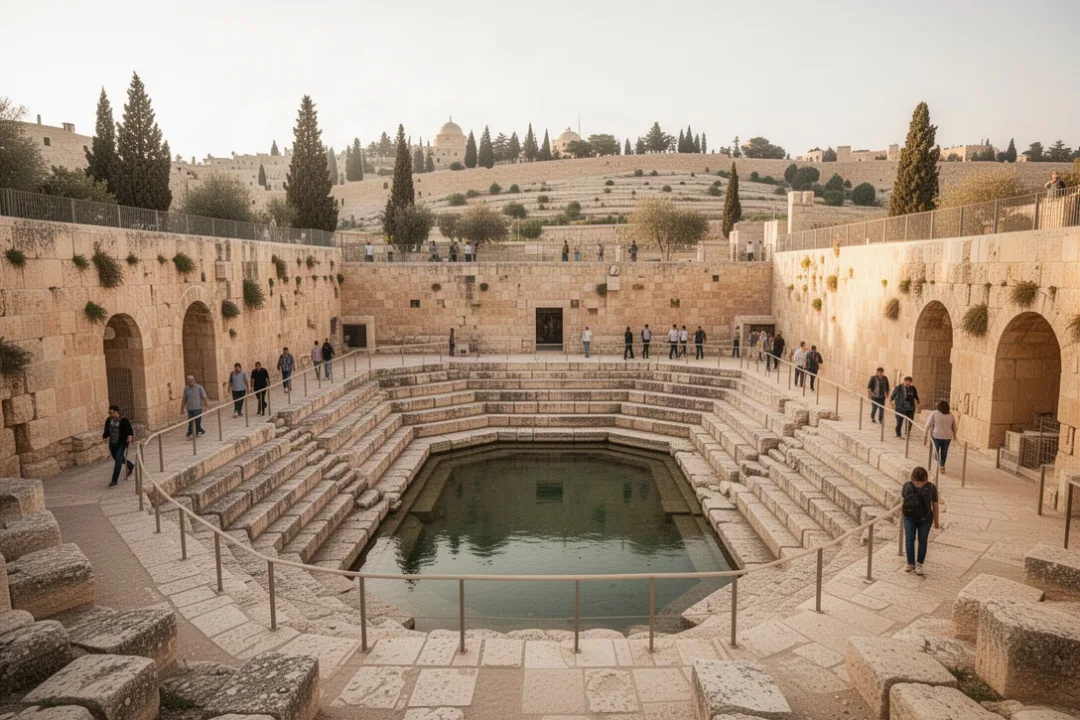
The visible remains indicate that the pool was much larger than the small rectangular structure many visitors imagine. Archaeologists identified a broad reservoir with steps descending into the water. These steps likely allowed people to enter and leave at different water levels, although their exact uses cannot always be established from the surviving stonework alone.
The pool is generally associated with the Second Temple period, when Jerusalem grew into a major religious and political center. The city attracted large numbers of pilgrims, especially during major Jewish festivals. A substantial water installation at the southern approach to the Temple area would have served both ordinary needs and the requirements of visitors.
Excavations connected with the pool became widely known after construction work in 2004 led to the discovery of ancient remains. Archaeologists then investigated the area and identified the stepped pool described in relation to the Gospel of John. The discovery helped distinguish the likely New Testament site from a smaller pool that had traditionally been identified as Siloam.
Archaeological interpretation remains careful rather than absolute. Ancient structures were repaired, expanded, and reused, and the surviving remains do not preserve every detail of the original site. Still, the combination of location, water connections, historical setting, and stepped construction makes the excavated reservoir a strong candidate for the pool mentioned in John 9.
Why the pool mattered during the Second Temple period
Jerusalem’s Temple attracted pilgrims from across Judea and from Jewish communities farther away. People arriving for worship needed water for drinking, washing, and other everyday purposes. Some may also have used pools associated with ritual purification, especially before entering sacred areas or participating in religious observances.
It is reasonable to connect the pool with the religious life of the city, but the evidence should not be overstated. The pool of Siloam is not described in the Bible as a formal mikveh in the same way that some other stepped immersion pools are identified. Its size and design could have supported several functions, including public water use and purification.
The Gospel of John places the pool within a public setting where a person could be sent to wash. That detail fits a large, accessible reservoir rather than a private household installation. The scene also reflects the importance of water in Jerusalem’s religious imagination, where cleansing, healing, pilgrimage, and worship were closely associated.
In the first century, the pool would have stood along an active route through the lower city. Its location near the southern approach to the Temple precincts made it a natural place for travelers and residents to encounter one another. The surrounding urban landscape would have included streets, retaining walls, homes, workshops, and other water facilities.
The pool of Siloam in John 9
John 9 tells of a man who had been blind from birth. Jesus made clay, placed it on the man’s eyes, and instructed him to wash in the pool of Siloam. The man followed the instruction and returned seeing.
The story emphasizes that the healing did not happen through the water as a magical substance. The man received the instruction, went to the pool, washed, and experienced healing. John presents the event as one of Jesus’ signs, meaning that the physical act points beyond itself to questions about faith, identity, spiritual perception, and opposition.
The passage also shows how the healing created conflict. Religious authorities questioned the man and his parents because the healing had taken place on the Sabbath. The man gradually became more direct in defending what had happened to him, while the authorities focused on the alleged violation of Sabbath expectations.
John uses the contrast between physical sight and spiritual blindness throughout the chapter. The man who had been blind comes to recognize Jesus, while people who claim to see remain resistant to what the sign reveals. The pool is therefore both a real place in Jerusalem and a setting within a larger theological argument.
John 9 connects washing at Siloam with a man’s restored sight and uses that event to explore the difference between seeing physically and recognizing truth.
Other biblical references to Siloam
The pool or water channel associated with Siloam appears elsewhere in the Bible. Isaiah 8 refers to the gently flowing waters of Shiloah, contrasting them with stronger and more threatening waters. The passage uses the local water system as an image within a message about trust, judgment, and the consequences of rejecting God’s provision.
In Luke 13, Jesus mentions the collapse of a tower in Siloam that killed eighteen people. He does not say that those victims were worse sinners than other people. Instead, the reference becomes part of a warning that calls listeners to repentance rather than encouraging them to interpret tragedy as a simple measure of personal guilt.
These references show that Siloam was more than a remote biblical name. It was a recognizable location in or near Jerusalem, associated with water, a local disaster, and the city’s religious life. By the time of Jesus, people could identify the place as part of the landscape around the lower city.
What the healing at Siloam means for Christian readers
Christian interpretations of John 9 often focus first on Jesus as the source of healing. The pool is significant because Jesus specifically sent the man there, but the narrative directs attention to Jesus’ authority rather than treating Siloam as an independent source of miraculous power.
The story also highlights obedience in a concrete form. The man did not receive a detailed explanation before acting. He was told to go and wash, and he responded by doing so. John does not present this as a formula that guarantees physical healing for everyone who visits a historic site. It is part of a unique Gospel sign with a particular purpose.
Another major theme is testimony. The healed man repeatedly describes what happened, even when questioned by people with authority. His account becomes clearer as the story continues: he knows that he was blind, he knows that he now sees, and he increasingly understands who Jesus is.
The setting also reinforces the Bible’s use of ordinary physical places. A spring, a tunnel, a pool, and a crowded city all become part of the story. The concrete geography does not replace the spiritual meaning; it gives the narrative a recognizable setting in which the message unfolds.
How the pool differs from other Jerusalem pools
Visitors sometimes confuse the pool of Siloam with other ancient water installations in Jerusalem. The Pool of Bethesda, mentioned in John 5, was located near the Sheep Gate, north of the Temple area. It is a different site from Siloam, which stood south of the Temple and was connected with the City of David.
The upper pool associated with Isaiah 7 and the lower pool mentioned in several biblical passages are also part of Jerusalem’s broader water history. Biblical names for water installations can refer to different periods, locations, or sections of a changing system, so similar-sounding references should not automatically be treated as the same place.
The traditional identification of Siloam was once associated with a smaller pool farther west. Excavations in the City of David produced the larger stepped reservoir that fits the historical and geographical setting of John 9 more convincingly. The identification is widely accepted, though visitors should remember that ancient-site research continues as new evidence is examined.
Practical tips for visiting the pool of Siloam
The pool is part of the City of David archaeological area, where access arrangements can change as excavation, conservation, construction, and public development continue. Check current visitor information before traveling. A tour or guided walk can help you understand the relationship between the pool, the Gihon Spring, Hezekiah’s Tunnel, and the Temple Mount.
Wear supportive shoes: The City of David includes uneven paths, stone surfaces, slopes, and steps.
Allow extra time: The pool makes the most sense when seen alongside the City of David and the ancient water system rather than as an isolated stop.
Check tunnel conditions: Hezekiah’s Tunnel involves darkness, confined passages, and water in some sections; it may require a separate ticket or reservation.
Bring water and sun protection: Jerusalem’s heat and exposed archaeological areas can make walking tiring, especially in warmer months.
Follow site rules: Barriers and restricted areas protect fragile remains and may change as work progresses.
Plan around religious observance: Nearby areas have significant religious importance, and opening hours or access may vary on Jewish holidays and the Sabbath.
Best preparation: Confirm opening hours, ticket requirements, accessibility information, and any route changes with the official City of David visitor information before you go.
Common mistakes when researching or visiting Siloam
Several misunderstandings can make the site harder to interpret. The most common involve treating a biblical reference as though it describes a single unchanged structure, or assuming that a modern visitor can see the entire ancient pool.
Expecting a complete pool: Excavation exposes portions of the ancient structure, not necessarily every original wall, edge, or channel.
Calling the water miraculous: John 9 describes a healing connected with Jesus’ instruction; it does not teach that the pool itself has magical healing power.
Confusing Siloam with Bethesda: The two pools appear in different Gospel stories and were in different parts of Jerusalem.
Assuming every stepped pool had one purpose: Steps could support access to changing water levels, and religious use should be discussed with appropriate caution.
Ignoring the historical setting: The pool was part of a water system and a busy urban area, not merely a symbolic location detached from daily life.
Relying on old travel information: Archaeological sites can change because of preservation work, development, security requirements, or new visitor routes.
How to understand the pool’s name and history
The name Siloam comes to English through the Greek New Testament, while the Hebrew forms Shiloah or Shiloach are connected with the same place or water system. The meaning is commonly related to sending or being sent, an idea that suits water moving through a channel from its source into a reservoir.
Names in ancient Jerusalem can be complicated because places changed over time and different languages used different forms. A biblical writer may use a name familiar to readers, while archaeological reports describe a structure by its location, period, or architectural features. Comparing these forms helps explain why the pool may appear under more than one spelling.
The site’s history extends beyond the event in John 9. Its water installations reflect centuries of construction and repair, while its location near the City of David places it within the earliest settled core of Jerusalem. The pool therefore offers evidence for both biblical geography and the practical engineering required to sustain an ancient city.
Why the pool remains significant today
The pool of Siloam matters because several kinds of evidence meet in one place. The Bible names the location, archaeology reveals a substantial ancient reservoir, and Jerusalem’s water system explains why the site was important to residents and pilgrims. Each perspective adds detail without eliminating the others.
For readers of the New Testament, the location gives John 9 a physical setting. The man born blind was not sent to an imaginary or purely symbolic place. He was directed to a real pool in the lower city, one connected to the water infrastructure of first-century Jerusalem.
For students of ancient history, the site shows how religious centers depended on engineering, public access, and careful management of scarce resources. For visitors, the surviving steps and surrounding remains offer a tangible connection to a landscape described in biblical texts.
The most responsible way to view Siloam is as both an archaeological site and a place shaped by religious memory. Its meaning comes from the interaction of water, city life, pilgrimage, healing, and faith—with each theme grounded in a specific location at the southern edge of ancient Jerusalem.
Frequently asked questions
Is the pool of Siloam still filled with water?
The excavated remains are not generally experienced as a functioning public swimming pool or as the fully preserved ancient reservoir. Water conditions and access can vary with conservation and site management. Visitors should not enter protected areas or assume that the present appearance reproduces the first-century pool described in John 9.
Can you visit the pool of Siloam today?
The pool is located within the City of David archaeological area, where public access, routes, hours, and ticket arrangements may change. Check current information before visiting. A guided tour can be especially helpful because nearby tunnels, channels, and excavated features explain how the pool fit into Jerusalem’s ancient water system.
Did Jesus heal the blind man with the water from Siloam?
John 9 presents Jesus as the one who performed the healing and instructed the man to wash at Siloam. The passage does not describe the pool as an independent healing source. Its role is part of the sign’s setting and action, while the Gospel’s larger message concerns Jesus’ identity and the contrast between physical and spiritual sight.
Is the pool of Siloam the same as the Pool of Bethesda?
No. They are separate Jerusalem sites associated with different Gospel accounts. Siloam was south of the Temple near the City of David and appears in John 9. Bethesda was north of the Temple area and appears in John 5, where Jesus healed a man who had been ill for many years.





Leave a Reply