Pool of Bethesda: Bible story, history, and meaning
Pool of Bethesda: Bible story, history, and meaning
The Pool of Bethesda was a large water complex in Jerusalem associated with healing and with the account of Jesus healing a disabled man in John 5:1–18. John describes it as having five covered colonnades, where sick people gathered, and identifies it as being near the Sheep Gate.
Most historians and archaeologists connect Bethesda with the remains of two adjacent pools beside the Church of Saint Anne in Jerusalem’s Old City. The Gospel story is set in a real Jerusalem location, but several details—especially the claim that an angel stirred the water—require careful attention because they are absent from some early copies of John.
The name Bethesda is commonly understood as meaning something like “house of mercy” or “house of graciousness,” although scholars discuss the precise form and meaning of the underlying name. In John’s Gospel, the pool is not presented merely as a decorative landmark. It is a place where people with serious illnesses and disabilities waited for the possibility of recovery.
John places the pool in Jerusalem near the Sheep Gate. The Sheep Gate was likely associated with the movement of animals toward the Temple area, making the location significant for readers familiar with the city. The pool’s proximity to the Temple also places the healing story within the religious and public life of Jerusalem rather than in an isolated countryside setting.
The site had five porticoes, or covered walkways supported by columns. These sheltered spaces could have provided shade and protection for people waiting beside the water. John specifically mentions the architectural feature because it would have helped readers recognize the location and because the five-sided arrangement seems unusual.
John lists people who were blind, lame, and paralyzed among those gathered there. The account does not suggest that they were all participating in a formal religious ritual. Instead, they were vulnerable people hoping for healing in a setting that had acquired a reputation for supernatural intervention.
Location in one sentence: Bethesda was a Jerusalem water complex near the Sheep Gate, probably the two-pool site identified beside Saint Anne’s Church in the Old City.
The passage begins by saying that Jesus went up to Jerusalem for a Jewish festival, but it does not name the festival. That omission has led to discussion about the chronology of Jesus’ ministry. The central point of the scene, however, is not identifying the feast. It is the encounter between Jesus and a man whose long illness had left him dependent on hope, other people, and an unpredictable healing tradition.
What happened when Jesus healed the man
The man at Bethesda had been disabled for thirty-eight years. John does not necessarily mean that he had spent every one of those years beside the pool, but the number emphasizes the extraordinary length of his suffering. He had lived with a condition that had shaped nearly his entire adult life.
Jesus saw him lying there and learned that he had been in this condition for a long time. Jesus then asked whether he wanted to be made well. The question can sound obvious, but it brings the man’s desire, discouragement, and helplessness into the conversation rather than treating him as an anonymous member of the crowd.
The man replied that he had no one to put him into the pool when the water was disturbed. Before he could reach it, someone else went down ahead of him. His response describes social isolation as much as physical disability: he lacked the assistance needed to compete for the healing opportunity.
Jesus told him to rise, pick up his mat, and walk. The man was healed immediately, took up his mat, and began walking. John gives the action a clear shape: Jesus does not direct the man through a long ceremony, prescribe a treatment, or ask him to prove his faith through repeated effort. The healing comes through Jesus’ authoritative word.
The mat matters because it was the ordinary object on which the man had rested. Carrying it publicly showed that his situation had changed. The same object associated with dependence and immobility became visible evidence that he could now move through the city on his own.
John then shifts attention from the healing to the Sabbath controversy. Some Jewish leaders objected that the man was carrying his mat on the Sabbath, which they regarded as unlawful work. Their concern reflects Jewish debates about how the Sabbath command should be applied, especially when a person performed an action that could be classified as carrying.
The man explained that the person who healed him had told him to carry the mat. Later, Jesus found him in the Temple and told him to stop sinning, using language that has prompted several interpretations. The statement does not require readers to assume that the man’s illness had been caused by a particular personal sin. Rather, it adds a moral and spiritual dimension to the physical restoration.
The leaders became more hostile because Jesus had healed on the Sabbath and referred to God as his Father, presenting himself as uniquely related to God. John uses the incident to move from a healing miracle toward a major claim about Jesus’ authority, divine activity, judgment, and life-giving power.
Why some Bibles handle the stirred-water passage differently
Many readers know a version of John 5:3–4 that says an angel went down at a certain time to stir the water. The first person to enter after the disturbance would then be healed. In some Bible editions, these words appear in the main text; in others, they are placed in a footnote or marked with brackets.
The reason is textual evidence. The explanation about the angel is missing from several early and important Greek manuscripts and appears to have been added by a later copyist or incorporated into the textual tradition at some stage. It may preserve an early explanation of the popular belief surrounding the pool, but scholars do not generally treat it as equally secure with the surrounding account.
The wording in the best-known form can also make the story seem unfair: many sick people wait beside the water, but only the first person to reach it receives healing. That detail fits the man’s complaint that he had no one to help him, yet the textual question means readers should distinguish between the secure core of the story and the later explanatory wording.
In the Greek text of John, the narrative moves naturally from the description of the sick people to Jesus’ question. Some translations therefore omit the angel sentence from the main reading. Others retain it while signaling that ancient manuscripts differ. Neither approach changes the main action: Jesus heals a man who has been unable to reach the water and then confronts the religious implications of that healing.
The phrase “when the water was stirred” may reflect a real observation about the pool. Water could move because of springs, channels, overflow, or other physical causes. A traditional explanation may have connected that movement with divine activity. The text’s later transmission shows how readers and copyists sometimes supplied background information to clarify a difficult or unfamiliar scene.
Readers can therefore avoid two opposite mistakes. They do not need to dismiss the entire story because one verse has a complicated manuscript history, and they do not need to ignore the manuscript evidence in order to defend every wording found in every translation.
Where archaeologists identify Bethesda in Jerusalem
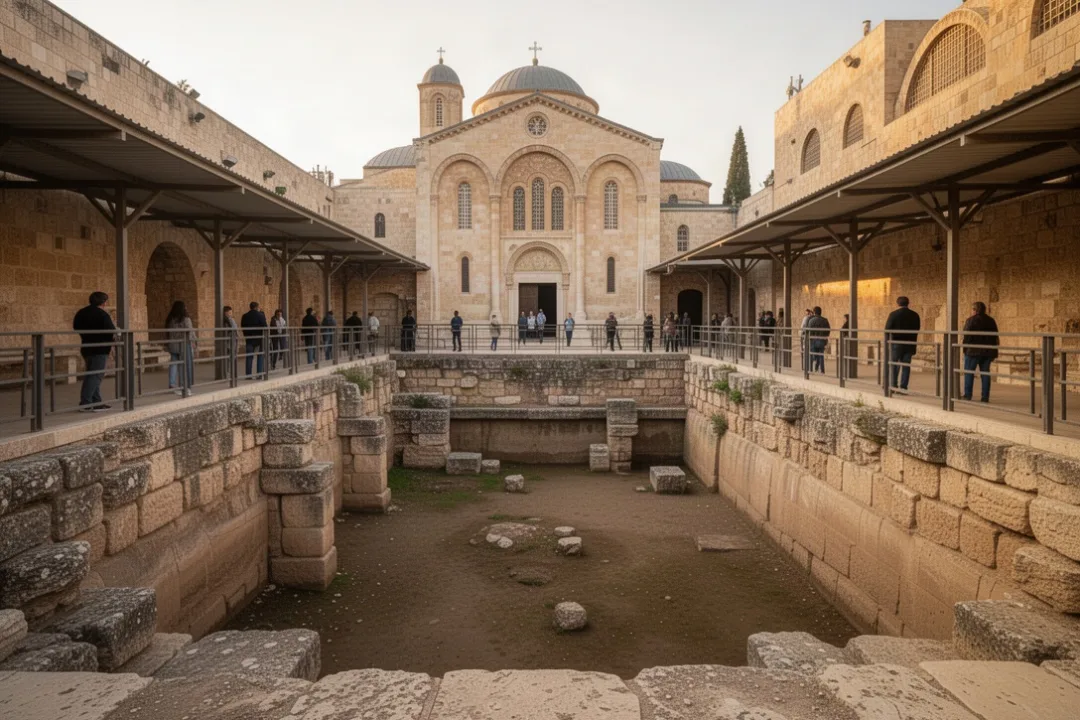
The traditional location of Bethesda lies in the northeastern part of Jerusalem’s Old City, near the Church of Saint Anne. Excavations there revealed a substantial water installation consisting of two pools separated by a central divider or partition. The remains include evidence of surrounding structures and covered walkways that can be compared with John’s reference to five porticoes.
The two-pool arrangement helps explain why the Gospel’s description is archaeologically plausible. A central partition, together with the sides of the pools, could create a five-sided or five-porch configuration. The porticoes may have been built along the perimeter or around the connected sections of the complex.
The pools were not necessarily designed as a healing shrine. Their original or primary function may have been related to water storage and supply for the city. Jerusalem needed dependable water systems, especially in a region where rainfall is seasonal and the city’s population and Temple activity created substantial demand.
Over time, a practical water installation could acquire religious associations. People may have attributed healing power to a pool because of unusual water movement, local traditions, or experiences that were interpreted as miraculous. A site could therefore serve both an engineering purpose and a place of popular devotion without those roles being mutually exclusive.
Archaeology cannot prove that a particular individual was healed there, nor can excavation independently verify every detail in John’s account. It can, however, test whether the named location fits the physical and historical setting. In this case, the discovery of a large two-pool complex with surrounding walkways supports the Gospel’s knowledge of Jerusalem’s topography.
The site has also been shaped by later religious construction. The Church of Saint Anne stands near the pools and preserves the area as a place of Christian pilgrimage. Visitors today see exposed remains, excavated walls, uneven stone surfaces, and later structures layered over an ancient urban environment.
Several places in and around Jerusalem have been proposed at different times, partly because the spelling of the name varies in ancient sources. Forms such as Bethesda, Bethzatha, and Bethsaida appear in discussions of the passage or its transmission. These variations reflect differences in manuscript traditions, pronunciation, and the way ancient names were copied into Greek.
Bethesda: the form most familiar from many English Bibles and Christian tradition.
Bethzatha: a form found in some ancient textual traditions and scholarly discussions.
Two-pool complex: the archaeological feature that best matches the named Jerusalem site near Saint Anne’s.
The evidence should be stated with appropriate care. The location near Saint Anne’s is widely accepted as the strongest identification, but the exact layout of the five porticoes and the pool’s precise use during the first century remain subjects of historical reconstruction rather than direct certainty.
What the healing reveals about Jesus in John’s Gospel
John’s account does more than report an impressive cure. The healing is a sign, meaning an event that points beyond itself to Jesus’ identity and mission. The man receives physical restoration, but the surrounding dialogue directs attention to Jesus’ authority to give life and to act in harmony with God.
The Sabbath setting is essential. Jesus does not heal in a way designed to avoid attention; the act becomes visible on a day when disputes about work and obedience were especially sensitive. John presents Jesus as challenging a narrow understanding of Sabbath observance while also claiming that God’s life-giving work does not stop.
The account should not be used to portray all Jewish leaders or Judaism as hostile to compassion. Jesus, the healed man, and the festival crowd belong within Jewish religious life. The conflict concerns particular interpretations of the Sabbath and Jesus’ authority, not a simple opposition between Judaism and kindness.
The man himself is not depicted as a model of confident faith before the healing. He does not ask Jesus directly for a miracle, and his first response focuses on the practical barrier that has kept him from the water. John’s emphasis is that Jesus takes the initiative and acts with authority toward someone who cannot solve his own problem.
At the same time, the command to take up the mat makes the man an active participant after the healing. He must respond to Jesus’ word and publicly live as someone whose former condition no longer defines his movement. The story joins divine initiative with human response without reducing healing to a formula.
“Get up, pick up your mat, and walk” is best understood as a paraphrase of Jesus’ command in John 5:8, not as a quotation from a specific English Bible translation.
The later meeting in the Temple prevents the story from ending with physical recovery alone. Jesus’ warning about sin and the man’s return to the authorities raise questions about the kind of life that should follow restoration. John does not give a detailed account of the man’s inner thoughts, so interpretations should avoid claiming more than the passage says.
The story also contrasts two kinds of attention. Jesus sees the suffering man and understands how long he has been waiting. The authorities see a violation involving a mat. John is not necessarily saying that rules have no value; he is showing how concern for a regulation can become detached from the mercy that the healing reveals.
How to read the Pool of Bethesda story responsibly today
The account speaks to people who have waited a long time for change and have felt excluded from the help available to others. The man’s statement that he has no one to assist him is one of the most human details in the passage. It expresses not merely illness, but barriers, dependence, and loneliness.
That message should not be turned into a promise that every illness will be cured immediately if a person has enough faith. John 5 does not provide a universal timetable for physical healing, and Christian interpretation should not blame sick or disabled people when recovery does not occur.
The story also should not encourage people to abandon medical care or practical support. Its religious meaning concerns Jesus’ authority and the man’s restoration; it is not a medical instruction. People dealing with illness deserve competent treatment, accessibility, companionship, and honest care.
For readers studying the passage, several questions help preserve its historical and literary depth:
What does the setting contribute? The pool is a real urban location associated with water, waiting, and healing hopes.
What changes for the man? He moves from prolonged dependence to public action, carrying the object connected with his former condition.
Why is the Sabbath central? The healing becomes a dispute about Jesus’ authority and the meaning of God’s work.
What does the manuscript evidence require? The angel-and-stirred-water explanation should be read with awareness that it is absent from some early witnesses.
What does the story leave unresolved? John gives limited information about the man’s background, faith, and later life.
The passage is especially useful for understanding how the Gospel of John combines place, action, and dialogue. A recognizable Jerusalem landmark grounds the narrative. A brief command changes the man’s physical situation. The resulting dispute opens into a larger discussion of life, judgment, and the relationship between Jesus and the Father.
The Pool of Bethesda therefore matters on several levels at once. It was a plausible water complex in ancient Jerusalem, a place remembered for healing expectations, the setting of one of Jesus’ most striking miracles, and the stage for a dispute over Sabbath practice. Reading all of those dimensions together gives a fuller picture than treating Bethesda as either only an archaeological site or only a symbolic story.
Frequently asked questions
Is the Pool of Bethesda still visible today?
Yes. The ruins traditionally identified as Bethesda are located near the Church of Saint Anne in Jerusalem’s Old City. Visitors can see remains of the two pools, surrounding walls, and excavated structures. The site is not preserved in its ancient complete form, but its archaeological remains provide a sense of the water complex described in John.
Did an angel really stir the water at Bethesda?
John 5 includes that explanation in some later manuscript traditions, but the sentence is absent from several early Greek manuscripts. Many modern translations place it in a footnote or bracket it. The passage’s central event remains Jesus healing the man who could not reach the pool, regardless of how the textual variant is handled.
Why did Jesus heal on the Sabbath?
The Sabbath healing demonstrates that Jesus’ life-giving work cannot be separated from his authority. It also triggered a dispute because carrying the mat was viewed by some leaders as prohibited work. John uses the conflict to present Jesus’ understanding of the Sabbath and his unique relationship with God.
What does the man’s thirty-eight years of illness mean?
The number emphasizes the extraordinary duration of his suffering and the depth of his dependence. John does not explain the medical cause or say that personal sin caused the illness. The detail helps readers recognize how completely the command to stand, carry the mat, and walk changes his daily life.







Leave a Reply