Solomon in the Bible was the son of King David and Bathsheba, and he ruled Israel after David. He is best known for asking God for an understanding heart, building the temple in Jerusalem, and becoming famous for extraordinary wisdom and wealth.
His story is also a warning. Solomon began his reign with humility and devotion, but his many political marriages eventually drew him toward foreign gods. His life combines remarkable achievement with serious spiritual failure, making him one of the Bible’s most complex kings.
Solomon’s family background was shaped by both promise and pain. He was born to David and Bathsheba after David’s earlier sin involving Bathsheba and her husband, Uriah. The biblical account presents Solomon’s birth within a troubled household, yet it also says that the Lord loved the child and that he was given the name Jedidiah, meaning “beloved of the Lord” (2 Samuel 12:24-25).
Solomon was not David’s oldest son, so his path to the throne was contested. Near the end of David’s life, Adonijah, another son, attempted to establish himself as king. Bathsheba and the prophet Nathan reminded David of his earlier commitment that Solomon would succeed him, and David ordered Solomon to be publicly anointed as king (1 Kings 1).
After David died, Solomon consolidated his rule. The early chapters of 1 Kings describe difficult actions against political rivals, including Adonijah and others who threatened the stability of the kingdom. These events show that Solomon’s reign did not begin in a peaceful, uncomplicated way; he inherited a royal house marked by conflict and competing claims.
A useful distinction: Solomon’s wisdom did not mean he always made morally right choices. In the biblical account, he could show extraordinary discernment in one situation and still make destructive decisions later.
What Solomon asked God for at Gibeon
One of the defining moments in Solomon’s life occurred at Gibeon. According to 1 Kings 3, God appeared to him in a dream and invited him to ask for what he wanted. Solomon did not request a long life, military victory, or personal riches. Instead, he asked for wisdom to govern God’s people and to distinguish right from wrong.
Solomon’s request reflected humility. He recognized that ruling Israel was a responsibility beyond his own experience and ability. The Hebrew idea often translated as an understanding heart points to the ability to listen, discern, and judge faithfully, not merely to possess a high intellect.
God’s response included wisdom as well as riches and honor. The same passage says Solomon would receive a long life if he walked in obedience. That condition matters because the narrative does not treat wisdom as an automatic guarantee of faithfulness. A gift from God still had to be used under God’s authority.
The account of the two women and one baby illustrates Solomon’s reputation. Both women claimed the living child, and no independent evidence could settle the dispute. Solomon proposed dividing the child, knowing that the true mother would give up her claim to save the baby. His judgment exposed her compassion and revealed the child’s identity (1 Kings 3:16-28).
This story is not praising cruelty or recommending a literal threat as a normal judicial method. It shows Solomon recognizing the emotional truth of a case when ordinary testimony was unavailable. The people were impressed because they saw that God-given wisdom was operating through the king’s judgment.
How Solomon built the temple in Jerusalem
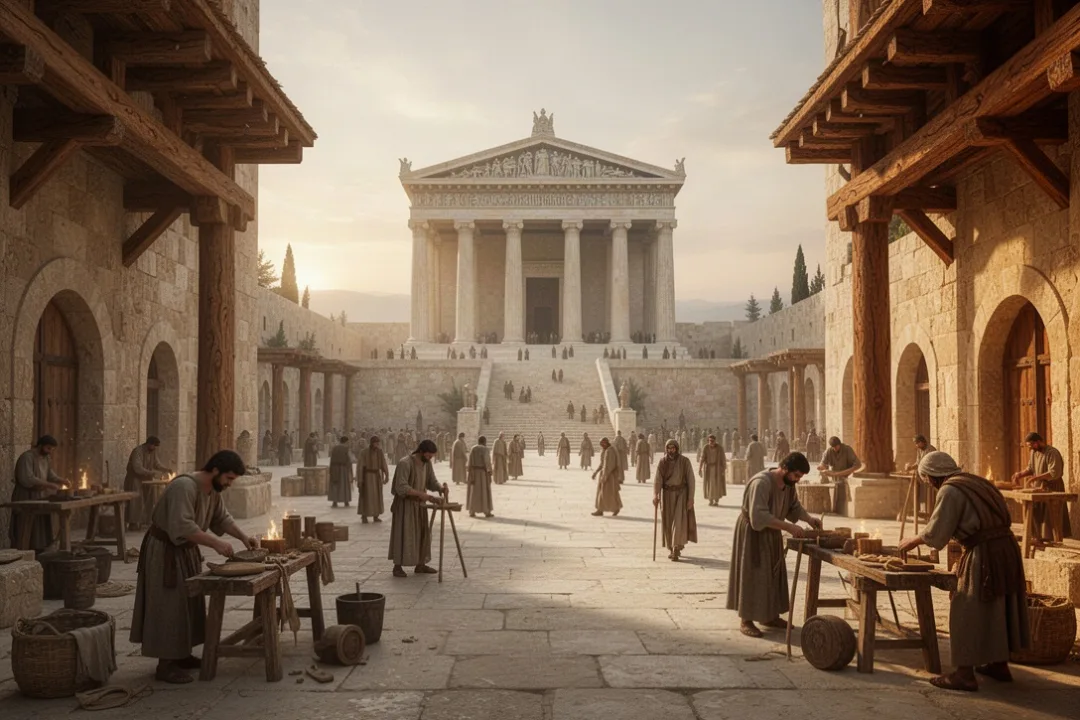
Solomon’s greatest national project was the construction of the temple in Jerusalem. David had wanted to build a permanent house for the Lord, but the biblical account says David was not the one who would complete it. Solomon carried out the project during his reign, using plans, resources, and preparations associated with his father.
The temple became the central place of Israel’s worship. It housed the ark of the covenant in the Most Holy Place and represented God’s presence among the people. The building itself was magnificent, with carefully crafted woodwork, gold, bronze, priestly furnishings, and arrangements for sacrifice and prayer, as described in 1 Kings 5–8 and 2 Chronicles 2–7.
Solomon relied on cooperation with Hiram, king of Tyre, whose kingdom supplied cedar and skilled workers. The construction also required organized labor and extensive materials from across the region. The biblical text presents the project as an achievement, but it also gives enough information to show that such grandeur came with a heavy cost in labor and administration.
At the temple’s dedication, Solomon prayed for God to hear the people when they turned toward this place in repentance, prayer, crisis, or exile. His prayer in 1 Kings 8 does not suggest that God could be confined inside a building. Instead, Solomon acknowledges that the heavens cannot contain God and asks God to honor prayers directed toward the temple.
The dedication also connected worship with justice and covenant faithfulness. Solomon asked God to distinguish between the righteous and the guilty, forgive people who turned back from wrongdoing, and respond to the needs of foreigners who sought the Lord. The temple was therefore more than a royal monument; it was intended to serve as a place of prayer, forgiveness, and covenant relationship.
Solomon’s temple was meant to direct Israel toward God, not to replace obedience to God.
What Solomon’s wisdom looked like in daily life
The Bible describes Solomon’s wisdom as broad and practical. He spoke about plants, animals, birds, reptiles, and fish, and his reputation attracted visitors from other nations. First Kings 4 portrays him as a ruler whose insight exceeded that of other celebrated wise figures of the ancient world.
His wisdom also appeared in proverbs and songs. The biblical tradition connects Solomon with a large collection of sayings and compositions. These references help explain why his name became associated with wisdom literature, even though not every work connected with him necessarily came directly from his own hand.
The Queen of Sheba came to test Solomon with difficult questions and observed the order of his court, the quality of his service, and the temple worship associated with his kingdom. After hearing his answers, she praised the God who had placed him on Israel’s throne (1 Kings 10; 2 Chronicles 9).
Her visit illustrates how Solomon’s wisdom functioned as a form of international influence. Israel’s reputation was not based only on military strength. The kingdom also attracted attention because of its administration, wealth, worship, and the king’s ability to answer challenging questions.
Still, biblical wisdom is more than impressive knowledge. In books such as Proverbs, wisdom begins with reverence for the Lord and expresses itself through honesty, self-control, teachability, justice, and care for the vulnerable. Solomon’s own life shows why wisdom must be practiced consistently rather than admired as a personal quality.
What wealth and power brought to Solomon’s kingdom
Solomon’s reign is portrayed as a period of prosperity and international importance. Israel benefited from trade, tribute, strategic alliances, and organized administration. The biblical descriptions emphasize abundant food, impressive royal buildings, large numbers of officials, and gold and other valuable goods flowing into Jerusalem.
He also developed military and commercial infrastructure. The text mentions fortified cities, storage centers, chariot cities, and strategic locations. Solomon’s control of trade routes helped strengthen the kingdom’s economy and expanded his influence beyond Israel’s immediate territory.
His marriages were also connected to diplomacy. Solomon married women from surrounding nations, including the daughter of Pharaoh, and these relationships helped create political alliances. In the ancient Near East, royal marriages often served international policy, but the Bible evaluates Solomon’s alliances by a deeper standard: they eventually affected his worship and loyalty to the Lord.
Great public achievements can hide burdens carried by ordinary people. Solomon organized forced labor and taxation to support his projects and court. First Kings 5 and 12 indicate that the kingdom’s building program placed substantial demands on the population. When Solomon died, the people asked his son Rehoboam to reduce the heavy yoke associated with his reign.
This tension helps explain the later division of the kingdom. Solomon’s administration produced grandeur, but it also created resentment. A ruler can increase national wealth while making daily life harder for many citizens. The biblical narrative does not ask readers to measure leadership only by monuments, prestige, or economic success.
Why Solomon’s foreign marriages led him away from God
Solomon’s central failure was not simply that he married foreign women. The deeper problem was that he allowed these relationships to reshape his worship. First Kings 11 says his wives turned his heart toward other gods, and Solomon built high places for deities associated with surrounding peoples.
This decline is especially striking because Solomon had dedicated the temple to the Lord. He knew Israel’s covenant obligations, had received unusual wisdom, and had experienced God’s favor. Yet his heart became divided. The biblical phrase does not describe a momentary mistake; it describes a gradual movement away from exclusive devotion.
Solomon honored Ashtoreth and Molek, among other deities named in the account. The text condemns these practices because they violated Israel’s worship and, in the case of Molek, were associated with abhorrent rites. Solomon’s royal authority gave his compromise public influence, making his personal choices a national danger.
First Kings 11 says that the Lord became angry with Solomon and announced consequences for the kingdom. The judgment would not fully occur during Solomon’s lifetime for David’s sake, but the kingdom would be torn from his son. This does not erase the seriousness of Solomon’s sin; it shows the biblical theme that God’s promises and judgments operate together.
Read the warning carefully: Solomon did not abandon wisdom because he lacked information. He drifted because his loyalties became divided. Knowing what is right and continuing to do it are related, but they are not the same thing.
How Solomon’s decisions prepared the kingdom’s division
As Solomon’s reign continued, opposition grew. First Kings 11 names Hadad the Edomite and Rezon of Damascus as adversaries, while Jeroboam, an Israelite official, became the most significant internal challenger. The prophet Ahijah told Jeroboam that God would give him authority over much of Israel because of Solomon’s unfaithfulness.
The division did not happen immediately after Solomon’s death because of a single isolated event. It developed from several pressures: religious compromise, forced labor, taxation, royal centralization, and unresolved tribal tensions. When Rehoboam succeeded Solomon, the people asked him to lighten the burdens they had carried.
Rehoboam rejected the older advisers’ counsel and followed the advice of younger men who urged him to rule more harshly. His response triggered the revolt of the northern tribes. The result was a divided monarchy: the northern kingdom retained the name Israel, while the southern kingdom became Judah, with Jerusalem as its capital.
Solomon’s legacy therefore includes both the temple in Jerusalem and the political fracture that followed his death. His accomplishments strengthened Israel’s central institutions, but his policies also created conditions that his successor handled badly and that the nation could not easily repair.
What the Bible says about Solomon’s death and legacy
Solomon reigned for forty years, according to 1 Kings 11:42. After his death, his son Rehoboam became king. The biblical account does not give Solomon a dramatic final speech or a clear scene of repentance. It closes his reign by emphasizing both his accomplishments and the divine judgment connected with his divided heart.
His legacy continued through several bodies of biblical literature. Proverbs 1:1 identifies Solomon as a major source or royal association for the sayings collected there. Ecclesiastes 1:1 speaks of “the Teacher” as a son of David who ruled in Jerusalem, and the book has traditionally been associated with Solomon, though its final form and authorship are discussed by biblical scholars.
Song of Songs 1:1 associates the work with Solomon. Traditional interpretation has linked the book to him, but readers should distinguish between a work’s association with Solomon and a claim that every line was personally written by him. Biblical books can preserve wisdom within a wider tradition of composition, editing, and use.
Solomon’s story should not be reduced to either “the wise king” or “the sinful king.” Both descriptions are true but incomplete. He was wise enough to recognize his need for discernment, capable enough to build a central sanctuary, powerful enough to shape international politics, and vulnerable enough to let success and divided loyalty damage the nation.
How to read Solomon’s story without common mistakes
Readers often focus on one attractive part of Solomon’s life and overlook the tensions in the full account. These practical guidelines help keep his story balanced:
Do not treat wealth as proof of God’s approval. Solomon’s prosperity came with exploitation, political pressures, and later judgment.
Do not confuse wisdom with perfection. Solomon made brilliant judgments while also making choices that violated covenant faithfulness.
Do not read the temple as a magic object. Solomon’s dedication prayer stresses that God hears and judges; the building itself cannot protect people who persist in rebellion.
Do not ignore the workers and taxpayers. Royal splendor looked different to the population carrying the labor and financial burden.
Do not treat political alliances as spiritually neutral. The narrative evaluates Solomon’s marriages by their effect on worship and loyalty.
Do not use Solomon to justify cynicism about wisdom. His failure shows the need for faithful obedience, not the uselessness of discernment.
A careful reading also compares the parallel accounts in 1 Kings and 2 Chronicles. Both describe Solomon’s temple, wisdom, wealth, and reign, but they emphasize different aspects. First Kings gives a sustained account of the political and spiritual decline, while Chronicles highlights temple worship, priestly service, and the Davidic line.
The best approach is to read each passage in its own setting before combining the themes. Ask what the text praises, what it criticizes, who carries the cost, and how the event affects Israel’s covenant with God. That method prevents Solomon’s story from becoming a simple success story or a simple morality tale.
What Solomon teaches about wisdom, leadership, and faithfulness
Solomon’s request at Gibeon presents a strong model for leaders: ask for the ability to listen, judge fairly, and serve people well. Wisdom is especially valuable when decisions involve competing claims, limited information, and serious consequences. It seeks truth rather than merely protecting power.
His temple prayer teaches that public worship must remain connected to repentance and justice. Buildings, ceremonies, and national identity cannot substitute for turning back to God. Solomon understood this in his prayer, even though his later conduct contradicted the standard he had articulated.
His decline also shows how compromise usually develops. The text does not portray Solomon as suddenly rejecting everything he once believed. Instead, his many relationships, political calculations, and tolerance of foreign worship gradually divided his heart. Small accommodations can become established loyalties when a person has enough power to avoid immediate consequences.
Leadership magnifies private decisions. Solomon’s worship choices did not remain private because the king built public shrines and influenced the nation. His administrative policies also affected generations after him. The story asks you to consider not only what a decision does to your own character but also what it teaches and permits in the people who depend on you.
Finally, Solomon’s life places limits on human achievement. Wisdom, wealth, influence, beautiful buildings, and international respect could not preserve the kingdom when loyalty to God weakened. The biblical message is not that achievement is worthless. It is that achievement without faithfulness cannot serve as a substitute for character.
Frequently asked questions
Was Solomon the wisest person in the Bible?
Solomon is presented as exceptionally wise, and the Bible says his wisdom surpassed that of other renowned figures of his time. However, Scripture does not describe him as morally flawless or as possessing unlimited knowledge. His wisdom was a gift for governing and discerning judgment, and his later religious compromise shows that intelligence and practical insight do not automatically produce obedience.
Did Solomon write all of Proverbs, Ecclesiastes, and Song of Songs?
No single answer fits all three books. Solomon is directly associated with portions of Proverbs and with the traditional identity behind Ecclesiastes and Song of Songs. Biblical books can contain material collected, shaped, or preserved by later communities. It is more precise to say that Solomon is a major traditional source or figure connected with these wisdom writings.
Why did God allow Solomon to have so many wives?
The narrative reports Solomon’s marriages but does not present them as an ideal to imitate. His foreign alliances became spiritually destructive because they led him toward other gods. Israel’s law warned against relationships that would turn the people from the Lord. Solomon’s experience shows that political advantage cannot justify divided worship or disobedience.
What happened to Solomon’s kingdom after he died?
Solomon’s son Rehoboam inherited the throne, but he refused to reduce the heavy burdens associated with his father’s rule. Most of the northern tribes then rebelled and followed Jeroboam. The kingdom divided into northern Israel and southern Judah. Jerusalem and the Davidic line remained in Judah, while the northern kingdom developed its own political and religious centers.








Leave a Reply