King Saul story summary: His rise, failures, and death
King Saul story summary: His rise, failures, and death
King Saul’s story begins when Israel asks for a king and God directs the prophet Samuel to anoint Saul, a tall Benjamite from an influential family. Saul initially appears humble and capable, leading Israel to victory over its enemies. His reign later unravels through repeated disobedience, jealousy toward David, and spiritual isolation, ending with his death in battle against the Philistines.
The main account appears in 1 Samuel 8–31, with the aftermath described in 2 Samuel 1. Saul’s story is both a political history of Israel’s early monarchy and a study of how fear, impatience, pride, and unrepented choices can damage a person’s leadership.
Before Saul became king, Israel was governed by judges, including Samuel. The nation faced repeated attacks from neighboring peoples, especially the Philistines, and its tribes wanted a central ruler who could organize the army and provide stable leadership.
Israel’s request for a king was complicated. The people wanted to be like the surrounding nations, but they also wanted protection and unity. God allowed the request while warning through Samuel that a king could take their sons for military service, claim their land and produce, and place heavy demands on the nation, as described in 1 Samuel 8.
Saul came from the tribe of Benjamin, a small tribe that had suffered severe losses during Israel’s earlier internal conflicts. His background made him a surprising but symbolically fitting choice. He was physically impressive, yet the narrative gradually shows that appearance and ability are not enough to sustain faithful leadership.
King Saul’s story in seven main stages
Saul is chosen and anointed. He meets Samuel while searching for his father’s lost donkeys and is privately anointed as Israel’s future king.
Saul is publicly confirmed. Israel selects him by lot at Mizpah, and he later proves himself by rescuing Jabesh-gilead from the Ammonites.
Saul leads Israel against the Philistines. His early military success makes him a respected commander and strengthens his position as king.
Saul disobeys Samuel’s instructions. He offers a sacrifice at Gilgal without waiting for Samuel, then later spares King Agag and the best Amalekite livestock against God’s command.
David replaces Saul in God’s purposes. Samuel anoints David, and David’s victory over Goliath brings him into Saul’s royal court.
Saul hunts David. Jealous of David’s popularity, Saul repeatedly tries to kill him, while David refuses to seize the throne by violence.
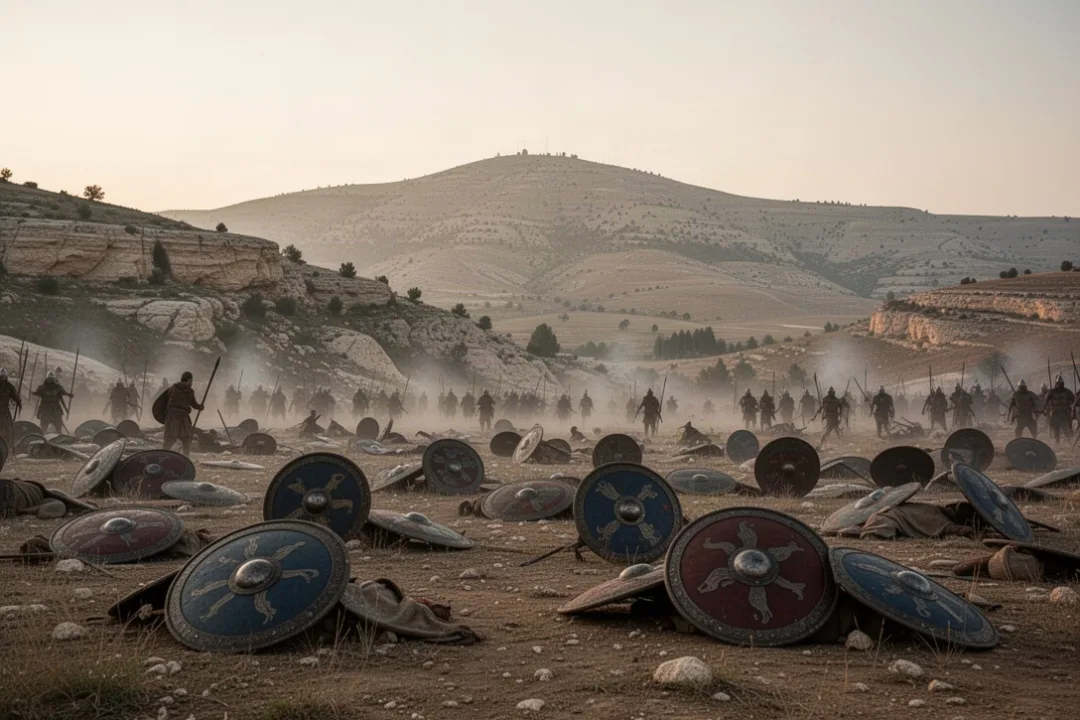
Saul dies at Mount Gilboa. The Philistines defeat Israel, Saul’s sons die, and Saul falls on his own sword after being severely wounded.
How Saul became Israel’s first king
Saul first appears in 1 Samuel 9 as the son of Kish, a wealthy Benjamite. He and a servant are looking for several missing donkeys, and their search leads them to Samuel’s town. Saul does not initially set out to claim power; he is dealing with an ordinary family problem.
Samuel has already received divine direction that Israel’s future king is coming. When Saul arrives, Samuel recognizes him, hosts him, and tells him that the donkeys have been found. Samuel then anoints Saul privately by pouring oil on his head, marking him for royal service.
Saul receives signs that confirm Samuel’s message. He encounters people near Rachel’s tomb, travelers carrying provisions, and a group of prophets. The narrative says that God changes his heart and that Saul prophesies with them. These events show Saul receiving both divine appointment and the spiritual empowerment needed for his new role.
At Mizpah, Samuel gathers the tribes and publicly presents the king through a selection process. Saul is found hiding among the supplies. His reluctance may suggest modesty, fear, or uncertainty about the responsibility. The people accept him, although not everyone is enthusiastic. Saul returns home without immediately exercising the full authority of a monarch.
Central idea: Saul does not begin as a cartoon villain. He starts with real advantages, genuine opportunities, and evidence of God’s help. The tragedy of his story develops through choices made after he has already experienced success.
Saul proves himself by rescuing Jabesh-gilead
Saul’s first major public test comes when Nahash the Ammonite besieges Jabesh-gilead. The city’s people seek terms, but Nahash imposes a humiliating condition that would leave them permanently disgraced. They ask for time to seek help from the Israelite tribes.
When Saul hears the news, the Spirit of God comes upon him, and he responds with urgency. He sends a clear call throughout Israel, gathers an army, divides it into groups, and launches a surprise attack. The Israelites defeat the Ammonites and rescue Jabesh-gilead.
This victory establishes Saul as a military leader. It also unites the people around him, because the threat is external and his response is decisive. Samuel then leads a renewal of the kingdom at Gilgal, where Saul is publicly recognized as king.
The account presents a leader who can act courageously when the danger is clear. Saul is not incapable of bravery or strategic thinking. His later weakness appears most sharply when he feels pressure to manage public opinion, control uncertain circumstances, or protect his own position.
Saul’s early military victories and growing pressure
Saul continues to fight the Philistines, Israel’s most persistent military enemy during this period. One of the earliest clashes begins after Jonathan attacks a Philistine outpost. The action provokes a major enemy response, and Israel’s forces face a much larger and better-equipped army.
Many Israelites hide, scatter, or cross the Jordan. Saul waits at Gilgal for Samuel, who has instructed him to wait a specified period. As the soldiers lose confidence, Saul becomes anxious. Before Samuel arrives, Saul offers the burnt offering himself.
When Samuel appears, he rebukes Saul for failing to keep the command he received. The issue is not simply that Saul performed a religious ritual. The deeper problem is that he allowed fear and impatience to override trusting obedience. He acted as though military pressure gave him permission to change the instructions.
Samuel tells Saul that his dynasty will not continue in the way he hopes. The text does not mean Saul immediately stops being king. He remains on the throne and continues to lead Israel, but the future of the royal line will belong to someone else.
Jonathan later demonstrates the courage and faith that Saul lacks at this moment. With only his armor-bearer, Jonathan attacks a Philistine position, trusting that God can give victory through a small force. His action triggers confusion in the enemy camp and contributes to an Israelite victory.
Saul then makes a rash oath requiring his soldiers to fast until evening. The exhausted troops struggle during the pursuit, and Jonathan unknowingly eats honey. When Saul discovers this, he is prepared to enforce the oath even against his own son, but the army intervenes. The episode reveals a recurring problem: Saul’s commands can be impulsive, and his need to appear decisive can create unnecessary harm.
Why Saul was rejected after the Amalekite campaign
One of the most important episodes comes in 1 Samuel 15. Samuel tells Saul to attack the Amalekites, a people associated in the biblical narrative with hostility toward Israel during its journey from Egypt. Saul is instructed to devote the Amalekites and their possessions to destruction.
Saul defeats the Amalekites but captures Agag, their king, and preserves the best animals and valuable goods. He and the people spare what they consider desirable, while claiming that the animals are intended for sacrifice. Saul has therefore not followed the command as given, even though he has achieved a military victory.
When Samuel confronts him, Saul first says that he has obeyed. He then shifts responsibility to the people, explaining that they kept the animals for sacrifice. Finally, he admits that he feared the people and listened to them. His explanations expose the difference between religious language and genuine submission.
Samuel’s response emphasizes that listening to God matters more than performing a sacrifice after disobedience. The point is not that worship is worthless. It is that worship cannot be used to disguise or compensate for deliberate refusal to do what God commanded.
Saul confesses that he has sinned, but his words also show concern about losing honor before the elders and the nation. He asks Samuel to accompany him so that he can be honored publicly. His repentance appears mixed with fear of consequences and concern for reputation.
Samuel then rejects Saul as king in a decisive sense. Saul continues to reign for a time, but the story makes clear that God’s purpose has moved beyond him. Samuel later grieves for Saul, showing that divine judgment does not erase human sorrow.
David enters Saul’s life
After Saul’s rejection, Samuel is sent to Bethlehem to anoint one of Jesse’s sons. Jesse presents several older sons, but God directs Samuel to David, the youngest, who has been tending the family’s sheep. David is anointed, and the Spirit of the Lord comes upon him.
David does not immediately replace Saul in a public transfer of power. Instead, the two men’s lives become closely connected. Saul experiences distress, and David is brought into the royal household as a musician who can soothe him. David also becomes Saul’s armor-bearer.
The narrative creates a striking contrast. Saul is still the recognized king, while David is the privately anointed future king. David’s rise unfolds gradually, and the delay gives Saul many opportunities to respond with humility, wisdom, and trust.
David’s victory over Goliath changes his public standing. The young shepherd accepts the challenge from the Philistine warrior, trusting that the battle belongs to God rather than relying on conventional armor. After David kills Goliath, Israel pursues the Philistines and wins a major victory.
David’s success earns him military responsibilities and popular admiration. Women from Israel’s towns celebrate Saul’s victories but attribute even greater success to David. Saul hears the comparison and becomes angry. From this point forward, jealousy turns David from an asset into a perceived threat.
Saul’s jealousy and attempts to kill David
Saul’s hostility begins with an attempt to strike David with a spear while David is playing music. David escapes, and Saul later sends men to watch David’s house. Michal, Saul’s daughter and David’s wife, helps David flee through a window and deceives the guards long enough for him to get away.
Jonathan, Saul’s son, becomes David’s loyal friend. He initially tries to persuade Saul that David has done nothing wrong and reminds his father that David has risked his life for Israel. Saul briefly agrees not to harm David, but the peace does not last.
Saul’s behavior becomes increasingly unstable and destructive. He pursues David through the wilderness, uses soldiers and informants, and even orders the killing of the priests at Nob after suspecting them of helping David. Doeg the Edomite carries out the massacre, while one priest, Abiathar, escapes and joins David.
The account shows how Saul’s fear damages more than his relationship with one rival. His suspicion corrupts judgment, places loyal people in danger, and turns royal power into a tool for personal security. His earlier concern about defending Israel is increasingly replaced by the need to eliminate David.
Saul also pursues David in the wilderness of En-gedi. David and his men are hiding in a cave when Saul enters, unaware that they are there. David’s men see the opportunity as proof that God has delivered Saul into David’s hands, but David refuses to kill him. He cuts off a corner of Saul’s robe and later uses it to prove that he could have attacked but chose not to.
David calls Saul “my lord” and “the Lord’s anointed,” recognizing Saul’s office even while Saul is acting unjustly. David does not treat Saul’s wrongdoing as acceptable. He simply refuses to become king through assassination and leaves judgment with God.
A similar event occurs on a later occasion when David enters Saul’s camp at night. Abishai offers to kill Saul, but David rejects the suggestion. David takes Saul’s spear and water jug instead, then calls out from a safe distance to show that he could have killed the king.
These episodes are central to the contrast between the two men. Saul repeatedly chooses suspicion and violence. David has opportunities to seize power but practices restraint. The story does not present David as flawless, yet it shows that his treatment of Saul distinguishes his approach to kingship.
Saul’s relationship with Jonathan and Michal
Jonathan’s loyalty to David creates a painful conflict within Saul’s family. Jonathan recognizes that David has God’s favor and makes a covenant of friendship with him. He does not treat David’s future kingship as a personal insult, even though Jonathan might otherwise have expected to inherit his father’s throne.
Saul reacts angrily to Jonathan, accusing him of siding with David. His anger reveals that he views family loyalty through the lens of political succession. Jonathan’s integrity contrasts with Saul’s desire to preserve his dynasty at any cost.
Michal also helps David escape Saul’s violence. Their marriage becomes strained as David remains a fugitive, and later Saul gives Michal to another man while David is absent. David eventually brings her back, but the relationship is marked by political conflict and personal pain.
Saul’s family therefore reflects the wider damage of his reign. Jonathan shows courageous loyalty, Michal acts decisively to protect David, and Saul increasingly isolates himself from the people closest to him.
Saul consults a medium at Endor
Near the end of Saul’s life, the Philistines gather for another major battle. Saul is terrified when he sees their army and seeks guidance from God, but he receives no answer through dreams, priests, or prophets. Earlier, Saul had removed mediums and spiritists from the land, following the law’s prohibition of such practices.
Despite that ban, Saul disguises himself and visits a medium at Endor. He asks her to bring up Samuel, who has already died. The woman is frightened when Samuel appears, and the message Saul receives is one of judgment: Israel will be defeated, Saul and his sons will die, and David’s rise will continue.
The passage is interpreted in different ways by readers, especially regarding the nature of the appearance. The plain narrative presents Samuel speaking a message of impending defeat. Its emphasis is on Saul’s desperate spiritual condition: he has rejected faithful guidance and now seeks forbidden help when the crisis is at its worst.
Saul collapses in fear and weakness after hearing the message. The medium gives him food, and he eats before leaving. This final search for supernatural guidance does not restore his relationship with God. Instead, it shows the depth of his isolation and the consequences of repeatedly refusing correction.
How Saul died at Mount Gilboa
The Philistines defeat Israel on Mount Gilboa. Saul’s sons, including Jonathan, die in the battle, and Saul is severely wounded by archers. Rather than being captured, Saul asks his armor-bearer to kill him, but the armor-bearer is afraid.
Saul then falls on his own sword. When the armor-bearer sees that Saul is dead, he does the same. The account in 1 Samuel 31 describes Saul’s death as part of a devastating military defeat, followed by the Philistines displaying the bodies of Saul and his sons.
The men of Jabesh-gilead later recover the bodies and give them a respectful burial. Their action recalls Saul’s first great victory, when he rescued Jabesh-gilead from the Ammonites. The story therefore ends by connecting Saul’s death with the people he once saved.
In 2 Samuel 1, an Amalekite gives David a different report, claiming that he killed Saul at Saul’s request. David has the man executed because he says he killed the Lord’s anointed. The narrative in 1 Samuel and the Amalekite’s account do not match in every detail, so readers should distinguish the two reports rather than treating them as a single straightforward version.
David’s reaction is grief rather than celebration. He mourns Saul and Jonathan and composes a lament for them. He also orders the people of Judah to learn it, honoring the fallen king and his son despite Saul’s long persecution.
What Saul’s story says about leadership and obedience
Saul’s story does not teach that every mistake makes a leader unusable. His most serious failures involve a repeated pattern: he receives clear direction, faces pressure, chooses his own course, and then offers explanations that minimize his responsibility.
His first major disobedience occurs when he refuses to wait for Samuel at Gilgal. His second major failure occurs when he spares Agag and the best animals. In both cases, pressure exposes what Saul values: immediate control, military appearance, public approval, and the preservation of his authority.
Saul also confuses outward success with divine approval. He wins battles and remains powerful for years, but those achievements do not erase his refusal to obey. The narrative separates being effective from being faithful.
His jealousy toward David reveals another dimension of leadership failure. Saul cannot celebrate a capable servant without feeling threatened by him. Instead of using David’s gifts for Israel’s good, Saul tries to destroy him because David’s popularity reminds Saul that his own position is unstable.
At the same time, the story preserves evidence of Saul’s strengths. He is courageous in battle, capable of rallying the tribes, and at times moved by genuine remorse. These qualities make his downfall more tragic. His problem is not a total absence of good traits but the steady surrender of those traits to fear and self-protection.
Reading tip: Saul’s rejection as king does not mean every event in his reign is pointless or every action is evil. The narrative shows a leader who can still accomplish important things while moving farther away from faithful dependence on God.
How Saul compares with David
Saul and David are both imperfect kings, and the text does not require readers to treat David as morally flawless. David later commits serious sins, including adultery and arranging the death of Uriah, as recorded in 2 Samuel 11. The contrast between the two men is therefore not simply “bad king versus perfect king.”
A major distinction is how each responds when confronted. Saul often admits wrongdoing only after trying to justify himself, blame others, or protect his public image. David also fails, but when confronted by Nathan in 2 Samuel 12, he acknowledges his sin directly and accepts the seriousness of the judgment that follows.
Another distinction is how they respond to God’s authority. Saul repeatedly treats instructions as negotiable when circumstances become difficult. David’s life includes grave disobedience, but the narrative portrays him as returning to God in repentance rather than making self-protection the defining goal of his reign.
David’s refusal to kill Saul is especially important. He believes the throne will come to him, but he will not force the promise through murder. Saul, by contrast, tries to secure his future through violence and ends up losing the very stability he wants to preserve.
Practical lessons from the king Saul story
Impatience can disguise itself as responsibility. Saul could argue that he acted to keep the army together, but his decision at Gilgal still rejected the instruction he had received.
Partial obedience remains disobedience. Saul won the battle against Amalek but did not carry out the command completely. A successful result did not change the nature of the choice.
Fear of people can control leadership. Saul eventually admitted that he feared the people and listened to them. Public pressure can become a substitute for conviction.
Jealousy distorts relationships. David’s success could have strengthened Israel and Saul’s administration, but Saul interpreted it as a threat.
Position does not guarantee character. Saul had the title, authority, and military power of a king, yet his inner life grew increasingly unstable.
Repentance must go beyond managing appearances. Saul often seemed most concerned with how his failures affected his honor before others.
Restraint can be a form of strength. David’s refusal to kill Saul shows that waiting for rightful authority can require more courage than seizing it.
Where to read Saul’s story in the Bible
For a focused reading, begin with 1 Samuel 8, where Israel asks for a king. Continue through chapters 9–12 for Saul’s calling, anointing, public confirmation, and early victory. Chapters 13–15 explain the key acts of disobedience that lead to Saul’s rejection.
Chapters 16–20 introduce David and describe the beginning of Saul’s jealousy. Chapters 21–26 follow David’s years as a fugitive and include the occasions when David spares Saul. Chapters 27–31 lead to Saul’s final battle and death.
Read 2 Samuel 1 afterward for David’s response to Saul’s death and his lament for Saul and Jonathan. Reading these passages in sequence helps you see the gradual change from a reluctant young king into a ruler consumed by fear, suspicion, and the need to preserve power.
The overall story is tragic because Saul receives genuine opportunity. He is chosen, empowered, supported by courageous people, and given repeated chances to change course. His fall comes not from a single bad day but from a pattern of fearful decisions without lasting repentance.
Frequently asked questions
Was Saul Israel’s first king?
Yes. Saul was the first king recognized over the united tribes of Israel. He came from Benjamin and was anointed by Samuel after the people requested a monarchy. David succeeded him as the central figure in Israel’s royal line, but Saul’s reign established the monarchy and showed both its military benefits and spiritual dangers.
Why did God reject King Saul?
The biblical account connects Saul’s rejection with repeated disobedience. He offered a sacrifice at Gilgal instead of waiting for Samuel, and he later spared Agag and valuable Amalekite animals after being told to devote them to destruction. His responses also showed fear of public opinion and concern for his reputation.
Did Saul and David ever become friends?
David and Saul were not lasting friends. David served Saul and married Saul’s daughter Michal, while Saul initially valued David’s abilities. After David became popular, Saul grew jealous and repeatedly tried to kill him. David still respected Saul’s position and twice spared his life, but their relationship remained marked by fear and hostility.
What happened to Saul’s sons?
Jonathan, Abinadab, and Malchishua died with Saul during Israel’s defeat by the Philistines at Mount Gilboa, according to 1 Samuel 31. Jonathan’s death deeply affected David. The loss of Saul and his sons created a leadership crisis that eventually opened the way for David to become king over Judah and later all Israel.






Leave a Reply