Benjamin tribe in the Bible: History and significance
Benjamin tribe in the Bible: History and significance
Benjamin was the youngest son of Jacob and became the ancestor of one of Israel’s twelve tribes. Although the tribe was small, its territory stood near major centers of Israelite life, and its people played important roles in the nation’s history.
Benjamin’s story includes family grief, military courage, civil war, kingship, exile, and restoration. The tribe produced Israel’s first king, Saul, and centuries later the apostle Paul identified himself as a Benjaminite. Its history shows how a community can remain significant even when it is numerically weaker than its neighbors.
Benjamin was born to Jacob and Rachel, the couple whose marriage and family story occupies a major part of Genesis. Rachel died while giving birth to him near Bethlehem. At first, she named the child Ben-oni, a name associated with her suffering, but Jacob called him Benjamin instead (Genesis 35:16-20).
The name Benjamin is commonly understood as “son of the right hand” or “son of the south.” In the ancient world, the right hand could represent strength, honor, or a favored position. The name therefore carries a more hopeful sense than the name Rachel gave him at birth.
Benjamin was Jacob’s youngest son and Rachel’s second child after Joseph. This family connection mattered in later biblical events. Benjamin and Joseph shared the same mother, and the emotional bond between them became especially important in the account of Joseph’s brothers traveling to Egypt for food.
When Joseph was serving as a powerful official in Egypt, he required his brothers to bring Benjamin with them on a later visit. Jacob was deeply reluctant to let Benjamin go because he feared losing Rachel’s remaining son after believing Joseph had died. The narrative in Genesis 42–45 presents Benjamin as the brother whose safety tested the sincerity of Joseph’s older brothers.
Joseph eventually revealed his identity to his brothers, and the family was reunited. The episode gave Benjamin a special place in the family story, not because of his own recorded speeches or actions, but because he represented Rachel’s surviving line and the family’s vulnerable future.
Jacob’s final words about his sons include a poetic statement about Benjamin. Genesis 49:27 portrays him as a wolf that seizes prey in the morning and divides spoil in the evening. The image suggests strength, fierceness, and military energy, although it should be read as poetic tribal imagery rather than a complete description of every Benjaminite.
A useful distinction: Benjamin was a person, while the tribe of Benjamin consisted of his descendants and the territory, leaders, and communities associated with them. Biblical references may shift between these meanings.
Where the tribe of Benjamin lived in Israel
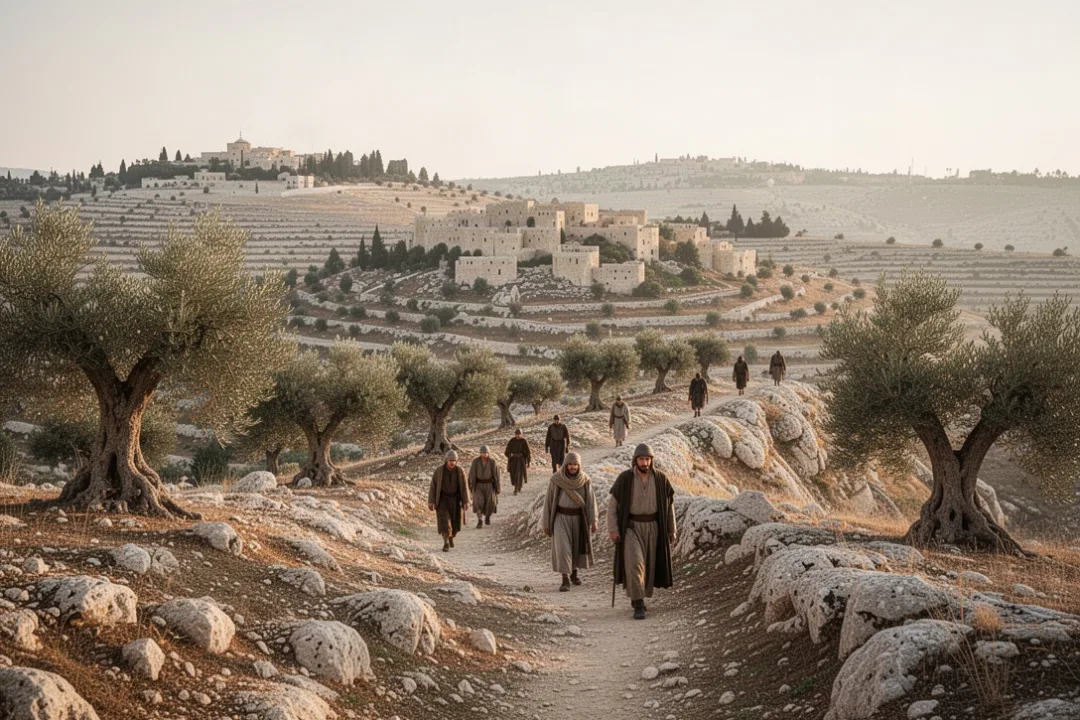
After the Israelites entered Canaan, Benjamin received land in the central part of the country. Joshua 18 describes the territory being assigned to Benjamin and lists its boundaries and towns. The territory lay between Judah to the south and the tribes connected with Joseph, especially Ephraim, to the north.
Benjamin’s land was relatively compact, but it occupied a strategic position. It included routes connecting the hill country with the Jordan Valley and stood close to Jerusalem. This location meant that the tribe was involved in movement, defense, trade, and political changes affecting the entire nation.
Important Benjaminite towns mentioned in the Bible include Gibeah, Gibeon, Mizpah, Ramah, Geba, and Anathoth. The exact borders and identification of some ancient sites are discussed by historians and biblical scholars, but the general location of Benjamin is clear: it was in the central highlands, immediately north of Judah’s territory.
Jerusalem became especially significant to Benjamin’s history. The city lay near the border between Judah and Benjamin, and biblical descriptions connect Benjamin with areas around Jerusalem. This border position later helped create a close relationship between Benjamin and Judah, particularly after the united monarchy divided.
Benjamin’s territory also included rugged hill country. Such terrain could provide defensive advantages, but it could make travel and communication difficult. A small tribe controlling important passes and roads could have influence beyond what its population alone might suggest.
The tribe’s location helps explain several later developments:
Benjamin stood near Jerusalem, which became the political and religious center under David and Solomon.
Its land connected northern and southern regions, making it strategically important during military campaigns.
Its towns became associated with prophets, judges, kings, and soldiers in different periods of Israel’s history.
Its closeness to Judah encouraged later political cooperation after the northern tribes separated from the southern kingdom.
Benjamin was not the largest or wealthiest tribal territory, but geography gave it a distinctive role. Its people lived in a place where major powers and competing groups regularly met. That setting helps explain why Benjamin appears so often in stories of leadership and conflict.
What the Bible says about Benjamin’s leaders and warriors
Benjamin’s earliest major appearance as a tribe comes during the wilderness period. The censuses in Numbers place Benjamin among the tribes organized for Israel’s journey and military life. Its descendants camped and marched within the structure of the larger nation, while tribal leaders represented Benjamin in national assemblies.
One of Benjamin’s best-known early figures was Ehud, the left-handed judge. Judges 3 describes him as a Benjaminite who delivered Israel from oppression by a Moabite ruler. The story emphasizes his unusual ability and strategic courage. His left-handedness may have given him an advantage in a culture where most people were expected to use the right hand, though the passage’s central point is his role as a deliverer.
Another important Benjaminite site was Gibeah, which became associated with a disastrous episode in Judges 19–21. A violent crime committed in Gibeah led to a national outrage and eventually to war between the other Israelite tribes and Benjamin. The conflict nearly destroyed the tribe.
This episode is one of the Bible’s starkest accounts of Israelite moral and political collapse. The other tribes gathered against Benjamin, while Benjamin defended the people of Gibeah. After a series of battles, only a small number of Benjaminite men survived. The other tribes then faced the terrible consequence of having nearly removed one of their own from Israel.
The account does not present Benjamin’s defense of Gibeah as admirable. Instead, it shows the destructive effects of collective loyalty when it protects wrongdoing. It also reveals how fragmented Israel had become during the period described by the recurring idea that everyone acted according to personal judgment.
The tribes eventually sought ways to preserve Benjamin. Wives were provided for surviving Benjaminite men through actions described in Judges 21. These measures are morally difficult and reflect the violence and disorder of the period, but within the narrative they explain how the tribe continued rather than disappearing.
Benjamin’s survival became important in the next stage of Israel’s history. Saul, Israel’s first king, was a Benjaminite from the family of Kish (1 Samuel 9). His rise transformed the tribe’s place in the national story.
Saul was selected during a period when Israel faced pressure from the Philistines and needed unified military leadership. The Bible presents him as an impressive figure at the beginning of his reign, but it also records his disobedience, insecurity, and eventual rejection as king. His personal failures did not erase Benjamin’s importance. Instead, they placed the tribe at the center of the transition from tribal leadership to monarchy.
Saul’s kingship gave Benjamin a direct connection to the first royal dynasty. Many Benjaminites supported Saul during his conflict with David. After Saul died, his son Ish-bosheth was made king over much of Israel, while David ruled Judah from Hebron. This created a prolonged struggle between the house of Saul and the house of David, described in 2 Samuel.
Benjaminite loyalty to Saul did not permanently exclude the tribe from David’s kingdom. As David’s rule expanded, people from Benjamin joined him, and Benjamin later became closely linked with Judah. The tribe’s political position therefore shifted from support for Saul’s house to participation in the united monarchy and, eventually, the southern kingdom.
Why Benjamin mattered after the kingdom divided
After Solomon’s reign, the kingdom split into two political entities. The northern kingdom included most of the tribes, while the southern kingdom centered on Judah. Benjamin remained with Judah, along with the Levites and the population connected to Jerusalem.
This alignment was not simply a matter of tribal identity. Benjamin’s territory was located beside Judah, and Jerusalem’s importance drew the two groups together. The southern kingdom is often called Judah because Judah was its dominant tribe, but Benjamin was a genuine part of that kingdom’s history.
Benjamin’s towns remained active during the divided monarchy. Ramah, Gibeah, Mizpah, and Anathoth appear in accounts involving kings, prophets, military decisions, and religious reform. The prophet Jeremiah came from Anathoth, a town associated with Benjamin. His ministry before and during the fall of Jerusalem placed a Benjaminite voice at the center of Judah’s crisis.
The prophet Jeremiah used the region of Benjamin in several settings. His hometown of Anathoth was near Jerusalem, and his family background connected him to priestly traditions. His messages warned Judah about judgment while also expressing hope for restoration. Through Jeremiah, Benjamin’s territory became part of the prophetic geography surrounding Jerusalem’s final years before the Babylonian conquest.
Benjamin also appears in the biblical accounts of the Babylonian exile and the return from captivity. Lists in Ezra and Nehemiah mention people from Benjamin who returned and helped rebuild the community. The returning population was not limited to one tribe, but Benjamin was among the groups that continued the life of the restored community.
The tribe’s postexilic identity is therefore tied to continuity after national catastrophe. Benjamin had nearly disappeared after the civil war in Judges, survived the instability of the monarchy, and remained present after Jerusalem’s destruction and the exile. Its story repeatedly moves from danger toward preservation.
Several themes become visible in Benjamin’s later history:
Proximity created responsibility. Benjamin’s closeness to Jerusalem placed it near the kingdom’s central decisions.
Small size did not mean insignificance. Benjamin produced leaders and occupied strategically valuable land.
Political loyalty could change. Benjamin first supported Saul’s royal house but later lived within the kingdom ruled by David’s dynasty.
Restoration included tribal memory. Benjamin remained part of the community that returned and rebuilt after exile.
Benjamin’s relationship with Judah also shaped how later readers understood the southern kingdom. The tribes were not identical, but they shared political institutions, territory, worship centered in Jerusalem, and the experience of exile and return.
What Benjamin represents in the New Testament
Benjamin is mentioned directly in the New Testament through the apostle Paul. In Romans 11:1, Paul identifies himself as an Israelite descended from Abraham and belonging to the tribe of Benjamin. In Philippians 3:5, he again refers to his Benjaminite ancestry as part of his Jewish credentials.
Paul’s tribal identity mattered because he was explaining that faith in Christ did not mean God had abandoned Israel. His reference to Benjamin connected him with Israel’s historic people and covenant story. He was not presenting himself as detached from Israel; he was emphasizing that he came from within it.
Paul’s Benjaminite background also linked him to a tribe known for producing Saul, Israel’s first king. Paul’s Hebrew name was Saul, although the New Testament generally uses Paul for his missionary work among the nations. The shared name does not mean the two men had the same character or calling, but it adds a notable connection between Benjamin’s earlier royal history and its later apostolic history.
The New Testament does not develop a separate theology of the tribe of Benjamin. It does, however, preserve the tribe’s identity as part of the continuing story of Israel. Paul’s references show that tribal descent still carried meaning in the first-century Jewish world, even after centuries of political changes and exile.
Benjamin’s biblical legacy can be understood through several connected ideas:
God’s purposes are not limited by size. Benjamin was one of the smallest tribes, yet it produced nationally important figures.
Heritage can carry both honor and warning. Benjamin is associated with Saul and Paul, but also with the violence at Gibeah.
Strategic location affects history. Benjamin’s land near Jerusalem brought opportunity, pressure, and responsibility.
Survival can itself become part of a people’s identity. The tribe endured events that could have ended its existence.
Tribal identity remains part of a larger story. Benjamin’s significance is found within Israel’s wider history rather than apart from it.
Readers sometimes focus only on Benjamin’s most famous individuals, especially Saul and Paul. The broader biblical picture is more complete when those figures are considered alongside the tribe’s geography, community life, periods of failure, and repeated recovery.
For Bible study: Read Benjamin’s story across Genesis 35, Judges 3 and 19–21, 1 Samuel 9–31, Jeremiah 1, Ezra and Nehemiah, Romans 11, and Philippians 3. The passages together show the tribe’s development more clearly than any single reference.
The tribe of Benjamin was small, but it was never peripheral. It stood at the crossroads of Israel’s geography and experienced the nation’s major transitions: settlement, judgeship, monarchy, division, exile, return, and the emergence of the early Christian movement.
Its history is also unusually balanced. Benjamin is connected with courage and leadership, but with violence and political conflict as well. It is associated with Saul’s troubled reign and Paul’s missionary calling. Taken together, these accounts present Benjamin as a tribe marked by resilience, proximity to power, and a complicated moral history.
How to study Benjamin without missing its wider context
Start with Benjamin’s family origins in Genesis, then trace the tribe’s land in Joshua. Next, read the stories of Ehud, Gibeah, and Saul. Finally, examine Benjamin’s place beside Judah during the monarchy, exile, and restoration, followed by Paul’s references in Romans and Philippians.
This approach prevents one famous person or event from defining the entire tribe. Benjamin’s importance lies in the full pattern: a vulnerable beginning, a strategic homeland, painful conflict, influential leaders, and survival within the continuing story of God’s people.
Frequently asked questions
Was Benjamin the smallest tribe of Israel?
Benjamin became one of the smallest tribes after the civil war described in Judges 19–21, when its population was nearly destroyed. Earlier biblical censuses also place it among the smaller tribes, though the exact rankings vary by period and by how the figures are interpreted. Its limited size did not prevent it from holding strategically important land or producing major leaders.
Was Jerusalem located in the territory of Benjamin?
Jerusalem stood near the boundary between Benjamin and Judah, and biblical descriptions connect the city with both regions. The city’s location and later political importance brought Benjamin and Judah into close relationship. Because boundary descriptions can be interpreted in different ways, it is safest to describe Jerusalem as lying on or near the border rather than assigning the entire city exclusively to one tribe.
What famous people came from the tribe of Benjamin?
The best-known Benjaminite figures include Ehud, one of the judges of Israel; King Saul, Israel’s first king; Jeremiah, who came from Anathoth; and the apostle Paul, who identified himself as a Benjaminite. Mordecai, introduced in Esther 2:5 as a Benjaminite, is another important figure associated with the tribe.
What does Benjamin mean in the Bible?
Benjamin is commonly explained as “son of the right hand” or “son of the south.” The right hand could symbolize strength, honor, or a favored position. Rachel originally gave him a name associated with sorrow, but Jacob changed it, giving the child a name with a more positive meaning. His name therefore reflects both grief at his birth and hope for his future.




Leave a Reply