2 Samuel records the rise, reign, failures, and continuing significance of King David. The book begins after Saul’s death and follows David as he becomes king over Judah, unites Israel, establishes Jerusalem, receives God’s covenant promise, and faces severe consequences after his sin with Bathsheba.
The book is not a simple celebration of David’s success. It presents him as a gifted, faithful, and deeply flawed ruler whose devotion to God exists alongside serious moral failure. Its central movement goes from political unity and royal promise to family violence, rebellion, and national trouble.
In English Bibles, 1 Samuel and 2 Samuel are two parts of one continuous story. The division between them was made for practical reasons related to the length of the ancient scroll, not because the narrative naturally ends at Saul’s death. The second book begins with David mourning Saul and Jonathan and continues through the later years of David’s reign.
The book belongs to the Old Testament historical books. It follows the period of the judges and the first years of Israel’s monarchy. Samuel was the prophet who anointed both Saul and David, but he dies before the events of most of 2 Samuel take place. The book’s title refers to the larger Samuel narrative rather than claiming that Samuel personally wrote every section.
Second Samuel also connects with other biblical books. 1 Kings continues the story after David’s death, while 1 Chronicles retells much of David’s reign with a different emphasis. Several psalms are traditionally associated with David, but 2 Samuel itself gives the clearest narrative account of his public life as king.
What happens in 2 Samuel
The narrative can be followed through several major movements. David first becomes king over Judah, then over all Israel. He captures Jerusalem and makes it the political center of the kingdom. After that high point, the story turns toward his adultery with Bathsheba, his arranged killing of her husband Uriah, and the conflicts that follow within his household.
Chapters 1–4: David mourns Saul and Jonathan, becomes king over Judah, and survives conflict with the house of Saul.
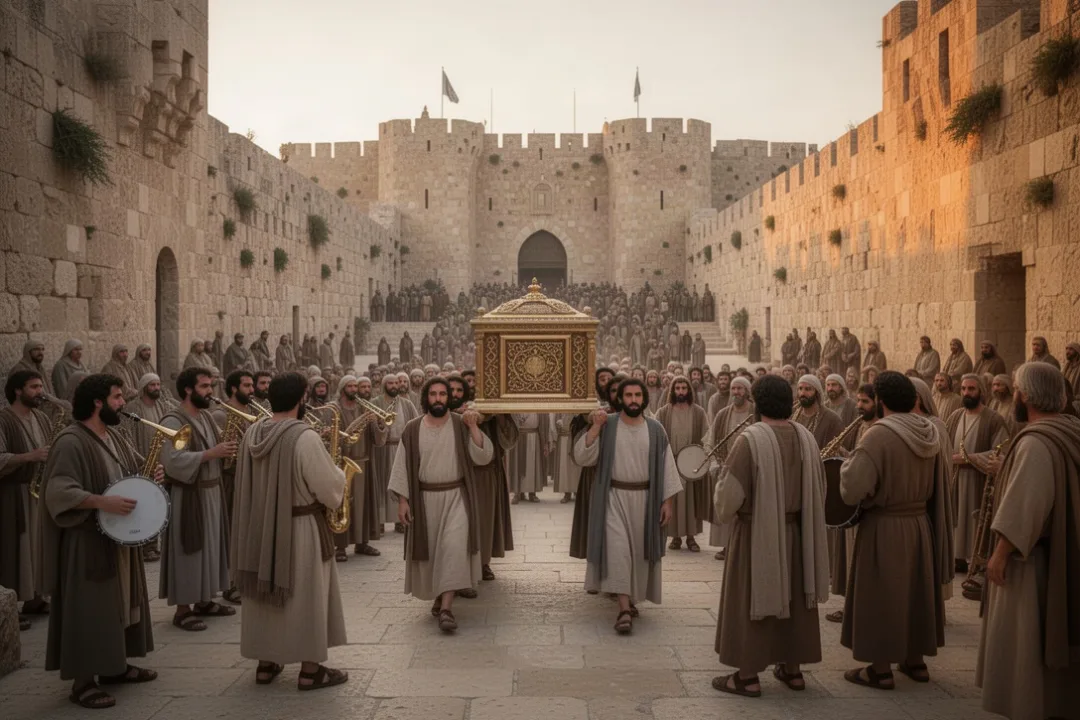
Chapters 5–10: David becomes king over all Israel, captures Jerusalem, brings the ark there, and expands Israel’s influence.
Chapters 11–12: David commits adultery with Bathsheba, arranges Uriah’s death, and is confronted by Nathan the prophet.
Chapters 13–20: violence among David’s children leads to Absalom’s rebellion and David’s temporary flight from Jerusalem.
Chapters 21–24: the book gathers later episodes, songs, lists, military accounts, and the story of David’s census and altar.
This arrangement creates a strong contrast. David’s early reign shows wisdom, patience, and dependence on God, while the middle of the book exposes the damage caused by his abuse of power. The later chapters do not erase either side of the story; they show a king whose reign remains significant even after his household and kingdom have been badly shaken.
David becomes king after Saul’s death
Second Samuel opens with an Amalekite reporting that he had killed Saul on Mount Gilboa. His account does not match the description in 1 Samuel, where Saul falls on his own sword after asking his armor-bearer to kill him. David does not reward the messenger. Instead, he has him executed for claiming to have killed the Lord’s anointed king.
David then composes a lament for Saul and Jonathan. The song honors their courage and grieves the loss of Israel’s leaders. David’s response is significant because Saul had repeatedly tried to kill him, yet David does not use Saul’s death as an occasion for revenge or public celebration.
At first, David rules over Judah from Hebron, while Ish-bosheth, one of Saul’s sons, rules over the northern tribes. This creates a divided kingdom and leads to conflict between the two houses. Abner, Saul’s former military commander, supports Ish-bosheth, but a dispute eventually drives him toward David.
Abner helps negotiate the transfer of the northern tribes to David, but Joab kills Abner in retaliation for the death of his brother Asahel. David publicly distances himself from the murder and mourns Abner. Later, two men assassinate Ish-bosheth and bring his head to David, expecting a reward. David has them executed instead, just as he punished the man who claimed responsibility for Saul’s death.
Reading insight: David’s early treatment of Saul’s household shows that he does not initially seize the throne through revenge. The narrative repeatedly presents him as waiting for legitimate kingship rather than treating political opportunity as permission for violence.
David unites Israel and establishes Jerusalem
After Ish-bosheth’s death, all the tribes of Israel come to David and recognize him as king. He is first anointed over Judah and later over the whole nation. The repeated anointing emphasizes that David’s authority develops through a process rather than appearing all at once.
David then captures Jerusalem from the Jebusites and makes it his capital. The city is strategically located between the northern and southern parts of the kingdom, which makes it useful for unifying the tribes. It also becomes the center of David’s government and worship.
The Philistines respond to David’s growing power with military attacks. In these encounters, David seeks direction from God before acting. The text shows him receiving different instructions for different battles, highlighting that previous success does not guarantee that the next decision can be made without discernment.
David’s attempt to bring the ark of the covenant to Jerusalem produces both celebration and tragedy. When Uzzah reaches out to steady the ark, he dies, and David becomes afraid to continue the procession. Later, the ark is brought to Jerusalem with careful celebration. David dances before it, while his wife Michal despises what she sees as undignified behavior.
The ark represents God’s presence and covenant relationship with Israel, not a magical object that guarantees victory. David’s actions show his desire to place worship at the heart of national life, but the account also stresses that holy things cannot be handled casually or treated as tools for royal prestige.
God’s covenant with David
In 2 Samuel 7, David wants to build a permanent temple for the ark. Nathan the prophet initially approves the idea, but God gives Nathan a different message during the night. David will not build the temple; instead, God will establish David’s house and dynasty.
The promise includes several related ideas. David’s family line will continue, his royal house will have lasting significance, and one of his descendants will be associated with a firmly established kingdom. The passage also uses the language of a father and son to describe the relationship between God and the future Davidic king.
This covenant becomes one of the most important foundations for later biblical hope. Israel’s expectation of a future righteous ruler is connected to David’s line. The New Testament identifies Jesus with this Davidic promise, but 2 Samuel itself presents the covenant in its original setting: God’s commitment to David’s dynasty despite David’s personal limitations.
David’s prayer in response is marked by humility. He does not present the covenant as something he has earned through military achievement. He recognizes the distinction between his own status and God’s greatness, then asks that God keep the promise made to his house.
David’s victories and his responsibilities as king
Following the covenant, 2 Samuel describes David’s military victories over surrounding peoples. These campaigns strengthen Israel’s security and expand the kingdom’s influence. The repeated reports of success show David functioning as a capable commander and national leader.
The book also describes David’s administration of justice. One of the clearest examples appears in his care for Mephibosheth, the son of Jonathan and grandson of Saul. David invites him to eat at the royal table and restores Saul’s land to him. This action honors the covenant of friendship David made with Jonathan.
David’s kindness toward Mephibosheth is especially meaningful because royal succession often involved removing rivals from a previous dynasty. Instead of treating Jonathan’s son as a threat, David protects him. The episode illustrates how a king can use power to preserve another person rather than simply secure his own position.
Yet the military and political sections also prepare readers to notice the danger of royal power. David has a large household, commanders with their own agendas, and a kingdom held together by loyalty to the king. These structures can serve justice, but they can also enable secrecy, favoritism, and abuse when the ruler refuses correction.
David, Bathsheba, and Nathan’s confrontation
Second Samuel 11 marks the book’s decisive moral turning point. While his army is away at war, David sees Bathsheba, the wife of Uriah the Hittite, and summons her. She becomes pregnant, and David attempts to conceal the relationship by bringing Uriah home from the battlefield.
Uriah refuses to enjoy domestic comfort while the ark, Israel’s army, and his fellow soldiers remain in the field. David then sends instructions through Joab to place Uriah in a vulnerable position and withdraw support from him. Uriah is killed, and David takes Bathsheba as his wife after her mourning period.
The narrative presents this sequence as a serious misuse of royal authority. David has access to people, information, and military power that Bathsheba and Uriah do not possess. The issue is not merely private desire; it is the exploitation of power, followed by deception and the arranged death of an innocent man.
Nathan confronts David through a story about a wealthy man who takes a poor man’s beloved lamb. David condemns the rich man’s behavior before realizing that the story exposes his own actions. Nathan announces consequences that will reach David’s household, even though David confesses his sin.
The text distinguishes between forgiveness and removal of consequences. David acknowledges his wrongdoing, and Nathan tells him that he will not die for it, but the damage caused by his actions will continue to affect his family and kingdom. Their child dies, and later violence among David’s sons reveals how deeply disorder has entered the royal household.
Important distinction: David’s repentance does not make the abuse disappear or make Uriah’s death less serious. The passage shows both divine mercy toward a repentant sinner and accountability for the harm that sinner has caused.
Violence within David’s household
The prophecy of trouble within David’s house begins to unfold through his children. Amnon, David’s firstborn son, becomes obsessed with his half-sister Tamar. He deceives her, assaults her, and then rejects her. Tamar is left devastated, while David becomes angry but fails to provide the kind of decisive justice the situation demands.
Absalom, Tamar’s full brother, eventually arranges Amnon’s murder. He then flees from David. This cycle shows how the king’s earlier failure to confront wrongdoing contributes to further violence. David’s household is not merely suffering from individual bad choices; it is also suffering from weak and inconsistent leadership.
After Absalom returns to Jerusalem, the relationship between father and son remains strained. Absalom gradually wins the loyalty of many Israelites by presenting himself as more available and responsive than David. He stands near the city gate, listens to people with unresolved cases, and suggests that their concerns would receive better treatment if he were judge.
Absalom’s political strategy combines charm, grievance, and ambition. He eventually declares himself king at Hebron, forcing David to flee Jerusalem. David leaves the city with loyal servants, priests, and soldiers, but he does not assume that every religious symbol guarantees his return. He tells the priests to take the ark back if God’s favor is not with him.
Absalom’s rebellion and David’s return
David’s flight exposes both his vulnerability and his continuing influence. Some people curse him, while others remain loyal. David receives conflicting counsel from Ahithophel and Hushai. Hushai secretly works against Absalom by giving advice designed to delay the attack, allowing David time to regroup.
The rebellion ends in the forest of Ephraim. Absalom’s hair becomes caught in a tree as he rides beneath it, leaving him suspended. Joab kills him despite David’s instruction to deal gently with him. The battle ends, but David’s victory is overwhelmed by grief when he learns that Absalom has died.
David’s lament for Absalom shows the painful conflict between public responsibility and private love. He is a king whose army has won, but he is also a father mourning a son who tried to remove him from the throne. Joab warns David that his grief is discouraging the people who saved his life, and David returns to the public role expected of him.
The return does not immediately restore complete unity. There are disputes between Judah and the northern tribes over who has taken the lead in bringing David back. Sheba then launches another revolt, and Joab suppresses it after the people of Abel Beth-maacah hand over the rebel’s head to protect their city.
These episodes show that restoring a king to Jerusalem does not automatically heal a divided nation. David’s reign survives, but the kingdom remains vulnerable to tribal rivalry, competing loyalties, and commanders whose decisions may not always follow the king’s wishes.
The final chapters and David’s census
The last four chapters of 2 Samuel are arranged as a collection rather than a single continuous narrative. They include a famine connected with Saul’s earlier actions against the Gibeonites, accounts of military victories, David’s song of deliverance, his final words, a list of prominent warriors, and the account of the census.
David’s song praises God as his rock, rescuer, and protector. Its themes include deliverance from enemies, the reliability of God’s ways, and the king’s dependence on divine help. The song uses poetic images that express security and strength rather than offering a simple report of military events.
David’s final words describe the ideal ruler as one who governs with justice and reverence for God. The standard is higher than personal charisma or battlefield success. A king must exercise authority in a way that reflects God’s character and benefits the people under his care.
The list of David’s mighty warriors honors the men who served him. It also subtly places royal achievement in a wider community. David is important, but he does not win battles alone. His reign depends on soldiers, commanders, administrators, prophets, priests, and ordinary people whose actions shape the kingdom.
The book closes with David ordering a census of Israel and Judah. The text presents the act as sinful, although the surrounding passages do not make every reason explicit. A census could serve legitimate administrative purposes, but in this context it appears connected with human confidence in military strength rather than dependence on God.
After the census, David recognizes his guilt. He is given a choice among forms of judgment and chooses to fall into God’s hands rather than into the hands of human enemies. A plague strikes the land, and David pleads for the people, accepting responsibility for the wrongdoing.
David then buys the threshing floor of Araunah and builds an altar there. Araunah offers the site and animals freely, but David insists on paying for what he gives to God, expressing the principle that worship should involve a real cost. The book ends with the plague stopped at the altar site, which later becomes associated with the location of the temple in Jerusalem.
Major themes in 2 Samuel
God’s faithfulness is greater than human success
David’s reign is important because of God’s purpose, not because David is consistently wise or morally reliable. The covenant in chapter 7 rests on divine initiative. David’s failures are real, but they do not cancel God’s larger commitment to the Davidic line.
This does not mean that behavior is irrelevant. David’s sin produces lasting harm, and his leadership is judged seriously. The book holds two truths together: God remains faithful to his promise, and human beings remain accountable for what they do.
Power can magnify both virtue and sin
David uses authority to protect Mephibosheth, unite Israel, and establish worship in Jerusalem. He also uses that authority to take Bathsheba and arrange Uriah’s death. The same position that gives a ruler the ability to serve others can make wrongdoing easier to conceal and more damaging when committed.
Second Samuel therefore asks readers to evaluate leadership by more than visible achievement. Military victories, political skill, and public popularity do not prove that a ruler is acting justly. Character, accountability, and care for the vulnerable matter as much as success.
Private sin can create public consequences
David’s actions in chapter 11 begin as a hidden abuse of royal power, but the effects spread through his household and kingdom. Amnon’s violence, Absalom’s revenge, and the rebellion against David all occur within a wider environment damaged by the king’s failure.
The narrative does not claim that every later event is a direct mechanical punishment for David’s sin. It does show that leaders’ choices influence families, institutions, and communities. Concealed wrongdoing often changes the conditions in which other people make their own decisions.
Repentance requires honest acknowledgment
David’s response to Nathan is brief but direct. He does not blame Bathsheba, Uriah, Joab, or the pressures of kingship. He admits that he has sinned against God. That acknowledgment does not restore everything he damaged, but it is the necessary beginning of a truthful response.
The book also shows that repentance must be distinguished from image management. David’s earlier attempt to conceal the pregnancy and Uriah’s death is the opposite of repentance. Nathan’s confrontation brings the truth into the open, where David can no longer control the story through royal authority.
Practical ways to read 2 Samuel accurately
Because 2 Samuel contains political conflict, sexual violence, family trauma, warfare, and theological promises, it can be misread if every event is treated as an example to imitate. Use the narrative carefully and distinguish what the text describes from what it approves.
Track the political setting. Notice whether David is ruling Judah, all Israel, or facing a rebellion. The changing political context explains many decisions.
Separate description from endorsement. The Bible records David’s adultery, deception, and violence without presenting them as acceptable behavior.
Watch who has power. Ask how the king’s position affects Bathsheba, Uriah, Tamar, Absalom, and the people who depend on royal justice.
Read Nathan’s confrontation carefully. The prophet’s message shows that royal status does not place David beyond moral accountability.
Compare parallel accounts thoughtfully. Passages in 1 Chronicles may emphasize different aspects of David’s reign. Differences in emphasis do not require ignoring either account.
Keep the covenant in context. God’s promise to David is not a reward for flawless conduct. It is a theological explanation for the continuing significance of his dynasty.
Do not reduce the book to leadership advice. Its main concerns include God’s covenant, kingship, sin, judgment, mercy, worship, and the future hope connected with David’s line.
Several common mistakes can distort the book. One is treating David as an uncomplicated hero and overlooking the victims of his actions. Another is treating his punishment as permission to minimize Bathsheba’s experience or Uriah’s death. A third is assuming that because God preserves David’s dynasty, God approves every decision David makes.
It is also a mistake to read the story of Absalom as a simple rebellion by an ungrateful son. Absalom is responsible for his violence and ambition, but the narrative places his actions within a damaged family system. David’s failure to address Amnon’s assault and his strained relationship with Absalom are part of the conditions surrounding the revolt.
Questions 2 Samuel raises for readers
Second Samuel asks what makes a king worthy of trust. David’s early patience, his willingness to seek God’s direction, and his care for Jonathan’s son point toward good kingship. His abuse of power, unwillingness to administer justice within his household, and dependence on military strength reveal how quickly leadership can become self-serving.
The book also asks how God’s promises relate to human failure. David is neither discarded as though his sin were insignificant nor praised as though his success erased it. The narrative keeps divine faithfulness and human responsibility together, refusing to make either one disappear.
For Christian readers, the Davidic covenant points beyond David to the expectation of a future king. The New Testament presents Jesus as the descendant associated with that promise. That later interpretation does not remove the difficult material in 2 Samuel; it makes the contrast between flawed human kingship and righteous kingship even more significant.
For any reader, the book offers a sober account of power, loyalty, grief, and accountability. David’s story demonstrates that public achievement cannot compensate for private wrongdoing, that repentance cannot be replaced by reputation, and that a community suffers when leaders are protected from truthful correction.
Where to begin if you are studying 2 Samuel
A focused reading can make the long narrative easier to follow. Read chapters 1–5 to understand David’s transition from fugitive to king. Then read chapters 6–10 for Jerusalem, the ark, the covenant, and the expansion of the kingdom.
Give special attention to chapters 11–12, since they explain the turn in David’s reign. Continue through chapters 13–20 to see how violence and unresolved injustice affect the royal family and the nation. Finally, read chapters 21–24 as a reflective collection that revisits David’s battles, worship, leadership, and dependence on God.
As you read, keep three questions in view: What is David doing with power? What does the book reveal about God’s covenant? And how do David’s choices affect people beyond himself? Those questions connect the major episodes and help preserve the moral and theological complexity of the book.
Frequently asked questions
Is 2 Samuel the same as the second book of Samuel?
Yes. In most English Bibles, “2 Samuel” is the standard title, while “Samuel 2” is an informal reversal of the same name. It continues directly from 1 Samuel, beginning after Saul’s death and following David’s reign. In Hebrew Bible organization, 1 and 2 Samuel are treated as one larger book.
Who wrote 2 Samuel?
The book does not identify a single author for the complete work. Samuel himself dies before most of the events in 2 Samuel, so the final form likely incorporates records, prophetic material, royal accounts, and later editorial arrangement. Jewish and Christian traditions have associated Samuel with the larger Samuel narrative, but the text does not claim that he personally wrote every chapter.
What is the most important chapter in 2 Samuel?
Chapter 7 is often considered central because it records God’s covenant with David and the promise concerning his royal house. Chapter 11 is equally crucial for understanding the book’s structure because David’s sin with Bathsheba changes the direction of his reign. Reading chapters 7, 11, and 12 together reveals the relationship between promise, failure, judgment, and mercy.
What should readers learn from David’s sin?
David’s story shows that authority does not excuse exploitation, secrecy, or violence. His confession demonstrates the need for honest repentance, but the consequences show that forgiveness does not always remove the effects of wrongdoing. The account also warns readers not to treat influential leaders as morally untouchable or to confuse public success with personal integrity.








Leave a Reply