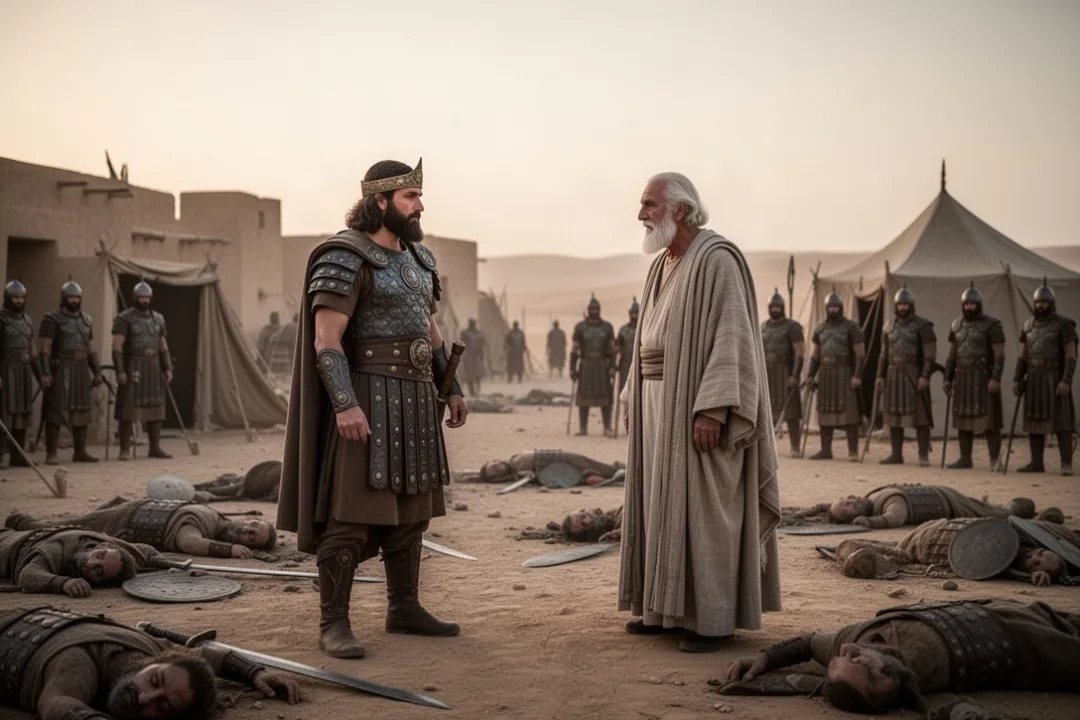
Agag was the king of the Amalekites whom Israel’s King Saul captured during a campaign described in 1 Samuel 15. Although God had commanded Saul to destroy Amalek’s military power completely, Saul spared Agag and kept the best livestock. The prophet Samuel then confronted Saul and executed Agag.
The name also appears in Numbers 24:7, where Balaam speaks of a future king being greater than Agag, and Haman is called an “Agagite” in the Book of Esther. The Bible does not explicitly prove that Haman was a direct descendant of the Agag whom Samuel killed, but the wording connects him with the biblical memory of Amalek’s enemies.
Agag appears most prominently in 1 Samuel 15. He was not an ordinary soldier or minor official but the ruler of Amalek, a people who had repeatedly opposed Israel. Saul defeated the Amalekites in battle, captured Agag alive, and preserved valuable animals instead of carrying out the full command he had received.
The passage presents Agag as a defeated king who expected to survive. When Samuel summoned him, Agag approached confidently, saying in effect that the danger of death had passed. Samuel’s response shows that Agag’s confidence was misplaced: the prophet declared that Agag’s violence had brought judgment upon him and then killed him before the Lord.
The text gives little personal information about Agag. It does not describe his age, family, appearance, or length of reign. Most of what readers can know comes from his position as Amalekite king, his defeat by Saul, and his execution by Samuel.
Direct answer: Agag was the Amalekite king spared by Saul and later killed by Samuel. His story is mainly about Saul’s failure to obey God completely, not about Agag’s personal biography.
Why Israel fought Amalek before Agag appeared
Agag’s story makes more sense when read alongside the earlier history of Amalek. The first major conflict appears in Exodus 17, shortly after Israel left Egypt. Amalek attacked the Israelites in the wilderness, and Moses’ actions during the battle are linked with Israel’s victory. The account emphasizes Amalek’s hostility toward a vulnerable people who were traveling through the wilderness.
Later, Moses reminded Israel of this attack in Deuteronomy 25:17–19. That passage says Amalek had struck those who were weak and lagging behind. Israel was told to remember the attack and, after receiving rest in the promised land, to remove Amalek’s memory from under heaven.
These passages create the biblical background for the command given to Saul. The conflict is not presented as a sudden dispute between Saul and an unrelated foreign ruler. Instead, Agag stands within a long-running national conflict that the biblical writers connect with Amalek’s earlier attack on Israel.
At the same time, the narrative concerns a specific judgment in a specific setting. Readers should not use the story as permission to treat modern ethnic groups as biblical enemies. The text describes an ancient judgment involving Amalek and Israel; it does not authorize individuals today to identify another people as Amalek.
What Saul was commanded to do in 1 Samuel 15
In 1 Samuel 15, the prophet Samuel delivered God’s command to Saul before the campaign against Amalek. Saul was told to attack Amalek and place everything under the ban, a severe ancient-war expression describing total destruction of the enemy’s military and social power. The command specifically included Agag and the livestock.
The wording is difficult for modern readers because it describes complete destruction as an act of divine judgment. The passage belongs to the Bible’s broader accounts of ancient warfare, where national survival, judgment, and religious loyalty are expressed through battles between kings and peoples. It should be read carefully rather than reduced to a general rule for ordinary life.
Saul’s army defeated the Amalekites, but Saul did not carry out the command fully. He captured Agag alive and allowed the people to keep the best sheep, cattle, and other valuable animals. The soldiers preserved the animals, but the narrative makes clear that Saul accepted and permitted what happened.
Saul later explained that the animals were being kept for sacrifice to the Lord. Samuel rejected that defense. The prophet’s message is that religious activity cannot excuse deliberate disobedience. Worship does not repair a choice to ignore a clear command and then present the result as devotion.
Why Saul’s decision to spare Agag mattered
Saul’s treatment of Agag was not a minor technical mistake. It exposed a deeper problem in his kingship: Saul obeyed selectively. He carried out enough of the command to claim success, but he kept what benefited him and the people under his authority.
Samuel told Saul that listening and obeying mattered more than sacrifice. The prophet compared rebellion with serious spiritual offenses and explained that rejecting God’s instruction had caused Saul to be rejected as king. The precise comparisons in the passage are forceful because Saul had tried to substitute public religious language for genuine obedience.
Agag’s survival became visible evidence of Saul’s failure. As long as the Amalekite king lived, Saul could not plausibly claim that the campaign had been completed. Agag was a symbol of the part of the command Saul had reserved for himself—or allowed his army to reserve.
Saul also admitted that he had feared the people and listened to their voice. That confession reveals a leadership problem. He was responsible for the campaign, yet he allowed popular pressure and practical benefit to shape his response more than the instruction he had received through Samuel.
The biblical narrative therefore links partial obedience with misplaced authority. Saul wanted the status of a successful king, the approval of his people, and the appearance of religious faithfulness. He did not want the cost of obeying when obedience required giving up a valuable captive and useful livestock.
What happened when Samuel confronted Agag
After rebuking Saul, Samuel ordered Agag to be brought before him. Agag approached expecting that his life had been spared. The passage portrays him as a king who had escaped one danger and did not understand that judgment still awaited him.
Samuel declared that Agag’s sword had caused women to lose their children, and that his own mother would now be bereaved. The wording presents Agag’s death as a measured response to the destruction associated with his rule. Samuel then killed Agag before the Lord at Gilgal, bringing the judgment Saul had failed to complete.
This scene is brief but significant. Saul, the official king and military leader, had spared Agag. Samuel, the prophet who had announced Saul’s failure, carried out the judgment instead. The contrast reinforces the narrative’s criticism of Saul’s kingship: the king had the authority and opportunity to act, but he did not obey.
The account does not invite readers to celebrate cruelty or imitate Samuel’s act. It records an ancient execution within a specific story of national judgment. For Christian and Jewish readers, interpretation also needs to account for the Bible’s changing historical settings and for the difference between describing an event and commanding modern behavior.
How Agag relates to Balaam’s prophecy
The name Agag appears earlier in the Bible in Numbers 24:7. Balaam, hired to curse Israel, instead spoke blessings and prophecies. In one oracle, he described Israel’s future power and said its king would be higher than Agag.
This reference creates an interpretive question because the Agag in Numbers appears before Saul’s reign, while the Agag in 1 Samuel belongs to Saul’s time. The text may use Agag as a royal name or title, much as some ancient rulers were known by recurring throne names. Another possibility is that the reference points to a prominent Amalekite ruler known in the tradition behind the prophecy.
The Bible does not explain the relationship in detail. It is therefore safer to say that Numbers 24 and 1 Samuel connect Agag with Amalekite kingship rather than claiming certainty about two fully identified individuals. The prophetic statement emphasizes Israel’s future strength over a representative enemy ruler.
Balaam’s prophecy also helps show that Agag was a recognized symbol of political power. Saying that Israel’s king would be greater than Agag communicated a reversal of expected status: the people who appeared vulnerable would ultimately possess authority over a powerful enemy.
Is Haman in Esther descended from Agag?
In Esther 3:1, Haman is called an “Agagite.” The designation links him with Agag or with the Amalekite tradition associated with that name. Because Haman becomes the chief enemy of the Jewish people in Esther, many readers see the label as a deliberate literary connection to the old conflict between Israel and Amalek.
However, the Book of Esther does not provide a genealogy proving that Haman was Agag’s direct biological descendant. The name may indicate ancestry, regional identity, political heritage, or a symbolic association with Israel’s historic enemy. The connection is meaningful, but its exact genealogical details remain unstated.
Esther’s story also echoes the earlier conflict in a striking way. Agag was spared by Saul and later killed by Samuel; Haman, the Agagite, plans the destruction of the Jewish people but is eventually executed on the very structure he prepared for Mordecai. The narrative reverses the apparent power of the enemy and presents deliverance for the threatened community.
Some readers compare Saul and Mordecai because both are associated with the tribe of Benjamin, while Haman is associated with Agag. The Bible does not directly spell out every connection, but these details encourage readers to notice a possible literary reversal: what Saul failed to resolve in the earlier story is answered through the events of Esther.
What Agag’s story teaches about leadership and obedience
The account of Agag is mainly framed as a lesson about Saul, but it also raises broader questions about authority. A leader’s responsibility includes decisions made by subordinates, especially when the leader benefits from those decisions. Saul could not shift blame to his soldiers because he accepted the outcome and defended it.
His failure also shows how easily people can redefine obedience. Saul did not say he had rejected God completely. He emphasized the sacrifices that would result from keeping the animals. Yet the prophet treated the issue as disobedience because Saul had changed the command and then placed a religious explanation over the change.
Several principles emerge from the narrative:
Partial compliance is not the same as faithfulness when a person knowingly preserves the part he wants to keep.
Good intentions do not erase responsibility for a decision that contradicts a clear instruction.
Public approval can distort leadership when a ruler fears people more than accountability.
Religious language can conceal self-interest when it is used to justify a choice already made.
Power does not guarantee discernment; Saul held the throne but still needed Samuel’s correction.
Agag functions as a concrete test of Saul’s integrity. A king’s character is revealed not only by how he wins a battle, but also by what he does after victory, how he handles power, and whether he obeys when obedience limits his advantage.
Common mistakes when interpreting Agag
Agag’s story is often quoted in debates about obedience, judgment, or spiritual warfare. Several interpretations go beyond what the biblical text actually says. Careful reading keeps the central lessons while avoiding claims the passage does not support.
Assuming Agag was the only issue. Saul’s disobedience involved both sparing Agag and keeping valuable livestock. Focusing only on the king can make the larger failure seem smaller than it was.
Claiming that Haman’s genealogy is certain. “Agagite” clearly creates a connection in Esther, but the text does not give a complete family tree linking Haman directly to the Agag of 1 Samuel.
Treating every use of Agag as one confirmed individual. Numbers 24 may refer to a royal title, a particular ruler, or a traditional name associated with Amalekite kings. The Bible does not settle the question explicitly.
Applying the command to modern ethnic or political groups. Amalek belongs to the ancient biblical setting. It should not be used to label a modern population as deserving violence.
Using the passage to defend careless aggression. Samuel’s execution of Agag is described within a unique prophetic and national judgment context. It is not a general example for personal revenge.
Ignoring the narrative’s criticism of Saul. The main focus is not admiration for military power. It is the king’s failure to obey, his fear of the people, and his attempt to justify the result.
Reading “obedience” as mindless compliance in every situation. The passage concerns Saul’s specific prophetic command. Applying its lesson today requires moral judgment, respect for lawful authority, and rejection of harm toward innocent people.
Reading tip: Keep the story’s ancient setting and literary purpose in view. Agag is both a historical enemy king within the narrative and a symbol of the obedience Saul failed to complete.
How the Agag account fits the story of Saul’s rejection
First Samuel 15 is a turning point in Saul’s reign. Earlier chapters show Saul receiving authority, winning victories, and being affirmed as king. This chapter exposes the limits of his leadership and explains why the prophetic relationship between Saul and Samuel deteriorates so sharply.
Samuel announced that the Lord had rejected Saul as king because Saul rejected the Lord’s command. Saul tried to repair the situation by admitting his sin and asking Samuel to honor him before the elders and the people. His concern about public reputation remained visible even after the confrontation.
The next chapter introduces David’s anointing. This sequence does not mean David immediately replaced Saul on the throne; Saul continued to rule for a time. It does mean the narrative has already declared that Saul’s dynasty will not continue as the chosen royal line.
Agag therefore marks more than a single military mistake. His survival exposes the king’s inability to place obedience above political calculation. The episode prepares readers for the contrast between Saul’s troubled reign and the kind of heart the narrative seeks in David, even though David’s later actions also receive serious criticism.
What Agag can mean for readers today
The story can prompt honest questions about selective obedience. You may not face a battlefield or royal command, but you can still recognize the pattern of doing what is convenient, retaining what is profitable, and explaining the result in spiritual or moral language.
It also encourages careful examination of leadership. People in authority cannot claim innocence simply because others carried out the practical details. Saul’s soldiers preserved the animals, but Saul remained accountable because he authorized the outcome and defended it.
At the same time, the account should be handled with humility. It contains severe ancient judgment, and its moral force is not found in copying the violence. The enduring questions concern responsibility, integrity, fear of public opinion, and the temptation to replace obedience with a more convenient religious performance.
A careful personal reflection might ask:
Where am I obeying only the parts of a responsibility that benefit me?
Have I blamed other people for a result I accepted or encouraged?
Am I using good motives to excuse a decision I know is wrong?
Do I fear losing approval more than I value truth and accountability?
Have I turned an ancient judgment story into a careless slogan about people today?
Agag remains memorable because the Bible gives him a precise role in a larger moral drama. He was the king Saul spared, the captive whose survival exposed Saul’s disobedience, and the figure later associated with the enemy tradition represented by Haman. Reading the passages together shows how biblical narratives use one name to connect history, prophecy, kingship, judgment, and the consequences of incomplete obedience.
Frequently asked questions
Was Agag a king or a title?
Agag is presented as the king of Amalek in 1 Samuel 15. Some interpreters think “Agag” may have functioned as a recurring royal title, especially because the name also appears in Numbers 24. The Bible does not explain whether the references identify one person, several rulers, or a title used by Amalekite kings.
Did Saul kill Agag?
No. Saul captured Agag alive after defeating the Amalekites, even though he had been commanded to destroy Amalek’s power completely. Samuel later confronted Agag and killed him at Gilgal. Saul’s decision to spare him was one of the main reasons Samuel declared that Saul had disobeyed God.
Was Haman directly descended from Agag?
The Book of Esther calls Haman an Agagite, which connects him with Agag or the Amalekite enemy tradition. However, Esther does not provide a complete genealogy proving direct descent from the Agag in 1 Samuel. The connection is intentional and significant, but its exact family details are not stated.
Why did God command judgment against Amalek?
The biblical explanation points back to Amalek’s attack on Israel in the wilderness, particularly against vulnerable people traveling at the rear. Deuteronomy 25 recalls that attack and announces later judgment. The command belongs to that ancient national setting and should not be applied as permission to target modern groups.











Leave a Reply