Saul in the Old Testament: His life, reign, and downfall
Saul in the Old Testament: His life, reign, and downfall
Saul was the first king of Israel, appointed when the people asked for a ruler like the nations around them. His story appears mainly in 1 Samuel 9–31, with later reflections in 2 Samuel and 1 Chronicles. Saul began as a promising leader, but repeated disobedience and jealousy eventually cost him his throne, his stability, and his life.
The Old Testament presents Saul as a complex figure rather than a simple villain. He could act bravely, lead Israel into battle, and show genuine humility, yet he also feared public opinion, resisted prophetic correction, and pursued David with destructive intensity. His life shows how an impressive beginning cannot replace faithful obedience.
Saul was the son of Kish, a wealthy man from the tribe of Benjamin. The biblical account describes him as physically striking and unusually tall, which helped him fit the people’s expectations of a powerful king. He was not seeking the throne when he first appears. He was looking for his father’s lost donkeys, accompanied by a servant, when events led him to the prophet Samuel.
Samuel had received a message from God telling him that a man from Benjamin would come and that this man should be appointed ruler over Israel. When Saul arrived, Samuel recognized him as the chosen leader. He invited Saul to a meal, gave him a place of honor, and later anointed him privately with oil. In the Old Testament, anointing signified that a person had been set apart for a particular purpose.
Saul’s early response was marked by modesty and uncertainty. When Samuel announced that Saul would lead Israel, Saul questioned whether his family was worthy of such a role. Later, when the people gathered to identify their new king, Saul was found hiding among the supplies. That detail suggests that he did not initially grasp for power or assume that leadership belonged to him.
God gave Saul signs confirming his calling, including encounters with prophetic worshipers and a striking change in Saul’s behavior. First Samuel 10 describes Saul prophesying among a group of prophets. The episode surprised those who knew him, producing the saying that Saul was among the prophets. The point is not that Saul became a prophet in the same permanent role as Samuel, but that God publicly marked him for his new responsibility.
Why Saul mattered: Saul’s appointment answered Israel’s demand for a human king, but it did not remove Israel’s responsibility to remain under God’s authority. The king was expected to rule as a servant, not as an independent sovereign.
Saul’s public confirmation came after an invasion by Nahash the Ammonite. When Saul heard that the people of Jabesh-gilead were in danger, the Spirit of God came upon him, and he summoned Israel’s tribes to battle. His response was decisive, and the Israelites defeated the Ammonites. This victory gave the people confidence in Saul and led to a renewed public recognition of his kingship at Gilgal.
How Saul led Israel as its first king
Saul’s main task was to defend Israel from surrounding enemies. The nation did not yet have a settled monarchy with established institutions, a large standing army, or a long tradition of royal administration. Saul therefore functioned primarily as a war leader who gathered tribal forces when threats arose.
His most persistent enemy was the Philistines, who possessed military advantages and controlled important territory. First Samuel describes a period when Israel had limited access to metalworking and weapons. This made the conflict especially difficult. Saul and his son Jonathan had to lead an army that was often less well equipped than its opponent.
Jonathan, Saul’s eldest son, appears as a courageous and faithful warrior. He attacked a Philistine outpost with his armor-bearer, trusting that God could give victory with many soldiers or with few. His initiative created confusion in the Philistine camp, and Saul’s army eventually joined the fight. The episode reveals both Jonathan’s faith and the military pressure under which Saul governed.
Saul could act boldly when a crisis was clear. His response to the Ammonites and some of his battles with the Philistines demonstrate real courage and strategic ability. The Old Testament does not deny his gifts. His failure came from how he handled authority, delay, pressure, and correction.
One problem was Saul’s tendency to act before Samuel arrived. At Gilgal, Saul waited for Samuel to offer a sacrifice before battle. When Samuel did not arrive as quickly as Saul expected, the soldiers began to scatter. Saul then offered the sacrifice himself. Samuel arrived soon afterward and rebuked him for failing to keep God’s command.
The issue was more than a technical violation of ritual procedure. Saul had been given a specific instruction and faced pressure when circumstances became difficult. Instead of trusting the word he had received, he tried to secure the situation on his own terms. His explanation focused on the troops, the enemy, and the delayed prophet, but it did not show submission to the command.
First Samuel 13 records Samuel telling Saul that his kingdom would not endure in the way Saul had hoped. The passage points toward a different kind of ruler, one whose heart would be aligned with God’s purposes. The statement does not mean Saul immediately stopped being king. It signals that his dynasty would not continue as the lasting royal line.
Saul also established rules for the army that sometimes created unnecessary hardship. During one campaign, he placed the soldiers under an oath not to eat before the battle was complete. Jonathan had not heard the order and ate some honey. His strength returned, while the exhausted army struggled. When Saul discovered what Jonathan had done, he was prepared to punish his own son, but the soldiers intervened.
This incident shows a troubling contrast in Saul’s leadership. He wanted a decisive victory and a reputation for complete dedication, yet his command weakened the army. Zeal without wisdom can burden the people a leader is meant to protect. Jonathan’s conduct, by contrast, highlights practical judgment and trust in God rather than confidence in an impulsive royal decree.
Why Saul lost God’s approval
Saul’s most direct rejection came during the campaign against the Amalekites. Samuel instructed him to carry out judgment against Amalek because of its earlier opposition to Israel. Saul defeated the Amalekites but spared Agag, their king, and kept the best animals and valuable possessions.
When Samuel confronted him, Saul first claimed that the people had spared the animals for sacrifice. He then insisted that he had obeyed. The account exposes a gap between Saul’s public explanation and his actual conduct. He had not followed the command fully, and he shifted responsibility toward the people rather than accepting his own failure.
Samuel’s response in 1 Samuel 15 teaches that ritual acts cannot substitute for obedience. The passage contrasts listening to God with offering sacrifices after disobedience has already occurred. Its message is not that worship is worthless. Rather, religious activity cannot be used to excuse deliberate resistance or to make partial obedience appear complete.
“To obey is better than sacrifice” is the central principle Samuel communicates in 1 Samuel 15:22, paraphrased rather than quoted from a particular Bible translation.
Saul eventually admitted that he had sinned, but his confession remained mixed with concern about public honor. He asked Samuel to accompany him before the elders and Israel, suggesting that maintaining his standing mattered greatly to him. The scene does not prove that every expression of regret was false, but it shows that fear of people continued to shape his choices.
Samuel then announced that God had rejected Saul as king. Saul’s reign did not end on that day, and he continued to lead Israel for a time. However, the decisive judgment had been made: Saul would not provide the enduring royal line God intended for Israel.
The Old Testament gives several connected reasons for Saul’s rejection:
He acted independently when he was expected to wait for Samuel and follow God’s instruction.
He practiced partial obedience by preserving what he had been told to destroy.
He blamed circumstances and other people instead of accepting responsibility.
He valued public approval and royal honor alongside, and sometimes above, faithful submission.
He treated his position as something to preserve rather than a responsibility held under God’s authority.
Saul’s rejection also shows that the Old Testament evaluates kings differently from many human systems do. Military success, physical presence, and popular support were not enough. A king could win battles and still fail in the central task of ruling under God.
How Saul’s conflict with David developed
After Saul’s rejection, Samuel was sent to Bethlehem to anoint David, the youngest son of Jesse. David did not immediately take Saul’s throne. Instead, he entered Saul’s service as a musician and armor-bearer. When Saul was troubled, David’s playing brought relief, creating an unusual relationship between the rejected king and the future king.
David became widely known after defeating Goliath, the Philistine champion. The victory brought David public praise, and the people celebrated him in songs that compared his achievements favorably with Saul’s. Saul heard the praise and became angry. From that point forward, he increasingly viewed David as a threat to his authority.
Saul’s jealousy developed into repeated attempts to kill David. He threw a spear at him, tried to use marriage arrangements against him, and sent messengers to capture him. At times Saul seemed remorseful and acknowledged David’s innocence, but the change did not last. His fear repeatedly returned, especially when he believed that David’s popularity endangered his throne.
Jonathan defended David and helped him escape. This created a painful conflict between loyalty to his father and loyalty to a friend. Jonathan recognized that David had done nothing deserving death, while Saul interpreted David’s survival and success as rebellion. Saul’s anger even turned against Jonathan when Jonathan challenged the king’s judgment.
David had opportunities to kill Saul but refused to take the throne by personal violence. At the wilderness of En-gedi, David secretly cut off part of Saul’s robe and then regretted even that action. He appealed to Saul from a distance and demonstrated that he could have killed him but chose not to. Later, David took Saul’s spear and water jar while Saul slept, again refusing to attack him.
These episodes present a sharp moral contrast. Saul used power to preserve himself, while David waited for God to determine when and how the kingship would change. David was not portrayed as sinless, but in his dealings with Saul he recognized that authority must not be seized through revenge.
A useful distinction: Saul’s jealousy was not simply disappointment over losing popularity. It became a pattern of suspicion, surveillance, and violence. The story warns how fear can turn a leader’s legitimate concern for security into a destructive obsession.
Saul’s relationship with David also reveals how unstable his inner life had become. He could acknowledge David’s righteousness and then resume the pursuit soon afterward. He could experience emotion, repentance, and even worship while remaining unwilling to surrender his resistance. Strong feelings alone did not produce lasting transformation.
What happened to Saul at the end of his life
Near the end of Saul’s reign, the Philistines gathered for another major battle. Saul was terrified when he saw their forces and sought guidance from God, but he received no answer through the usual means described in the account. This silence exposed the spiritual and political isolation that had developed over his reign.
Saul then consulted a medium at Endor, despite having previously removed mediums and spiritists from the land. He disguised himself because he knew the act violated his own policy and Israel’s religious law. The narrative describes Samuel appearing and announcing that Saul and his sons would die in the coming battle. The passage is difficult and has been interpreted in different ways, but its central point is clear: Saul had reached a crisis after repeatedly rejecting God’s instruction.
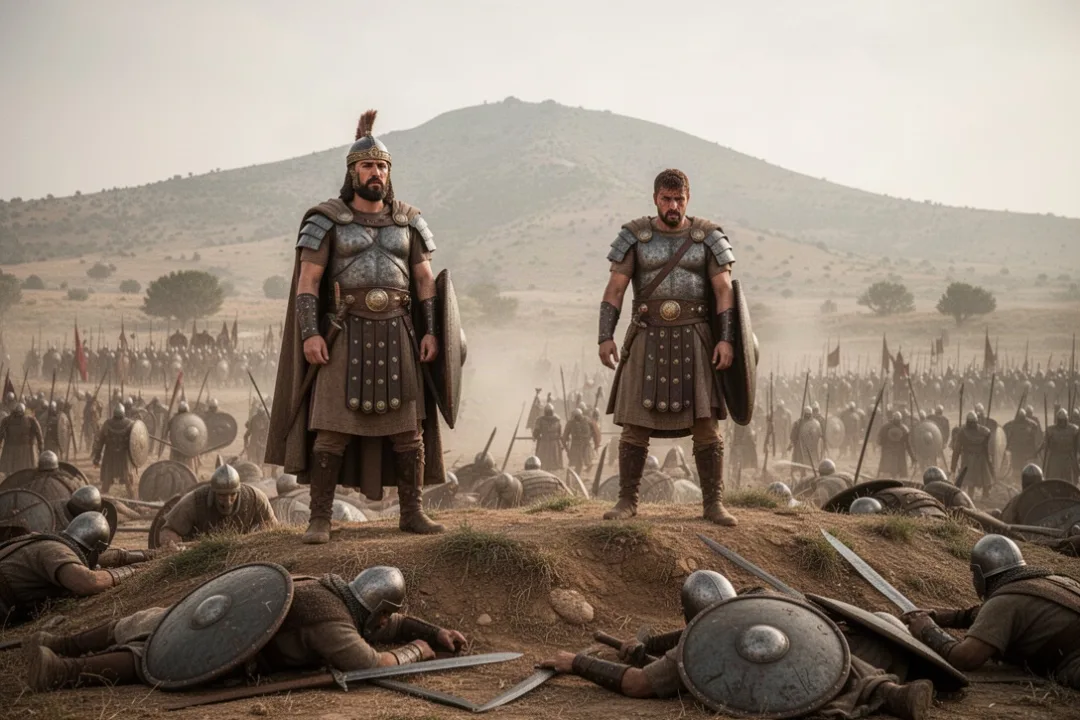
In the battle at Mount Gilboa, the Philistines defeated Israel. Saul’s sons, including Jonathan, were killed. Saul was wounded and asked his armor-bearer to kill him so that his enemies would not capture and abuse him. When the armor-bearer refused, Saul fell on his own sword. First Samuel 31 presents this as the manner of his death.
Second Samuel 1 gives a different report from an Amalekite who claimed to have killed Saul at Saul’s request. David did not celebrate the news. Instead, he mourned Saul and Jonathan and ordered the Amalekite punished for claiming to have harmed the Lord’s anointed. Readers should distinguish the two accounts rather than treating the Amalekite’s report as identical to the narrative in 1 Samuel.
The people of Jabesh-gilead recovered the bodies of Saul and his sons and buried them with respect. Their action remembered Saul’s earlier rescue of their city from the Ammonites. Even after Saul’s failures, the biblical account preserves the good he had done and the courage he had shown at the beginning of his reign.
Saul’s death marked the end of his rule but not the end of Israel’s political struggle. David would eventually become king, first over Judah and later over all Israel. Saul’s family and supporters remained part of the story for some time, showing that the transfer of power was gradual and contested rather than instantaneous.
What Saul’s story teaches about leadership and faith
Saul’s life raises questions about calling, character, authority, and repentance. He was genuinely chosen for an important task and genuinely gifted for aspects of it. His failure was not caused by a lack of opportunity. It came through repeated decisions to protect his image, manage outcomes, and reinterpret commands when obedience became costly.
One lesson concerns the difference between appearance and character. Saul looked like the kind of king Israel wanted, and he could inspire people through his physical presence. Yet biblical kingship depended on something deeper than appearance. A leader’s public strength could not compensate for a private refusal to listen.
A second lesson concerns partial obedience. Saul did not reject every command outright. He followed some of the instructions and then changed the parts that seemed inconvenient or beneficial to him. The narrative treats this as serious disobedience because Saul claimed the authority to decide which parts of God’s word remained binding.
A third lesson concerns fear of people. Saul’s decisions were often shaped by the reaction of soldiers, elders, enemies, or the public. Concern for others can be responsible leadership, but Saul allowed public pressure to override his duty. His desire to appear successful made him more willing to compromise and more threatened by David’s popularity.
A fourth lesson concerns the danger of unresolved insecurity. Saul began by hiding among the supplies, but later he clung fiercely to power. His insecurity did not disappear when he became king; it changed form. Instead of feeling too small for the position, he became afraid that someone else would replace him.
His story also gives a careful picture of repentance. Saul could recognize wrongdoing, express regret, and ask for honor in front of the people. Yet repeated confession without a changed direction did not restore his leadership. The Old Testament emphasizes that repentance involves more than remorse; it requires a return to faithful action.
Readers should also avoid reducing Saul to his worst moments. He rescued Jabesh-gilead, defeated enemies, led Israel through dangerous conflicts, and loved Jonathan in his own way. His tragedy is that real gifts and real achievements existed alongside serious disobedience. The account is therefore a warning against assuming that success proves spiritual approval.
For readers studying Saul in the Old Testament, these passages provide a useful order:
Read 1 Samuel 9–10 to see Saul’s calling, anointing, and public recognition.
Read 1 Samuel 11–14 to follow his early victories, military leadership, and conflict with Samuel.
Read 1 Samuel 15 to understand why God rejected Saul’s dynasty.
Read 1 Samuel 16–20 to trace David’s rise and Saul’s growing jealousy.
Read 1 Samuel 21–26 to compare Saul’s pursuit of David with David’s refusal to kill Saul.
Read 1 Samuel 28–31 to follow Saul’s final crisis, defeat, and death.
Saul remains one of the Old Testament’s most searching portraits of a leader who had ability but would not consistently submit that ability to God. His reign began with promise and moments of courage, yet his choices gradually narrowed his world until fear governed him. The story’s central warning is direct: position cannot protect a person whose character refuses correction.
Frequently asked questions
Was Saul a good king or a bad king?
Saul was a mixed and tragic king. He showed courage, led successful military campaigns, and rescued Jabesh-gilead from the Ammonites. At the same time, he repeatedly disobeyed God, blamed others, feared public opinion, and pursued David unjustly. The biblical account does not present him as wholly incompetent or evil; it shows how serious character failures undermined genuine gifts and achievements.
Why did God reject Saul as king?
God rejected Saul because he repeatedly treated divine commands as negotiable. He offered a sacrifice without waiting for Samuel and later spared Agag and valuable livestock after being told to destroy them. Saul also shifted blame and focused on preserving public honor. His rejection concerned a settled pattern of disobedience, not one isolated mistake.
Did Saul know that David would become king?
Saul came to understand that David represented a threat to his dynasty and eventually recognized that David would likely become king. Jonathan also understood that David’s future was significant. Saul’s awareness did not lead him to accept the change. Instead, fear drove him to pursue David, even though David repeatedly demonstrated that he did not intend to seize the throne through violence.
How did Saul die in the Old Testament?
First Samuel 31 says Saul was critically wounded during the battle with the Philistines and then fell on his own sword after his armor-bearer refused to kill him. Second Samuel 1 records an Amalekite claiming that he killed Saul at Saul’s request. These reports differ, so they should be presented separately rather than merged into one unqualified account.








Leave a Reply