Via Dolorosa: route, meaning, stations, and visiting tips
Via Dolorosa: route, meaning, stations, and visiting tips
If you are planning a visit to Jerusalem, you may be wondering where the Via Dolorosa begins, how long the walk takes, and what you will actually see along the way. The Via Dolorosa, or “Way of Sorrows,” is the traditional route associated with Jesus’ journey to his crucifixion. It crosses the Old City from the area traditionally linked with his trial to the Church of the Holy Sepulchre, where Christians commemorate the crucifixion, burial, and resurrection.
The route is both a place of Christian prayer and a living city street. It passes through busy lanes, shops, homes, schools, and historic religious sites. A visit can feel solemn, crowded, confusing, and deeply meaningful at the same time. Understanding its history and traditions before you arrive will help you recognize the significance of each stop without expecting every detail to function as an archaeological certainty.
The name Via Dolorosa comes from Latin and is commonly translated as “Way of Sorrows” or “Way of Suffering.” It refers to the traditional path Jesus took through Jerusalem before his crucifixion. Christian pilgrims walk the route while remembering the Passion, the series of events surrounding Jesus’ suffering and death.
The route is especially associated with Stations of the Cross, a devotional practice that uses a sequence of stops to contemplate moments from the Passion. Some stations are based directly on Gospel accounts, while others come from longstanding Christian tradition. The stations are not intended to be a modern crime-scene reconstruction; they are places of prayer and remembrance shaped by centuries of worship.
For many visitors, walking the Via Dolorosa is an act of spiritual reflection rather than sightseeing alone. People may pray silently, carry a cross, listen to a guide, sing hymns, or pause in a small chapel. Others visit because of historical interest, family heritage, or a desire to understand one of Christianity’s most important pilgrimage traditions.
Keep the distinction in mind: the Via Dolorosa is a traditional devotional route, not a path whose every turn can be proven as the exact road Jesus walked. Its religious meaning remains significant even where historical evidence is limited.
Where the Via Dolorosa runs in Jerusalem
The Via Dolorosa lies inside Jerusalem’s Old City. Its traditional starting point is near the Lion’s Gate, in the Muslim Quarter, in the area associated with the Antonia Fortress and the Roman trial of Jesus. The route then winds westward and southward through narrow streets before reaching the Church of the Holy Sepulchre in the Christian Quarter.
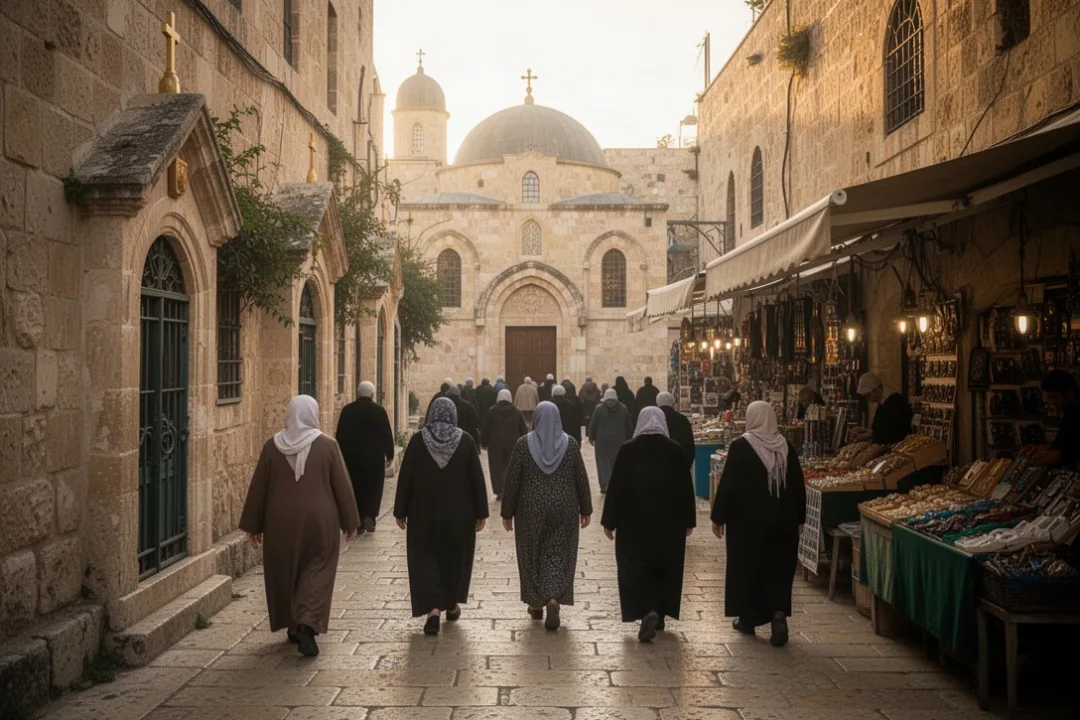
Modern Jerusalem does not present the Via Dolorosa as one uninterrupted pedestrian promenade. It is a network of ordinary stone streets and passageways. Vendors may display religious objects, spices, clothing, and souvenirs beside the route. Residents and local workers use the same lanes, and groups of pilgrims may need to step aside to let others pass.
The route’s traditional geography reflects the layout of the Old City as it has developed over many centuries. Some locations associated with the Passion are inside churches, courtyards, or buildings that require a short detour from the main lane. Street signs and station markers can help, but they are not always easy to spot when crowds are present.
How the 14 stations of the cross are arranged
The best-known form of the Via Dolorosa includes 14 stations. They mark selected events or moments connected with Jesus’ Passion, ending at the Church of the Holy Sepulchre. The numbering is generally consistent for pilgrims, although the appearance and accessibility of individual stations can vary.
The first stations are traditionally located near the beginning of the route in the Muslim Quarter. The final stations are within the Church of the Holy Sepulchre, where several important Christian shrines stand close together. The route is therefore not simply a straight walk from one outdoor marker to another; the last portion unfolds inside a large and complex church.
Stations one through five
Station I is traditionally associated with the place where Jesus was condemned to death. The site is commonly linked with the area of the former Antonia Fortress, although the exact location of the Roman governor’s judgment has been debated by historians and archaeologists.
Station II commemorates Jesus taking up the cross. The station is associated with a location near the traditional site of the condemnation. Nearby chapels connected with this section allow pilgrims to pray indoors and reflect on the beginning of the journey.
Station III remembers Jesus’ first fall beneath the cross. The tradition is not described in the same way in every Gospel account, so this station represents a devotional meditation on suffering rather than a detail established by all biblical sources.
Station IV commemorates Jesus meeting his mother, Mary. Like the previous station, this scene comes from Christian tradition rather than a specific Gospel passage. The location is near a chapel associated with the Armenian Catholic community.
Station V recalls Simon of Cyrene being compelled to help carry the cross. This event is described in the Synoptic Gospels, and the station is marked at a junction along the route. Pilgrims often pause here to consider themes of forced service, shared burdens, and compassion.
Stations six through ten
Station VI remembers a woman traditionally known as Veronica wiping Jesus’ face. Veronica does not appear in the canonical Gospel narratives, but her story became an established part of Christian devotional tradition. The station is connected with a small chapel and a relief that depicts the encounter.
Station VII commemorates Jesus’ second fall. The traditional location is associated with an old city gate or boundary, although the precise historical interpretation of the site is not certain. The station is often experienced in a narrow, active part of the Old City.
Station VIII recalls Jesus addressing the women of Jerusalem. The event is connected with the Gospel account in Luke, which describes Jesus speaking to women who mourned for him. A stone marked with a cross is associated with this station along the route.
Station IX commemorates Jesus’ third fall. It is located near the entrance to the Church of the Holy Sepulchre, although access may be affected by crowds, worship services, or building schedules. From this point, the final stations are found inside the church.
Station X marks the place where Jesus is traditionally believed to have been stripped of his garments. It is located within the Church of the Holy Sepulchre, near the area associated with Calvary. The station’s setting makes clear that the final moments of the route are part of a larger sacred complex.
Stations eleven through fourteen
Station XI commemorates Jesus being nailed to the cross. It is associated with the Roman Catholic chapel on Calvary, also called Golgotha. The chapel forms part of the church’s upper level and may be reached by a staircase from the main entrance area.
Station XII marks Jesus’ death on the cross. This station is associated with the Greek Orthodox chapel at Calvary. A traditional stone beneath the altar is connected with the place of the crucifixion, and pilgrims may approach it during permitted visiting hours.
Station XIII remembers the removal of Jesus’ body from the cross and its reception by Mary. The station is associated with the Stone of Anointing, where many Christians pray before continuing toward the tomb area.
Station XIV marks the tomb of Jesus. The shrine known as the Edicule stands within the Church of the Holy Sepulchre and is traditionally identified with the burial place. The church also contains the traditional site of the resurrection, making it central to Christian worship and pilgrimage.
The order of the stations helps structure prayer, but visitors should not assume that each site has a large sign or a clearly separated room. Some markers are small. Several stations are incorporated into chapels, walls, or church spaces used by different Christian communities, so quiet attention is often more useful than trying to rush from one number to the next.
Which parts come from the Bible and which come from tradition
The Gospels provide the primary Christian accounts of Jesus’ arrest, trial, crucifixion, and burial. They mention events such as Simon of Cyrene carrying the cross and Jesus speaking to women of Jerusalem. They do not provide a complete street map of Jerusalem or identify every place represented by the modern stations.
Several familiar scenes in the stations come from later Christian devotion. These include Jesus falling beneath the cross, meeting Mary along the road, and Veronica wiping his face. Their inclusion does not make the devotion meaningless, but it does mean that a careful visitor should distinguish between biblical narrative, local tradition, and later religious meditation.
The same principle applies to the route itself. Jerusalem has been destroyed, rebuilt, expanded, and reshaped many times. The city’s streets in the time of Jesus were not identical to the lanes that pilgrims walk today. Archaeology can illuminate the city’s history, but it cannot confirm every traditional station as the exact location of a Gospel event.
For many Christians, the value of the Via Dolorosa lies in remembering the Passion in a physical setting. Walking, stopping, and praying can make familiar religious themes more tangible, even when the precise historical path remains uncertain. Visitors can respect both the devotional tradition and the limits of historical evidence.
How long the Via Dolorosa walk takes
The physical route is relatively short, but the total visit can take much longer than the walking distance suggests. A person moving steadily without stopping may cover the route in a limited amount of time. Pilgrimage groups often spend several hours because they pause for prayers, enter chapels, wait for access, and listen to explanations.
Your timing will depend on the crowds, church hours, weather, and group size. The Old City’s lanes are narrow, and a large procession can move slowly. The Church of the Holy Sepulchre may be especially busy, with queues for particular shrines and occasional closures for services or religious ceremonies.
If you want a quiet experience, allow more time than the walking distance alone would suggest. A self-guided visitor may choose to see the route in one morning and return to the church later. A pilgrim following a formal liturgy or group procession should expect the schedule to be shaped by worship rather than by sightseeing efficiency.
Practical tips for walking the Via Dolorosa
A little preparation makes the route easier and helps you behave respectfully in a busy sacred district. Conditions can change quickly because the walk is outdoors for much of its length and ends inside an active church.
Wear supportive shoes. The Old City has uneven stone paving, steps, slopes, and polished surfaces that can become slippery.
Dress respectfully. Cover shoulders and knees when entering churches and chapels, and carry an extra layer if you are visiting during a cool season.
Carry water. Summer heat, direct sun, and crowded lanes can make the walk tiring, even though the route is not especially long.
Bring small cash and a secure bag. You may encounter donations, shops, and crowded areas, but keep valuables close to you.
Check church access. Services, holy days, restoration work, and local rules can affect entry to individual chapels and shrines.
Leave space for worshippers. Do not block doorways, altars, staircases, or narrow passages while taking photographs or waiting for your group.
Use a map or guide. Station markers can be easy to miss, especially where the route turns or passes through a building.
Allow time at the Church of the Holy Sepulchre. The final stations are not a quick outdoor stop; the church deserves patient and respectful attention.
Common mistakes visitors make on the route
The Via Dolorosa is easy to underestimate. People sometimes arrive expecting a quiet, clearly marked path and feel disappointed when they find a crowded commercial neighborhood. Others focus so closely on taking photographs that they miss the religious character of the places they are visiting.
Expecting an untouched ancient road: The route runs through a living urban quarter, not an isolated archaeological park. Shops, residents, deliveries, and schoolchildren are part of the setting.
Treating every tradition as proven history: The stations combine Gospel events with devotional traditions developed over time. A good guide will identify the difference rather than presenting every detail as certain.
Rushing the final stations: The Church of the Holy Sepulchre can be confusing. Entering without allowing time for queues, stairs, chapels, and worship services often makes the final part feel hurried.
Ignoring local worship: Loud conversation, flash photography, or blocking a procession can disturb people who have come to pray. Watch what worshippers and church staff are doing.
Following an outdated schedule: Opening arrangements may vary. Confirm current access information locally, particularly around major Christian feast days.
Assuming one guide represents every tradition: Catholic, Orthodox, Protestant, and other Christian visitors may approach the stations differently. Ask questions respectfully and allow room for more than one perspective.
Best approach: treat the Via Dolorosa as both a historic urban route and an active place of worship. Move patiently, listen to local guidance, and let the experience be more than a checklist of numbered stops.
When to visit the Via Dolorosa
The best time depends on what you want from the visit. Early morning is often preferable for people seeking cooler temperatures and fewer casual visitors. The streets may still be active, and church access is never guaranteed, but starting early can make the narrow route easier to follow.
Friday is particularly significant because Franciscan friars traditionally lead a public procession along the Via Dolorosa on that day. The schedule and access arrangements can change, so confirm details before planning around it. The procession may be meaningful for some visitors but crowded for those seeking a quiet, independent walk.
Christian holy days can bring special services, processions, and large numbers of pilgrims. These occasions may offer a powerful sense of communal worship, but they also limit personal space and make some areas difficult to enter. During warmer months, avoid the hottest part of the day when possible and protect yourself from the sun.
How to visit the Church of the Holy Sepulchre respectfully
The Church of the Holy Sepulchre is shared by several Christian communities, each with its own traditions, worship schedules, and responsibilities. The building contains chapels and shrines with different forms of decoration and ritual. Its interior may seem dark, crowded, or architecturally complex, especially to a first-time visitor.
Keep your voice low and follow instructions from clergy, attendants, and security staff. Photography rules may differ by area, and a place that looks open can be reserved for a service. If a line forms at a shrine, wait your turn rather than stepping forward because you are part of a tour group.
Some pilgrims kneel, touch stones, light candles, or remain in silent prayer. You do not need to copy these actions to show respect. Stand aside when necessary, avoid obstructing a devotional practice, and remember that for many people inside the church, the visit is an act of worship rather than a cultural excursion.
Guided tour or self-guided walk?
A guided tour can be useful if you want help finding small markers, understanding the relationship between biblical texts and later traditions, or learning how different communities use the Old City. A knowledgeable guide can also explain changes in the city’s layout and help manage the practical challenge of entering the church.
A self-guided visit gives you more time for silence and personal reflection. You can move at your own pace, return to a station, or spend longer inside the Church of the Holy Sepulchre. The tradeoff is that you may miss a turn or arrive when a chapel is closed.
If you choose a guide, look for someone who presents the route with care rather than overstating certainty. Useful questions include:
Which details come from the Gospels, and which come from later tradition?
How has the Old City’s layout changed over time?
Who is responsible for each chapel or shrine?
When is the Church of the Holy Sepulchre least crowded?
Are there current restrictions on photography or entry?
What the Via Dolorosa can offer beyond sightseeing
The route invites visitors to think about suffering, injustice, compassion, death, and hope. Those themes are not limited to one denomination or one kind of traveler. A Christian pilgrim may use each station for prayer, while a history-focused visitor may reflect on how communities preserve memory through places and rituals.
The physical experience matters as well. The walk passes through a city where sacred tradition and ordinary life occupy the same narrow spaces. That contrast can help you understand why the Via Dolorosa has remained a living pilgrimage route: it is not separated from daily life, but encountered within it.
Approach the walk with realistic expectations. You may not feel a dramatic emotional response, and you may find some locations difficult to identify. The significance of the Via Dolorosa does not depend on a particular mood or photograph. Its meaning is carried through the stories, prayers, buildings, communities, and generations of pilgrims connected with the route.
Planning a thoughtful visit
Before you go, decide whether your priority is prayer, historical context, architecture, photography, or a combination of these. Read the Gospel accounts of the Passion in advance if that helps you connect the stations with their religious themes, but remember that the route includes traditions not described in those accounts.
Plan enough time for delays and be ready to change course if a service is taking place. The Old City is compact but not always easy to navigate, and the best visit may include returning another day rather than trying to see every chapel in one rushed walk.
The Via Dolorosa is most rewarding when approached with patience, humility, and curiosity. It is a traditional path through Jerusalem, a framework for Christian devotion, and a busy neighborhood where modern life continues around ancient memories. Knowing all three aspects before you arrive allows you to experience the route more honestly and respectfully.
Frequently asked questions
Is the Via Dolorosa the exact route Jesus walked?
Not with complete historical certainty. The modern route is a longstanding Christian tradition, but Jerusalem’s streets and landmarks changed substantially after the time of Jesus. Some stations correspond to events described in the Gospels, while others come from later devotional traditions. The route’s importance comes from centuries of pilgrimage and prayer, even where archaeology cannot verify every location.
Can non-Christians visit the Via Dolorosa?
Yes. Visitors of any faith or no faith may walk the route, provided they respect the people, churches, and religious practices along it. You can approach it as a historical, cultural, architectural, or spiritual site. Dress modestly, follow photography rules, keep noise down inside churches, and avoid interrupting worship or processions.
Are all 14 stations outdoors?
No. The first stations are located along streets and near chapels in the Old City, while the final five are traditionally associated with locations inside the Church of the Holy Sepulchre. Some markers are small or incorporated into walls and buildings. Access can vary because of services, crowds, religious holidays, and changing church schedules.
What should I read before walking the Via Dolorosa?
Reading the Passion narratives in the four Gospels can provide useful context, especially the accounts of Jesus’ trial, crucifixion, and burial. You may also want a current Old City map and information about church visiting hours. A reliable local guide can explain which stations are biblical and which belong to later Christian tradition.









Leave a Reply