Galatia: Its history, location, and place in the Bible
Galatia: Its history, location, and place in the Bible
Galatia was an ancient region in central Anatolia, the central part of modern-day Turkey. In the New Testament, the name can refer either to the Galatian people and their homeland or to the broader Roman province that included several cities visited by Paul.
Galatia became known for its Celtic settlers, who moved into Asia Minor during the third century BC. Later, the area came under Roman rule and became closely associated with several early Christian communities. Paul’s Letter to the Galatians addresses churches connected with this region, defending the message of salvation through faith in Christ rather than dependence on circumcision and the law of Moses.
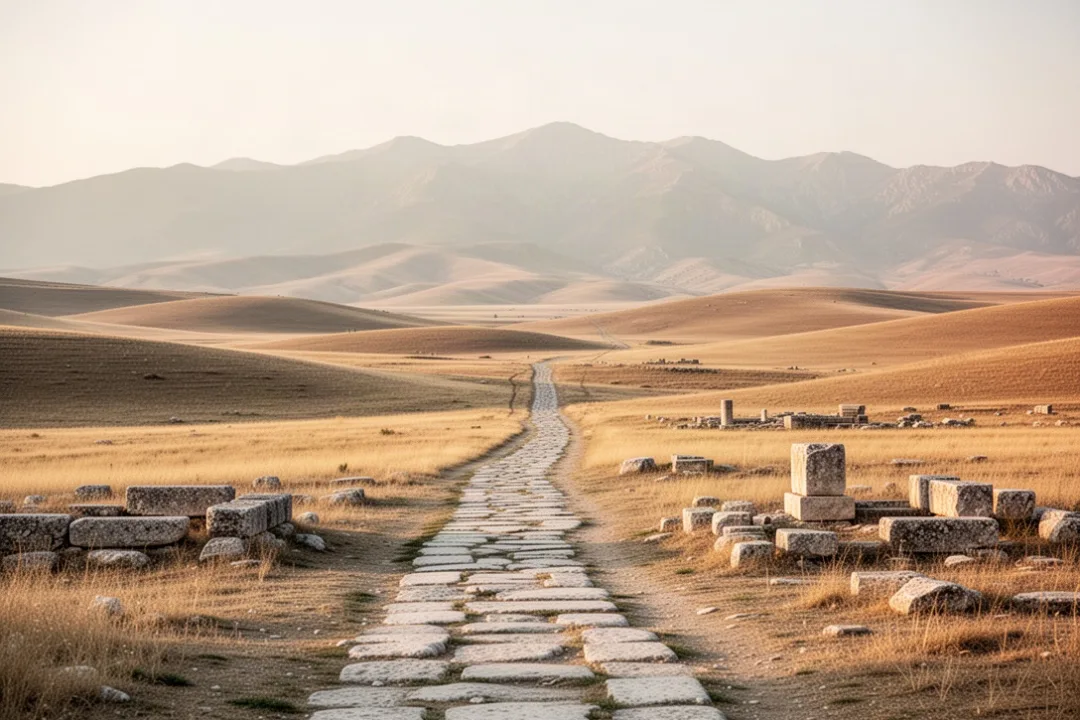
Galatia lay in central Anatolia, on the high plateau of what is now Turkey. Its core territory was north of modern Ankara and included areas around ancient settlements such as Ancyra, Pessinus, and Tavium. The landscape consisted of broad uplands, open plains, dry valleys, and distant mountain ranges.
The region did not have one fixed boundary throughout its history. Its borders changed as local kingdoms, Roman administrators, and later emperors reorganized central Asia Minor. For that reason, “Galatia” can mean a cultural homeland in one passage and a much larger political province in another.
The territory stood at a crossroads between the Aegean coast, the Black Sea, Syria, and the eastern regions of Anatolia. Roads crossing the plateau connected important cities and military routes. This location helped Galatia become a place where Greek, Roman, Anatolian, and Celtic influences met.
Galatia was generally inland and lacked the prosperous coastal cities associated with western Asia Minor. Its climate could be harsh, with cold winters and hot, relatively dry summers. Agriculture and livestock raising were important, while its strategic position made the region valuable to rulers who wanted to control movement across central Anatolia.
Geography matters: Galatia was not a single ancient city. It was a region whose meaning expanded and shifted as political boundaries changed.
How Celtic peoples established themselves in Galatia
The people called Galatians were connected with Celtic groups who migrated into the Balkans and then crossed into Asia Minor during the third century BC. Ancient sources commonly identify three major groups: the Tectosages, the Tolistobogii, and the Trocmii. Each group occupied a different part of the region and maintained its own leadership structures.
These migrants were related culturally and linguistically to Celtic peoples known farther west in Europe. Their arrival did not erase the existing populations of Anatolia. Instead, the newcomers settled among older communities, and the region developed a mixed identity shaped by local traditions, Greek language and culture, and Celtic customs.
Greek writers often described the Galatians as fierce warriors. Their reputation came partly from their military activity and partly from the shock their migration caused among established kingdoms. They served as mercenaries and took part in conflicts involving rulers throughout Asia Minor and the eastern Mediterranean.
Over time, the Galatians adopted many features of the surrounding Hellenistic world. Greek became important for administration, trade, and public life, even though local languages and Celtic speech continued in some settings. Religious practices likewise reflected multiple cultural layers rather than one uniform tradition.
The Galatian political structure was not a single centralized kingdom in the same way as the Seleucid or Pontic kingdoms. Different tribal leaders controlled their own territories, while outside powers tried to influence or contain them. Rome gradually increased its authority in the area after defeating major regional opponents.
From independent communities to Roman rule
Galatia became a Roman client kingdom under rulers who governed with Roman support. The most prominent later ruler was King Amyntas, who expanded his territory beyond the older Celtic heartland. After his death, Rome transformed his kingdom into a province in 25 BC.
The Roman province was larger than the original ethnic region. It included parts of southern and western Anatolia, bringing cities with different histories and populations under one administrative framework. This distinction explains why scholars ask whether Paul’s “Galatians” were the northern Celtic communities, the southern cities added to the province, or both.
Roman administration brought new roads, taxation systems, military oversight, and legal institutions. It also connected Galatia more closely to the wider imperial economy. Yet Roman political control did not eliminate local identities. People could identify themselves by city, ethnic background, religion, province, or allegiance to the empire.
What Galatia means in the New Testament
The New Testament uses Galatia in more than one way. It can describe a geographic area, a Roman province, or the people living in churches associated with that area. The exact reference depends on the passage and on how one interprets the political geography of the first century.
The name appears most prominently in Paul’s Letter to the Galatians. The letter begins by addressing churches in Galatia, but it does not name each congregation or city. That absence has led to a long-running discussion about which Christian communities Paul had in mind.
Acts also refers to Galatia as Paul and his companions traveled through Asia Minor. Acts 16:6 says that the missionaries passed through the region of Phrygia and Galatia, while Acts 18:23 describes Paul traveling through the region in a later period. These references show that Galatia was part of Paul’s missionary setting, even though the wording does not settle every geographic question.
Paul’s connection with the Galatians developed within the wider mission to Gentiles. Early Christian communities were working out how Jewish and non-Jewish followers of Jesus should live together. Questions about circumcision, food practices, sacred days, and the authority of the Mosaic law became especially urgent as more Gentiles joined the churches.
The northern and southern Galatian theories
Scholars commonly describe two main interpretations of Galatia in Paul’s writings. The North Galatian theory identifies the recipients of the letter with churches in the traditional Celtic region, north of the main southern route through the Roman province.
The South Galatian theory identifies them with congregations in cities such as Pisidian Antioch, Iconium, Lystra, and Derbe. Paul’s first missionary journey, described in Acts 13–14, included these cities. They later fell within the Roman province of Galatia, even though they were not part of the original Celtic homeland.
Both views attempt to connect Paul’s letters with the geographical language and travel accounts of the New Testament. The South Galatian view emphasizes the cities clearly associated with Paul’s first journey. The North Galatian view gives more weight to the traditional ethnic meaning of “Galatian.”
The evidence does not produce universal agreement. Ancient provincial boundaries changed, travel descriptions can be interpreted in different ways, and Paul may have visited more than one part of the region. A careful reading should therefore distinguish what the text states directly from what scholars infer from historical geography.
Paul’s ministry among the Galatian churches
Paul’s work in Galatia formed part of his broader mission across Asia Minor. According to Acts, he preached in southern cities where people from different religious and ethnic backgrounds heard the message about Jesus. Some accepted the teaching, while others opposed it, and the new communities faced pressure soon after the missionaries left.
The churches were not isolated from their surroundings. They lived in cities shaped by Roman authority, Greek public culture, local Anatolian traditions, and Jewish communities. Their members likely included Gentile converts as well as people with Jewish backgrounds. That mixture made questions of identity and communal practice unavoidable.
Paul’s letter suggests that other teachers had challenged the message the Galatians first received. These teachers appear to have argued that Gentile believers needed to adopt circumcision and other markers associated with Jewish law. Paul responds forcefully because he believes the issue affects the heart of the gospel and the unity of the church.
He presents the Christian message as centered on Christ’s death and resurrection and on God’s grace received through faith. Paul does not treat obedience as meaningless, but he rejects the idea that Gentiles must become Jews in order to belong fully to God’s people. For him, adding circumcision as a requirement would change the gospel’s foundation.
The main themes of the Letter to the Galatians
Paul begins by defending the divine source of his apostleship and the message he preaches. He then recalls his interactions with other Christian leaders and explains why he opposed conduct that separated Jewish and Gentile believers. The letter’s early chapters focus on the relationship between faith, grace, and the law.
Paul uses Abraham as an important example. In Galatians 3, he argues that God’s promise and acceptance are connected with faith rather than with ethnic descent or ritual status. His interpretation of Abraham supports the claim that Gentiles who trust in Christ share in the blessing promised through him.
The letter also explains the purpose of the law in relation to God’s promises. Paul describes it as having a temporary, supervisory role rather than serving as the final basis of belonging. With the coming of Christ, believers enter a new stage in God’s work and are recognized as children and heirs through faith.
Paul then turns to Christian freedom. Freedom does not mean permission to exploit other people or pursue selfish desires. Instead, it leads to loving service. Galatians 5 presents love as the way believers fulfill the law’s central purpose and contrasts the works of the flesh with the fruit produced by the Spirit.
Galatians 5:22–23 names qualities such as love, joy, peace, patience, kindness, goodness, faithfulness, gentleness, and self-control. These are not presented as a checklist for earning salvation. They describe the kind of life that grows when people live under the direction of God’s Spirit.
The letter closes with practical instruction about restoring people who have gone astray, carrying one another’s burdens, examining one’s own conduct, and doing good. Paul also returns to the question of circumcision and makes clear that he places his confidence in the cross of Christ rather than in external religious status.
The central dispute: Paul argues that Gentile believers do not need to adopt Jewish identity markers to become full members of God’s people; faith in Christ creates a new community.
Galatian cities and the early Christian setting
Several cities associated with the Roman province help explain the setting of Paul’s mission. Pisidian Antioch was a Roman colony and a significant administrative center. Acts 13 describes Paul preaching there in a synagogue and then addressing Gentiles who wanted to hear more.
Iconium stood along important routes through central Anatolia. According to Acts 14, Paul and Barnabas preached there, and the response was divided. The account reflects a recurring feature of early Christian mission: some people welcomed the message, while others created opposition.
Lystra was another city visited by Paul. Acts 14 describes a crowd misidentifying Paul and Barnabas as gods after a healing, followed by a sharp change in public response. The story illustrates how unfamiliar Christian preaching could be interpreted through local religious categories.
Derbe marked the eastern end of the route described in Paul’s first missionary journey. Paul and Barnabas preached there and later retraced their path, encouraging the new believers and appointing local leadership. These communities were young and needed teaching, organization, and ongoing support.
These cities were not all located in the old Celtic heartland. Their association with Galatia comes from the Roman provincial system. That is why reading the New Testament against a map of the original tribal territory alone can produce confusion.
Christian communities in Galatia would have met in homes or other suitable spaces rather than in purpose-built church buildings. They depended on local hosts, traveling teachers, letters, and personal networks. Worship included prayer, instruction, shared meals, and practices shaped by the developing life of the early church.
Local synagogue connections: Paul often began by speaking in Jewish settings, where Scripture and belief in Israel’s God were already familiar.
Gentile participation: Non-Jewish hearers became an important part of the growing communities.
Traveling leadership: Missionaries and messengers connected churches separated by long and difficult journeys.
Local pressure: Religious, social, and political expectations could make Christian commitment costly.
Why Galatia still matters for understanding early Christianity
Galatia is significant because it shows how Christianity moved across cultural boundaries. The region was not culturally uniform, and the churches there had to decide how people from different backgrounds could share one religious community. The dispute addressed by Paul was therefore both theological and practical.
The Letter to the Galatians also reveals that early Christian unity was not automatic. Leaders disagreed, congregations were influenced by competing teachers, and believers had to work through difficult questions about tradition and identity. Paul’s strong language reflects the seriousness of a debate that affected who could belong and on what basis.
For readers studying the New Testament, Galatia provides a useful case study in the relationship between history and interpretation. A passage may use a place name according to ethnic, geographic, or Roman administrative meaning. Understanding that flexibility helps explain why reputable scholars can reach different conclusions about the letter’s audience.
The region also demonstrates how ancient identities could overlap. A person might be connected to a local city, a tribal heritage, a Roman province, a Greek-speaking public culture, and a particular religious community at the same time. Galatia’s history resists simple categories because its population and political structures changed over many centuries.
Today, the ancient landscape of Galatia lies mainly within modern Turkey. Ancient roads, city remains, inscriptions, and archaeological sites offer evidence of Roman and pre-Roman life, although many locations have been built over or altered by later communities. The modern map should not be treated as identical to the ancient one, but it can help orient readers to central Anatolia.
When you encounter Galatia in the Bible, ask three questions:
Is the passage referring to the ethnic region associated with the Celtic Galatians or to the wider Roman province?
Which cities or journeys are nearby in the text, and do they help identify the geographical setting?
What issue is being addressed: travel, church identity, Jewish-Gentile relations, Christian conduct, or political administration?
Those questions keep the historical and theological dimensions together. Galatia was a real region with a complex past, but in the New Testament it also became a setting where the early church confronted one of its defining questions: how God’s people are formed through faith in Christ across ethnic and cultural boundaries.
Frequently asked questions
Was Galatia a city or a country?
Galatia was a region, not a single city or a modern nation-state. Its central territory was in modern central Turkey, and it included several towns and cities. Under Roman rule, the province became larger than the original homeland of the Celtic Galatians, which is why New Testament references can seem geographically broad.
Were the Galatians actually Celtic?
The Galatians descended in part from Celtic groups that migrated into Asia Minor during the third century BC. They lived among older Anatolian populations and adopted Greek and Roman cultural features over time. “Galatian” therefore described a mixed regional identity as well as a Celtic heritage.
Which churches received Paul’s Letter to the Galatians?
The letter addresses churches in Galatia but does not name individual congregations. Some scholars identify them with communities in the northern Celtic region, while others connect them with southern cities such as Pisidian Antioch, Iconium, Lystra, and Derbe. The exact audience remains debated.
What is Paul’s main message to the Galatians?
Paul argues that people are accepted by God through faith in Christ and God’s grace, not by adopting circumcision or Jewish law as requirements for belonging. He also teaches that Christian freedom should produce love, service, and life shaped by the Spirit rather than selfish behavior.




Leave a Reply