Elijah in the Bible: His story, miracles, and meaning
Elijah in the Bible: His story, miracles, and meaning
Elijah was a prophet who called Israel back to exclusive loyalty to God during the reign of King Ahab.
His story combines dramatic miracles, courageous confrontation, deep discouragement, and a quiet encounter with God. Elijah appears mainly in 1 Kings 17–19 and 21, then again in 2 Kings 1–2. Although his recorded ministry is relatively short, his influence reaches into the New Testament and remains central to the Bible’s teaching about faithful witness.
Elijah came from Tishbe in Gilead, east of the Jordan River. The Bible introduces him suddenly in 1 Kings 17, without describing his family, education, or earlier life. That abrupt entrance emphasizes the urgency of his mission: he appears as a messenger from God in a national crisis.
Elijah served during the reign of Ahab, king of Israel, whose rule was strongly influenced by his wife Jezebel. Ahab promoted the worship of Baal, a Canaanite storm and fertility deity, and built an altar for Baal in Samaria. The royal court also supported the persecution of the Lord’s prophets, making Elijah’s public ministry dangerous.
The central question behind Elijah’s work was simple but demanding: Who truly rules Israel? Ahab’s policies treated Baal as a source of rain, harvests, and prosperity. Elijah’s message challenged that belief by showing that the Lord alone controls the weather, provides food, judges evil, and restores life.
Central idea: Elijah’s ministry was not mainly about spectacular miracles. The miracles served a larger purpose: calling people away from divided loyalty and back to the living God.
The drought announced by Elijah in 1 Kings 17
Elijah first appears before Ahab with a warning that there will be no dew or rain except when God permits it. Because Baal was associated with storms and fertility, the drought directly confronted the religious claims promoted by the king and queen.
After delivering the message, Elijah leaves at God’s command and hides near the Cherith Ravine, east of the Jordan. Ravens bring him food, while he drinks from the stream. The episode shows that the prophet who announces judgment must also depend on God for his own daily needs.
When the stream dries up, God sends Elijah to Zarephath, a town in the region of Sidon. This is significant because Sidon was associated with Jezebel’s homeland and with the worship of Baal. Elijah is not protected only inside Israel; God sustains him in a foreign territory through a poor widow.
The widow’s flour and oil
Elijah meets the widow as she gathers sticks to prepare one final meal for herself and her son. She has only a small amount of flour and oil, but Elijah tells her not to be afraid and asks her to prepare food for him first. He gives her God’s promise that the flour and oil will not run out until rain returns.
The widow acts on that promise, and the supplies continue. The miracle is presented as daily provision rather than sudden wealth. She does not become rich; instead, she and her household receive enough food through a season of severe scarcity.
Later, the widow’s son becomes seriously ill and dies. Elijah carries the boy upstairs, prays earnestly, and asks God to restore his life. God answers, and the child lives again. This event confirms Elijah as a genuine prophet and demonstrates that the Lord has authority not only over rain and crops but also over death.
The widow responds by recognizing that Elijah truly speaks God’s word. Her statement does not mean that every question has disappeared. It shows that God’s faithfulness has become personally visible to someone outside Israel’s royal and religious establishment.
What happened on Mount Carmel
After three years of drought, God sends Elijah to meet Ahab. The king blames Elijah for Israel’s troubles, but Elijah identifies the deeper problem: Ahab and the people have abandoned God’s commands and followed Baal.
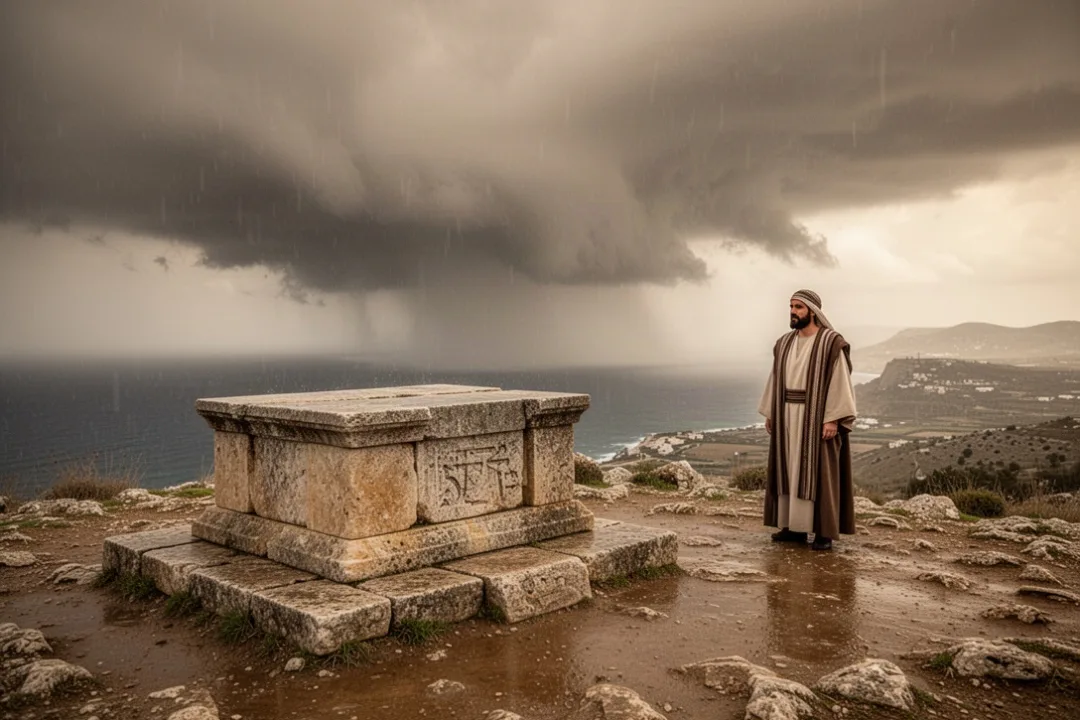
Elijah proposes a public test on Mount Carmel. The prophets of Baal will prepare a sacrifice, and Elijah will prepare another. Neither side will light the offering. The god who answers by fire will be shown to be the true God.
The contest is designed to expose the emptiness of Baal worship. The prophets of Baal cry out from morning until afternoon, performing increasingly frantic rituals, but nothing happens. The biblical account stresses the silence of their god: no answer, no fire, and no response.
Elijah then repairs an altar associated with the Lord and uses twelve stones, representing the twelve tribes of Israel. He places the sacrifice on the altar and orders water to be poured over it repeatedly. The soaked altar makes the result unmistakable and prevents anyone from claiming that the sacrifice caught fire by ordinary means.
Elijah prays briefly, asking God to reveal that Israel’s God is the true God and that Elijah is acting as his servant. Fire falls and consumes the offering, the wood, the stones, the dust, and the water around the altar. The people respond by acknowledging the Lord.
The point of Carmel is not that Elijah possesses magical power. God answers to restore his own name and turn the people’s hearts. Elijah’s prayer is grounded in God’s covenant with Israel, not in the prophet’s personal importance.
The prophets of Baal and the difficult judgment
After the contest, Elijah orders the prophets of Baal to be seized and killed at the Kishon Valley. This action belongs to the severe judicial setting of Israel’s covenant law and the conflict between the nation’s worship of the Lord and its official promotion of idolatry.
Modern readers often find this scene difficult, and it should not be softened or treated as a model for ordinary religious disagreement. The narrative presents it as a unique act of judgment in a particular theocratic and prophetic context. It does not authorize private violence or give individuals permission to harm people who hold different beliefs.
How Elijah prayed for rain after Mount Carmel
Once the confrontation is over, Elijah tells Ahab that rain is coming. Yet the rain does not appear immediately. Elijah climbs to the top of Carmel, kneels, and sends his servant to look toward the sea.
The servant returns several times with no sign of rain. Elijah continues praying until a small cloud appears. The cloud grows, the sky darkens, and a powerful storm arrives. The drought ends because God responds to persistent prayer.
This sequence matters because the public miracle on the mountain is followed by private perseverance. Elijah has already seen fire fall, but he still waits and prays for the next part of God’s promise to be fulfilled.
The New Testament refers to Elijah in James 5 as an example of a human being who prayed earnestly. The emphasis is not that Elijah was superhuman. It is that God listens to faithful prayer, even when the person praying has ordinary weaknesses and fears.
Why Elijah ran from Jezebel after a great victory
Jezebel hears what happened on Mount Carmel and threatens Elijah’s life. Instead of returning confidently to the palace, Elijah becomes afraid and runs south. He eventually leaves his servant, travels into the wilderness, and sits beneath a broom tree.
His collapse can seem surprising. He has just confronted hundreds of prophets, witnessed God’s answer, and announced the return of rain. Yet the story shows that spiritual courage in one moment does not remove human vulnerability in the next.
Elijah asks to die, lies down, and sleeps. An angel wakes him and provides bread and water. After he sleeps again, the angel gives him more food and tells him to eat because the journey is too demanding for him.
God does not begin by scolding Elijah for his fear. He provides rest and nourishment. That detail gives the passage a practical dimension: physical exhaustion can shape how a person perceives danger, responsibility, and hope. The biblical account does not reduce Elijah’s spiritual crisis to tiredness, but it does show that his bodily needs matter.
Elijah at Mount Horeb
Strengthened by the food, Elijah travels forty days and nights to Mount Horeb, also called Sinai, the mountain associated with Moses and Israel’s covenant. There he enters a cave, and God asks what he is doing there.
Elijah explains that he has been deeply committed to the Lord, while Israel has broken the covenant, destroyed the altars, killed the prophets, and now seeks his life. His complaint contains both truth and distortion. The nation is genuinely corrupt, but Elijah believes he is completely alone.
A powerful wind passes, followed by an earthquake and fire, but the account says God’s personal communication is not found in those dramatic events. Then comes a quiet, gentle sound. Elijah covers his face and goes to the entrance of the cave.
The passage does not claim that God never works through fire, wind, or earthquakes. Mount Carmel has already shown that he can. Instead, the scene teaches that God’s presence and guidance are not limited to spectacular displays. After public confrontation, Elijah receives direction through a quiet encounter.
God gives Elijah new assignments: anoint Hazael over Aram, Jehu over Israel, and Elisha as his prophetic successor. God also corrects Elijah’s assumption that he is the only faithful person left, revealing that a faithful remnant remains in Israel.
For readers facing discouragement: Elijah’s story presents fear and exhaustion honestly, while also showing that God meets his servant with care, correction, renewed purpose, and companionship.
Elijah and the vineyard of Naboth
Elijah appears again when Ahab desires the vineyard of a man named Naboth. Naboth refuses to sell it because it is his inherited family land. Ahab becomes depressed, and Jezebel arranges a false accusation against Naboth. He is condemned and killed, allowing Ahab to take the vineyard.
Elijah confronts Ahab at the vineyard with a judgment from God. He identifies the king’s actions as murder and theft, even though Jezebel organized the scheme. The prophet refuses to treat royal power as an exemption from moral law.
This episode shows another side of Elijah’s ministry. He is not only a defender of correct worship; he is also a voice for justice and accountability. Idolatry, political power, and exploitation are connected in the story because false worship can make people treat others as disposable.
Ahab responds with grief and humility, and God delays part of the announced judgment during Ahab’s lifetime. That response shows that divine judgment is not presented as a mechanical process. Humiliation and repentance matter, even though Ahab’s earlier actions have serious consequences.
Elijah’s message to King Ahaziah
After Ahab’s death, his son Ahaziah becomes king. Ahaziah suffers an injury and sends messengers to ask Baal-Zebub, the god of Ekron, whether he will recover. Elijah intercepts the messengers and asks why the king is seeking guidance from a foreign deity instead of the God of Israel.
Elijah announces that Ahaziah will die. The king then sends military groups to arrest him. The first two captains approach Elijah arrogantly and command him to come down. Fire falls from heaven and consumes them and their men. A third captain approaches with humility and pleads for his life and the lives of his soldiers; God tells Elijah to go with him without fear.
This account continues the theme of divine authority, but it also distinguishes between arrogant coercion and humble appeal. Elijah does not use his authority as a personal weapon. The narrative presents the fire as God’s judgment against hostile royal power.
How Elijah was taken to heaven
Elijah’s final recorded event is his departure from earthly life. In 2 Kings 2, he travels with Elisha from Gilgal to Bethel, then Jericho, and finally across the Jordan River. At each stage, Elijah tells Elisha to remain behind, but Elisha refuses to leave him.
Elijah strikes the Jordan with his rolled-up cloak, and the waters divide so the two prophets can cross. Elisha asks for a double share of Elijah’s spirit. This request refers to the portion associated with an heir and successor, not a demand to become twice as powerful as Elijah.
A fiery chariot and horses appear, and Elijah is taken up in a whirlwind. His cloak falls to Elisha, who picks it up and returns to the Jordan. When Elisha strikes the water and it divides, the prophetic succession is confirmed.
The Bible does not describe Elijah as dying in the ordinary way. His departure helps explain why later Jewish expectation connected Elijah with the future work of God. The prophet’s ministry ends not with retirement but with a dramatic transfer of responsibility to the next generation.
Elijah’s place in later biblical prophecy
The prophet Malachi closes the Old Testament section of the Christian Bible by promising that Elijah will come before the great and fearful day of the Lord. The passage connects this future work with turning the hearts of parents and children toward one another.
This expectation made Elijah a significant figure in Jewish thought during the time of Jesus. His name represented restoration, repentance, and preparation for God’s decisive action.
In the New Testament, an angel says that John the Baptist will minister with the spirit and power of Elijah. John is not literally Elijah returned from heaven; he is a prophet who fulfills a similar role by calling people to repentance and preparing them for the Messiah.
Jesus also speaks of Elijah in connection with John the Baptist. The relationship is one of prophetic mission and fulfillment rather than personal identity. John’s clothing, message, and bold confrontation with immoral rulers recall Elijah’s pattern, especially in his challenge to Herod’s unlawful conduct.
Elijah at the transfiguration of Jesus
Elijah appears with Moses during Jesus’ transfiguration, recorded in Matthew 17, Mark 9, and Luke 9. The disciples see Jesus in radiant glory, while Moses and Elijah speak with him about what he is about to accomplish in Jerusalem.
Moses represents the Law, and Elijah represents the prophets. Their presence shows that Jesus’ mission stands in continuity with Israel’s Scriptures while also surpassing the earlier covenant leaders. The focus shifts from Elijah’s prophetic ministry to Jesus as the one whom the disciples must hear.
The scene also answers a question raised by Elijah’s unusual departure. Elijah is not the central figure of God’s final revelation. He is a servant whose ministry points beyond himself to the fulfillment of God’s purposes in Christ.
What Elijah teaches about faith and courage
Elijah’s life offers several connected lessons rather than one simple slogan. He demonstrates that faithfulness may require public resistance, private endurance, repentance, and the willingness to train someone who will continue the work.
Loyalty to God may require a clear choice. Elijah confronted Israel’s attempt to combine worship of the Lord with devotion to Baal.
Prayer depends on God rather than performance. At Carmel, Elijah asked God to reveal the truth; he did not claim that the power belonged to him.
Victory does not eliminate vulnerability. Elijah became afraid after one of the greatest public moments of his ministry.
God cares for exhausted servants. Food, sleep, and a safe journey came before Elijah received further instructions.
God may speak through quietness. The Horeb account corrects the assumption that only dramatic events can reveal God’s presence.
Faithfulness is not a solo project. Elisha became Elijah’s companion and successor, while a larger faithful remnant remained in Israel.
Spiritual conviction should include concern for justice. Elijah defended Naboth’s rights against royal abuse.
Practical ways to read Elijah’s story carefully
Readers can misunderstand Elijah when they focus only on the fire from heaven or treat his life as a formula for guaranteed miraculous results. A careful reading keeps the miracles, moral context, emotional struggle, and wider biblical story together.
Read the surrounding chapters. Begin with 1 Kings 16:29–34 to understand Ahab’s setting, then read 1 Kings 17–19, 21 and 2 Kings 1–2.
Ask what each miracle reveals about God. The ravens show provision, the widow’s oil shows sustained care, Carmel confronts idolatry, and the rain shows divine authority over creation.
Separate description from command. The Bible records Elijah’s severe confrontations, but those events do not authorize Christians to imitate prophetic judgment through violence.
Notice the emotional movement. Compare Elijah’s confidence on Carmel with his fear under Jezebel’s threat and his honesty at Horeb.
Look for the role of other people. The widow, Obadiah, Elijah’s servant, Elisha, and the faithful remnant all challenge the idea that the prophet acts alone.
Read Elijah through the New Testament. James emphasizes prayer, John the Baptist recalls Elijah’s prophetic role, and the transfiguration places Elijah alongside Moses while directing attention to Jesus.
Common mistakes about Elijah
Assuming Elijah never felt fear. His courage and fear appear in the same life.
Calling every unusual event a miracle. The text specifically identifies certain acts as God’s intervention; readers should avoid making unsupported claims about other details.
Thinking Elijah was the only faithful person in Israel. God tells him that a remnant remains faithful.
Confusing John the Baptist with Elijah himself. John carries Elijah’s prophetic mission and power, but the New Testament does not present him as Elijah reincarnated.
Using Elijah to promise automatic personal success. His prayers are answered within God’s redemptive purposes, and his story includes waiting, hardship, grief, and correction.
Ignoring the vulnerable people in the story. The widow and Naboth reveal that Elijah’s ministry concerns food, land, justice, and human dignity as well as public worship.
Why Elijah remains a significant biblical figure
Elijah remains memorable because his story holds together qualities that people often separate. He is both bold and frightened, publicly confident and privately exhausted, capable of confronting kings and dependent on a widow’s hospitality.
His ministry insists that worship is not an abstract preference. What Israel worships shapes how it understands power, responsibility, wealth, suffering, and justice. The conflict with Baal therefore reaches into every part of national life.
Elijah also shows that a servant of God is not the same as God. He performs no miracle by independent power, misjudges his own isolation, and must receive correction. His story honors his faithfulness while directing attention beyond him to the God who provides, judges, restores, and continues his work through new servants.
For readers today, Elijah’s life offers a balanced picture of faith: firm conviction without self-reliance, honest lament without surrender, and courageous action without forgetting dependence on God. His story begins with a drought and ends with a successor taking up his cloak, leaving a lasting picture of judgment, mercy, and continuing hope.
Frequently asked questions
Was Elijah a real person in the Bible?
Yes. Elijah is presented as a historical prophet who served in the northern kingdom of Israel during the reigns of Ahab and Ahaziah. His ministry is recorded primarily in 1 Kings and 2 Kings. The New Testament also refers to him in James, the Gospels, and the account of Jesus’ transfiguration.
Did Elijah die or go straight to heaven?
The Bible says Elijah was taken up in a whirlwind while accompanied by Elisha. It does not describe him dying in the ordinary manner. A fiery chariot and horses appear in the scene, but the text emphasizes the whirlwind as the means by which Elijah is taken away.
Why did Elijah challenge the prophets of Baal?
Elijah challenged them because Israel’s leadership had promoted Baal worship and led the people away from exclusive loyalty to the Lord. The contest on Mount Carmel publicly tested which deity could answer with fire. Its purpose was to reveal the Lord as Israel’s true God and call the people back to covenant faithfulness.
How is Elijah connected to John the Baptist?
John the Baptist was not literally Elijah returned to earth. Instead, the New Testament describes John as serving with Elijah’s spirit and power. Both confronted corrupt rulers, called people to repentance, and prepared others for God’s decisive work. John therefore fulfills the prophetic pattern associated with Elijah.










Leave a Reply