If you have heard that Emperor Constantine created Christianity at the Council of Nicaea, you may wonder how much of that claim is true. The short answer is that Constantine called the council in 325, helped make the meeting possible, and supported its decisions, but he did not invent the Christian faith or personally settle every theological question.
The Council of Nicaea was the first major gathering of Christian bishops from across the Roman Empire. Its central dispute concerned the relationship between Jesus Christ and God the Father: Was the Son a created being, as Arius and his supporters argued, or did the Son share the same divine reality as the Father? The council rejected Arius’s position and expressed its own view in the Nicene Creed.
The essential answer: Constantine was the council’s political convener and host, not the author of its theology. The bishops debated doctrine, approved the creed, and issued disciplinary rules.
Before Constantine’s reign, Christianity had often faced official hostility, though the intensity varied by place and period. The persecution under Emperor Diocletian at the beginning of the fourth century was especially severe. Constantine’s victory at the Milvian Bridge in 312 and his subsequent rule changed the political position of Christians dramatically.
In 313, Constantine and Licinius issued an agreement commonly called the Edict of Milan. It granted Christians and other religious groups the right to practice their faith and ordered the restoration of confiscated church property. Constantine did not immediately make Christianity the sole religion of the empire, but he became its most influential imperial patron.
That new freedom exposed a serious internal conflict. Arius, a presbyter in Alexandria, taught that the Son was not eternal in the same way as the Father. In Arius’s view, the Son was the highest and most exalted of God’s works, brought into existence before the rest of creation. This position protected a strong distinction between the one uncreated God and everything created, but many bishops believed it undermined Christian worship of Christ.
Alexander, the bishop of Alexandria, opposed Arius’s teaching. The dispute spread beyond Egypt through letters, sermons, and supporters in other cities. Constantine saw the conflict as a threat to church unity and imperial stability, especially after years of religious division and political upheaval.
Constantine therefore invited bishops to meet at Nicaea, a city in Bithynia near Nicomedia in modern-day Turkey. The location was accessible from important eastern provinces and close enough to the imperial court for the emperor to provide logistical support.
What happened at Nicaea step by step
The council’s work can be understood as a sequence of related decisions rather than as one dramatic vote that instantly settled every disagreement.
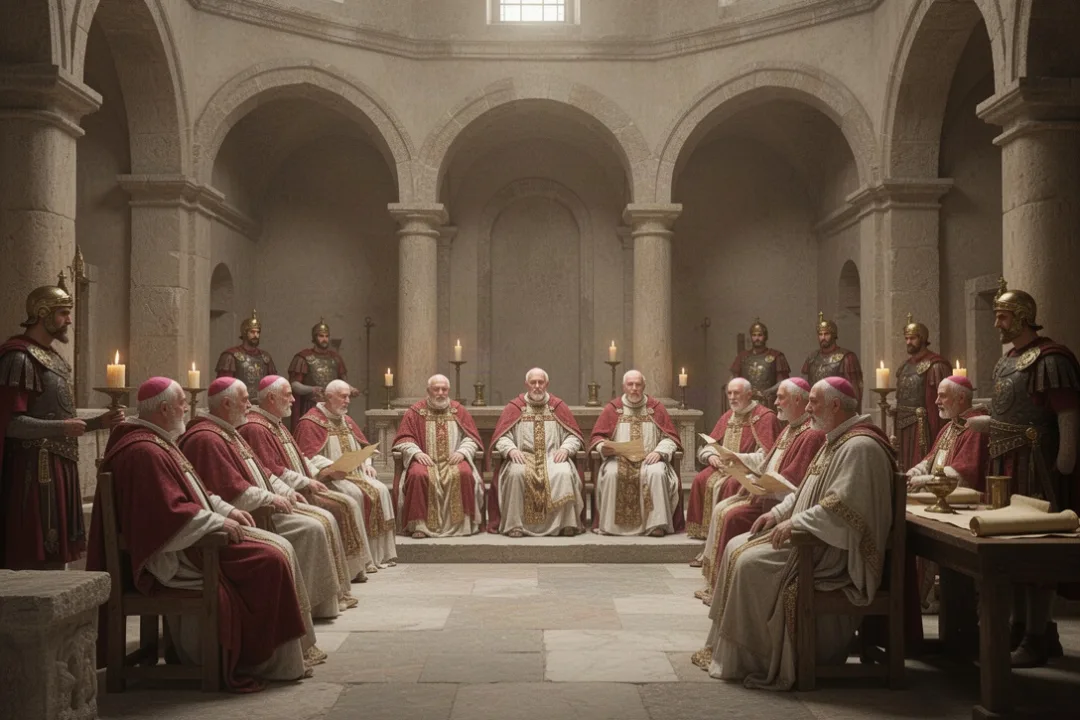
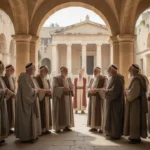
Constantine summoned the bishops. He used imperial authority and resources to make travel and accommodation possible. Bishops, clergy, and assistants came from many parts of the empire, although representation was stronger in the East than in the Latin-speaking West.
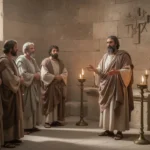
The bishops examined the controversy. They considered Arius’s teaching, the language used by his opponents, and the implications for Christian baptism, worship, and salvation.
The council selected precise theological wording. The most important term was homoousios, usually translated as “of the same substance” or “of the same essence.” It stated that the Son is not a lesser divine being but shares the same divine reality as the Father.
The council approved the Nicene Creed. The creed affirmed the Son’s eternal relationship to the Father and rejected claims that the Son was created or had not always existed.
The bishops issued disciplinary canons. These rules addressed matters such as clergy conduct, ordination, church administration, and the treatment of people who had abandoned the faith during persecution.
The council dealt with related disputes. It addressed the controversy involving Melitius of Lycopolis and recognized a settlement concerning the status of clergy in his movement.
Constantine supported the outcome. He urged bishops to accept the council’s decision and treated refusal as a matter with political consequences, but the theological formulations came from the episcopal deliberations.
The meeting lasted for weeks, and its participants did not all arrive with identical beliefs or terminology. Some bishops were cautious about language that might sound like it erased the distinction between Father and Son. Others believed that only strong language could prevent Arius’s teaching from being read back into Christian worship.
What the Nicene controversy was really about
The dispute was not simply an argument over whether Jesus was “important” or “divine.” Arius and his opponents both used Christian language about Christ, and both claimed biblical support. The deeper question was whether the Son’s divinity was eternal and fully divine or derived and subordinate.
Arius emphasized that the Father alone is without origin. He argued that the Son was brought into being by the Father before the universe and therefore stood above all other creatures. His supporters feared that saying the Father and Son were too similar would compromise monotheism and confuse their personal distinction.
Alexander and other bishops argued that Christian faith, worship, and salvation required a different conclusion. If the Son were a creature, even the highest creature, then worshiping Christ could appear to be worshiping something made rather than God. They also reasoned that a created being could not fully reveal God or unite humanity to God.
The council’s response was not to say that the Father and Son were the same person. Instead, it distinguished between person and divine essence. The Father is the Father, and the Son is the Son, but the Son is not a created being with a different kind of divinity.
The term homoousios became the council’s most recognizable contribution. It was not a word taken directly from the New Testament, which is one reason some bishops initially viewed it with caution. The bishops used it as a technical term to exclude the claim that the Son was a creature and to affirm that the Son truly belongs within the identity of the one God.
The Nicene decision focused on the Son’s eternal divine status, not on a claim that the Father and Son are one person.
What the Council of Nicaea said about Jesus
The creed adopted at Nicaea described Jesus Christ as the Son of God, begotten rather than made, and sharing the same divine essence as the Father. It connected the Son with creation, incarnation, suffering, death, resurrection, ascension, and future judgment.
Those statements were intended to make several boundaries clear. The Son was not a creature, the incarnation was not an illusion, and the Christian message was not based on a merely human teacher who was later promoted to divine status.
The creed also used language that directly rejected Arius’s position. It condemned claims that the Son came into existence from nothing, that the Son did not exist before being begotten, or that the Son was changeable in the way created things are changeable.
At the same time, the creed was relatively brief compared with later Christian explanations of the Trinity. It did not provide a complete account of every question about the Holy Spirit, the relation of the divine persons, or the philosophical meaning of every theological term.
That distinction matters because people sometimes treat Nicaea as though it produced the final form of all later Trinitarian doctrine. The council established a crucial foundation, but further debates continued. The Council of Constantinople in 381 expanded the creed and gave greater definition to teaching about the Holy Spirit.
What Constantine personally did at the council
Constantine’s role was substantial, but it needs to be described accurately. He called the council, arranged the conditions for it to meet, attended at least part of the proceedings, and encouraged the bishops to reach agreement.
He was not a bishop, priest, or trained theologian in the same sense as the men debating the creed. His speeches emphasized unity and peace, and he approached the conflict partly as an imperial problem. A divided church could create public disorder and weaken the cohesion of the empire.
Constantine also had authority to enforce the practical consequences of the council’s decision. Arius was condemned, and Constantine initially ordered the destruction or suppression of writings associated with his teaching. Arius was later recalled from exile under changing political circumstances, showing that the controversy was far from permanently settled in 325.
The emperor’s later actions also reveal the limits of his control. His sons and successors adopted different positions, and some later emperors supported bishops who rejected or revised Nicene language. The Nicene settlement therefore went through decades of conflict rather than receiving uninterrupted imperial enforcement.
Constantine was baptized near the end of his life by Eusebius of Nicomedia, a bishop connected with the broader controversy and not a simple representative of the Nicene party. His baptism late in life was not unusual for the period, when some Christians postponed baptism because of concerns about serious sins committed afterward.
Common misconception: Constantine did not choose the books of the Bible at Nicaea, turn Jesus into a god, or preside over a vote that invented the Trinity. Those claims confuse the council’s actual agenda with much later speculation.
What Nicaea did not decide
Several popular stories attribute decisions to Nicaea that the council never made. Understanding these limits helps separate reliable history from later legends.
It did not decide which books belong in the Bible. The surviving records of Nicaea do not show the bishops creating or approving a biblical canon. Lists of accepted Christian writings developed over time through church use, teaching, and later regional discussions.
It did not invent belief in Christ’s divinity. Christians were worshiping Jesus and describing him in exalted terms long before Constantine. Nicaea clarified and defended one interpretation of those existing beliefs.
It did not create the Trinity from nothing. Trinitarian language and reflection had developed before 325. Nicaea gave especially strong expression to the Son’s relationship to the Father, while later councils addressed other aspects of the doctrine.
It did not settle every Christian disagreement. The council’s decision was followed by more disputes about terminology, authority, and the relationship between divine persons.
It did not consist of a simple democratic vote by all Christians. Bishops represented local churches, and the procedures reflected the culture of late Roman imperial administration. The exact details of attendance and voting are not preserved in a complete transcript.
It did not make Christianity the official religion of the empire. Constantine favored Christianity, but the empire remained religiously diverse during his reign. The later emperor Theodosius I took stronger steps favoring Nicene Christianity in the late fourth century.
How many bishops attended the Council of Nicaea?
Ancient sources give somewhat different numbers, but the traditional figure is around 318 bishops. Other accounts suggest a somewhat different total. The discrepancy is not surprising because attendance lists, counting methods, and later symbolic interpretations varied.
Most participants came from the eastern provinces, where the theological dispute had been especially intense. Western representation was smaller because of distance, language, and the political realities of the empire. Pope Sylvester I did not attend personally; Roman representatives participated as delegates.
The gathering also included priests and deacons who accompanied bishops. Athanasius, then a deacon and assistant to Alexander of Alexandria, played an important role in defending the position that became Nicene orthodoxy. He later became bishop of Alexandria and one of the most determined defenders of the Nicene creed.
The council did not leave behind a verbatim record of every debate. Historians reconstruct its proceedings from the creed, canons, letters, later histories, and writings by participants. That evidence is enough to identify the main decision, but it does not support every dramatic story told about the meeting.
The Council’s decisions about church discipline
Nicaea addressed practical matters alongside the central theological dispute. The council’s canons dealt with the conduct and organization of clergy, showing that a church council in late antiquity was concerned with both doctrine and daily administration.
One canon restricted self-castration among clergy and candidates for the clergy. Another addressed the ordination of men who had been ordained by multiple bishops or had moved between churches improperly. Other rules concerned the treatment of clergy who had been disciplined, the position of deacons, and the administration of church offices.
The council also discussed how to restore people who had lapsed during persecution. The bishops created categories and periods of penance rather than treating every case identically. This reflected a broader concern: How could the church maintain moral seriousness while receiving back people who had failed under pressure?
One well-known canon prohibited clergy from lending money at interest. The precise application and historical context of this rule require care, because ancient economic practices do not map neatly onto modern banking or consumer loans. It should not be read as a complete modern financial code.
The canons also recognized certain regional arrangements. Alexandria’s bishop retained authority over Egypt, Libya, and nearby areas, while other major sees received acknowledgment of their established influence. These provisions helped organize a growing church whose administrative structures were becoming more visible and formal.
Nicaea and the date of Easter
The council is associated with the effort to establish a common method for celebrating Easter. Christians in different regions had used differing calendars and customs, and Constantine strongly preferred a unified practice throughout the empire.
Nicaea supported the principle that Easter should be celebrated on the same Sunday across the churches rather than according to separate regional calculations. The council itself does not appear to have left a detailed formula for calculating the date. Later traditions often describe the result more definitively than the surviving evidence allows.
The issue was connected to the relationship between the lunar calendar, the spring equinox, and the Jewish calendar, but the practical calculations were complex. The western and eastern churches eventually developed different calendar systems, contributing to differences in the date of Easter that still exist among Christian communities.
Constantine’s interest in a common Easter date was both religious and political. A single major festival could symbolize unity across the empire. Yet agreement on the principle did not eliminate all later disagreements over calendars and calculations.
What happened to Arius after Nicaea
The council condemned Arius and rejected his teaching. He was sent into exile, and his written works were targeted for suppression. The creed included an anathema against propositions associated with his position, making clear that the council considered the dispute a matter of Christian doctrine rather than a harmless difference in vocabulary.
That settlement did not end the controversy. Arius gained support from some bishops, including influential figures who preferred alternative language. Political changes after Constantine’s death allowed anti-Nicene or non-Nicene positions to become influential in different regions.
Athanasius became a leading defender of the Nicene position, but his career included multiple exiles. Opponents accused him of political and personal misconduct, while his supporters saw the charges as attempts to remove the strongest advocate of Nicene theology. The conflict illustrates how theological disagreements became intertwined with imperial politics and episcopal rivalries.
By the time of the Council of Constantinople in 381, many bishops had moved toward language that preserved the central Nicene claim while addressing objections to terminology. The creed associated with Constantinople is often called the Nicene-Constantinopolitan Creed and is the form widely used in many churches today.
Why the Council of Nicaea still matters
Nicaea matters because it established a durable answer to a central Christian question: Who is Jesus in relation to God? Its answer shaped later teaching about the Trinity, worship, baptism, preaching, and the meaning of salvation.
The council also demonstrated how Christianity had changed after gaining imperial toleration. A dispute that might once have been handled through local letters and regional synods now brought bishops together across a large political territory with the support of the emperor.
Its importance is not limited to theology. Nicaea shows how religious beliefs, institutional authority, imperial policy, language, and local church practice interacted in late antiquity. The council’s decisions were religious, but their implementation depended on communication networks, political power, and the ability of bishops to maintain alliances.
For readers trying to understand the event, three distinctions are especially useful:
Historical setting: Constantine’s toleration made a large empire-wide council possible.
Theological issue: The bishops debated whether the Son was eternal and fully divine or a created being.
Long-term outcome: Nicaea produced a foundational creed, but later councils and debates continued to refine and defend its claims.
Seen in that context, Constantine and Nicaea are closely connected but not interchangeable. Constantine supplied imperial sponsorship and sought unity; the bishops formulated the creed and judged the theological dispute. The council did not manufacture Christianity, but it gave one understanding of Christian belief an authoritative and lasting form.
How to evaluate common claims about Constantine and Nicaea
When you encounter a claim about the council, ask what evidence the claim would require. A statement that Nicaea “invented” a doctrine should be compared with Christian writings and worship practices from before 325. A statement that the council selected the Bible should be checked against the council’s surviving creed, canons, and correspondence.
It also helps to distinguish imperial influence from direct theological authorship. Constantine could summon bishops, pressure them to agree, exile opponents, and enforce decisions. Those powers mattered, but they do not mean he wrote the creed or that the bishops were merely carrying out a script he supplied.
Finally, avoid treating the council as the end of the story. Nicaea was a decisive moment, but its meaning was contested for decades. The Nicene formula became more firmly established through continued debate, the work of theologians such as Athanasius and the Cappadocian Fathers, and the later decisions of church councils.
Frequently asked questions
Did Constantine become a Christian before the Council of Nicaea?
Constantine openly favored Christianity before Nicaea and supported Christian churches, clergy, and worship. He was not baptized until near the end of his life, however. Ancient Christians did not all follow the same timing for baptism, and postponement could reflect concerns about sin and repentance. His religious commitment and his political use of Christian unity therefore need to be considered together.
Was the Council of Nicaea the first Christian council?
No. Local and regional Christian gatherings had taken place earlier, including meetings that addressed disputes about persecution, church discipline, and theology. Nicaea was the first council with broad representation from across the Roman Empire and the first to receive major imperial sponsorship, which gave its decisions unusual reach and long-term influence.
Did Nicaea decide that Jesus was God?
Nicaea did not introduce the idea that Jesus was divine. Christians had worshiped Jesus and described his relationship to God in exalted terms before the council. The bishops addressed a specific dispute by affirming that the Son was eternally divine and shared the same divine essence as the Father, rather than being a created being.
Why is the council sometimes called Nicea instead of Nicaea?
Both forms refer to the same ancient city in Bithynia, now İznik in Turkey. “Nicaea” is the common English spelling in modern historical and theological writing, while “Nicea” appears in some older or alternate transliterations. The spelling difference does not indicate two separate councils or locations.



Leave a Reply